Image source: wikiart.org
Introduction
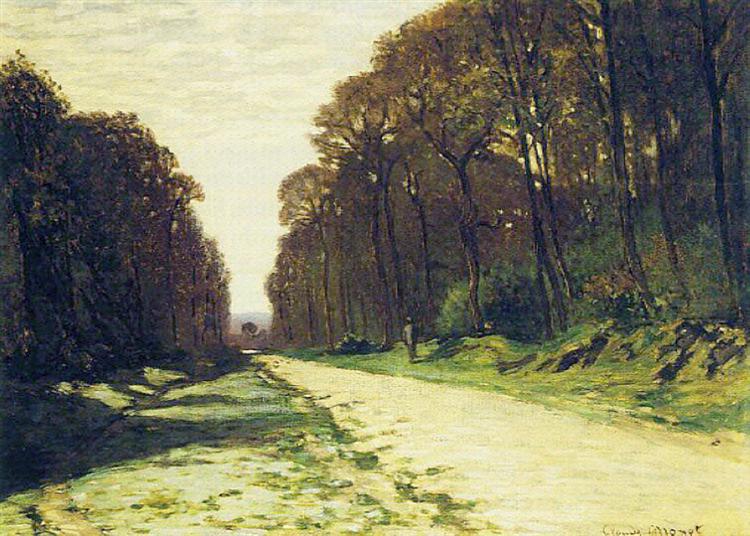
Claude Monet’s Road in a Forest Fontainebleau from 1864 is a quiet painting, but it has remarkable depth. At first glance, the image seems simple. A pale road stretches forward through a wooded landscape, bordered on both sides by tall trees whose trunks rise like vertical columns. The scene appears calm, almost empty, and free from narrative distraction. Yet this simplicity is exactly what gives the work its power. Monet turns an ordinary forest road into a study of space, atmosphere, light, and mood. He invites the viewer to look slowly, to follow the road into the distance, and to feel the presence of nature not as spectacle, but as lived experience.
This painting belongs to an early moment in Monet’s career, before Impressionism had fully formed as a movement. Because of that, it offers a fascinating look at the artist in development. We can already see many qualities that would later define him, especially his sensitivity to changing light and his interest in painting directly from the natural world. At the same time, the work still carries traces of the landscape traditions that shaped him, particularly the influence of the Fontainebleau region and the painters associated with it. The result is a painting that feels both rooted in tradition and quietly forward looking.
What makes this work especially rewarding is the way it balances observation and feeling. The road is real, the trees are carefully studied, and the space is structured with intelligence. But the painting is not merely descriptive. It also creates a mood of stillness, solitude, and reflection. It is a scene of passage, of entering deeper into nature, and perhaps of entering deeper into thought itself. Monet does not dramatize the forest. He lets it speak through light, shadow, color, and rhythm.
Claude Monet in 1864
In 1864, Monet was still a young painter trying to establish himself. He had not yet become the celebrated artist now associated with water lilies, haystacks, and the shimmering surfaces of late Impressionism. Instead, he was part of a generation of ambitious French artists searching for new ways to paint modern life and the natural world. His early years were marked by study, experimentation, financial difficulty, and a restless desire to move beyond academic expectations.
The Fontainebleau region was especially important for artists in the mid nineteenth century. Located southeast of Paris, it had become a major destination for landscape painters. The forest, with its varied terrain, winding roads, dramatic trees, rocky passages, and changing seasons, offered rich material for direct observation. Painters connected to the Barbizon School had already helped make the area famous as a site where artists could work from nature and challenge the more formal conventions of studio landscape painting.
Monet’s presence in this environment mattered deeply. Fontainebleau was not just a scenic subject. It was a place where a young painter could test his eye and develop a more immediate relationship with landscape. In Road in a Forest Fontainebleau, we can sense Monet learning how to translate what he sees into paint while also discovering that the atmosphere of a place matters as much as its physical forms. This balance between structure and sensation would become essential to his later art.
The painting therefore occupies an important position in Monet’s evolution. It reveals a painter who is still connected to the earthier tonal qualities of earlier landscape traditions, yet already attentive to fleeting visual effects. It is less dazzling than many later Monet paintings, but in some ways it is just as revealing. It shows the foundations of his vision being laid.
The Composition and the Pull of the Road
One of the most striking aspects of the painting is its composition. Monet organizes the scene around the long central road that recedes steadily into the distance. This road is not merely an element within the landscape. It is the painting’s visual and emotional axis. It draws the eye inward and creates the experience of movement even though the scene itself is still.
The perspective is carefully controlled. The road narrows as it moves away, while the lines of the trees on either side reinforce the sense of depth. The trunks act almost like architectural supports, framing the passage and guiding the viewer forward. This makes the composition feel stable and deliberate. Even in a natural setting, there is a strong sense of order.
At the same time, Monet avoids making the composition rigid. The road is broad and luminous, but its edges are irregular. The trees are vertical, yet not mechanical. Their trunks bend slightly, and their canopies create uneven rhythms across the upper half of the painting. The forest floor is also broken by subtle variations in light and shadow. These small irregularities keep the image alive. The painting has structure, but it does not feel stiff.
The distant opening at the end of the road is especially important. Monet places a small bright area near the horizon, giving the composition a point of release. Without this distant opening, the scene might feel enclosed or heavy. Instead, it breathes. The viewer moves through the shaded corridor of trees toward a light filled space beyond. This creates a quiet psychological tension between closeness and openness, shadow and illumination, present experience and distant possibility.
Because the road is so dominant, the viewer’s relationship to the painting becomes almost physical. We do not simply look at the road. We seem to stand on it. That sense of bodily presence gives the work much of its intimacy. Monet is not presenting a grand panoramic view from above. He places us inside the landscape, at ground level, as if we are walking through it ourselves.
Light as the True Subject
Although the painting depicts a road and a forest, light may be its true subject. Monet was already deeply interested in the ways light transforms the visible world, and this early work shows that fascination clearly. The broad path appears almost radiant, as if washed in pale sunlight, while the trees and bordering ground remain comparatively dark. This contrast creates the painting’s essential drama.
The road catches and reflects light in a way that immediately separates it from the surrounding woods. It becomes a ribbon of brightness cutting through a darker mass of vertical trunks and foliage. The effect is not harsh, but it is pronounced. Monet uses this luminous strip to establish both visual focus and atmosphere. It is as though the forest has opened momentarily to allow light to settle on the earth.
This use of light also affects the emotional tone of the painting. The shadows are substantial, and the forest edges feel dense, but the bright road keeps the scene from becoming gloomy. Instead, the work suggests a cool, clear stillness, perhaps in late afternoon or a moment of gentle seasonal sun. The light does not burst dramatically across the landscape. It rests on it. That restraint gives the painting its meditative quality.
Monet is also attentive to transitions rather than absolute oppositions. The road is not uniformly white, and the darker zones are not flat blocks of shadow. There are subtle variations throughout. Greens, browns, ochres, and muted grays intermingle, allowing the painting to feel atmospheric rather than schematic. This sensitivity to visual nuance is one of the features that points toward Monet’s later development.
The painting shows that even at this stage, Monet understood that landscape is not made only of objects. It is made of relationships, especially the relationship between matter and light. Trees, soil, and sky are all present, but their meaning comes from how they receive, reflect, and soften illumination. That idea would become central to Impressionism, and here we see it beginning to take form.
Color, Tone, and Seasonal Atmosphere
The palette of Road in a Forest Fontainebleau is restrained, and that restraint is one of its strengths. Monet does not rely on brilliant, high key color. Instead, he works through a range of muted earth tones, cool greens, smoky browns, soft creams, and pale grays. This creates a tonal harmony suited to the subject and season.
The trees are dark, but not black. Their trunks and foliage are built from layered browns and deep greenish shadows. The road, by contrast, is pale and creamy, touched with cool highlights that suggest either dust, sand, or light lying across the ground. Along the edges, small passages of green break into the composition, offering freshness without overpowering the overall mood. The sky is subdued, almost veiled, and this further supports the painting’s quiet unity.
This palette helps establish a specific seasonal impression. The foliage does not appear lush in a summer sense, nor does it suggest the dramatic colors of high autumn. Instead, the painting seems poised in a transitional moment, perhaps early spring or late autumn, when the landscape feels open, slightly spare, and sensitive to subtle changes in weather and light. That ambiguity adds to the painting’s poetry. It belongs to a living seasonal cycle, but it does not force a single emphatic reading.
Monet’s tonal control is especially effective in maintaining balance across the canvas. The dark masses of trees on both sides could easily have overwhelmed the lighter central road, yet the painting remains harmonious because the tones are carefully modulated. The road glows, but it does not feel pasted on. The forest encloses, but it does not crush. Every tonal decision serves the larger atmosphere.
What is remarkable is how much emotional resonance Monet creates from such limited means. The colors are understated, yet the painting is not dull. On the contrary, the restricted palette allows the viewer to become more aware of temperature, light, and silence. It teaches the eye to appreciate delicate relationships rather than dramatic contrasts. That kind of looking is central to Monet’s art.
Nature as Experience Rather Than Spectacle
This painting does not treat nature as something grand, wild, or theatrical. There are no storms, no heroic mountains, no picturesque ruins, and no dramatic figures to animate the scene. Instead, Monet paints an ordinary road through a forest. This choice matters. It reflects a modern way of seeing landscape as a real place encountered through direct experience.
The forest here is not symbolic in any heavy handed sense. It is simply present, observed, and respected. Yet out of that directness, the painting gains emotional force. Because Monet does not overload the scene with narrative, the viewer is free to respond more personally. The road can suggest a walk, a memory, a pause, a moment of solitude, or the quiet passage of time. The painting becomes contemplative precisely because it remains open.
There is also something democratic in Monet’s subject. He does not search for the exceptional. He finds visual significance in a common path bordered by trees. This approach anticipates one of the great achievements of modern painting, which is the discovery that everyday motifs can carry profound artistic meaning. A road, a field, a riverbank, a haystack, or a station platform can all become worthy subjects when seen with enough intensity.
The absence of figures is also notable. The landscape feels empty of human presence, yet the road is obviously shaped by human use. This creates a subtle tension. The place is natural, but not untouched. It is a zone where human movement and natural growth coexist. That may be one reason the painting feels so accessible. It is a landscape meant to be entered, not merely admired from afar.
Monet therefore presents nature not as a stage set, but as a lived environment. The viewer can imagine the cool air, the muffled sound of footsteps, the filtered light between the trees. The scene engages the senses quietly but fully. In this way, the painting offers not just an image of a forest road, but an experience of being there.
Fontainebleau and the Legacy of Landscape Painting
The Fontainebleau forest had long attracted artists because it offered a rich alternative to academic landscape ideals. By the time Monet painted this work, the region already carried strong artistic associations. Painters of the Barbizon School, including Théodore Rousseau, Jean-Baptiste-Camille Corot, and others, had explored the expressive possibilities of direct landscape study in and around Fontainebleau. Their art emphasized close observation, tonal subtlety, and the emotional presence of rural nature.
Monet’s painting can be seen in dialogue with that tradition. The sober palette, the attention to trees and earth, and the seriousness of the subject all recall the values of Barbizon landscape painting. Yet Monet is not simply imitating those earlier artists. There is a greater lightness in the treatment of the road and a stronger sense that the painting is organized around immediate visual sensation. The work respects tradition while gently moving beyond it.
This is what makes early Monet so compelling. He is learning from established models without being confined by them. In Road in a Forest Fontainebleau, the forest is solid, weighty, and believable, but the painting’s real vitality lies in the sensation of light passing through space. That subtle shift in emphasis is important. It points toward the future of landscape painting, where atmosphere and perception will become as important as form and subject.
The Fontainebleau setting also links the painting to broader changes in nineteenth century art. Artists were increasingly interested in painting outdoors, working directly before the motif, and capturing the particularity of place rather than relying on idealized formulas. Monet would become one of the great masters of this new way of seeing. This painting shows him at an early but meaningful stage in that transformation.
As a result, the work stands at an intersection. It belongs to the inherited language of French landscape painting, but it also anticipates the more radical visual freedoms that Monet and his contemporaries would soon pursue. It is both a continuation and a beginning.
Emotion, Silence, and the Psychology of Space
Part of the painting’s beauty lies in its emotional restraint. Nothing overtly dramatic happens here, yet the work carries a strong mood. The long road, the dark framing trees, the pale light, and the absence of figures all combine to create a sense of solitude. But it is not a lonely solitude. It is reflective, almost restorative.
The painting’s silence is one of its most memorable qualities. One imagines a place where sound is absorbed by earth and trunks, where the world slows down. This emotional stillness is created visually through repetition and balance. The tree trunks rise in a steady rhythm. The road stretches forward without interruption. The space is open enough to invite movement, but calm enough to encourage pause.
There is also a psychological dimension to the way the forest encloses the road. The viewer is guided inward between darker borders toward a small distant opening. This can be read as a simple compositional effect, but it also has emotional resonance. It suggests journey, transition, and perhaps the attraction of what lies just beyond sight. The painting does not tell a story, yet it evokes the idea of passage.
The work’s mood may also be connected to youth and discovery. Since Monet painted it early in his career, there is something fitting in the image of a road moving into depth through a space of filtered uncertainty and light. Whether or not one wishes to read the painting biographically, the motif of the road feels symbolically rich. It is a path through nature, but it can also suggest an artistic path, a process of moving forward through observation and experimentation.
What is especially admirable is that Monet achieves this emotional atmosphere without sentimentality. He does not exaggerate effects or rely on obvious symbols. The mood emerges naturally from the visual language of the painting itself. That is one reason the work continues to feel fresh and compelling.
Why the Painting Still Matters
Road in a Forest Fontainebleau remains significant because it shows Claude Monet before the full flowering of Impressionism, yet already reveals the seriousness and sensitivity that would define his career. It reminds viewers that great artistic revolutions are often built from careful looking, modest subjects, and incremental discoveries. Before Monet painted famous cathedrals, gardens, and water lilies, he painted roads, trees, and the quiet effects of light on ordinary ground.
The work also matters because it demonstrates how much can be achieved through understatement. In an age when many paintings sought dramatic themes or polished theatricality, Monet offers a restrained image grounded in direct perception. Its beauty comes not from spectacle, but from concentration. The painting rewards patience and teaches the viewer to value nuance.
For modern audiences, the painting may feel especially meaningful because of its stillness. It offers an image of nature as a place of attention rather than distraction. The road does not rush anywhere. The forest does not perform. The painting simply asks us to look, and in looking, to slow down. That experience remains powerful.
It is also a reminder that Monet’s art did not emerge fully formed. Works like this allow us to see him thinking through problems of tone, depth, atmosphere, and structure. They reveal the continuity between early landscape practice and later Impressionist innovation. Rather than treating the young Monet as merely a prelude to the mature master, this painting shows that the early work already possesses its own integrity and beauty.
Ultimately, Road in a Forest Fontainebleau is a painting about presence. It is about standing in a place, noticing the fall of light, the shape of space, the density of trees, and the soft invitation of a road disappearing into distance. It transforms a simple forest path into an image of contemplation and visual discovery. That transformation is at the heart of Monet’s greatness.
