Image source: wikiart.org
Introducing Francisco de Zurbaran’s “Revelation of John”
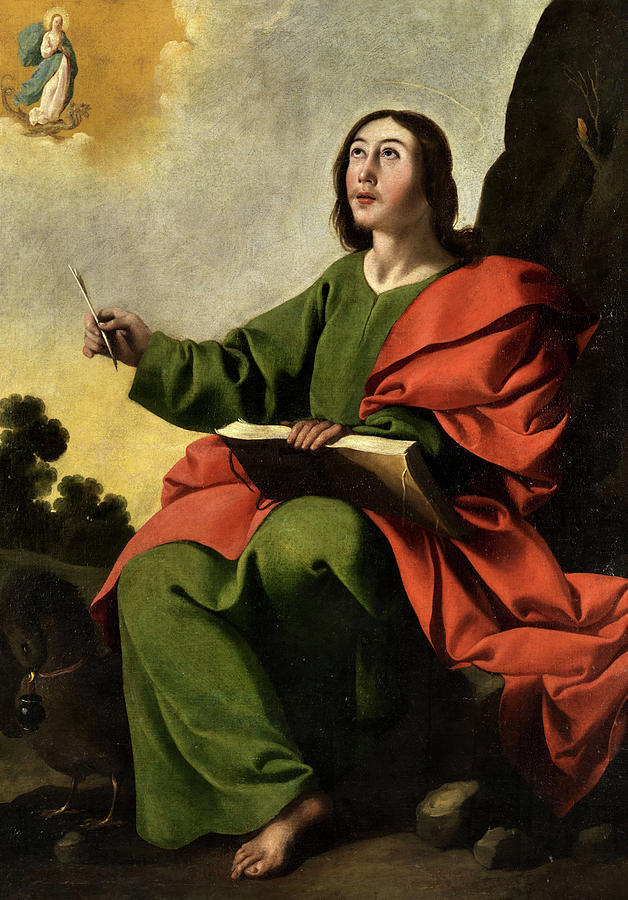
Francisco de Zurbaran’s “Revelation of John” presents one of the most contemplative visions of the beloved apostle in Spanish Baroque painting. Rather than illustrating a specific dramatic episode from the Book of Revelation, Zurbaran portrays the evangelist in the quiet yet intense moment of receiving divine inspiration. Seated outdoors against a rocky outcrop, John gazes upward toward a luminous apparition in the sky, stylus poised, his large book open on his lap.
The composition brings together the world of nature, the physical labor of writing, and the mystery of heavenly vision. The artist does not overload the scene with apocalyptic symbols. Instead, he focuses on the human figure of John, the saint who must translate ineffable visions into words. The result is an image that is both approachable and awe filled, showing revelation as a living encounter between God and a listening heart.
The Evangelist John and the Book of Revelation
In Christian tradition, John the Evangelist is the author of the Fourth Gospel, three epistles, and the Book of Revelation. The last of these, also called the Apocalypse, recounts visions received while John was exiled on the island of Patmos. He sees Christ in glory, angels, sealed books, beasts, and the heavenly Jerusalem. These visions, full of symbolic imagery, were meant to strengthen persecuted Christians and affirm that God’s victory over evil is certain.
Zurbaran does not attempt to paint the complex narrative of Revelation in this canvas. Instead, he chooses to show the source of the text: the moment of inspiration when John sits in solitude, listening to God. This emphasis reflects an important Counter Reformation conviction. The sacred books of Scripture exist not as abstract documents but as living words born from the prayer and obedience of the apostles. John is not just a distant writer of the past. He is a model for anyone who seeks to receive and transmit God’s message.
Composition and the Central Figure of John
The painting is structured around the full length figure of John, who occupies most of the right side of the canvas. He is seated on a rock, legs relaxed, one bare foot extended toward the viewer. His posture is calm yet attentive. The torso leans slightly back while the head tilts upward, eyes wide and alert.
John’s clothing is striking. He wears a long green tunic that covers his body to the ankles. Over this is draped a voluminous red cloak that wraps around his shoulders and flows down his side in rich folds. These two colors, green and red, create an immediate visual impact. Green evokes life, hope, and spiritual fruitfulness, appropriate for an apostle who speaks of eternal life and love. Red evokes charity, zeal, and the blood of martyrdom, reminding viewers that John’s witness comes at the cost of suffering.
Across his lap rests a large, thick book. Its pages, slightly open, are ready to receive the words of the revelation. In his left hand John holds this book steady. In his right hand he raises a stylus or quill toward the sky, as if tracing the vision he sees or indicating the source of his inspiration. The diagonal formed by the stylus leads the viewer’s eye upward to the small figure that appears in the clouds.
Behind John, at the upper right, a dark rock wall rises, anchoring the composition and providing a strong contrast to the lighter sky. To the left, the landscape opens into a gentle valley with trees and distant hills. The asymmetrical balance between rock and open space deepens the sense that John is simultaneously grounded on earth and open to the infinite.
The Heavenly Vision in the Sky
In the upper left area of the painting, surrounded by soft golden clouds, a small figure appears. The figure wears blue and white garments and stands within a luminous atmosphere. This apparition may represent Christ, an angel, or perhaps the Virgin Mary depending on the specific tradition that commissioned the work. What matters visually is that the figure is clearly supernatural and clearly the focus of John’s gaze.
Zurbaran paints the vision much smaller than the main figure of John, emphasizing the distance between earth and heaven. Yet the brightness of the cloud and the clarity of the small figure make this apparition the visual destination of John’s uplifted eyes and raised stylus. The viewer understands that what John sees cannot be captured fully by the canvas. We glimpse only a fragment of the mystery that overwhelms him.
The placement of the vision in the top left corner also creates a compositional dialogue with John’s head in the center-right. The line of sight between them forms a subtle diagonal. This invisible line is the axis of the painting, signifying the channel through which revelation flows.
Light and Atmosphere
Light plays a crucial role in “Revelation of John.” The main source of illumination seems to be the glowing cloud in the upper left. Its golden light spreads across the sky and gently bathes John’s face, hands, and garments. This supernatural light contrasts with the deeper shadows that fall on the rock and parts of his clothing.
Zurbaran uses this light to highlight the parts of the figure that express interior life. The face, turned upward, is clearly visible; its smooth modeling and subtle shadows reveal an expression of wonder and serenity. The hands that hold stylus and book are also well lit, emphasizing John’s role as both contemplative and writer.
The folds of the red cloak create dramatic areas of light and shade. On the outer surfaces, the red becomes bright and radiant. In recesses, it deepens toward burgundy. This play of values gives the cloak an almost sculptural presence, echoing the swirling forms of the clouds above. The green tunic, by contrast, is rendered in more even tones, suggesting stability and calm.
The landscape in the background is softer and less detailed. Trees and hills are suggested with broad strokes rather than minute description. This keeps the attention on the saint while still situating him in a real, natural environment. The sky, though partially filled with clouds, retains a sense of clear daylight, supporting the idea that John’s vision occurs not in a dreamlike night but in full consciousness.
The Symbolic Presence of the Eagle
At the lower left corner of the painting, near John’s feet, a dark bird appears. On closer inspection it is an eagle, the traditional symbol of the Evangelist John. In Christian iconography, each of the four evangelists is associated with one of the four living creatures mentioned in Ezekiel and Revelation: a man or angel for Matthew, a lion for Mark, an ox for Luke, and an eagle for John. The eagle, capable of flying close to the sun, symbolizes the soaring theology of John’s Gospel and the lofty visions of Revelation.
In Zurbaran’s painting, the eagle stands on the ground, head turned upward, echoing John’s own gaze. The bird’s posture mirrors that of the apostle, almost as if it too is listening to the heavenly message. This duplication reinforces John’s identity and highlights the spiritual elevation of his writing.
The presence of the eagle also adds a subtle note of dynamism to the otherwise tranquil foreground. Its dark feathers and sharp beak contrast with the soft folds of John’s garments, while its organic form grounds the painting in the world of living creatures.
Psychological Depth and the Face of John
The psychological power of the painting lies especially in John’s face. Zurbaran portrays him as a young man with smooth skin, dark hair framing his cheeks, and wide, dark eyes. His mouth is slightly parted, as if he is silently repeating the words he hears or uttering a prayer of amazement.
There is no trace of fear in his expression. Instead, the face combines awe, love, and serene concentration. John appears fully captivated by the vision yet not overwhelmed. This suggests a soul that has already been shaped by years of friendship with Christ and is now prepared to receive deeper mysteries.
The choice to depict John as youthful is also significant. Tradition often speaks of him as “the beloved disciple,” perhaps the youngest among the apostles. In Christian spirituality he becomes an image of contemplative love, the disciple who rests close to Christ’s heart and who remains by the cross. Zurbaran’s John embodies this ideal: pure, receptive, and wholly turned toward God.
The Act of Writing as Sacred Service
One of the most meaningful elements of this painting is Zurbaran’s emphasis on writing as a sacred act. The large book open on John’s lap and the stylus raised in his hand make clear that revelation is not only seen but recorded. The book is substantial, its pages thick, suggesting the weight of the text that will emerge from this encounter.
By focusing on the moment before words are fully written, Zurbaran captures the tension between inspiration and expression. John’s gaze is still fixed on the vision even as his hand is ready to move. The viewer can almost sense the flow of thoughts and images pressing to be translated into language.
For seventeenth century viewers, many of whom were engaged in prayerfully reading Scripture, this depiction of John would have underscored the sacred origin of the texts they cherished. The book in John’s lap prefigures the Bible in their hands. By meditating on this image, they could feel connected to the living stream of revelation that begins with the apostles and continues in the Church.
Zurbaran’s Style and the Spanish Baroque Context
“Revelation of John” displays many hallmarks of Zurbaran’s mature style. He favors clear forms, strong but not harsh contrasts of light and shadow, and monumental figures rendered with sculptural solidity. There is a quiet dignity in the way he paints saints, emphasizing their humanity while enveloping them in an atmosphere of prayer.
Compared with the more dramatic, swirling compositions of some Italian Baroque artists, Zurbaran’s approach is restrained. Movement is present in the swirling cloak and in the upward glance, but the overall effect is one of calm. This fits the spiritual aims of much Spanish religious art, which often sought to foster meditative devotion rather than theatrical excitement.
The painting also reflects the Counter Reformation emphasis on the clarity of sacred images. John is easily identifiable, the symbols are straightforward, and the message is accessible: the Word of God descends from heaven, is received by the apostle, and will be written for the benefit of all.
Spiritual Reflections for Contemporary Viewers
For viewers today, “Revelation of John” remains rich with spiritual implications. It portrays revelation not as something abstract or distant, but as a deeply personal encounter. John sits alone in nature, yet he is not isolated. He listens and looks, open to a voice beyond himself.
In an age when many people feel overwhelmed by noise and information, the painting suggests the value of silence and attentive listening. The apostle’s posture invites viewers to pause, to lift their own gaze, and to become more receptive to the quiet movements of grace in their lives.
The image also speaks to anyone engaged in creative or intellectual work. John receives a message and must express it faithfully. His raised stylus can symbolize the responsibility of writers, artists, and thinkers to remain honest to what they have seen and heard, rather than distorting it for personal gain.
Finally, the painting reassures believers that revelation continues to bear fruit. The book on John’s lap eventually becomes the written text that generations will read. By showing the origin of that text in a moment of loving contemplation, Zurbaran encourages confidence that Scripture, when read with the same spirit of openness, can still be a living source of inspiration.
Conclusion
Francisco de Zurbaran’s “Revelation of John” is a masterful meditation on the meeting of heaven and earth in the person of the apostle. Through a balanced composition, a harmonious palette of green and red, the soft glow of supernatural light, and the quiet intensity of John’s gaze, Zurbaran captures the essence of divine inspiration.
The painting avoids sensational apocalyptic imagery and instead focuses on the contemplative heart that receives God’s word. John sits with bare feet on the ground, book and stylus in hand, eagle at his side, eyes fixed on a small yet radiant figure in the sky. The viewer is invited to join him in that gaze, to feel the weight and beauty of the revelation that will soon be written.
More than just a historical or narrative scene, “Revelation of John” is a visual prayer. It celebrates the apostle who listened so deeply to God’s voice and challenges every viewer to become, in their own way, a witness to the light that shines from above.