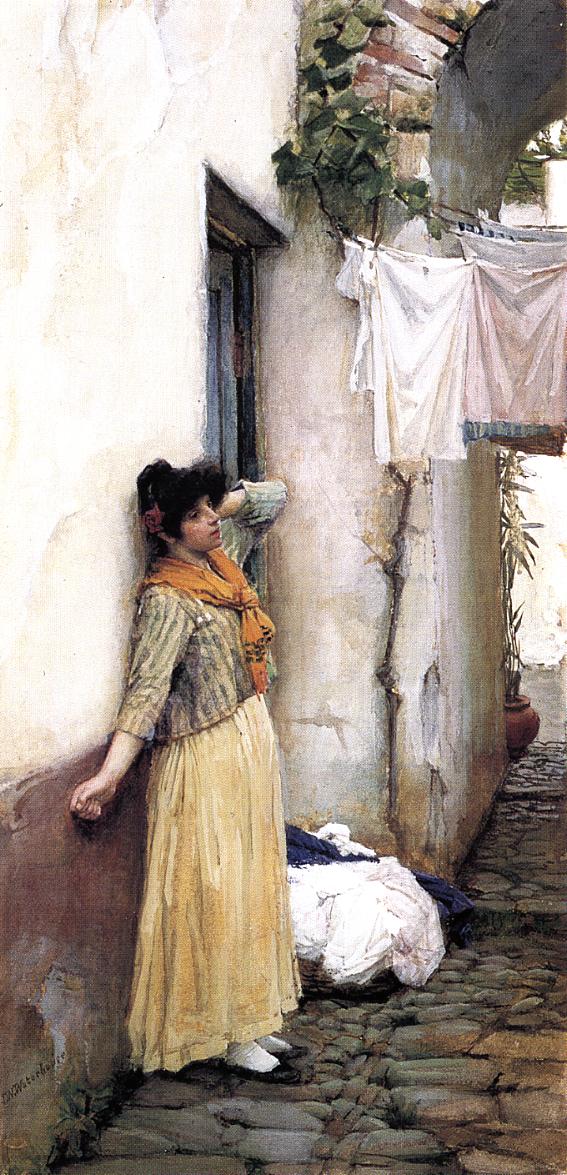
Image source: wikiart.org
Introduction to Resting (1886)
In Resting (1886), John William Waterhouse turns away from spectacle and myth to linger on something quieter: a pause in the middle of ordinary work. The subject is simple, a young woman leaning back against a sunlit wall, but the scene is built with the same seriousness Waterhouse often gives to grand narratives. Instead of gods or tragic heroines, we get a moment that feels overheard, almost accidental, as if the painter arrived while the day was already in progress and chose not to disturb it.
That decision shapes the painting’s mood. Nothing “happens” in the dramatic sense, yet everything suggests life continuing just outside the frame: laundry to finish, heat to endure, footsteps that will pass through the narrow lane. The title does not insist on a backstory. It simply names a bodily truth. Rest is an action, not an absence, and Waterhouse treats it as meaningful, worthy of patient looking.
Setting and the everyday narrative
The setting reads as a modest courtyard or narrow passage, edged by rough plaster walls and cobblestones that tilt and bunch with age. A doorway cuts into the left wall, its dark interior offering a cool, vertical recess against the glare. To the right, an archway opens the space toward brightness, while a clothesline stretches across, loaded with pale sheets that catch the light like sails.
Domestic labor is everywhere, but it stays implicit rather than staged. A heap of fabric sits low to the ground near the figure’s feet, the kind of untidy pile that exists only when work is midstream. Nothing is neatly folded for display. The woman’s posture suggests she has stopped for only a minute, long enough to unhook her arm and ease the tension in her shoulders. The scene becomes a portrait of labor’s rhythm: effort, pause, and effort again.
The figure as the painting’s center of gravity
Waterhouse places the woman low and left, so the huge wall above and around her becomes almost as important as she is. She leans with her back and shoulder against the plaster, one arm lifted behind her head in a gesture that reads as both relief and fatigue. The other arm drops down and outward, her hand relaxed, not gripping any tool, not performing for the viewer.
Her clothing reinforces the everyday tone while still providing visual richness. A striped bodice in muted greens and grays gives structure, while the long skirt falls in warm yellow tones that glow against the cooler wall. Around her shoulders sits a russet-orange scarf, a strong accent that draws the eye to her chest and face, and then back out into the space. White stockings and dark shoes anchor her to the cobbles, emphasizing that this is a working body in a working place, not an idealized figure floating free of circumstance.
Composition: walls, angles, and controlled asymmetry
The painting’s design is quietly sophisticated. The left wall forms a dominant plane, pale and nearly blank, that takes up much of the surface. This broad emptiness is not dead space. It is a deliberate field that slows the viewer down and heightens sensitivity to small shifts in tone, cracks, stains, and light. Against this near-monumental wall, the figure feels vulnerable and human, scaled by architecture.
The doorway provides a dark wedge that breaks the wall’s flatness and introduces depth. On the right, the archway and hanging laundry create a counterweight: softer shapes, lighter fabric, and a sense of air moving. The cobblestones form a path that guides the eye inward, while also emphasizing the passage’s narrowness. Waterhouse balances these elements so the composition feels natural, not symmetrical, but stable. The result is a scene that looks casual yet is carefully orchestrated to keep the viewer’s attention circulating between figure, wall, doorway, and light.
Light as atmosphere and narrative
Light does more than illuminate, it tells you how the day feels. The plaster wall is washed with sun, not in a harsh, single tone, but in a range of creams, warm grays, and faint blushes where the surface catches and holds heat. The laundry brightens in places and falls into soft shadow in others, suggesting a strong overhead sun and a mild breeze or shifting folds.
The woman stands close to the wall where the light is strongest, yet her face and bodice carry gentler shading, implying she is not fully exposed. That half-sheltered quality matters. It turns rest into a small negotiation with the environment: she has chosen a spot where the wall offers support and perhaps a trace of coolness near the doorway, even as the rest of the passage bakes. The painting becomes tactile. You can almost sense the warmth in the plaster and the dryness in the air.
Color relationships: warmth, restraint, and a single flare
Waterhouse keeps the palette restrained, letting one or two colors do the emotional work. The wall’s pale tones and the laundry’s whites establish a high-key environment, a world bleached by daylight. Against that, the skirt’s yellow feels like stored sunshine, and the scarf’s orange feels like a concentrated ember. These warm notes do not overwhelm the scene because they are balanced by the cooler greens and grays of the bodice and the shadowed doorway.
This color strategy creates a gentle hierarchy of attention. The scarf leads you to the face, the skirt leads you to the stance and the weight-bearing legs, and the neutral setting allows those cues to remain clear. The painting never turns theatrical. Instead, it suggests an emotion closer to endurance than drama: the mild weariness of a task repeated, the calm resignation of heat, the quiet satisfaction of a break earned.
Surface and technique: making time visible
Even without focusing on medium, you can see Waterhouse’s sensitivity to surface. The plaster is not a smooth, ideal wall. It bears stains, hairline cracks, and subtle patches of discoloration. Those marks are not merely descriptive, they imply time. The wall is old enough to have a history. The cobblestones, irregular and scuffed, reinforce that sense of long use.
The laundry is painted with folds that feel weighty despite their brightness. It is not decorative drapery, it is fabric with a job to do, drying in air and sun. The pile of clothes on the ground has a believable messiness, with dark and light fabrics tangled, suggesting the moment before sorting or folding. Through these textures, Waterhouse makes duration part of the subject. Rest is not only a pose, it is a small unit of time within a longer day.
Gesture and psychology: the meaning of a pause
The woman’s lifted arm is the painting’s most expressive gesture. It reads as stretching, as if she has been bent forward over work and now tries to open her chest and shoulders. It can also read as a fleeting self-soothing posture, a way of holding the head and easing strain. Her lowered hand, loose and open, suggests she has let go of something, literally or mentally.
Her expression is quiet and not exaggerated. She does not look directly out with a theatrical appeal. Instead, she seems turned inward, perhaps listening to the sounds of the lane, perhaps simply letting her thoughts drift while the body recovers. That choice keeps the painting from sentimentality. The viewer is invited to empathize without being instructed what to feel. The result is unusually modern in its understatement, a portrait of interior life presented through ordinary posture.
Objects as subtle symbols: laundry, vines, and the cracked wall
The painting’s objects are practical, yet they carry symbolic weight because they are so well integrated. Laundry is a sign of care and maintenance, the repetitive labor that keeps life clean and functioning. Hung across the passage, it becomes a temporary architecture, a soft ceiling that turns the space into a workroom under open sky.
The vine above, climbing near the arch, introduces a different kind of time: organic growth against built stone. It softens the architecture and hints at seasons, at endurance, at life continuing beyond human routine. The crack running down the wall adds another register, suggesting age, fragility, and the way structures wear under sun and weather. Together, these elements give the scene quiet depth. The woman rests not only within a physical space, but within a world shaped by maintenance, growth, and gradual decay.
Waterhouse in the 1880s: realism alongside romance
Waterhouse is widely associated with poetic, often myth-inflected imagery, but works like Resting show how attentive he could be to everyday observation. In 1886, this kind of subject aligns with a broader interest in scenes of daily life and believable environments, while still allowing the artist to bring a refined sense of design. The figure is not treated as a mere anecdote. She is composed with dignity, given scale, and set into a carefully constructed world.
What makes Resting especially compelling is how it bridges modes. The setting and details feel grounded and specific, yet the painting also has an almost lyrical structure: the pale wall as a quiet “page,” the figure as the central line of thought, the laundry as soft punctuation across the right side. Waterhouse shows that the everyday can be arranged with the same elegance as legend, and that a pause can hold the emotional resonance of a story.
The viewer’s experience: space, silence, and empathy
Standing before this painting, you are likely to feel the space as much as you see it. The narrow passage and tall wall create a sense of enclosure. The doorway’s darkness reads as cool, while the sunlit plaster reads as hot. The laundry introduces softness and motion, and the cobbles suggest uneven footing. These sensations draw the viewer into a bodily response, not only an intellectual one.
Empathy arises naturally because the scene is familiar across time. Most people know what it means to stop mid-task, to lean against a wall, to let muscles slacken for a moment. Waterhouse captures that universal feeling without stripping it of particularity. The woman is not an anonymous symbol. She is a person with weight, clothing, and presence. The painting asks the viewer to respect the reality of her fatigue and the legitimacy of her rest.
Why Resting still feels relevant
Resting endures because it honors a small human necessity that modern life often undervalues. It does not romanticize exhaustion, and it does not turn rest into laziness. It presents rest as maintenance, as part of the same cycle as work. In that sense, the painting is quietly ethical. It suggests that care for the self is woven into the fabric of daily labor, just as surely as washing is woven into the fabric of daily life.
The painting also remains relevant because of its restraint. In an age of loud images, Waterhouse offers a scene built from light, texture, and a single human gesture. Its drama is the drama of time passing and energy returning. The viewer leaves with an afterimage of warm wall, white cloth, and a figure who pauses long enough to breathe. That is a small gift, and it is exactly what the title promises.