Image source: wikiart.org
Introduction to Rembrandt’s “Rest on the Flight to Egypt” (1647)
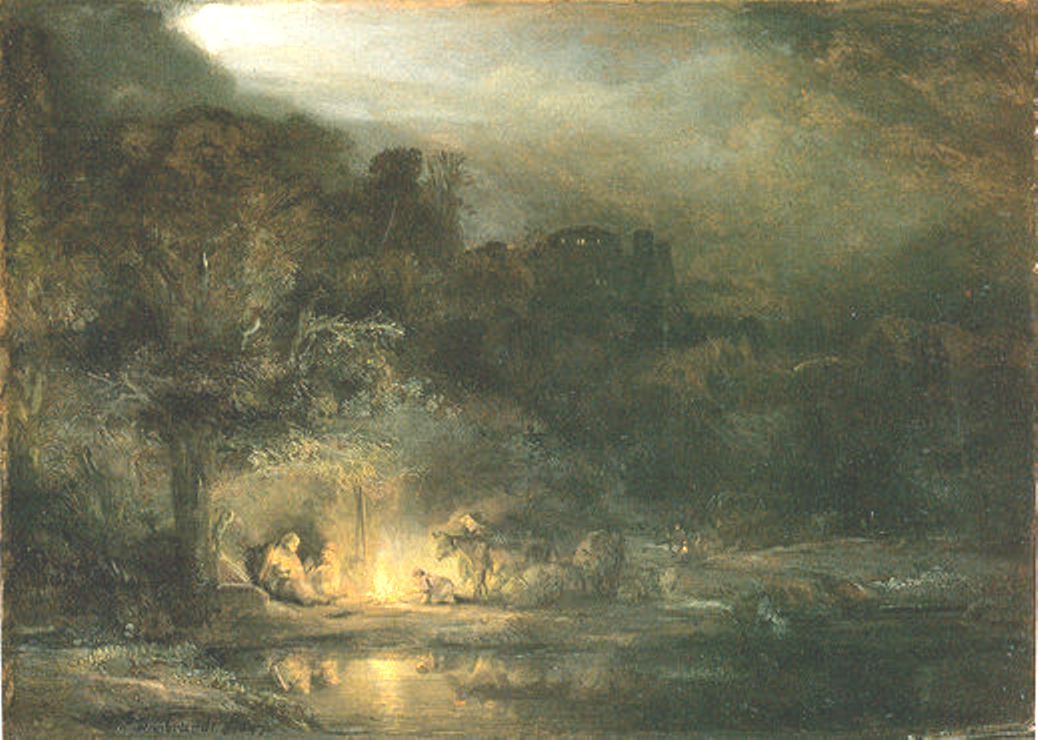
Rembrandt’s “Rest on the Flight to Egypt” is a night-piece that turns the biblical story into an atmosphere you can almost breathe. In the lower left a campfire glows, encircling Mary, Joseph, and the sleeping Child with a shell of warmth. Around that fragile hearth, the world expands into a cavernous landscape of trees, water, and rising hills. A pale seam of moonlight opens the sky, but it does not dominate; the painting’s true sun is the fire that humans make to keep the dark at bay. With minimal incident and maximal feeling, Rembrandt shows how a family survives a dangerous journey—by light, by patience, and by staying close to one another.
A Nocturne Built on Two Lights
Everything in the composition is organized around two distinct sources of illumination. The first is earthly: the orange core of the campfire, which spills sideways across faces, shoulders, the rump of a donkey, and the damp ground. The second is heavenly: a milk-pale, cloud-edged moon opening a track through the sky. These lights are not rivals; they converse. The fire delivers intimacy and legibility at human scale, the moon gives reach and destiny. Rembrandt calibrates their strengths carefully so one teaches the eye how to read the other: the campfire shows us the people, the moon shows us the way.
Composition as a Map of Refuge
Although the landscape feels expansive, the figures sit in a pocket of safety. A great tree stands sentry at the left edge; an embankment behind the family deflects the night wind; the fire occupies the clearing’s center like a modest altar. The reflective pool in the foreground doubles the glow, softening the ground and confirming the distance between the travelers and the darkness beyond. Far up the slope, nestled in shadow, is a suggestion of settlement or ruin—architecture that keeps the picture from drifting into pure wilderness and hints at a human world they have left or will reach.
Chiaroscuro with Human Priorities
The painting’s chiaroscuro is ethical as well as optical. Rembrandt guides the brightest notes to the infant and Mary’s lap, then lets light walk from person to animal to ground to water in gradually weakening steps. The dark does not smother; it enfolds. Trees retain a burred edge; distant masses breathe rather than block. The result is a darkness that honors privacy and allows the eye to rest, while the flame articulates what matters most: touch, faces, and the basic instruments of care.
The Fire as Theology and Technology
At the narrative level the fire is practical—heat, light, a way to rest. At the symbolic level it stands for human cooperation with providence. The moon is given; the fire is made. Together they suggest a world in which the divine and human collaborate. Rembrandt refuses to overstate that relationship. There are no halos, no angelic choruses. Sanctity is baked into ordinary survival: feeding an animal, warming a child, staying awake while others sleep.
The Landscape Speaks in Murmurs
Rembrandt’s handling of terrain is exceptionally musical. The banks are not diagrammed; they are hummed. Brushwork travels in small runs and pauses: a scrim of strokes to indicate foliage, a single dragged tone to mass a hillside, a softened scumble to press the sky back. The surface gives you just enough to imagine the rest. This is how memory works during a journey at night: you sense more than you see, and you put the place together from small proofs of texture and light.
Water as a Second Eye
The little pool under the fire is compositional glue and a poetic device. It mirrors the flame, doubles the warmth, and anchors the foreground so the viewer has a place to stand. Reflection here is not spectacle; it is reassurance. By binding fire to water, Rembrandt also quietly fuses opposites—heat and cool, orange and green-gray—so the picture settles into harmony rather than anxiety.
Mary, Joseph, and the Craft of Care
The figures are compact but eloquent. Mary’s body forms a cradle; the Child’s face turns toward the source of warmth; Joseph hovers as watcher and stoker, a guardian whose work is readiness. The donkey’s head dips, sharing the circle of comfort. These small truths—how a mother holds, how a father keeps watch, how an animal’s posture admits fatigue—are more instructive than any emblem. They show that holiness is enacted through ordinary competence.
The Rhythm of the Journey
Rembrandt captures a precise tempo: after the day’s labor, before the next stretch of road. The composition is balanced like a breath held between inhale and exhale. We feel the miles that lie behind in the slump of shoulders and the spread of baggage; we feel the miles ahead in the diagonal of the riverbank and the road-like gap that the moonlight draws across the clouds. This suspended time is crucial to the painting’s tenderness. Rest is not an afterthought to the story; it is the story’s hinge.
Color as Weather
The palette leans toward cool greens, grays, and bituminous browns. Against them the fire throws buttery yellows and ember reds, which register more powerfully because they are surrounded by restraint. Where the moonlight rides the clouds, a chalky, almost silver note appears, thinning the paint as if the sky were truly luminous from within. The narrow range of color ensures cohesion and allows emotion to accrue through tiny shifts of temperature rather than through spectacle.
Brushwork That Thinks
One delight of Rembrandt’s mid-century painting is how the brush seems to form thought on the surface. In the foliage, dry-brush scuffs summon the rough nap of leaves in darkness; in the sky, broad, wiped passages breathe vapors; in the fire’s core, quick dabs of thick paint describe sparks and wood. Even the donkey’s flank is resolved with two or three thick, directional strokes, enough to tell us the tilt of muscle and the light’s angle. The touch remains visible, reminding us that the scene is both dream and made thing.
A Landscape of Migration
“Rest on the Flight to Egypt” belongs to a tradition of paintings that cast the Holy Family as refugees traveling through real geographies. Rembrandt intensifies that realism by refusing theatrical hazard. There is no pursuing army, no explicitly exotic terrain. The danger is the dark and the wilderness; the heroism is endurance. In a mercantile Dutch Republic that knew both prosperity and displacement, this human-scale reading of the story would have felt close to daily experience.
The Human Line in a Vast World
Although the dark landscape dwarfs the travelers, Rembrandt keeps them from insignificance by giving them the most articulate light, the clearest edges, and the warmest color. The eye finds them naturally and returns. This repeat visitation replicates the way concern works in life: we keep checking on what is fragile. The painting trains the viewer’s attention to move in that moral rhythm.
The Moon’s Role Beyond Illumination
The wedge of sky is not mere backdrop; it is a narrative collaborator. The break in the clouds aligns with the campfire, creating a vertical of light that links earth and heaven. The moon’s cool beam is also a cartographic tool, suggesting contours in the hills and isolating the silhouette of a distant structure. These cues prevent the right half of the painting from collapsing into undifferentiated darkness and keep the journey’s geography comprehensible.
Echoes Within Rembrandt’s Oeuvre
This nocturne converses with Rembrandt’s other night scenes from the mid-1640s. In the “Adoration of the Shepherds,” the infant is the source of light; here the fire is the source, and the infant receives it. In “Joseph’s Dream in the Stable,” an angel breaks the night; here nature and human labor share illumination. The differences clarify intention: when Rembrandt wants to depict revelation, he lets light arrive; when he wants to depict perseverance, he lets humans kindle it.
Sound, Smell, and the Synesthetic Night
Good night paintings suggest more senses than sight. You can hear the small mechanics of the scene: wood ticking in heat, animal breath, a murmur between parents, a night bird. You can smell damp soil near the water and speakable smoke from green wood. These sensory hints arise from paint itself—the wet glazes in the foreground, the dry scuffs in the trees, the smoky browns feathered into the sky—so you do not imagine them arbitrarily. The surface persuades your body as well as your eye.
The Economy of Figures
The human group is small and without ornament. Rembrandt keeps gestures simple and readable at a glance. The Child is a loop of luminous cloth; Mary, a soft wedge; Joseph, a diagonal near the fire; the donkey, a lowered oval. Because each shape is clear, the viewer can locate the family instantly even within the vast spread of nocturne. That instantaneous legibility carries meaning: the vulnerable may be small, but they must be findable.
Narrative Without Rhetoric
The canvas avoids heroic narration and speaks in the plain prose of necessity: make fire, share warmth, keep watch, sleep when you can. From these verbs, all the pathos flows. Such restraint is Rembrandt’s signature strength. He declines the temptation to turn the scene into an emblem of virtue or a theater of exotic travel. Instead he gives us the grace of plausible behavior, and the story’s moral emerges from that truthfulness.
The Viewer’s Vantage and Participation
Rembrandt places the viewer at water’s edge, close enough to see how the fire lifts into its reflection and how the bank turns away. We stand just outside the circle of heat, allowed to look without disturbing the sleepers. This vantage makes the painting hospitable and reverent at once. We are not voyeurs; we are night travelers stopping to share light in silence.
The Afterimage of Compassion
When you step back from the canvas, the landscape’s dark gradually regathers. What remains is a pulse of warmth at the lower left and a pale seam at the top—a memory of care and a suggestion of guidance. This afterimage is the painting’s lasting gift. It teaches a way of seeing in which the world’s vastness is acknowledged, yet attention continues to focus on what is fragile and good. As a devotional picture, it persuades without sermon. As a landscape, it dignifies human smallness without despair.
Why This Night Still Feels Contemporary
Viewers today recognize themselves in the picture’s economy. Families still rest at the margins of uncertainty; journeys still pause beside water; light is still borrowed and shared. Rembrandt’s humility before these facts makes the painting feel not historical but present. Its power lies in the recognition that survival is holy work and that the most eloquent miracles are the ones that involve hands, wood, and watchfulness.
Conclusion: Two Lights and a Circle of Care
“Rest on the Flight to Egypt” is a portrait of endurance written in light. A campfire keeps its amber oath to a small circle of bodies; a moon opens a path across the sky; the dark allows both to matter. Rembrandt’s paint breathes like night air, his brush records the modest heroism of rest, and the whole scene becomes a manual for compassion. We leave with the image of a family preserved by warmth and attention—proof that even in the largest night, tenderness knows what to do.