Image source: wikiart.org
Introduction
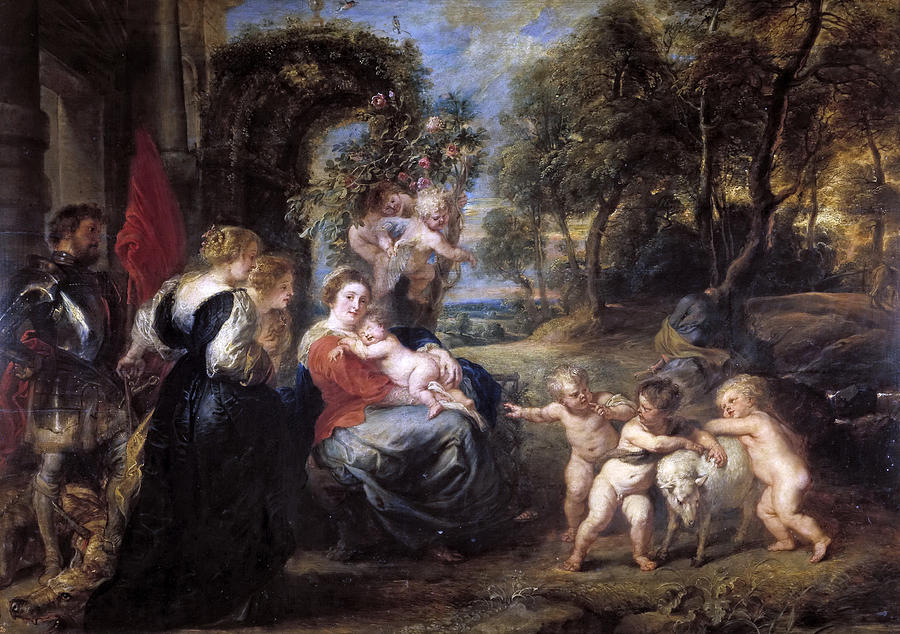
“Rest on the Flight into Egypt with Saints” by Peter Paul Rubens transforms a brief biblical pause into an expansive, joy-filled vision of protection, play, and divine providence. The Holy Family’s journey into exile becomes the occasion for a lyrical gathering of saints, angels, and putti in a wooded landscape that feels both Flemish and Mediterranean. Instead of emphasizing hardship and danger, Rubens stages the scene as a moment of radiant respite: the Virgin, seated and serene, cradles the sleeping Christ Child while around her unfold layers of narrative and symbolism, from armored knight to mischievous cherubs.
The painting is not a quiet, minimal meditation but a rich orchestration of figures, gestures, and colors. It reflects Rubens’ ability to take a familiar religious episode and fill it with the warmth of his own world: sumptuous fabrics, golden light, and the affectionate atmosphere of a large family gathering. Yet beneath the surface charm lies a complex interplay of meanings about pilgrimage, protection, intercession, and the hidden tension of a family temporarily safe yet not yet home.
Historical and Devotional Context
The Flight into Egypt appears briefly in the Gospel of Matthew, where Joseph is warned in a dream to flee with Mary and the infant Jesus to escape Herod’s massacre. Over the centuries, artists expanded this episode into a rich cycle of scenes, especially the “Rest on the Flight,” which offered opportunities for landscape, still life, and tender intimacies between mother and child. In Counter-Reformation Europe, such images served as devotional aids, inviting believers to accompany the Holy Family in contemplation and sympathy.
Rubens, working in the early seventeenth century, approaches this subject with typically Baroque generosity. He multiplies figures and folds the narrative into a broader theological context by introducing saints and angelic attendants. The presence of an armored knight, female saints, and numerous putti situates the painting in a tradition where sacred history and the communion of saints overlap: Christ’s earthly life is never isolated from the protection and veneration that surround him across time. The result is a vision that speaks simultaneously about the past event and the ongoing life of the Church.
Composition and Spatial Drama
At first glance the composition reads as a gently curving arc from left to right. On the left, under a shadowed architectural arcade, stand the armored knight and two richly dressed women. At the center, just beyond a stone threshold, Mary sits with the Christ Child on her lap, backed by a lush arch of foliage and flowers where winged putti perch. To the right the eye moves into a sunlit glade where three naked infants struggle playfully with a lamb, and further still into a wooded distance where Joseph rests near the baggage of the journey.
This left-to-right progression traces a path from the heavier, more static world of stone, armor, and courtly dress into the open freedom of nature and childhood play. Yet Rubens binds the scene together through circular rhythms. The arched greenery above Mary echoes the curves of her blue drapery and the rounded forms of the children. The diagonal line of sight from the knight toward the Virgin and child keeps the viewer’s attention circling back to the central mystery: the Incarnate Word asleep in his mother’s arms.
Foreground, middle ground, and background interlock seamlessly. The viewer stands almost on the same ground as the putti with the lamb; the Holy Family occupies the middle distance; the landscape recedes to a peaceful horizon. This carefully staged depth invites devotional participation: we are drawn in through the playful children, led to Mary and Christ, and then allowed to rest with Joseph in the distant quiet.
The Holy Family at the Center
At the compositional heart sits the Virgin Mary, calm and robust, dressed in warm red and cool blue that identify her across Christian art. She holds the naked Christ Child, who lies diagonally across her lap, one small arm extended toward the group of putti at the right. The child’s relaxed pose and rosy flesh convey total trust. His sleep is not obliviousness but the rest of one who is divinely protected even in a foreign land.
Mary’s gaze is gentle and contemplative. She looks not at the saints on the left or the children on the right but downward at her son, creating a meditative axis of love between mother and child. Her slightly tilted head and soft smile express both maternal affection and quiet awareness of the child’s destiny. She appears neither anxious nor triumphant; rather, she embodies the calm at the center of the painting’s swirling activity.
Behind Mary, the arch of foliage loaded with flowers functions almost like a natural halo. Angels nestle in the leaves and present garlands, visually crowning the Virgin as Queen of Heaven even as she rests like an ordinary mother in the countryside. This juxtaposition of throne and resting place, crown and tenderness, reveals Rubens’ gift for fusing theology with human experience.
Saints as Companions and Intercessors
To the left stand the saints who give the painting its additional title. An armored knight, likely Saint George or Saint James the Greater, watches over the scene. His polished breastplate catches the light, and a red banner or cloak flutters behind him, linking visually to Mary’s own red garment and suggesting that his martial courage is placed at the service of Christ and his mother. At his feet a dragon or defeated beast seems to writhe, a sign that evil has been vanquished around the Holy Family.
In front of the knight, two female saints approach with reverence. They are richly dressed, their dark gowns gleaming with reflections of light. One inclines her head slightly; the other clasps her hands or carries an attribute. They could represent Mary Magdalene, Saint Elizabeth, or generalized noble saints, but in any case they convey the Church’s homage. Their presence tells the viewer that the humble refugee family is, in fact, the royal family of heaven, attended by the bravest and most virtuous of Christian history.
These saints also serve a devotional function. In Baroque spirituality, saints are intercessors and models; including them in the painting allows the faithful to identify with their response. The viewer can “stand” with the knight in protective solidarity or with the women in contemplative admiration. Rubens thus constructs a layered community of worship: angels above, saints beside, the faithful implied in front of the picture plane.
Putti and the Play of Grace
One of the most enchanting aspects of the painting is the swarm of small children and putti who animate the scene. Above Mary’s head, chubby cherubs climb among the branches, carrying garlands of flowers that cascade down like a decorative crown. They personify heavenly joy and celebrate the safe pause in the Holy Family’s journey. Their carefree movement contrasts with the earlier danger of Herod’s wrath, now momentarily suspended.
In the foreground to the right, three naked children contend with a lamb. One holds the animal by the neck, another pushes from behind, while the third seems half helpful, half playful. The lamb, symbol of Christ’s sacrificial destiny, becomes a toy in their hands—a reminder that the innocent child on Mary’s lap will one day be “the Lamb of God” offered for the world. Yet the tone remains tender rather than ominous. Rubens shows how divine mystery permeates even the games of children.
These putti also act as compositional bridges. Their pale flesh echoes the Christ Child’s body, spreading his presence visually across the lower half of the painting. Their circular wrestling with the lamb mirrors the roundness of Mary’s seated posture and the arch of foliage, reinforcing the sense that love and playful vitality radiate outward from the tiny Savior.
Landscape and Atmosphere
Rubens’ landscape is more than a backdrop; it participates in the narrative. On the right, tall trees rise in loose clusters, their trunks twisting in soft rhythms that echo the figures’ gestures. Patches of golden light filter through the leaves, illuminating glades and paths. In the far distance, beyond the rustic path where Joseph sits, the land opens toward a luminous horizon, possibly a river or sea that recalls the Nile and the journey’s destination.
The atmosphere feels like late afternoon or early evening. The sky is streaked with blues, creams, and hints of violet, suggesting light beginning to mellow but not yet fading. This temporal setting suits the idea of rest: the day’s heat and exertion are waning, allowing the travelers a moment of respite before nightfall.
Joseph, seated near the edge of the path, contributes to this mood. Clad in muted colors, he appears older and more worn than the other figures. He leans on his staff, watching over the baggage or perhaps simply catching his breath. His presence anchors the scene in the reality of travel. While saints and angels gather in rapt devotion, Joseph reminds us of the practical labor that undergirds the Holy Family’s survival.
Color and Light
As in much of Rubens’ work, color is central to the emotional impact. Warm, saturated hues dominate the central group: Mary’s red gown, her blue cloak, the rich blacks and golds of the female saints’ dresses, the shining steel of the knight’s armor. These strong local colors are tempered by the surrounding greens and browns of the landscape, creating a harmonious balance between human drama and natural setting.
Light seems to pour gently from the upper left, illuminating Mary and the Christ Child most strongly. Her face and the baby’s body glow with soft, pearly tones, while the surrounding figures exist in slightly deeper, warmer shadows. The effect is not theatrical spotlighting but a gradual, enveloping radiance that subtly privileges the central mystery.
Rubens uses reflections and highlights to enliven surfaces: the flicker of light on armor, the sheen on silk sleeves, the glistening lamb’s wool, and the delicate shimmer on the cherubs’ wings. These sparkling touches reinforce the painting’s celebratory atmosphere, as though the physical world itself rejoices in the presence of the Incarnate Word.
Texture and Painterly Touch
Looking closely, one can sense Rubens’ vigorous brushwork. Fabrics are built from broad, confident strokes, particularly in the heavy folds of Mary’s skirt and the voluminous dresses of the female saints. The armor of the knight is rendered with swift, reflective marks that capture both solidity and gleam. The foliage above and the trees at the right are painted with more broken, loose strokes, suggesting leaves and branches in constant movement.
The skin of the children and the Virgin is handled with extraordinary delicacy: soft transitions of color, gentle modeling, and subtle touches of pink around knuckles, knees, and cheeks. This variety of textures, from rough bark to polished metal to tender flesh, showcases Rubens’ technical mastery and reinforces the painting’s sensory richness. The viewer almost feels present in the scene, able to hear rustling leaves, feel the lamb’s wool, and sense the weight of the sleeping child.
Theological Meanings and Spiritual Reading
Beyond its sensory appeal, the painting offers a layered theological message. At its core is the paradox of the Incarnation: the eternal Son of God rests as a fragile infant, dependent on his mother’s arms, yet at the same time he is surrounded by saints and angels who recognize his kingship. The sleeping Christ Child, vulnerable yet central, embodies the mystery of divine humility.
The inclusion of saints from various eras underscores the timelessness of Christ’s saving presence. Though historically the Flight into Egypt occurred long before the lives of most Christian saints, Rubens collapses time to show how all holiness ultimately orbits around Jesus and Mary. The knight’s conquered dragon hints that Christ’s victory over evil is already anticipated, even as he begins life as a refugee. The lamb in the putti’s game foreshadows his sacrificial death, yet the tone remains joyful, reminding believers that the Passion is ultimately a passage to resurrection.
The path winding through the trees, with Joseph resting by the way, can be read as an image of the Christian journey through a world that is sometimes hostile, sometimes welcoming. Moments of rest, like the scene portrayed here, are gifts of grace where heaven and earth draw close. The viewer is invited to join this moment of pause, contemplating both the beauty of the earthly setting and the deeper promise of protection and guidance.
Rubens’ Personal and Artistic Concerns
Rubens often included familial tenderness and domestic warmth in his religious works, reflecting his own experience as a devoted husband and father. The ease with which Mary cradles the child, the natural play of the children, and the subtle attention each figure pays to the others all suggest a painter who understood the rhythms of large families and gatherings.
At the same time, Rubens was deeply involved in diplomatic and courtly life. The knight and elegantly dressed women may echo the world of his patrons, effectively bringing contemporary viewers into the biblical story. By dressing saints and attendants in courtly fashion and placing them under classical architectural arches, he suggests that the realities of salvation history are not remote; they intersect with the present and demand a response from rulers and nobles as much as from common believers.
The painting thus functions on multiple levels: as a charming pastoral scene, a courtly devotional image, and a profound meditation on journey, rest, and protection. It demonstrates Rubens’ ability to unify these concerns into a coherent, emotionally resonant whole.
Conclusion
“Rest on the Flight into Egypt with Saints” is a luminous example of Peter Paul Rubens’ capacity to weave theology, landscape, and human emotion into a single, compelling tapestry. The Holy Family’s brief pause in their journey becomes an opportunity for heaven and earth to converge: angels crown the Virgin, saints offer homage and protection, children play with symbols of Christ’s destiny, and the surrounding woods bask in warm, late-day light.
Through dynamic composition, rich color, and varied textures, Rubens invites viewers into an atmosphere of grateful rest. The dangers that forced the family into exile are absent from the frame, yet their memory hovers at the edges, heightening appreciation for the peace depicted. The painting reassures believers that, even in times of displacement and uncertainty, there are moments when grace encircles them as tangibly as saints and angels surround Mary and her child. It remains a vivid, enduring vision of refuge, tenderness, and the joyful companionship of heaven along the pilgrimage of life.