Image source: wikiart.org
Introduction
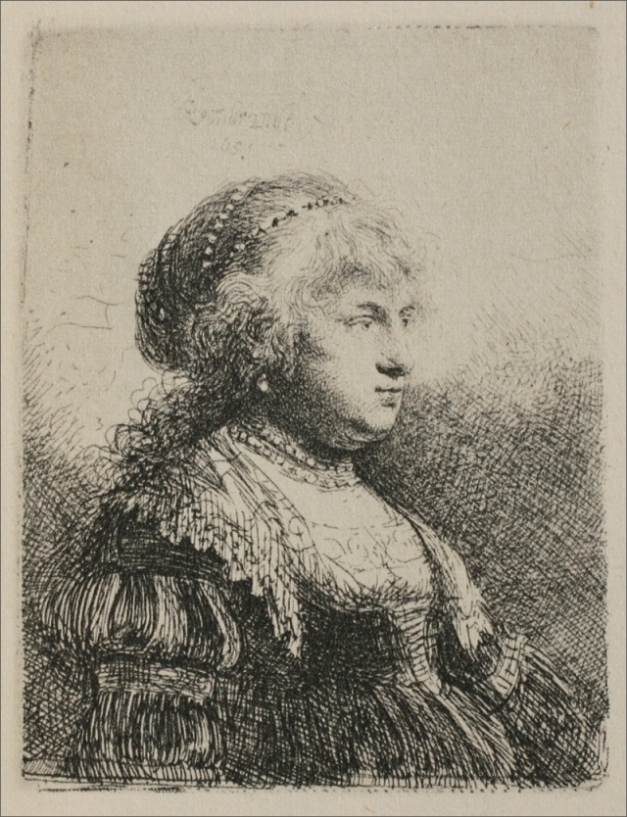
“Rembrandt’s Wife with Pearls in her Hair” (1634) is a small but ravishing etching from the year of Rembrandt’s marriage to Saskia van Uylenburgh. In a few inches of copper, the artist compresses an entire world of affection, fashion, and experimental line. The sitter—almost certainly Saskia—appears in three-quarter profile, her gaze turned toward a luminous field of open paper. A delicate string of pearls traces the arc of her coiffure; a second necklace glints at the collar; soft, tiered sleeves and a lace-edged bodice anchor the costume. The print’s modest scale belies its ambition: it is both a love token and a workshop of invention, where Rembrandt tests how etched lines can breathe like paint and how a handful of marks can evoke substance, light, and living presence.
Historical Context
The year 1634 marks a decisive threshold in Rembrandt’s life and career. Having left Leiden for Amsterdam not long before, he had quickly gained elite patrons for portraits, history paintings, and prints. His marriage to Saskia, the well-connected cousin of art dealer Hendrick Uylenburgh, drew him into a dynamic social network and brought a new muse into his studio. Around their courtship and marriage he produced numerous images of her—painted, drawn, and etched—probing her expressions, costumes, and roles (from playful fancy dress to solemn portrait). The present etching belongs to this cluster and records a youthful, affectionate view: Saskia as an elegant young woman whose ornaments and dress are evoked as much by rhythm as by literal detail.
Medium and Technique
This work is a consummate display of early Rembrandt etching. He incised the image into a wax-covered copper plate with an etching needle, then exposed the plate to acid, which bit the lines to different depths depending on exposure. The technical vocabulary—short, curved hatches for curls; tight parallel strokes for shadow; open reserves for light—creates a dynamic surface where line density translates directly into tone. There is no drypoint burr here as heavy as in his later plates; instead we read crisp, bitten lines that maintain sparkle when printed. Rembrandt’s hand is unmistakable in the way marks change speed and pressure mid-stroke, as if adjusting to the sitter’s living forms in real time. The plate likely existed in more than one printed “state,” allowing the artist to adjust passages as he saw proofs; the liveliness of the mark-making suggests that experimentation was part of the image’s purpose.
Composition and Cropping
The composition is tightly framed, placing Saskia’s head high in the sheet and allowing the torso to taper toward the lower right corner. The upper left quadrant retains a halo of untouched paper where the artist’s delicate signature hovers; the right side dissolves into a net of hatching that sets the head in relief. This asymmetry is deliberate. By giving the figure more breathing space ahead of her gaze than behind her head, Rembrandt hints at thought and movement—the sitter seems to lean into the light, not simply occupy it. The cropped shoulder and lower sleeve contribute to immediacy, as if the viewer were seated close by, catching her in mid-turn.
Light and the Physics of Hatching
Etching is drawing with acid, and Rembrandt uses its grammar masterfully to simulate light. The face receives the most open treatment: loosely spaced strokes model the cheek and temple, allowing the paper’s whiteness to act as illumination. The background hatching tightens as it approaches the silhouette, throwing the profile forward without heavy outlining. Around the eye and nose, tiny hooks and flicks of the needle toggle between structure and softness; under the lower lip, a short crescent secures volume without hardening the mouth. The result is a facial topography that seems breathed into being. Light is not painted on; it is the silence between marks.
The Pearls and the Theater of Ornament
Pearls are the etching’s title and one of its subtlest effects. Rembrandt does not labor each bead. Instead he suggests the string through alternations of dot and dash, letting the brain complete the rhythm. A sparing micro-highlight—really just a gap in the ink—turns a dot into a pearl. The hair beneath acts as a softly shaded ground, so that the suggestion of spherical gleam is irresistible. The same economy governs the necklace at Saskia’s throat and the tiny earring that punctuates the profile. In all, ornament becomes music: a sequence of notes that carry the eye across the image and back to the face.
Costume, Fashion, and Identity
Saskia wears a fashionable gown with tiered sleeves and a bodice trimmed in lace. Rembrandt does not count every loop; he captures the “behavior” of fabric. The sleeves are built from nested curves that indicate their stuffed, ribbed structure; the bodice uses broken hatching to imply sheen; the lace edging is caught with jagged, bright notches. This approach transforms costume from static display into an active participant in the portrait. The opulent details—pearls, lace, elaborately dressed hair—speak the language of courtship and celebration typical of their wedding year, but they never overwhelm the sitter’s humane, approachable presence.
Psychology Without Posturing
Many portraits of the period strive for public gravitas. Here the mood is private and relaxed. The mouth rests in a neutral softness—not a smile, not an expression of ceremony—while the eye glances outward with alert gentleness. The subtle fullness at the jawline and the lightly shaded under-eye lend the face a lived reality that refuses idealization. Rembrandt’s gift is to let character emerge from the mechanics of looking: the sitter appears absorbed by whatever lies in the bright space before her, and we, catching her in profile, sense both her dignity and her spontaneity.
The Oval Head and Classical Echo
Rembrandt’s choice of three-quarter profile and high placement of the head suggests the cameo tradition and the “bust” format of antique portraiture. Yet the print resists classicizing chill. The textured hair and the springing strings of pearls keep the head vivid and contemporary. The classical echo instead functions as a frame—an armature that concentrates attention on the light-struck planes of forehead, nose, and cheek while allowing the clothing to flower around it.
The Signature and Date
At the top left, faintly inscribed, Rembrandt writes his name and the date. The inscription is not a brash cartouche; it is nearly absorbed into the light. This modest placement suits the print’s intimate character. It reads like a note jotted at the top of a letter, a private confirmation that the object was made by the same hand that knew the sitter so closely.
Comparison with Contemporary Images of Saskia
Rembrandt’s paintings of Saskia from 1633–1634 often dress her in brilliant costumes—feathered hats, gold-embroidered bodices, or fur mantles—making her the star of a theater of textures and color. By contrast, this etching strips the spectacle to hatching and light. The two modes inform each other. The etching carries into line the same tender modeling developed in paint; the paintings borrow from the printmaker’s precision of contour and structure. Across media, Saskia remains constant: dignified, youthful, and vividly present.
Scale, Intimacy, and the Act of Printing
Etchings are not single objects but printed multiples, and that repeatability carries emotional charge here. The small format fits the hand; the paper’s surface records the bite of lines like a whisper. When printed with a touch of plate tone—a thin film of ink left on the plate—the background can warm and the highlights intensify, giving the impression that the sitter emerges from a gentle dusk. Each impression might vary slightly, meaning the portrait could appear alternately brighter or moodier, as if time of day or emotional weather changed from print to print. That variability is not a defect; it is a part of the image’s living quality.
The Edge Between Drawing and Sculpture
Look closely at the silhouette along the forehead, nose, and lips. Rembrandt keeps the outermost contour soft, built from clustered lines rather than one hard boundary. This choice gives the head a sculptural roundness, as if the air itself were a gentle pressure on the face. In darker areas—the back of the head, the shoulder—he lets the contour firm up. These modulations create a breathing edge that transports the viewer from two-dimensional ink to the imagined three-dimensional head.
Tempo and Rhythm of the Hand
One can almost reconstruct the sequence of the artist’s motions. The hair is laid in nimble curls, then toned with shorter strokes; the face is addressed more slowly, with measured hatches; the costume, particularly the sleeves, receives broad, confident arcs that accelerate toward the lower right corner. The print becomes a choreography of the artist’s hand—a visible record of tempo changes aligned to kind of material being described. That choreography is a source of latent emotion: we feel the energy of making carried through to the printed sheet.
Gender, Virtue, and Representation
Dutch portraiture often deployed clothing and accessories as moral language: pearls could evoke purity and wisdom; lace spoke of order and domestic competence. In this print, the language is present but softened. The pearls indeed crown Saskia’s hair, but they are presented with delight rather than sermon. The lace is crisp, yet it shares space with the play of curls and the gentle roundness of cheek. The portrait suggests that virtue and pleasure are not enemies—an idea consistent with a wedding-year image made by a young husband-artist enraptured with both his craft and his bride.
The Background as Space and Silence
The right half of the sheet thickens into a mesh of cross-hatching that performs as shadow and as abstract field. It pushes the head forward while also acting as a kind of acoustic panel, quieting distractions so that the viewer can attend to the face. The transition from blank paper at the top left to saturated hatching at the right creates a diagonal drift of light—subtle but decisive—that the eye unconsciously follows.
The Afterlife of an Intimate Image
Over the centuries, this etching has been cherished by collectors precisely because it trades scale for immediacy. It invites close looking, rewarding patience with small revelations—the pearl that is only a dot; the eye that is built from two or three tiny hooks; the lace that appears frothy although it is only strategic white paper. It also serves historians as evidence of how Rembrandt built an iconography of Saskia that ranged from courtly splendor to domestic ease. In this sheet, the balance tilts toward the latter: it feels like a glance from life, stabilized by art.
The Ethics of Looking
Part of the print’s power is ethical. The artist does not exploit the sitter’s youth or beauty; he honors her with attention and restraint. The face is observed, not embellished; the pearls are celebrated but not flaunted; the background is kept plain to keep the portrait honest. This ethic is a current that runs through Rembrandt’s best portraits: a pledge that seeing another person clearly is itself a form of respect.
Legacy within Rembrandt’s Etching Practice
This work anticipates later, more experimental plates in which Rembrandt would push line into painterly richness—employing drypoint burr, deeper bites, and dramatic plate tone. Here, he is still relatively crisp, and the lesson is fundamental: drawing can do everything if each mark is meaningful. The plate’s success likely encouraged him to treat etching not as an adjunct to painting but as an equal theater of invention, capable of projecting psychology and atmosphere with no color at all.
Conclusion
“Rembrandt’s Wife with Pearls in her Hair” condenses love, craft, and modernity into an etching no larger than a hand. Through the disciplined grammar of hatching and the strategic silence of open paper, Rembrandt makes light the principal subject and turns ornament into music. Saskia appears at once dignified and alive, a newlywed seen by someone who knows her well. The pearls sparkle without ostentation, the lace breathes, the head turns toward a bright, unprinted future. More than an exercise in technique, the print is a demonstration of how attention—patient, affectionate, exact—can make a small sheet radiant.