Image source: wikiart.org
Introduction
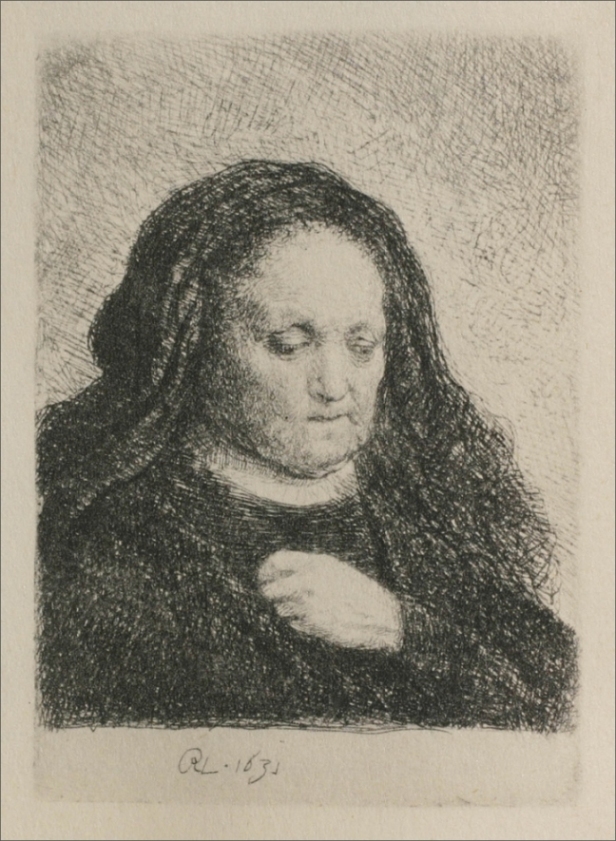
“Rembrandt’s Mother in a Black Dress, as Small Upright Print” (1631) offers an intimate window into the young Rembrandt’s early Amsterdam years while preserving the tenderness of his Leiden roots. The small plate concentrates on a bust-length figure whose downcast eyes and modest gesture of the hand convey reserve rather than display. Wrapped in dark garments that sink into an equally dark ground, the sitter’s face and hand emerge as islands of light. The image is simultaneously filial, observational, and technical—a study of character built from the disciplined variations of etched line and plate tone. Its quiet gravity demonstrates how the artist could make a small, unassuming print carry the weight of a full interior life.
The Work In Context Of 1631
The year 1631 marks a hinge in Rembrandt’s trajectory from Leiden to Amsterdam. He was synthesizing his earlier attention to character heads with the demands of a larger city and more ambitious clientele. Prints from this moment reveal a young master forging a personal repertoire of tones, from the dense velvet of accumulated crosshatching to the breathy softness of paper left to glow. In this small upright print, he turns that technical experimentation toward a subject of unusual intimacy: a maternal figure presented without heraldry, placed near the plate’s center, and imbued with the discipline of inwardness that would remain a hallmark of his art.
A Study Of Modesty And Presence
The sitter’s pose avoids confrontation with the viewer. Her gaze is cast down; the head inclines slightly; the left hand rises to the chest as if to secure the shawl or still a private emotion. Nothing theatrical interrupts the mood. Yet the presence is powerful because the gestures are honest. Rembrandt’s visual grammar of modesty—averted eyes, soft mouth, gathered garments—does not diminish personality. Rather, it refines it, allowing the viewer to arrive at a sense of character through small, cumulative cues rather than a single emphatic statement.
The Architecture Of Light And Shadow
Light falls from the upper left, gently washing the forehead and nose before dissolving along the cheek and rounding the chin. The hand, turned palm-inward near the heart, catches a quieter reflection that binds it visually to the face. Everything else sinks into a controlled dusk. This orchestration is more than chiaroscuro; it is a moral geometry. Light defines the zones of attention—the face that thinks and feels, the hand that testifies. Shadow, far from being a mere absence, becomes a shelter that concentrates the image’s interiority.
Etching As A Language Of Tenderness
The plate demonstrates the extraordinary range that etching allows when guided by a sensitive hand. Small, tight hatchings build the dark of the cloak; looser, more open strokes articulate the softer transitions in the face; a few stippled dots enliven the cheeks without hardening them. Across the background, Rembrandt drags the needle lightly to produce a woven aura that feels like air rather than wall. The medium’s capacity to register pressure changes gives the portrait an audible hush. One can almost hear the scratch of the needle transmuted into the whisper of cloth and breath.
The Headscarf And The Theology Of Fabric
Clothing in this print is more than costume; it is an ethic. The heavy black dress and veil reduce decorative incident to nearly zero, redirecting attention to the sanctity of the face. Rembrandt renders the scarf as a sequence of curved, shadow-rich planes that cradle the head like a cowl. This framing device reads as an embrace. It protects the sitter from the glare of spectacle and casts the portrait as a meditation on quiet endurance. The black dress, without embroidery or lace, invites the eye to study tonal nuance rather than fashion. Restraint becomes a form of eloquence.
The Hand As Confession
Few passages in the print are as telling as the small hand rising toward the chest. Its posture is ambiguous: it could be a modesty gesture, a reflex of cold, a placeholder for prayer, or a simple resting position. Rembrandt keeps the articulation soft; tendons are suggested rather than spelled out; the knuckles catch just enough light to give structure. Because the hand occupies a middle value—neither as bright as the face nor as dark as the dress—it becomes a hinge between thought and body. The gesture therefore reads as a confession without words, and it anchors the emotional rhythm of the sheet.
A Portrait That Refuses Sentimentality
The maternal identification has often tempted commentators to read the print as sentimental. Rembrandt resists that trap. He neither smooths away age nor exaggerates it for effect. Slight puffiness under the eyes, the softened edge of the jaw, the tender hollows around the mouth—all are recorded with sympathy but without sugar. The result is not a shrine but a witness. The artist honors the sitter’s reality by granting her the dignity of truthful description.
Composition And The Breath Of The Plate
The portrait fills the rectangle without crowding it. The head and shoulder mass occupies the lower two-thirds, leaving an airy cap of background that keeps the figure from feeling pinned to the top edge. This negative space matters. It admits breath and light into the sheet and stands as a visual pause above the concentrated modeling below. At the very bottom, Rembrandt places his small monogram and date, anchoring the image while keeping authorship unobtrusive. The plate thus reads as a complete room for the sitter, modest in size yet hospitable in spirit.
Texture As Narrative
Every texture in the print participates in storytelling. The veil’s crosshatched darkness bears the work of years; the dress’s slightly different grain distinguishes cloth from covering; the skin’s stippled softness announces living warmth within the surrounding shadow. Even the background, with its web of light strokes, contributes to the sense of a world built from modest materials. This layered tactility makes the image believable to the hand as well as to the eye.
The Psychology Of Averted Eyes
Rembrandt’s decision to lower the sitter’s gaze accomplishes several things at once. It creates privacy, encouraging the viewer to approach with respect rather than hunger. It installs a slow tempo in the image; attention descends rather than darts. It also generates a vertical rhythm: from the soft cap of light on the forehead down to the downward-looking eyes, then to the mouth at rest, and finally to the hand. The eye’s path mirrors the sitter’s interior motion, producing empathy not by narrative but by shared pacing.
The Role Of Plate Tone And Printing
Impressions of this print can vary depending on how the plate was inked and wiped. A retained plate tone deepens the surrounding dusk and heightens the face’s glow; a cleaner wipe clarifies the drawing and shifts the mood toward crystalline sobriety. Rembrandt understood and exploited such variables, treating printing as a second stage of picturing. This malleability suits the subject. The mother’s presence feels capable of living in slightly different atmospheres without losing identity, just as a face changes with time of day yet remains itself.
Relation To The Artist’s Broader Studies Of Old Age
Rembrandt’s sustained interest in aged faces—saints, beggars, patrons, and relatives—was never a mere catalog of wrinkles. He found in age a readable map of experience and a field for his evolving light. This print joins that investigation by translating aged softness into a lattice of small strokes and reserves. Rather than dramatizing decay, he locates beauty in the persistence of calm amidst the press of time. The image stands as an early articulation of that lifelong theme.
The Paradox Of Small Scale And Monumental Feeling
The print is physically small, suited to the hand rather than the wall. Yet its emotional amplitude is large. Rembrandt achieves this paradox by compressing the portrait’s drama into elementary forms: an oval of light for the face, a dark mantle for shelter, a single hand for confession, and an airy halo of background for breath. By reducing the vocabulary, he enlarges the resonance. The viewer senses monumentality not as size but as moral weight.
Theology Without Emblems
Although not explicitly religious, the portrait carries a devotional mood. The cowl-like veil and the lowered eyes recall types familiar from sacred art, but no attribute binds the image to a specific doctrine. Rembrandt treats the sitter’s inwardness as sufficient subject. That approach grants the print a broad humanist reach. It speaks to anyone who recognizes the dignity of stillness, regardless of creed.
What The Viewer Should Notice Up Close
Close viewing reveals the delicacy of the etched web that holds the light in the face. The strokes scarcely cross at the brow, allowing the paper to shine through as a living warmth. Along the jaw, a gentle net of short lines turns the plane without hard edge. The tiny reserve that separates lower lip from surrounding shadow keeps the mouth from sinking. In the hand, brief flicks of line become the soft ridges of knuckles. Such decisions are microscopic, yet they shape the portrait’s entire emotional temperature.
Comparison With Other Maternal Studies
Rembrandt made several images of an older woman long associated with his mother. Some are more elaborate in costume; others explore different lighting schemes or expressions. This plate is one of the most reticent and therefore one of the most affecting. By stripping away anecdote, it achieves a clarity that the more embellished versions sometimes trade for spectacle. It crystallizes a relationship—artist to sitter, child to parent—without resorting to sentimental devices.
Time, Memory, And The Print’s Afterlife
Because prints can be widely distributed, this image carried the presence of the sitter far beyond the studio. Each impression becomes a portable memory, a small reliquary of attention. The date beneath the image fixes it in 1631, yet the plate’s tones feel elastic, capable of inhabiting many years’ worth of looking. That elasticity matches the subject’s role in the artist’s life: an origin point that continues to radiate meaning even as the artist’s world expands.
Why The Image Still Feels Contemporary
Contemporary viewers find in this print an antidote to spectacle. Its refusal of noise, its faith in small gestures, and its trust in tonal nuance align with modern sensibilities that look for authenticity over display. The image models a way of seeing loved ones that privileges patience over performance. In a culture crowded with declarative portraits, its whisper has unusual carrying power.
Conclusion
“Rembrandt’s Mother in a Black Dress, as Small Upright Print” transforms a modest plate into a site of deep attention. It gathers light around a face and hand, shelters them in a veil of shadow, and allows the viewer to arrive at intimacy through quiet observation. The etched line becomes a language of tenderness; the negative space becomes a breath; the lowered eyes become a tempo. Beyond filial affection, the print demonstrates a young master’s belief that the everyday dignity of a single person—drawn without spectacle—can sustain the full resources of art.