Image source: wikiart.org
Introduction
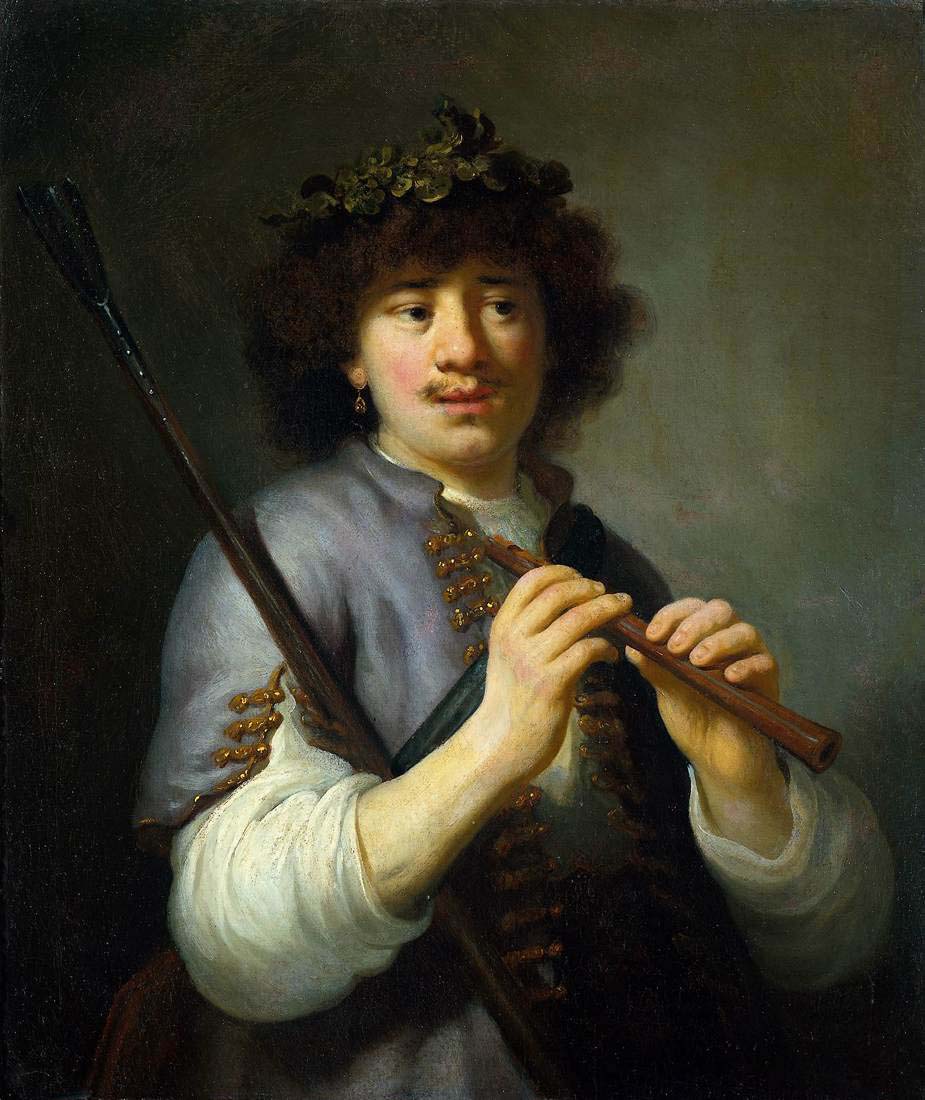
“Rembrandt as Shepherd” (1636) is one of those quietly disarming works in which Rembrandt bends the conventions of self-portraiture to test an idea about identity. He paints himself not as a prosperous Amsterdam artist in a studio but as a pastoral figure, reed flute in hand and staff slanting over the shoulder, crowned with a wreath that hints at Arcadian play. The effect is not masquerade for its own sake. Rather, Rembrandt explores how role, costume, gesture, and sound can reshape the viewer’s understanding of the artist’s inner life. The image turns on a paradox: a young painter—ambitious, urban, and newly established—imagines himself as a shepherd, emblem of simplicity and care. Within that collision of city and pasture, performance and sincerity, Rembrandt discovers a new register of self-knowledge.
Arcadia Meets Amsterdam
The 1630s in the Dutch Republic produced a lively taste for pastoral subjects. Collectors purchased scenes of shepherds and nymphs, musicians resting under trees, and allegories of rustic ease rooted in classical poetry. Rembrandt had already played with this vogue in paintings such as “Flora” and in etchings of peasants and strolling performers. Here he inserts himself directly into the imaginary landscape. The laurel wreath, the flute, and the staff are instantly legible markers of shepherd iconography, yet none of them feel theatrical in a gaudy way. The wreath is modest, the flute a simple wooden pipe, the staff functional. Even the garment—soft violet-gray with braided buttons and a white linen shirt rising at the cuffs—reads as plausible working dress, not courtly costume. Instead of parodying the pastoral, Rembrandt treats it as a serious language in which he can speak about calm, vigilance, and song.
An Experiment In Role-Playing
Rembrandt painted himself constantly across decades, testing faces and costumes to see what they revealed about the self. In 1636 he is in his late twenties, flush with commissions, newly married, experimenting restlessly with persona. The shepherd role allows him to smuggle into self-portraiture themes that a straightforward likeness would not carry. A shepherd guides, protects, and stays alert; he is both humble and responsible; his “studio” is the open field; his “clients” are living creatures. By stepping into that role, Rembrandt suggests an analogy to his vocation. The staff becomes a painter’s mahlstick, the flute a stand-in for the modulated voice of painting, the watchful eyes the instruments of care. The pastoral isn’t escapism; it is a metaphor for artistic stewardship.
A Composition Tuned Like Music
The design is sparing and exact. Rembrandt places his bust three-quarters to the viewer, torso angled left, head revolving gently right so that the gaze floats slightly away, as if listening for a distant response. The long diagonals of staff and flute create a subtle cross, the two lines meeting at the chest where jacket and shirt form a bright hinge. That crossing stabilizes the pose and generates rhythm, as though the body were a musical instrument being tuned. The hands cluster around the flute at the lower right quadrant, their warm, modeled flesh providing a counterweight to the dark, shawl-like shadow unfolding over the left shoulder. The background is a misty gray-brown field that withdraws without a fight, allowing the figure to project forward in space. The whole composition behaves like a lyric, balanced between phrase and refrain.
The Psychology Of A Sideways Gaze
Rembrandt’s eyes do not address us directly; they drift to the near distance. That decision steers the picture away from mere display. We don’t catch the artist preening; we catch him listening—to his own playing, to the imagined flock, to the atmosphere he has conjured. The faint compression at the lips, the small tension at the nostrils, and the focused lids suggest that the ear is in charge. In many Rembrandt self-portraits the eyes dominate; here the ear governs. The painter presents himself not primarily as a seer but as a hearer, attuned to harmony and to the needs of others, a shepherd’s essential skill.
Chiaroscuro As Pastoral Weather
Light enters from the upper left and moves across face, hands, and shirt, leaving the rest in caressing shade. This is classic Rembrandt chiaroscuro, yet it is gentled to suit the pastoral fiction. There is no violent contrast, no prophetic blaze. The light here behaves like the overcast of a northern afternoon thinning to reveal a clear patch. It exposes the textures we most need to feel—the nap of the sleeve, the soft shine of the flute, the fleshy architecture of fingers—then withdraws into silence. As in music, rests matter. The dark background is not ominous; it is the acoustic into which the flute can sound.
The Palette’s Quiet Authority
Rembrandt’s color strategy is restrained and eloquent. The jacket’s violet-gray carries hints of blue and mauve, a cool middle note against which the creamy shirt and ruddy flesh vibrate. Small, warm accents—the brass-like beads that trim the seams, the single earring that glints beneath the wreath, the pink in the cheeks—punctuate the harmony. The laurel leaves, bruised green with touches of dull gold, crown the head with just enough chromatic life to keep the upper register engaged. The wood of the flute, polished but not flashy, threads the whole with a chestnut warmth. Nothing shouts; everything converses.
Hands That Know Their Craft
The hands are marvels of calm articulation. The left supports the pipe with the economy of a practiced player; the right hovers with fingers lifted, ready to land on holes and alter the pitch by a breath. Rembrandt is not interested in dazzling anatomical display; he wants to tell the truth of touch. The knuckles are softly squared, the nails kept short, the skin slightly ruddy where pressure pools. These are painter’s hands masquerading as a shepherd’s, and the masquerade is persuasive because Rembrandt understands how craft settles into a body. The pianist’s hand, the surgeon’s hand, the shepherd’s hand share a poised readiness. He paints that readiness flawlessly.
The Staff And The Ethics Of Watchfulness
The staff slants diagonally past the ear and out of sight, its forked tip just visible above the hat. It signals vigilance and responsibility. Even while playing, the shepherd remains equipped to guide or fend. The choice to keep the staff dark and minimally described prevents it from dominating the narrative. It is present as a moral line more than as a visual star, a reminder that music and care coexist. In this, Rembrandt aligns the image with his broader ethic: beauty must attend to duty; art must be awake to the world.
Costume As Self-Fashioning
The jacket’s braided ornaments and metal buttons flirt with fantasy without abandoning functionality. The shirt’s rolled cuffs create swelling forms that catch and reflect light, a visual echo of breath filling the chest for music. The modest earring, often seen in Rembrandt’s role-play self-portraits, tilts the image toward theatrical self-fashioning—an artist’s delight in props—but it never tips into vanity. The laurel wreath deserves special attention. Classical poets and musicians receive laurel as token of mastery; shepherds in pastoral literature sometimes wear woven greens to honor festivals. Rembrandt fuses the two, suggesting that the artist within the frame is both rustic performer and laureate, both humble and crowned.
Texture, Skin, And The Sensation Of Nearness
Rembrandt’s handling invites the eye to touch. The wreath’s leaves crinkle, matte and irregular; the hair emerges as a loose, frizzy mass that catches highlights; the jacket’s nap absorbs light in tiny, soft bites; the shirt’s linen blooms with faint nubs and wrinkles; the flute gleams with a shell-like polish. The face is painted with the most delicate transitions: warm half-tones around the nose and mouth, a cooler, grayer note under the eye where stubble casts shadow, a tender flush at the ear where blood rises with effort. These minute observations tether the pastoral fiction to physical truth. However lyrical the role, the person remains specific and present.
Sound And Silence In Paint
Because the subject is a musician, the painting teases the viewer into hearing. Rembrandt orchestrates this synesthetic effect with compositional rhythm. The triangle formed by head, hand, and flute reads like a phrase; the staff’s diagonal answers like a countermelody; the wreath and collar, with their repeating shapes, act as trills. The soft, even brushwork in the background is the painted equivalent of hush. Viewers often describe Rembrandt’s work as having “a voice”; here that voice modulates into audible quiet—a low pastoral air that drifts just beneath the threshold of hearing.
Between Portrait And Character Study
Is this a “self-portrait” or a “tronie,” a character study using the artist’s face as a vehicle? The answer is fruitfully ambiguous. Rembrandt signs the work with the authority of a likeness, yet he layers on attributes that belong to an archetype. That doubleness releases the image from a purely biographical reading and invites a more elastic interpretation: the artist is not simply documenting his face; he is confessing a temperament. The shepherd is temperament made visible—watchful, tender, musical, slightly solitary, content in quiet duties. In 1636, as his public acclaim grew, Rembrandt proposes an inward counter-identity to guard against the dangers of noise.
Dialogues With Other Works
This canvas converses with Rembrandt’s theatrical self-portraits in exotic dress, with “Flora,” with the series of musicians and beggars etched in the mid-1630s, and with the pastorals fashionable among his contemporaries. But it also looks forward to the later self-portraits where the costume falls away and only the mind remains. In those late works the shepherd’s watchfulness becomes the painter’s introspection. You can trace a line from the soft, sideward gaze here to the steady, searching stares of the 1650s and 1660s, as if the pastoral role taught the young Rembrandt how to listen to his own interior.
The Ethics Of Modesty
No grand architecture crowds the figure, no landscape unrolls, no allegorical accessory steals attention. The painting’s modesty is the point. Rembrandt honors a scale of life that values attention over display and service over spectacle. To paint oneself as a shepherd is to embrace a hierarchy in which the artist becomes guardian rather than celebrity. The hands are busy, the ear attentive, the face unguarded. In a market culture that celebrated virtuosity, this image argues that the highest mastery may be the art of gentle focus.
Technique And The Discipline Of Edges
Close looking reveals a disciplined play of hard and soft edges. The hat melts into the background on one side and crisps against it on the other, a cue that controls the viewer’s attention. The fingertips are sharpest where they meet the flute, then soften as they recede, summoning a depth of field like a lens. Brushwork tightens at the lips and the glittering earring, loosens in the shadows under the chin, and barely whispers at the far sleeve where form dissolves into atmosphere. Such technical authority supports the pastoral fiction with persuasive realism, enabling the role to read as lived rather than staged.
The Viewer’s Position And Invitation
We stand close—at a conversational distance, roughly at the height of the flute. The musician’s gaze slides past us, which paradoxically draws us in. We can look without feeling looked at, a condition that allows contemplation without defensiveness. The staff points out of the frame toward our space, a subtle bridge between image and world. We are invited not only to observe the shepherd but to overhear and, in the ear’s silence, to bring our own breathing into tempo with his.
Why This Painting Still Feels Fresh
Centuries later, “Rembrandt as Shepherd” speaks easily because it addresses perennial questions: how to hold private attentiveness inside public work; how to reconcile ambition with care; how to let art be a form of shepherding rather than display. The painting’s quiet makes a claim on viewers overrun by noise. It proposes that identity is not a rigid mask but a role explored with sincerity, and that the roles we try on—if chosen wisely—can teach us to live.
Conclusion
Rembrandt’s vision of himself as a shepherd is not a costume party; it is a compact philosophy. In the flute’s poised breath, the staff’s diagonal of duty, the wreath’s modest honor, and the listening gaze, he sketches an ethic for making art and living among others. The composition sings in crossed lines and soft intervals; the color hums in calm harmonies; the modeling of hands and face translates music into paint. Pastoral fantasy meets urban candor, and the result is a portrait of attention—of a young master practicing how to hear the world he will spend a lifetime painting. In the still air of the canvas, we catch a tune that sounds like responsibility made beautiful.