Image source: wikiart.org
Introduction
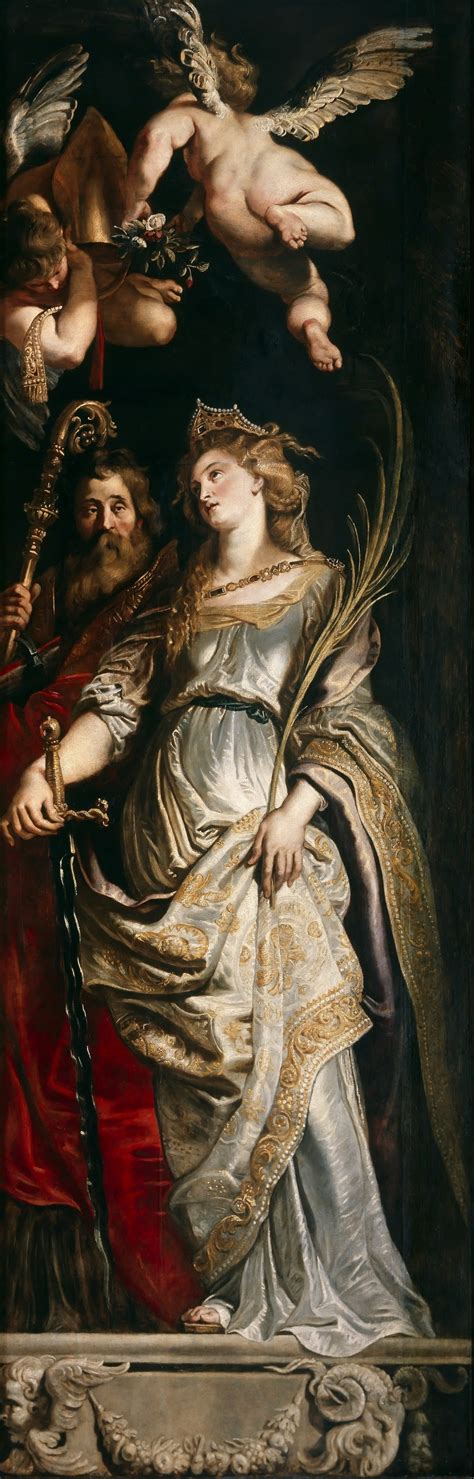
Peter Paul Rubens’s “Raising of the Cross – Sts Eligius and Catherine” (1610) is a slender, soaring panel that reads like a processional banner in paint. It accompanies the monumental central scene of the “Raising of the Cross,” yet it stands securely on its own as a hymn to sanctity, craft, and learned courage. The holy goldsmith-bishop Eligius and the philosopher-martyr Catherine are presented as living statues on a carved stone pedestal, while a gliding angel descends with floral honors. Rubens fuses Roman grandeur with Flemish tactility: silk glows like a poured metal, embroidery catches sparks of light, and faces breathe with poised intelligence. The panel turns biography into choreography, arranging emblems—the crozier, the sword’s broken blade, the martyr’s palm, the goldsmith’s tools—within a vertical theatre where heaven leans close to earth.
Historical Setting and Purpose
Painted in 1610, the panel belongs to Rubens’s triumphant return to Antwerp after a decade in Italy and the first, hope-filled years of the Twelve Years’ Truce. Churches in the Southern Netherlands sought images that would renew devotion and civic pride after conflict. Rubens answered with an altarpiece whose side panels honor local and broadly venerated saints. Eligius, patron of metalworkers and mintmasters, embodied Antwerp’s mercantile craft culture; Catherine, the learned princess who confounded philosophers and accepted martyrdom, stood for wisdom defended by faith. In a port city of guilds, scholars, and merchants, the pair proclaimed a Counter-Reformation ideal: art and intellect, work and witness, joined in harmony.
A Vertical Composition that Celebrates Ascent
The panel is a tall column of motion. Rubens organizes its climb from the carved, scroll-lipped plinth at the base to the hovering putti above. The saints stand in slightly opposed contrapposto: Eligius rooted in red and gold, Catherine gliding forward in shimmering silver. An angel sweeps diagonally across the upper register, its body stretched like a ribbon of light as it tilts a wreath. Everything urges the eye upward. The architecture of the image is devotional: you begin with stone, pass through living figures, and arrive in cloud, as if ascending a spiritual stair.
St Eligius: Craft, Charity, and Office
Eligius wears a bishop’s cope over a cardinal-red tunic that floods the shadows with warmth. The crozier is planted like a staff of office, but Rubens paints it with the same metal-loving care a goldsmith would admire. Eligius’s beard and hair are abundant, framing a face that mixes gravity and benevolence. He is not a courtly mannequin; he is a working bishop who knew the feel of metal, the weight of coins, and the responsibility of guilds. Through subtle cues—traces of tooling on the crozier, the jeweled accents along the vestment, the steady grip of the left hand—Rubens signals a saint who sanctifies labor. In a city of artisans, Eligius is the intercessor who understands the bench, the furnace, and the contract as spaces where holiness can flourish.
St Catherine: Philosophy in Silk
Catherine advances like a column of light. The gown is a marvel of painted textile: a skin of liquid silver shot with golden embroidery that catches the descending illumination in quick, prismatic flashes. She wears a crown that sits lightly on braided hair, its pearls and small stones rendered with a few decisive touches. In her right hand she holds the hilt of a sword whose broken blade signals the instrument of her martyrdom; in her left she lifts the palm, evergreen sign of victory. The famous spiked wheel from her legend is absent, but the swing of the fabric around her hips and the unapologetic step forward supply the energy that wheel would have implied. Catherine’s gaze is lifted—not to evade the world but to read it through a higher light. Rubens gives her elegance without fragility, scholarship without coldness.
The Angelic Attendants and the Theatre of Honor
A vigorous angel, body foreshortened and wings spread, sails across the upper field with a garland of roses. A second attendant peeps over a cloud, ready to celebrate the saints’ virtues. These airborne figures are not decoration; they are liturgical extras who turn the scene into ceremony. Their pink flesh reflects warm tones onto Catherine’s gold trim and Eligius’s red, knitting heaven’s joy to earthly splendor. The tilt of the garland echoes the curve of the crozier and the swoop of Catherine’s mantle, creating a braided rhythm that keeps the vertical panel from feeling stiff.
Light as Blessing and Definition
Rubens’s light falls as if from an unseen clerestory, slanting across silk and metal before collecting on faces and hands. The highlight on Catherine’s sleeve is crisp enough to feel, while the glow along Eligius’s cope softens into a fabric-breath. Shadows are not black voids; they are saturated, warm caverns that preserve color. This chiaroscuro does more than model form. It performs a sacramental logic: grace clarifies what already exists, revealing the beauty of materials and the nobility of service.
Gestures that Teach
The saints’ gestures read like a catechism. Eligius steadies the crozier, a shepherd who guides and guards. Catherine accepts the palm and holds the sword’s hilt, enacting the paradox of Christian victory through suffering. Her foot, just visible at the hem’s break, plants a step that is both dance and declaration. The angel’s lowered wreath leans toward their heads, implying a crown that comes from above rather than from politics or fashion. Rubens’s choreography is precise enough to be legible at a distance and nuanced enough to reward close prayer.
The Plinth and the Idea of the Church
The sculpted base—acanthus leaves curling, masks peering—anchors the holy pair in the built tradition of the Church. Rubens often opposes living flesh to carved stone to suggest grace quickening matter. Here the juxtaposition is affectionate. The stone is not a dead weight; it is a carved memory of classicism baptised for Christian use. The saints stand on the shoulders of a culture that art refines and faith redirects.
Color Harmony and the Baroque Palette
The palette is an elegant chord of silver, gold, red, and flesh. Catherine’s cool gown and warm embroidery play off Eligius’s red and the gold of his cope. The angel’s pink body mediates between the two, while the deep, resinous background keeps the figures forward. Rubens learned in Venice to let color carry emotion. Silver sings of wisdom and clarity; gold proclaims dignity and joy; red breathes charity and courage. The harmony is not loud; it is symphonic.
Texture and the Pleasure of Materials
Rubens is a tactile painter. The silk he gives Catherine is not an abstract sheen; it has weight and nap, catching on the stride of her leg. Gold embroidery is built with translucent glazes that then receive tiny opaque sparks, mimicking brocade’s reflective thread. The crozier flashes where metal is polished smooth and dulls where a craftsman’s hand left micro-scratches. Even the feathers of the angel’s wing hold a mild resistance, as if they would rasp softly if touched. This sensual truth is not mere display. It embodies the doctrine that creation is good and that sanctity does not require contempt for matter.
The Saints as Patrons of Work and Mind
Pairing Eligius and Catherine is an inspired pastoral decision. Together they bless the two great energies of a thriving city: skilled work and learned discourse. Eligius legitimizes the workshop and the mint; Catherine dignifies the schoolroom and disputation hall. At a moment when Antwerp’s economy and Catholic identity needed rebuilding, the message was bracingly simple: holiness attends hammer and pen, bench and book, exchange and argument.
The Counter-Reformation Rhetoric of Clarity
Rubens meets the era’s call for legible, persuasive sacred art with a design that can be “read” instantly. There is no confusing allegorical excess: a crozier for a bishop, a sword and palm for a martyr, a garland from heaven, a pedestal for the Church. Yet within that clarity he maintains psychological and material richness. Eligius’s kindly steadiness and Catherine’s alert confidence keep the panel human. The result is a picture that instructs without scolding and delights without distracting.
Italian Lessons, Flemish Heart
The heroic scale, the camera-like foreshortening of the angel, and the stately posture of the figures show Rubens’s Roman education. The color, the caress of paint on fabric, and the love of things—silk, metal, carved stone—are Flemish. He synthesizes these worlds so cleanly that the painting feels inevitable. Italian grandeur gives the saints public power; Flemish tactility makes them companions for private devotion.
A Processional Image for a Processional City
The panel’s proportions and theatrical stance suggest movement. One imagines it flanking the high altar while guild members in livery pass below with their own metalwork glinting and silk banners lifting in the incense-laden air. Images like this did not merely illustrate, they participated in the liturgy of a city, strengthening bonds among confraternities, workshops, and parishes. The saints’ calm majesty becomes civic instruction: work honestly, study boldly, and accept honor as a trust.
The Sound the Picture Carries
Though silent, the panel suggests sound: the dry jingle of a crozier ring, the whisper of silk against silk as Catherine turns, the wing-swish of the descending angel, the murmur of prayer rising from the nave beneath the plinth. Rubens often paints with the ear in mind. These implied noises humanize the spectacle and place the viewer within the ceremony rather than outside it.
The Viewer’s Vantage and Participation
Rubens positions the viewer slightly below the saints, as one would stand before a shrine. The plinth’s lip meets our eye line, then the figures rise to a height that invites respect without intimidation. The angel’s angle and the wreath’s tilt feel addressed to us as well as to the saints. The panel quietly instructs: lift your gaze, align your step with Catherine’s forward stride, hold your post like Eligius, and accept heaven’s honors as gifts for service, not ends in themselves.
Theology in Small Things
Rubens encodes doctrine in detail. The palm is evergreen, a sign of life that does not wither; the broken blade concedes the limits of force against conviction; the crown is delicate, an earthly honor that sits below the promised one; the embroidery’s vines recall Eucharistic life; the crozier’s curl echoes a shepherd’s hook, the church’s ancient parable of care. These signs require no Latin caption. Their meaning unfolds as the eye lingers.
Technique and the Persuasion of Paint
Rubens likely prepared the surface with a warm ground that glows through the shadows and lends flesh its inner heat. He blocked large areas swiftly—Catherine’s silver mass, Eligius’s red, the stone base—and then modeled forms by driving light into mid-tones, leaving the darkest passages thin and transparent. Final accents—white sparks on embroidery, minuscule pearls on the crown, the catch-light on a knuckle—arrive late to quicken the surface. The panel keeps the vitality of a sketch while wearing the authority of a finished altar picture.
Legacy and Contemporary Resonance
Modern viewers can read the panel without historical footnotes. It honors competent work and courageous intellect, virtues still required in any community that aspires to justice and beauty. It also reminds us that excellence is communal: the goldsmith serves the city, the philosopher serves the truth, and both accept oversight and sacrifice. Rubens’s saints model leadership that is splendid yet serviceable, learned yet kind.
Conclusion
“Raising of the Cross – Sts Eligius and Catherine” is a vertical anthem to sanctity lived in public. Rubens composes a procession of meanings: stone foundations, luminous bodies, instruments of office and witness, and a wreath borne on wings. Eligius steadies the crozier with the calm of a craftsman-bishop; Catherine steps forward in a river of silk, palm lifted, sword’s hilt held without theatricality. Above them, angels turn honor into motion. The whole panel breathes the early Baroque conviction that grace perfects nature—that silk, gold, muscle, and mind can all sing God’s praise. As a companion to the “Raising of the Cross,” it anchors the drama of redemption in the daily heroism of work and wisdom.