Image source: wikiart.org
Introduction
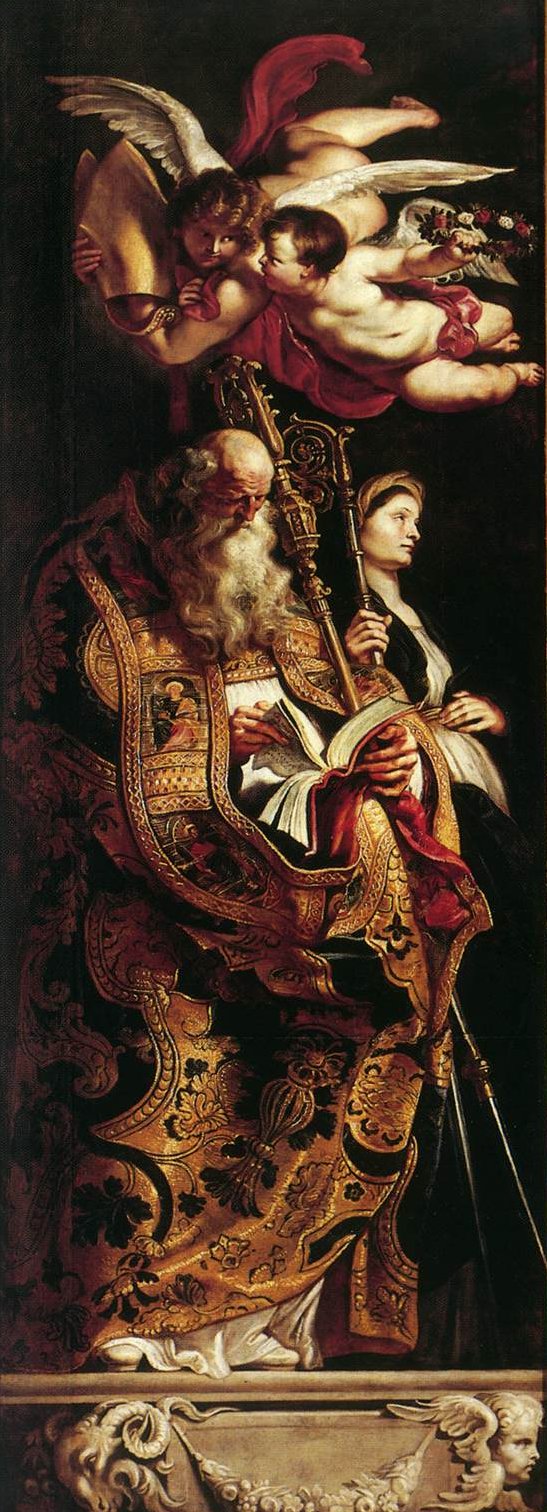
Peter Paul Rubens’s “Raising of the Cross – Sts Amand and Walpurgis” (1610) is a tall, narrow celebration of sanctity, splendor, and learned devotion. It shows a richly vested bishop—St Amand—seated like a monumental sculpture upon a carved pedestal while, at his side, the abbess St Walpurgis stands with grave composure. Above them a cluster of putti sails in on a ribbon of crimson, one bearing a great book, another a garland, while radiant light grazes the saints’ faces and the shimmering embroidery of the cope. The panel belongs to the early Antwerp period when Rubens returned from Italy and, in a single burst, redefined sacred painting for the Southern Netherlands. Here he binds local saints to the triumphal rhetoric of the Baroque, turning fabric, gesture, and architecture into a liturgy of sight.
A Side Panel That Reads Like an Altarpiece
Although this picture accompanies the great “Raising of the Cross,” it functions as a self-contained altar image. Its vertical format and stepped pedestal recall a shrine niche; the saints appear enthroned rather than merely posed. Rubens uses the upward sweep of the composition to guide the eye: from the carved stone ledge with its chimeric heads, through the billowing, gold-sown vestments of Amand, past Walpurgis’s calm profile, and into the rolling cloud where winged children hover. The entire panel behaves like a processional: earthly church below, heavenly court above, the two held together by the bishop’s crozier and the book of prayer and doctrine.
Antwerp in 1610 and the Return of Grandeur
The year 1610 stands at the beginning of the Twelve Years’ Truce. Antwerp, hungry for images that could restore civic and religious confidence, welcomed Rubens home from Rome and Venice. He arrived with a vision in which local devotion could be staged with Roman monumentality and Venetian color. The saints chosen for this panel—missionary Amand, closely linked with Flanders, and the Anglo-Saxon abbess Walpurgis, venerated across the Low Countries—root the grand style in regional memory. The mixture of public splendor and familiar intercessors captures the Counter-Reformation’s strategy: reinforce doctrine, gladden the eye, and make sanctity feel near.
The Architecture of Sanctity
Rubens seats Amand on what reads like a stone cathedra set atop a sculpted parapet. The pedestal’s scrolling heads and foliage are not idle ornament. They declare that the church is built—literally and figuratively—on carved tradition. That material weight steadies the composition so the upper half can burst into motion. The angelic cloud curls forward as if the heavens themselves were leaning over the balustrade to honor the saints. Between rock and cloud, the human figures occupy the mediating zone where prayer, study, and office turn earth toward heaven.
St Amand as Scholar and Pastor
Amand’s presence dominates. His cope is a field of gold brocade, seeded with scrolling vines and framed by narrative orphreys that show tiny sacred scenes. Rubens renders the garment with an intoxicating mixture of strict pattern and living light: the gold threads pick up highlights like little fires; the dark velvets surf underneath in broad, oily swathes. Yet splendor does not eclipse character. Amand’s head inclines toward his book, beard fanning like a soft cloud across the chest; his eyes hold the patient concentration of a reader. One hand steadies the crozier; the other nestles the pages. The bishop is portrayed not only as a prince of the church, but as a theologian—office and study joined in one body.
St Walpurgis and the Feminine Grammar of Authority
At Amand’s right stands St Walpurgis, whose cult was vigorous throughout the Low Countries. Rubens gives her the bearing of an abbess: modest wimple, simple but weighty garment, and a staff that echoes the bishop’s crozier while remaining distinct. Her face, turned toward the light, combines alertness with restraint. She is neither sentimental nor severe; she is a guardian of memory and a guide for souls, a feminine counterpart to Amand’s learned gravity. The pairing indicates harmony between episcopal governance and monastic wisdom. Even in the narrow format, Rubens allows a subtle dialogue: Amand’s attention bends to the book, Walpurgis’s to the horizon—study complemented by watchfulness.
Angels, Book, and Garland: The Iconography of Praise
Overhead, putti move with the quickness of windblown banners. One presses a monumental book to his chest, the other extends a garland of roses. The book signifies doctrine and preaching—the written tradition in which both saints labored—while the garland signals the church’s honor for their virtue. The flying crimson drapery stitches the upper group together and throws warm reflections onto Amand’s cope. Angels in Rubens rarely sit idle; here they serve as liturgical attendants, bearing the symbols that crown the saints without cluttering the stage.
Light as Benediction
The light is selective and sacramental. Much of the background remains a mature darkness that reads as church interior or night sky, but the saints bask in a warm, directional radiance. It slides along the cope’s gold, licks the polished crozier, and sets Walpurgis’s profile aglow. The illumination seems to rise from the lower right and fold back across the figures, creating a pendulum between contemplation (the book) and proclamation (the angels). Rubens learned in Venice how light can feel like touch; here it lays hands upon vestments and skin with benedictory tenderness.
The Cope as Painted Tapestry
Few painters make fabric speak like Rubens. The cope is a moving tapestry—emblems, medallions, curls of foliage, and broad, dark reserves of velvet bloom under a net of gold. He paints with layered glazes to simulate the reflective threads, then caps them with neat highlights where the embroidery catches the strongest light. The edge of the garment lifts in a little wave over the pedestal, as if the fabric had weight and breath. Iconographically, the cope’s garden of motifs—vines, flowers, leaf scrolls—suggests the flourishing of the church under saintly care. Sensuously, it rewards the eye like a piece of real embroidery brought inches from the viewer.
The Crozier and the Staff: Two Modes of Care
Amand’s crozier, intricately worked, curves like a shepherd’s hook—the classic sign of pastoral care. Walpurgis’s staff, straighter and simpler, suggests governance within the rule of a house. The parallel lines glue the pair together visually, but Rubens is careful to differentiate authority without hierarchy: both staffs are held with calm assurance, neither threatening nor timid. This quiet grammar of leadership resonates with the panel’s larger tone. The saints do not command by spectacle; they persuade by wisdom and steadiness.
Carved Stone and Living Flesh
Rubens sets living bodies against carved heads at the base to draw a subtle contrast between the animated and the made. The grotesques peering from the parapet snarl and grin, reminders of the pagan and the bestial subdued by the Church’s foundation. Above them, the saints’ faces breathe. That contrast intensifies the sense that grace humanizes, that a life given to prayer, study, and service acquires softness and authority beyond stone’s hard eloquence.
The Baroque Vertical and the Viewer’s Devotional Climb
The composition asks the eye to climb. Starting at the pedestal, the gaze ascends the cope’s great fields, rests on the book, meets Walpurgis’s attentive face, touches the crozier’s crook, and then leaps into the angelic cloud. This ascent mirrors the viewer’s devotional path: from material support (church, sacraments, community) to the exemplars (the saints), and finally to praise. The panel thus acts as a ladder, each rung a different texture, until the gilded pages of the heavenly book meet the earthly codex in Amand’s hands.
Italian Lessons, Flemish Warmth
The heroic scale and swelling drapery descend from Roman altarpieces; the glow in the gold and the generosity of texture belong to Venice; and the tactile persuasion of surfaces—brocade, paper, hair, carved stone—is distinctly Flemish. Rubens synthesizes these schools so completely that the panel feels both grand and intimate. One experiences the saints as near, not remote: the book’s edge lies almost within reach; the cope’s fringe seems to rustle if one leans closer.
Theology Made Visible in Gesture
The saints’ gestures carry doctrine. Amand’s bowed head over the text expresses submission to tradition. Walpurgis’s open, slightly forward posture suggests readiness to serve. The angels’ forward-tilting bodies, book pressed and garland extended, indicate that heaven honors learning and virtue together. No inscriptions are necessary. The painting is its own teaching: holiness grows where study, office, and charity are braided.
The Color Chord: Gold, Black, White, and Rose
Rubens tunes the panel to a restrained but sumptuous chord. Gold dominates, laid over deep black with greenish undertones; white appears in pages and linen, cooling the blaze; flesh is warmed with rose, especially in the putti, whose color then rises into the crimson drapery. The balance avoids monotony. Gold’s wealth is chastened by black; warmth is governed by intellect (the white pages); fleshly cherubs carry their color upward into a banner of praise. The palette’s harmony mirrors the harmony of earthly and heavenly orders.
A Work Made for Procession and Prayer
Viewed in its original ecclesial context, this panel would have framed the central drama of the Cross with the steadfastness of local patrons. Processions, feast-day sermons, and daily devotions would all read the panel as a living reliquary, a reminder that regional history and universal salvation interlock. Rubens’s ability to make saints feel both stately and approachable served parish needs perfectly: the faithful could recognize their protectors and feel their dignity.
The Sound the Picture Makes
Though silent, the painting hums with implied sound: the faint rasp of pages turned; the heavy whisper of brocade; the crisp flutter of the angels’ banner; the soft consonant of murmured prayer. This imagined soundscape slows the viewer’s eye and keeps the contemplation near. Rubens often uses sensory cues to deepen piety; here, touch and sound enter through sight so that the panel is not merely seen but “felt.”
Contemplation Versus Action and the Balance Struck
Amand’s absorption in the book represents the contemplative life; Walpurgis’s outward look and staff symbolize active service. The angels crown both. Rubens refuses to rank one path over the other. Instead, he shows how the church breathes with two lungs: interior study and exterior charity. That balance is not a doctrinal footnote; it is the painting’s emotional center. The viewer leaves with an image of sanctity that is learned, beautiful, and useful.
Technique and the Persuasion of Paint
Rubens builds forms with a warm ground, drives the darks deep, and then brings light forward in elastic, confident strokes. The gold of the cope is achieved through transparent layers punctuated by opaque sparks; the flesh is modeled wet-into-wet so transitions read as living circulation; the putti’s wings are dashed in with creamy touches that retain the mark of the brush. Nothing is over-finished; everything breathes. That breath is the secret of the panel’s persuasiveness: the saints are not specimens but presences.
Enduring Appeal and Contemporary Relevance
Modern viewers, even at a distance from the panel’s original cult, can feel its argument: wisdom and care, scholarship and service, are beautiful. The painting dignifies reading, governance, and praise—the unglamorous disciplines by which communities endure. It also dignifies materials: cloth, paper, metal, stone become sacraments of meaning in a culture that still finds truth through touch and attention.
Conclusion
“Raising of the Cross – Sts Amand and Walpurgis” is a hymn in gold to steadfast holiness. Rubens composes a vertical procession where carved stone grounds, shimmering vestments sing, faces think, and angels lean in to honor the work of study and rule. The saints are not remote ideals but companions stationed at the church’s threshold, book and staff ready. In 1610 Antwerp, such an image steadied a city learning to hope again; today it still steadies the eye, teaching that beauty and wisdom, humility and authority, can live together on the same luminous page.