Image source: wikiart.org
Introduction
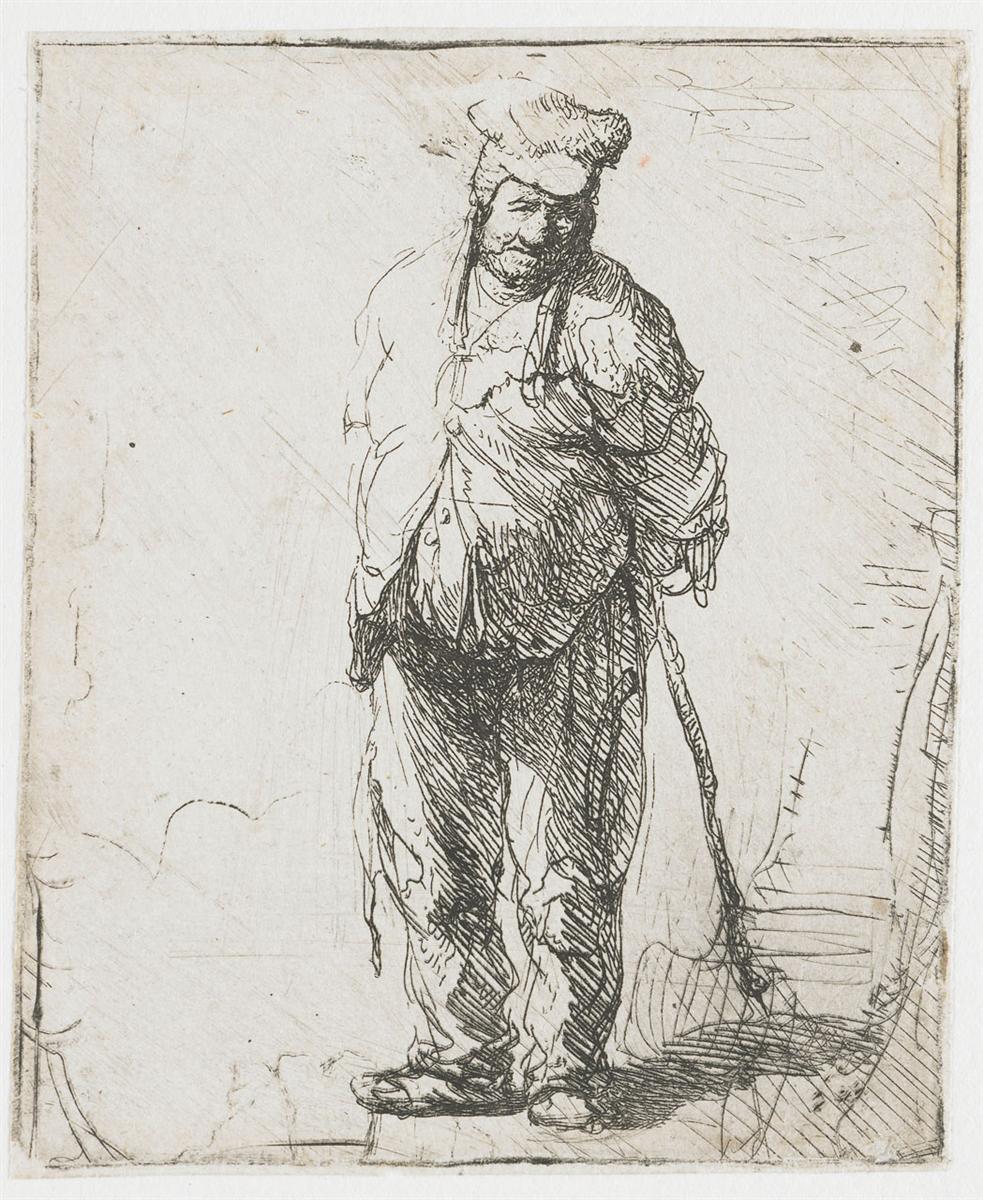
Rembrandt’s “Ragged Peasant with His Hands Behind Him, Holding a Stick” (1630) distills a life into a handful of lines. The figure stands slightly off-center, head tilted, shoulders slumped under a loose shirt and patched trousers. Hands slip behind his back while a long staff angles from the right, touching ground in a small wedge of shadow. The air around him is mostly untouched paper, a pale field that works like weather—cool, open, and without judgment. In this compact etching from Rembrandt’s Leiden years, the young master demonstrates how economy can equal eloquence, turning an ordinary pause in the street into a complete drama of balance, self-possession, and endurance.
Historical Context
The year 1630 places the print among a cluster of small etchings in which Rembrandt explored anonymous figures—beggars, peasants, elders—alongside biblical scenes. These sheets circulated among collectors who prized virtuoso drawing and scenes of everyday life. Rather than use such subjects as moral caricatures, Rembrandt approached them as problems of posture, light, and feeling. His beggar suite of 1629–1630—men with wooden legs, couples conversing, figures warming hands at a chafing dish—constitutes a humanistic atlas of ordinary adjustments to cold, fatigue, and ground. The present image belongs to this series but adds a distinctive note: the stance of someone who rests by placing both hands behind the back, letting a stick do part of the work while the mind wanders.
The Etching Medium and the Vocabulary of Marks
Etching records the speed and pressure of the hand with uncanny accuracy. A needle scratches through a wax ground onto copper; acid bites the exposed lines; ink clings to those bites and prints onto paper. Rembrandt uses this responsiveness to assign different “dialects” of line to different materials. The hat is built from soft, rounded strokes that read as worn cloth. The hairline and beard flicker in short, wiry touches. The shirt collects in small folds, rendered by broken curves and gentle cross-hatching. The trousers descend in long, gravity-aligned strokes whose density maps weight. The stick is a decisive contour with a slight thickening near the tip, as if polished by use. Each mark contributes literal texture and, more importantly, lived plausibility.
Composition and the Architecture of Balance
The composition is simple, but the arrangement of masses and voids is exact. The figure occupies the central vertical band while the right half of the plate remains open, a pale arena into which the staff extends. A strip of ground beneath the feet, darkened with quick parallel hatchings, secures the stance. At lower right, a few angled lines sketch the edge of a step or curb, a modest architectural note that keeps the body from floating. The head tilts toward the left, counterbalancing the forward slant of the stick. The result is an image that feels poised between rest and movement, as if the next step were possible but not yet required.
Gesture and the Psychology of the Pose
Hands clasped behind the back is a posture that complicates a reading. It is neither supplication nor defiance. In this sheet it reads as pragmatic rest and quiet attention. The shoulders round; the chest softens; the spine bows slightly; the chin drops as the eyes look out from under the hat’s low rim. The body’s angles imply a familiar street habit: shift weight to one leg, hook fingers in the other hand, let the stick take pressure off the knee, and watch the world. Without overt emotion, the pose communicates self-containment. It is a social stance that neither invites nor rejects contact, and it is precisely this neutrality that allows the viewer to linger.
Clothing as a Ledger of Use
Rembrandt’s treatment of garments avoids caricature while recording wear. The shirt gathers in bunches at the shoulder and elbow, the fabric indicated by short, repeated strokes that sag with gravity. The trousers carry patches suggested by discontinuities of line and sharp zigzags near stress points. A ragged hem at the left leg is registered with quick serrations. The shoes are flattened and wide, as if soaked and dried many times. None of this is theatrical. It is descriptive truth that endows the figure with a history. Viewers can read the clothes the way one reads a map: here is strain, here repair, here habit.
The Stick as Axis and Biography
The stick is more than prop. It is a portable architecture that makes the pose possible. Its diagonal introduces the only strong linear thrust in a scene composed mostly of curves and droops. It touches down in a small patch of shadow that anchors the entire composition. The staff’s slight bend and the variation of pressure along its length imply age and use—details that expand the figure’s biography without a word. In Rembrandt’s beggar etchings, tools like staffs, crutches, and wooden legs are as eloquent as faces; they announce a person’s ongoing negotiation with the world.
Light, Paper White, and the Breath of Space
Because etching constructs darkness and leaves light as bare paper, the vast pale field around the peasant is crucial. It does not indicate “nothing,” but air—the space of a street, the distance to the next wall, a patch of sky. Rembrandt leaves the upper half almost untouched, save for a few exploratory scratches that behave like drifting cloud. The brightest white concentrates around the figure’s front, especially between stick and leg, which makes the silhouette sharp and the stance legible. Light, in this print, is not a beam but a permission: an allowance of space in which the man can stand.
The Face and the Ethics of Reserve
The head is drawn with sparing means: a bent line for brow and nose, a small pocket of dark for the eye, a few hooked strokes for a mustache, and soft scribbles under the chin. The hat’s edge casts a shallow shadow that helps the features cohere. This restraint is ethical as much as stylistic. It keeps the peasant from becoming a comic mask and preserves privacy. The viewer senses mood—fatigue, patience, mild curiosity—without being asked to judge or pity. The image’s dignity comes from this reserve.
Minimal Setting and Implied Street
A handful of lines at lower right and left, and a small cluster at the top edge, are enough to hint at a built environment: perhaps a doorway, a stair, a canal edge. The plate refuses anecdotal detail, preferring to keep the scene open-ended. This minimalism is not a lack but a decision. The street is not the subject; the way a person occupies the street is. The emptiness around the figure also allows contemporary viewers to project their own city edges onto the scene, making the image perpetually current.
Relation to the Beggar Suite
Seen alongside “A Beggar with a Wooden Leg,” “Beggar Leaning on a Stick, Facing Left,” and “Beggar Seated Warming His Hands at a Chafing Dish,” this print adds a new verb to Rembrandt’s lexicon: waiting. The others are about walking, balancing, and warming; here the drama is the held moment between one errand and the next. In all cases, the artist takes actions that anyone might overlook and gives them the same compositional seriousness he grants to saints and scholars. The suite, taken together, argues that the human condition is articulated as much by small adjustments as by grand gestures.
Printing Variants and Atmospheric Mood
Impressions of early Rembrandt etchings can differ markedly. A plate tone left on the surface may gray the field, wrapping the figure in damp weather; a clean wipe makes the paper blaze, sharpening the silhouette and cooling the mood. Heavier inking deepens the trouser shadows and ground; lighter inking brightens the shirt’s crumples and the sparkle along the stick. These options allow the same copperplate to register different days in the peasant’s life—foggy morning or crisp noon—without altering a single line.
The Sound of the Image
Look long and the sheet becomes audible. The quick hatchings at the ground whisper like scuffed leather; the stick taps; the shirt rustles; the empty field hums with quiet. Rembrandt orchestrates this “sound” by varying line length and density. He slows the eye along the heavy trousers, speeds it across the staff, and stills it in the open paper. The resulting tempo matches the figure’s state: a calm pause tuned to the street’s background murmur.
Humanism Without Sentimentality
Seventeenth-century artists often depicted poor people as comic foils or moral warnings. Rembrandt does neither. His peasant is not a punchline, nor is he a sermon. He is a person attended to with exactness. The respect lies in the drawing: in the honest rendering of posture, in the faithful description of worn cloth, in the decision to leave the face understated. This humanism—attention without agenda—gives the print its modernity and its persisting warmth.
Lessons for Draftsmen and Designers
The sheet doubles as a compact manual. To convey weight, align hatchings with gravity and vary their spacing to suggest compression and release. To separate textures, assign each material a distinct mark language—wiry for hair, soft for cloth, firm for wood. To anchor a figure, draw only a sliver of ground; let suggestion do the rest. To push a silhouette forward, place a small wedge of dark behind one contour and leave the opposite side open as paper white. Above all, stop before the page is full. The most expressive element here is the silence of the background.
Comparisons with Painted Contemporaries
In paintings from the same period—such as “Jeremiah Mourning over the Destruction of Jerusalem” and “Old Woman in Prayer”—Rembrandt turns light into moral atmosphere. The etchings achieve a parallel effect with nothing but line and white paper. Where paint offers glow and impasto, the print offers tempo and reserve. The continuity across media confirms the artist’s core belief: the drama of a life can be told without props if posture and light are true.
The Viewer’s Role and the Ethics of Looking
This etching expects the viewer to come near. Its small scale requires face-to-face distance, the sort of nearness used for conversation. That proximity creates an ethical demand: to look without prying. Rembrandt meets that demand by protecting the peasant’s privacy through restraint—no exaggerated expression, no intrusive detail—while giving us enough truth to honor his presence. The best response is a kind of quiet companionship.
Enduring Resonance
The image endures because it records a universal interval: pausing on a street, weight shifted, mind briefly unmoored from obligation. The staff stands in for any implement that steadies us; the ragged clothing for any life that has absorbed weather; the blank air for the hours between tasks. In the hands of a lesser artist, the subject might shrink. In Rembrandt’s, it expands—until the ordinary pause feels like a permanent part of human time.
Conclusion
“Ragged Peasant with His Hands Behind Him, Holding a Stick” proves how far a few lines can go when guided by sympathy and rigor. The figure’s stance is a geometry of experience: shoulders rounded by work, hands tucked for rest, a staff angled as a modest architecture of support. Around him, paper white breathes; under him, quick hatchings secure ground. The print neither flatters nor indicts. It attends. And in that attention the peasant becomes more than a type—he becomes a person, present in our space, sharing a moment of stillness that we recognize as our own.