Image source: wikiart.org
Introduction to Psyche Taken up into Olympus
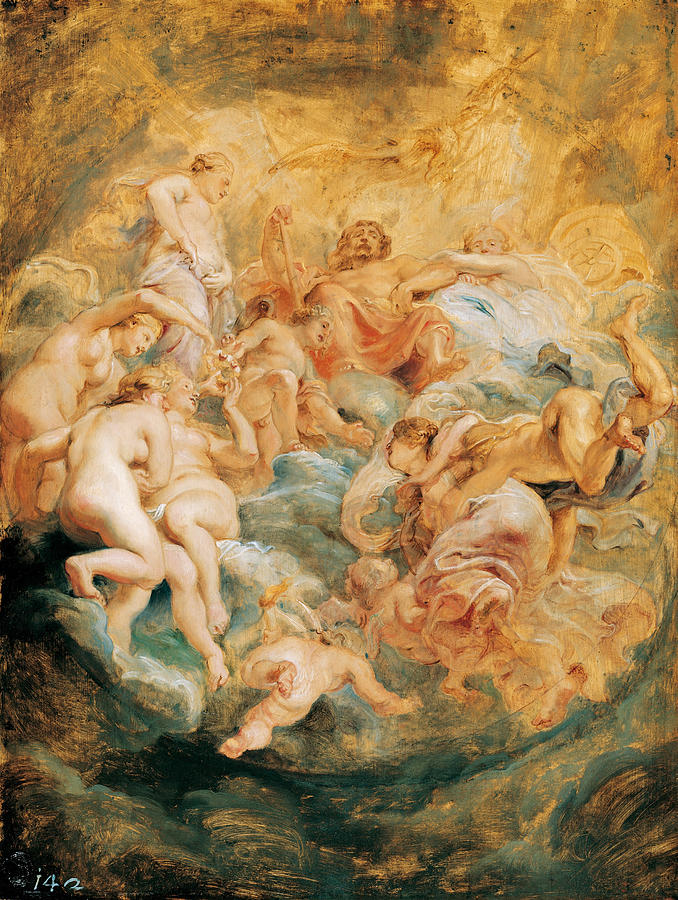
“Psyche Taken up into Olympus” by Peter Paul Rubens is a radiant visualization of one of antiquity’s most beloved love stories. Rather than showing the hardships and trials that fill the tale of Cupid and Psyche, Rubens concentrates on its triumphant conclusion: the moment when the mortal Psyche is accepted into the company of the gods and granted immortality.
The canvas is a whirl of clouds, bodies, and golden light. At the center, Psyche and Cupid are surrounded by a crowded ring of deities and attendants, all caught in a spiraling movement that seems to lift them heavenward. The painting combines Rubens’s signature qualities—full-bodied figures, dynamic poses, and vibrant color—into a compact yet exuberant vision of divine celebration.
The Mythic Background: From Trial to Triumph
In the classical story, Psyche is a mortal princess whose beauty is so dazzling that people neglect the worship of Venus. Enraged, the goddess of love orders her son Cupid to make Psyche fall in love with a monstrous creature. Instead, Cupid himself falls for Psyche and hides her in a secret palace, visiting her only at night and forbidding her to look upon his face.
Through a mixture of curiosity and deception, Psyche eventually disobeys, glimpses Cupid, and loses him. To win him back, she must undergo a series of impossible tasks imposed by Venus—sorting seeds, fetching golden wool, descending into the underworld. With divine assistance she succeeds, but not without nearly losing her life. In the end, Jupiter intervenes, grants Psyche immortality, and legitimizes her marriage with Cupid on Olympus.
Rubens chooses to depict this final apotheosis. All the suffering, labor, and separation are left behind. What we see is the soul (for “Psyche” also means “soul” in Greek) arriving at its destination, surrounded by divine approval. The scene is at once mythological and allegorical: the elevation of a woman and the glorification of the soul united with divine love.
Overall Composition: A Heavenly Whirlpool
The composition of “Psyche Taken up into Olympus” is one of its most striking features. Rubens organizes the figures and clouds into a rotating oval that fills the center of the canvas. Around this oval the gods and nymphs cluster like petals around a flower, their limbs and draperies echoing the circular motion.
The movement is primarily clockwise. Our gaze begins at the lower left, where a group of nude female figures crouch and lean, then rises across the central zone where Psyche and Cupid appear, and finally reaches the upper right, where Jupiter sits in golden light with his eagle and chariot. The eye then loops back down along the right-hand figures and cherubs, completing the visual circuit.
This swirling arrangement gives the impression that Olympus itself is in motion, as if the entire assembly of gods is rising or turning in celebration. There is no fixed architecture or rigid horizon to anchor the scene. Instead, clouds, light, and bodies all participate in a kind of celestial dance. Psyche is literally taken up by this collective movement, swept into the center of divine life.
The Figure of Psyche: The Soul Glorified
Psyche occupies the luminous heart of the painting. Rubens portrays her in a twisting, upward-reaching pose, caught between standing and floating. Her torso turns toward Cupid and the gods, one arm lifted, the other extended, as if she is both accepting an invitation and balancing herself in mid-air.
Her body is painted with the creamy, glowing flesh tones typical of Rubens’s female nudes. The light caresses her shoulders, thighs, and belly, making her appear almost translucent against the cooler blues of the surrounding clouds. Unlike some of the other women, who are partially draped, Psyche is almost entirely nude. This lack of ornament underscores the symbolic idea of the soul stripped of earthly encumbrances, presented in pure beauty before the gods.
Yet Psyche is not anonymous. Her pose and expression convey a distinct emotional state: surprise mixed with joy, humility combined with a growing sense of belonging. Her gaze is directed toward the upper gods rather than downward toward the world she has left. Rubens thus captures her in the act of transition, no longer fully mortal, not yet entirely at home in Olympus but already bathed in its light.
Cupid: Guide, Lover, and Link Between Realms
Close to Psyche is Cupid, easily recognizable by his wings and youthful form. Rubens portrays him slightly smaller than Psyche but full of energy, his body leaning toward her, hand reaching out as if to steady or welcome her. In many depictions of the story, Cupid is the one who pleads with Jupiter to grant Psyche immortality; here he appears as both advocate and companion.
Cupid’s presence is crucial. Without him, Psyche’s ascent might seem purely a reward for virtue or suffering. With him, the emphasis falls on the power of love to bridge the gap between mortal and divine. His winged body also acts as a visual mediator between the human softness of Psyche and the more authoritative forms of the gods above.
Rubens gives Cupid the same warm flesh tones and dynamic pose he uses for his putti, but Cupid’s expression is more focused and personal. His attention is entirely on Psyche, making clear that this apotheosis is not a solitary achievement but the consummation of a relationship.
Jupiter and the Olympian Court
At the top of the composition sits Jupiter, ruler of the gods. Rubens wraps him in a rich red-orange drapery that billows across his lap and shoulders, a color that instantly marks him as the figure of highest importance. He holds a scepter, symbol of authority, and his eagle and chariot appear near him as familiar attributes.
Jupiter’s posture is relaxed but commanding. He leans forward slightly, arm raised in what can be read as a gesture of acceptance or proclamation. His gaze seems directed toward Psyche, acknowledging her new status. The light around him is particularly intense, with golden hues almost dissolving the boundaries between his figure and the sky.
Around Jupiter cluster other gods and attendants, though Rubens does not individuate each one with clear attributes. Instead, they read as a chorus of divine witnesses, their bodies interwoven with clouds and each other. Some lean in to observe Psyche, others appear in conversation, all contributing to the sense that the whole of Olympus is engaged in this event.
The Surrounding Nymphs: Sensual Chorus of Olympus
One of Rubens’s trademarks is his ability to populate scenes with a multitude of lively secondary figures. In this painting, the surrounding nymphs and goddesses form a sensual chorus that enriches the central narrative.
At the lower left, several nude women kneel and bend across the cloud bank. Their bodies are painted with voluptuous curves, dimpled skin, and subtle variations in skin tone that give each figure individual presence. One leans forward to greet a cherub; another turns her back toward us, creating a bold display of hips and shoulders that anchors the composition.
On the right, additional female figures stretch and twist in complex poses. Some are partially draped in soft pink or orange fabrics that catch the light, adding flashes of color that echo Jupiter’s robe and Psyche’s glowing skin. These women mirror Psyche’s physical fullness, yet they occupy a slightly more shadowed zone, ensuring that she remains visually dominant.
The effect of these groups is twofold. They underline the lushness and sensuality of Olympus, a realm overflowing with physical beauty. At the same time, their varied gestures and directions of gaze guide the viewer’s eye toward the central event, acting as visual signposts that all point back to Psyche’s ascent.
Putti and Emblems of Celebration
Scattered throughout the composition are small winged putti, the playful spirits that populate so many of Rubens’s mythological and religious works. Here they function like celestial acolytes in a joyous ceremony.
One putto tumbles near the lower center, arms flung out, body twisting in mid-air as if caught up in the same vortex that lifts Psyche. Another appears near the center, perhaps presenting a wreath, a bouquet, or a symbolic object of honor. Their chubby, energetic forms punctuate the swirling movement and add a note of exuberant innocence to the scene.
These putti also help to bridge scale and perspective. Their small bodies contrast with the larger gods and nymphs, adding depth and variety. They emphasize that Olympus is not a static assembly of solemn beings but a lively, multi-layered world filled with different kinds of celestial creatures.
Color Harmony and the Glow of Olympus
Color plays a central role in establishing the mood of “Psyche Taken up into Olympus.” The upper part of the painting is suffused with gold, created through warm yellows, ochers, and touches of orange applied in loose, sweeping strokes. This golden atmosphere suggests divine radiance rather than ordinary sunlight; it is the visual equivalent of heavenly glory.
Against this warm field, the blues and turquoises of the clouds stand out, especially in the central band where Psyche and the surrounding figures hover. These cooler tones provide a refreshing contrast and prevent the painting from becoming overwhelmingly hot in color. They also create a sense of depth, as if the figures are floating on layers of soft vapors.
Rubens intersperses accents of red and pink—Jupiter’s robe, the draperies around some nymphs, faint blushes on cheeks and limbs—throughout the composition. These touches knit the figures together chromatically and echo the theme of love that underlies Psyche’s story. The flesh tones are rendered with Rubens’s typical richness, using subtle variations of rose, ivory, and ocher that give a convincing sense of blood and warmth beneath the skin.
Brushwork and the Sense of Spontaneity
The surface of the painting reveals Rubens’s energetic handling of paint. Figures are modeled with confident strokes, while backgrounds and clouds are often loosely indicated. In the golden sky, individual brush marks remain visible, moving in different directions like gusts of wind. This visible brushwork adds to the feeling that the scene is in flux, as if the paint itself participates in the swirling movement.
Edges are often soft rather than sharply defined. Limbs dissolve into surrounding light, folds of drapery blur into clouds, and hair blends with the background. This softness suggests motion and atmosphere, allowing the viewer’s imagination to complete the forms. It also reinforces the idea that Olympus is not a solid, earthly place but a shimmering, intangible realm.
The painting’s sketch-like quality may indicate that it served as a preparatory modello for a larger work or decorative scheme. Even so, the evident spontaneity has its own charm. It feels as though we are seeing Rubens’s imagination at full speed, laying down the essential rhythms of the scene with minimal hesitation.
Allegory, Spiritual Resonances, and Baroque Sensibility
Although the subject is drawn from pagan mythology, the painting resonates with broader spiritual ideas meaningful to Rubens’s contemporaries. Psyche’s name and her upward journey naturally invited allegorical interpretation. Viewers could see in her ascent a metaphor for the soul purified by trials, raised by divine grace, and admitted to eternal happiness. Cupid, as divine love, becomes the force that ultimately secures this elevation.
This allegorical reading aligns with Baroque spirituality, which often used intense emotion, dramatic transformation, and sensory richness to express religious truths. Just as saints in Baroque altarpieces swoon in ecstasy or rise toward beams of light, here Psyche is swept toward a radiant Olympus. The difference is in vocabulary—classical rather than explicitly Christian—but the underlying sense of transcendence is similar.
At the same time, the painting fully indulges the Baroque delight in the physical world. The bodies are soft and substantial; the clouds and fabrics are tangible; the colors luxuriate in warmth and contrast. The spiritual meaning does not negate the sensuality of the scene but works through it, suggesting that beauty and pleasure, rightly ordered, can be part of divine joy.
Emotional Impact and Viewer Experience
For viewers, “Psyche Taken up into Olympus” offers a layered experience. On an immediate level, it is a feast of motion and color: swirling clouds, intertwined figures, and radiant light create a sense of continuous movement that draws the eye around the canvas. The viewer feels almost swept into the vortex, sharing in the exhilaration of Psyche’s ascent.
On a more reflective level, the painting invites contemplation of transformation and acceptance. Psyche is not portrayed as a distant, unreachable goddess; she is a once-mortal woman whose story includes suffering, doubt, and perseverance. Seeing her now welcomed by the gods evokes feelings of relief and satisfaction, as if the universe has finally been set right.
The work also communicates a communal sense of joy. Unlike solitary visions of apotheosis, Rubens’s Olympus is crowded and sociable. The gods gather not only to witness but to participate in the celebration. This sense of collective rejoicing can resonate with viewers as an image of belonging: the soul not only saved or exalted, but fully integrated into a joyous community.
Conclusion
“Psyche Taken up into Olympus” distills the essence of Rubens’s mythological art: dynamic composition, sumptuous bodies, luminous color, and an underlying narrative of passion and transformation. By choosing the moment of Psyche’s glorification, Rubens emphasizes hope and fulfillment rather than trial and suffering.
The painting invites us into a world where divine and human are intertwined, where love can bridge the gap between mortality and immortality, and where the soul’s journey finds its culmination in a realm of overflowing beauty and shared joy. Through swirling clouds and glowing flesh, Rubens gives visual form to the idea that the end of the story is not tragedy but radiant acceptance.