Image source: wikiart.org
First Impressions and the Moment of Arrival
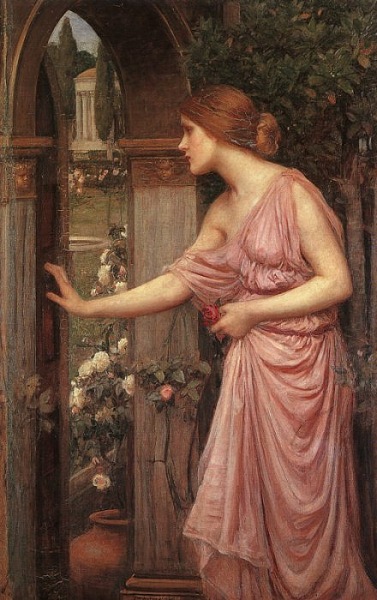
John William Waterhouse’s Psyche entering Cupid’s Garden captures a turning point that feels both intimate and ceremonial. Psyche is not shown in the middle of a grand mythic spectacle but at the threshold of one, caught in that suspended instant when curiosity becomes action. The scene is quiet enough to hear: the soft slide of fabric, the careful placement of a hand against a doorway, the near-silent hush of a hidden garden. Waterhouse builds the drama through restraint. The painting’s energy comes from anticipation rather than movement, from the sense that Psyche is stepping into a space charged with consequence.
The title frames the subject as an entrance, and Waterhouse treats “entering” as an emotional state. Psyche’s body leans forward, yet she remains composed. She is not rushing, not recoiling. Her posture suggests a delicate negotiation between desire and caution, a choice to cross into beauty that might also be danger. This is one of Waterhouse’s lasting gifts as a storyteller: he makes myth feel like an inward decision, something that happens inside the body before it happens in the plot.
The Myth Behind the Image
The story of Cupid and Psyche, best known through Apuleius’ Metamorphoses (also called The Golden Ass), centers on love tested by secrecy, jealousy, and trials. Psyche, a mortal of extraordinary beauty, becomes the object of Venus’ envy and is bound by fate to a mysterious husband she cannot see. Their relationship is shaped by an agreement that is also a temptation: she may be loved, protected, and surrounded by splendor, but she must not look too closely, must not demand proof in the form of sight. The myth turns on thresholds, doors, and forbidden knowledge, which makes Waterhouse’s choice of an entry scene feel especially apt.
By depicting Psyche at the boundary of Cupid’s garden, Waterhouse emphasizes the myth’s central tension: the pull between surrender and understanding. A garden is a traditional emblem of pleasure and enclosure, but it is also a place of rules. In many stories, gardens are curated paradises, spaces where nature is shaped into an ideal that can feel both comforting and controlled. Psyche’s entrance becomes a symbolic crossing into love’s promise and love’s constraints at once.
Waterhouse in 1903 and His Late Style
Painted in 1903, this work belongs to Waterhouse’s mature period, when his reputation as a painter of poetic heroines and mythic narratives was firmly established. By the early twentieth century, the world around him was changing quickly. Modern art was pushing into new directions, and Victorian certainties were giving way to more ambiguous moods. Yet Waterhouse continued to refine a personal language that blended classical subject matter with a tactile realism and an unmistakable romantic atmosphere.
In this painting, the late style is evident in the controlled composition and the sensuous handling of materials. Waterhouse avoids spectacle and instead focuses on mood, texture, and psychological nuance. The figure is rendered with warmth and solidity, while the setting is built from layered browns, greens, and muted stone tones that create a sheltered world. The result is a scene that feels timeless but also quietly modern in its emphasis on inner feeling.
Composition and the Architecture of a Threshold
The composition is structured around a doorway-like opening and the vertical frame of architecture. Waterhouse turns this into more than a background element. It becomes the painting’s spine, the literal and metaphorical boundary between Psyche and what lies beyond. Psyche occupies the right side of the canvas, anchored by the curve of her shoulder and the weight of draped fabric. The left side opens into a glimpse of the garden and distant architectural forms, suggesting depth and invitation.
Psyche’s outstretched arm creates a bridge between her body and the threshold. Her hand presses gently against the surface, as if testing whether this world is real or permitted. That gesture is crucial. It is not a dramatic clutching or a forceful push. It reads as careful contact, an expression of hesitation that is also yearning. Waterhouse composes the figure so that her forward movement is checked by the frame. The painting holds her in that tension, inviting the viewer to linger in the moment before consequence.
The arch and surrounding structure also contribute to a feeling of enclosure. Even though a garden is visible, it is partially concealed, filtered through architecture and foliage. We do not receive the garden as a wide panorama but as a secret space revealed through a narrow opening. This controlled view makes the garden feel more precious and more mysterious, as if it belongs to a private mythic order.
Psyche’s Gesture, Face, and Psychological Presence
Psyche’s profile is presented with calm clarity. Waterhouse often depicts women in profile or three-quarter view when he wants to emphasize contemplation rather than confrontation. A profile can feel like a private thought made visible. Here, Psyche’s gaze is directed inward toward the space she is about to enter, not outward toward the viewer. That choice keeps the viewer in the position of observer, watching a decision unfold without being invited to interrupt it.
Her expression is not overtly emotional, which makes it more powerful. It suggests focus, a quiet seriousness, perhaps a flicker of apprehension. The myth invites readings of Psyche as both innocent and brave, and Waterhouse supports that duality. Her body language carries confidence in its grace, but her hand and forward lean reveal caution. This is curiosity that respects the possibility of harm.
Waterhouse also gives Psyche a tangible physicality. She is not an ethereal apparition. The weight of her arm, the curve of her shoulder, and the way fabric gathers at her waist create the sense of a real body moving through space. That realism makes the myth more immediate. Psyche’s choice becomes something felt in muscle and breath, not merely recited as story.
Drapery, Texture, and the Sensual Language of Cloth
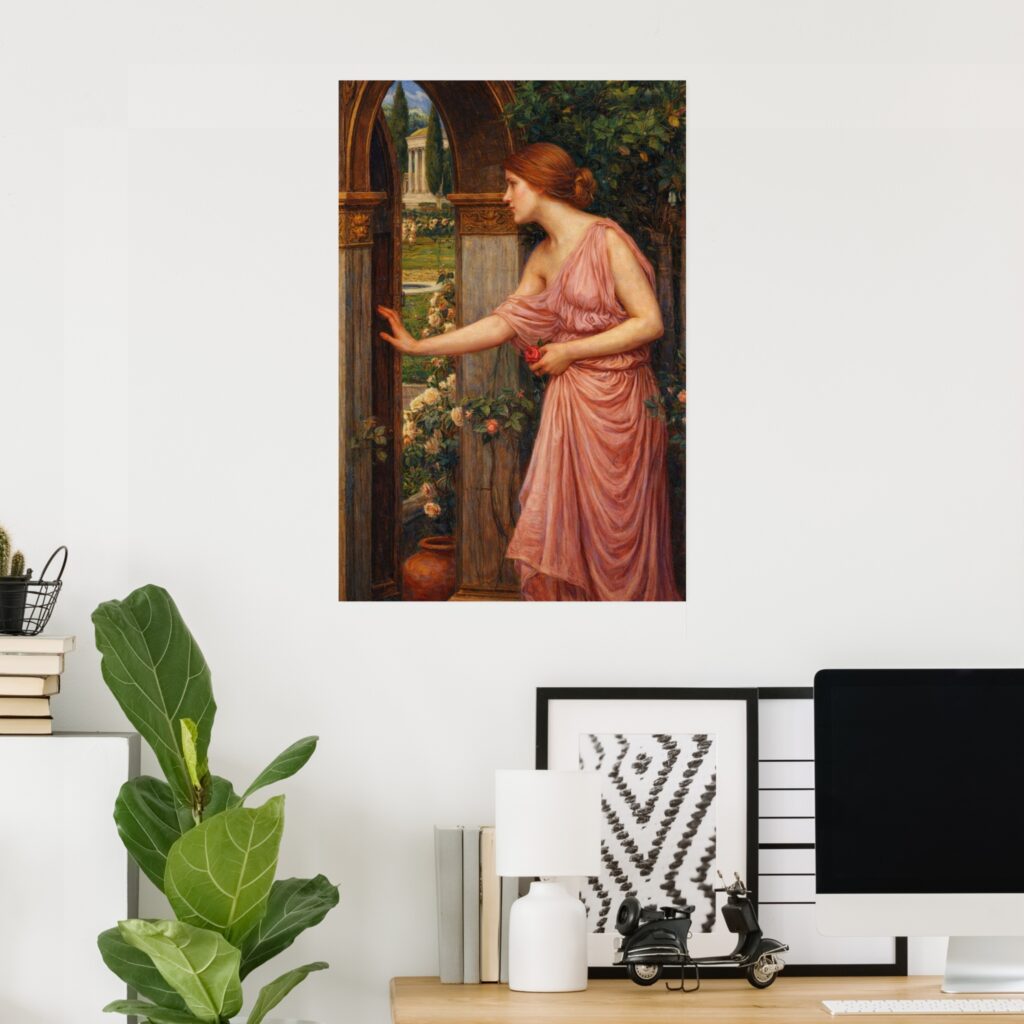
The pink drapery is one of the painting’s main emotional instruments. Waterhouse uses fabric as both a visual pleasure and a narrative clue. The garment clings and falls in folds that suggest motion and softness, emphasizing the tactile richness of the scene. Its color, a rose-pink warmed by light, stands out against the darker, earthier tones of the architectural setting and foliage.
This contrast sets Psyche apart as a living presence entering a shadowed realm. The cloth reads as delicate, almost luminous, and it carries associations of youth, tenderness, and vulnerability. At the same time, the way Psyche gathers the fabric at her waist suggests modesty and self-protection. The garment becomes a psychological extension, something she holds onto as she reaches toward the unknown.
Waterhouse’s careful modulation of highlights and shadows across the folds also creates a rhythm. The eye travels along the drapery’s contours, then returns to Psyche’s arm and face. The painting’s sensuality is quiet, embedded in craftsmanship rather than posed as provocation. The emphasis is on the human experience of touch and atmosphere, on the way beauty can be both comfort and temptation.
Color, Light, and the Mood of a Hidden Garden
Waterhouse orchestrates a palette that feels enclosed and warm, dominated by browns, greens, and muted stone tones, with Psyche’s pink acting as the focal note. The lighting appears soft and filtered, as if coming through leaves or an unseen opening. This is not sunlight blazing across a landscape but light that suggests privacy. The garden is not fully revealed in bright clarity. It is hinted, veiled, and held at a distance.
That choice intensifies the sense of secrecy in the narrative. Cupid’s domain in the myth is a place of luxury and enchantment, but it is also a space governed by rules. Waterhouse’s subdued light creates an atmosphere where enchantment feels plausible. The shadows are gentle, not threatening, yet they imply that the garden contains more than can be seen at once.
The painter’s color strategy also shapes emotional tone. The warmth of Psyche’s garment against the cooler, darker setting creates a subtle drama of belonging and difference. Psyche brings living warmth into an older, quieter world. She is both guest and intruder, both chosen and uncertain.
Nature and Architecture as Symbols of Desire and Constraint
The setting blends natural growth with architectural order. Foliage frames Psyche, and flowers cluster near the threshold. The garden beyond includes a suggestion of classical structures, hinting at a cultivated paradise rather than wild nature. This mixture matters because it mirrors the myth’s themes. Cupid’s love offers Psyche pleasure and protection, but within boundaries. The garden can be read as a place where desire is allowed to bloom, yet only within a system that remains partly concealed.
The flowers near the entrance contribute to the sense of invitation. They soften the architecture, making the threshold feel less like a barrier and more like a transition. Yet the doorway remains firm. Psyche’s hand touches something solid, a reminder that beauty can have walls.
In this way, the environment participates in the narrative. The painting is not simply a figure in a setting. It is a dialogue between Psyche and the space that receives her. Waterhouse makes the garden feel like a character: silent, alluring, and private.
Waterhouse and the Tradition of the Mythic Heroine
Waterhouse repeatedly returned to stories of women poised at decisive moments. His heroines are often figures who carry myth and literature into psychological space: not just characters defined by plot, but presences defined by feeling. Psyche fits naturally into this lineage. She is the embodiment of the soul in the mythic sense, the human capacity to love, doubt, and endure.
In many artistic treatments, Psyche is either idealized as pure innocence or dramatized as reckless curiosity. Waterhouse chooses a middle path. His Psyche is thoughtful. Her beauty is undeniable, but it does not overwhelm her humanity. The painting invites empathy rather than distant admiration.
This approach aligns with Waterhouse’s broader interest in the interior life. Even when he paints myth, he paints moods: longing, hesitation, melancholy, fascination. The myth becomes a mirror for emotions that remain recognizable. Psyche entering the garden is a mythic moment, but it is also an everyday human experience: stepping into something you want, knowing it might change you.
Interpreting the Entrance as a Metaphor
The act of entering can be read as a metaphor for love, maturity, and knowledge. Psyche stands at a boundary where innocence meets experience. The garden represents a promise of fulfillment, but also a world that requires trust. The viewer, knowing the myth, senses that this beauty is not free of tension. Secrets live in gardens like this, and curiosity will eventually demand its due.
The painting also speaks to the psychology of desire. Psyche is drawn forward by what she cannot fully see. Waterhouse makes the unseen as important as the visible. The garden is partly hidden, and Cupid himself is absent. This absence is not a deficiency but a strategy. It allows the painting to dwell on expectation, on the imagination reaching beyond what is given.
Psyche’s careful touch suggests that crossing a threshold is not only a physical act. It is a moral and emotional one. The painting invites contemplation of what it means to step into love under conditions, to accept beauty while sensing the boundaries around it.
Why the Painting Still Resonates
This work continues to appeal because it captures a universal emotion with extraordinary clarity. The scene is about approaching something beautiful and unknown, about the quiet courage required to step forward when certainty is impossible. Waterhouse’s restraint keeps the image open to the viewer’s own experiences. You do not need to know every detail of the myth to feel the tension of the moment.
The painting also resonates through its craft. The figure feels present, the drapery feels touchable, the setting feels lived-in rather than theatrical. Waterhouse builds a world that seems to have air and silence. The viewer is invited to imagine what lies beyond the threshold, and that imaginative participation is part of the painting’s lasting power.
By focusing on the entrance rather than the climax, Waterhouse honors the subtlety of transformation. Lives change not only in dramatic moments but in quiet decisions, in the second when you place your hand on the door and choose to cross. Psyche’s story is mythic, but her gesture is human.