Image source: wikiart.org
Introduction
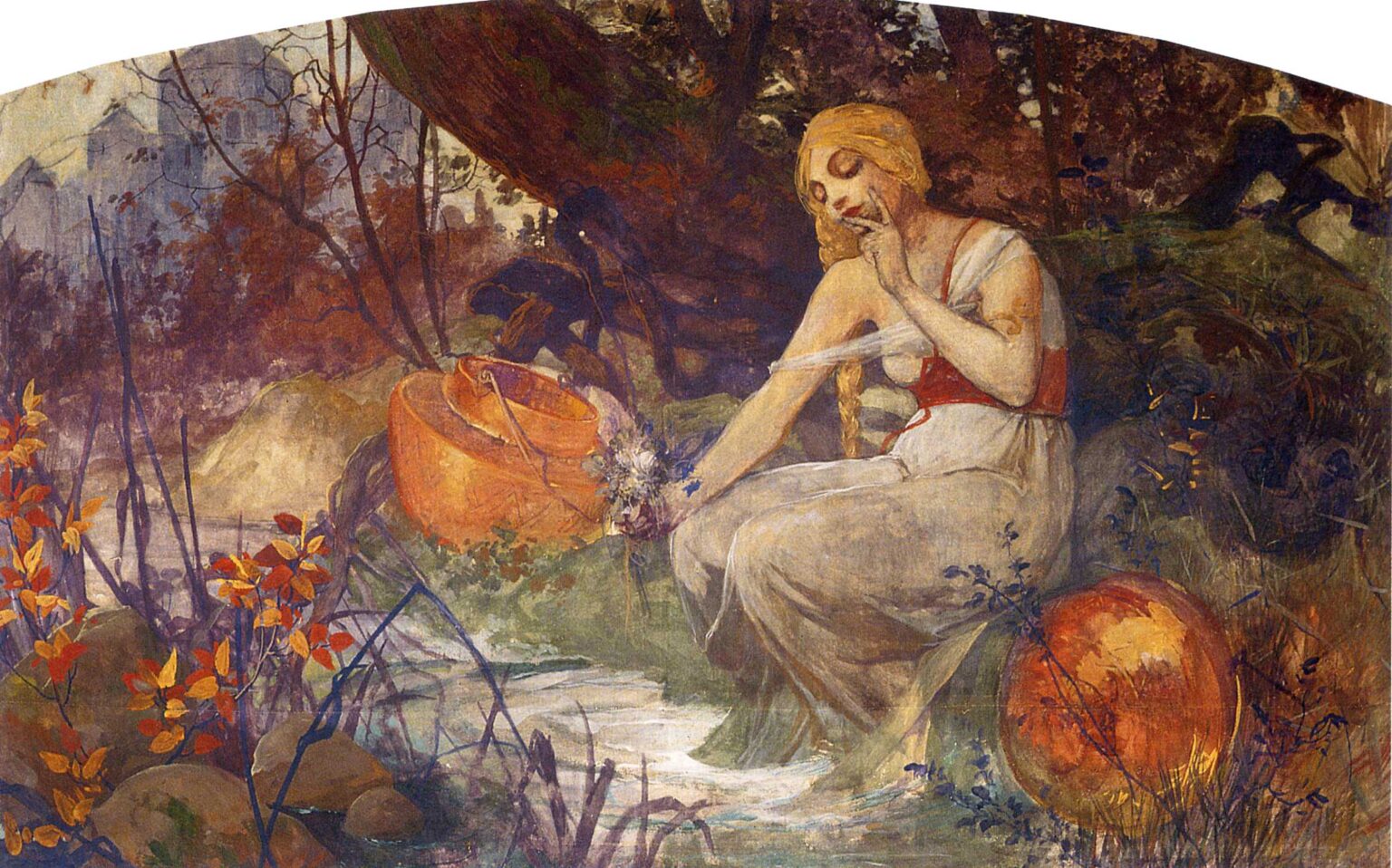
Alphonse Mucha’s “Prophetess” (1896) is a quiet, haunted scene that folds Art Nouveau grace into a folk-legend mood. In a shallow, arched landscape a young woman sits at the lip of a stream, one hand lifting a small bouquet from the water while the other rests against her cheek in thought. Ceramic vessels glow in orange beside her, their rounded bodies echoing the curve of the lunette. Autumn shrubs, long reeds, and the deep canopy of an old tree press in from every side. Far behind, the pale masses of architecture rise like a memory of a distant town. The painting is neither a portrait nor a myth illustration in the academic sense; it is an allegory of insight, a meditation on how knowledge arrives when attention meets the elements—earth, water, plant, and light.
Historical Context
The work sits at a critical moment in Mucha’s life. In Paris during the mid-1890s he had emerged as the face of Art Nouveau through his famous lithographs for Sarah Bernhardt and luxury brands. At the same time he pursued a parallel track of poetic paintings and decorative panels rooted in Moravian folklore and a personal spirituality. “Prophetess” belongs to that second current. Its arched format anticipates later mural ambitions; its woodland setting and introspective heroine foreshadow the epic allegory of the Slav Epic; and its handling of line and color shows the same discipline that made his posters legible from a distance. Instead of selling a product, however, “Prophetess” dramatizes a state of mind: the moment of divination as a form of listening.
Composition
The composition is arranged like a small theater of nature. The arch compresses the field so that foreground, figure, and background knit together as a single pattern. Mucha anchors the left side with a cluster of stones, reeds, and flame-colored leaves that step down to the water. These angles and accents push the eye toward the seated woman, who balances the design on the right. Her body forms a supple triangle, knee forward, torso leaning, head tilted, braid draped along the line of her arm. Behind her a great tree trunk arcs diagonally, bridging figure and sky while casting the middle ground in deep shade. Orange vessels—one overturned, one upright—repeat the curve of the arch and punctuate the scene with warm, circular masses. The stream cuts across the lower edge in a pale band, a moving counterpoint to the dark bank and foliage. Nothing is accidental: every curve answers another, every color binds one area to the next.
The Figure and Gesture
Mucha’s prophetess is not grand; she is humanly contemplative. Her pose suggests both fatigue and alertness—elbow on knee in a habit of thought, fingers touching the mouth in a sign of inward speech. The other hand extends delicately to the stream, lifting a cluster of pale, thistle-like blooms. Her eyes are almost closed, remembering rather than staring, as if the vision she seeks rises from within the very act of touching water and flower. The white dress, gathered at the shoulder and bound with a red sash, is rural rather than courtly. It allows the anatomy to read through soft folds without the hard modeling of salon nudes. The long braid encircles her like a second belt and ties the figure to the earth tones of the bank. She is an oracle shaped by landscape, not set apart from it.
Setting and Motifs
The setting operates on two scales. At arm’s length we read the tactile world of grasses, leaves, rocks, and clay. In the distance, ghosted shapes of buildings—perhaps a monastery or town—rise beyond a river bend. The prophetess belongs to the threshold between culture and wild land. Ceramic pots lie near her hand like tools of domestic life, yet they are not in service; one is toppled, one rests and waits. Their roundness links them to the cycle of seasons and the moon, recurrent symbols of foresight and time. Even the palette of the brushy shrubs—orange tipping to rust—speaks of the moment when summer intelligence cedes to the reflective labor of autumn. Mucha composes a world that has already begun to quiet, a good climate for hearing the future.
Water, Vessels, and Divination
Water is the conduit in the picture. It carries reflections and hints of other places; it cools the terra-cotta of the jars; it receives the bouquet and returns it changed by light. Many folk traditions tie prophecy to wells and streams, to scrying in bowls and to listening for signs in the ripple. Mucha alludes to these without illustration. The vessels may be for drawing or pouring; the stream may be for washing or for seeing. Either way, the logic is the same: knowledge is transmitted when a surface is calmed and made receptive. The prophetess’s light touch performs this ritual. She does not clutch the flowers; she supports them the way a person holds a thought that must be allowed to expand.
Color and Light
The palette is tuned to a low, resonant key. Warm earths—burnt orange, ocher, sienna—are countered by cool violets and greenish grays in the shadows. The woman’s gown is a subdued ivory that gathers these ambient hues; the red sash and the deep terracotta jars supply sustained notes of heat. Light is not theatrical but dispersed. It filters through leaves, glancing off the vessels and threading the stream with a cold ribbon. This distribution suits the subject, because enlightenment here is not a bolt but a permeation. You feel the future arriving the way mist arrives over water, visible only where it touches the world.
Line and Texture
Mucha’s line is decisive yet gentle. He outlines the figure with a continuous contour that swells and thins like calligraphy, then softens the interior modeling with broken strokes and translucent scumbles. Foliage is written in shorthand, a tangle of looping marks that consolidate into legible plants when seen at the right distance. The terracotta jars are shaped with broad, almost poster-like bands of color, a reminder that Mucha was already a master of lithographic clarity. Texture changes meaning: the scratch of reeds communicates chill and damp, while the smooth sweep along the jar’s shoulder feels warm and touchable. In this alternation of rough and gloss the painting stages the two kinds of knowledge it values—intuition and craft.
Space and Framing
Depth is shallow and layered. Foreground reeds and leaves press against the front plane; the prophetess sits in the middle like a carved relief; the distant town and hills hover in a veil. The arch intensifies the tapestry effect, bringing the world forward until it nearly touches the viewer. This closeness is psychological. A prophecy does not come from a horizon; it unfolds in the near field of thought. The frame echoes the mind’s enclosure, keeping distractions at bay so that the small river of time at our feet becomes audible.
Narrative Time
The moment described is not the revelation itself; it is the poised instant before. We see a gesture mid-action, a gaze almost closed, a bouquet still wet. The jars are half-used or half-abandoned; the stream moves without rushing. Time is elastic, stretched by attention. This delay is essential to the image’s charm. Mucha understands that foresight is born in suspension. The longer the pause, the more fully the figure belongs to both present and future, one hand in each.
Symbolism and Interpretations
The title names the woman a prophetess, but her identity remains open enough to invite several readings. She can be seen as a Slavic sibyl whose counsel comes from springs, a village girl with second sight, or the allegorical voice of Autumn who predicts winter and prepares the household by the stream. The overturned jar can be read as emptied knowledge, poured out to make room for new; the upright jar as potential; the bouquet as fragile truth that must be lifted carefully or it will fall back into the current. Even the far, pale town plays a role: the civic world is there, but insight is born outside its walls. Mucha’s restraint keeps these symbols from hardening into message. They remain part of a lived scene.
Gender and Gaze
Mucha’s female figures are often framed as ideals, yet the prophetess escapes the charge of ornamented passivity. Her expression is active: thinking, testing, tasting a thought. She is not offered to the viewer; she is occupied with her own interior commission. The modest, practical dress and the long braid woven into the body’s silhouette convert beauty into purpose. The gaze directed inward becomes the painting’s ethical center, proposing that true vision requires absorption rather than display.
Relation to Mucha’s Other Works
Placed alongside the seasonal panels and the grand decorative cycles of the same years, “Prophetess” looks both familiar and unusual. Familiar are the arabesque contours, the low-keyed yet luminous palette, and the arch that ties picture to architecture. Unusual is the mood of rustic seclusion. Where other panels revel in ornament and abundant pattern, this one favors brushy textures and earthy masses. It shares more with Mucha’s later historical allegories than with his Paris posters: a belief that landscape is a thinking partner and that figures can carry cultural memory without pageantry.
Technique and Material Imagination
Even when Mucha paints on canvas, his experience designing for lithography shapes his decisions. Large forms read cleanly; color areas are laid with clarity; the orchestration of warms and cools ensures legibility at a glance. But unlike a poster, this surface is full of painterly incidents—thin washes exposing the weave, dry brush catching on ridges, opaque touches dropped into wet passages. These small surprises are important because they keep the scene from becoming merely decorative. They signal a hand at work, discovering meaning as it goes.
The Viewer’s Path
The eye is invited to wander in a loop. It begins with the bright stream in front, steps up to the bouquet in the prophetess’s fingers, climbs the arm to the contemplative face, slips down the braid to the band of red, slides along the curve of the overturned pot, and returns by way of reeds and stones to the water. This path mirrors the act of divination: gather a sign, reflect on it, let it circulate through memory, and deliver it back to the world. The painting teaches this rhythm by making it pleasurable to follow.
Nature and Culture in Balance
A distant settlement appears beyond the trees, yet the drama of thought happens at the stream’s edge. Mucha weighs these spheres without denigrating either. The town stands for continuity—architecture, ritual, human arrangement—while the grove supports change—growth, decay, and the flowing present. Prophecy, in this balance, is not rebellion against culture; it is the country’s gift to the city, a reminder carried back in a jar or a bouquet that time moves beneath the stone.
Contemporary Resonance
The image speaks persuasively today because it treats knowledge as a craft of attention rather than a thunderbolt. In an age of constant announcement, the prophetess models a slower intelligence grounded in touch and environment. The painting also honors domestic objects—vessels, water, gathered plants—as sources of meaning, a stance sympathetic to contemporary interest in craft, ecology, and embodied thinking. Its Art Nouveau curves feel fresh not because they are fashionable again, but because they capture how understanding actually moves through a body and a place.
Conclusion
“Prophetess” draws its power from quiet operations: a curve that repeats across jar, arch, and shoulder; a band of water that explains time better than any clock; a face that chooses inwardness over spectacle. Alphonse Mucha uses the decorative language he perfected for the poster to stage a different drama—the moment before knowledge becomes speech. What lingers after looking is a sense of time slowed to the pace of a stream and of thought that rises like color through clay. The painting suggests that prophecy is not thunder in the heavens but the clarity that arrives when attention, hand, and landscape are gathered into one rhythm.