Image source: wikiart.org
Introduction
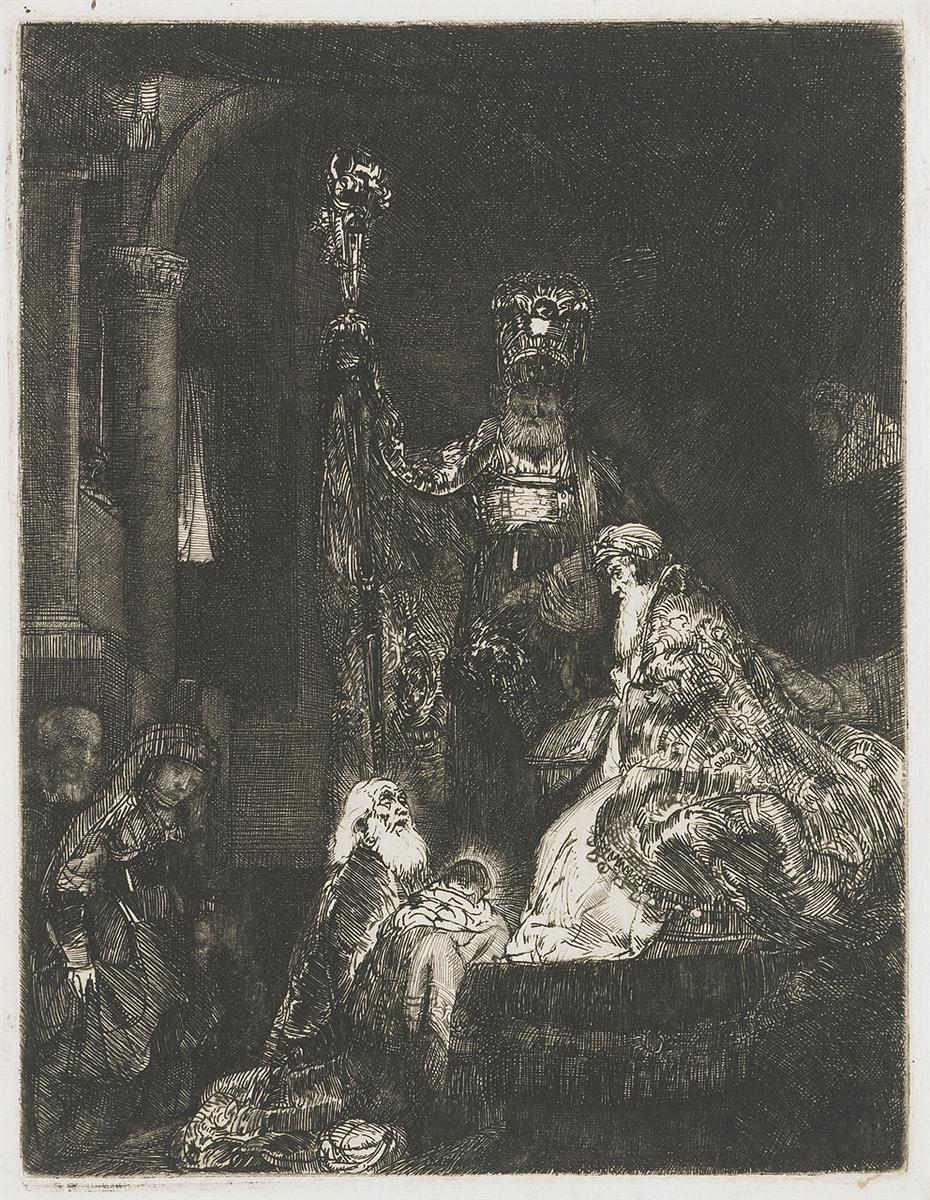
Rembrandt’s “Presentation in the Temple” (1654) is a late etching of extraordinary theatrical power, compressing architecture, ritual, and revelation into a high-contrast chamber where light behaves like meaning. The Gospel scene—Mary and Joseph bringing the infant Jesus to the Temple, where the aged Simeon recognizes him—is usually rendered as a clear, broad tableau. Rembrandt does the opposite. He plunges the sanctuary into a nearly continuous dusk and lets recognition flare out of the shadows in a few concentrated places: Simeon’s lifted face, the tiny haloed child, the dazzling robe of the presiding priest, and the glittering staff that punctuates the ascending space. The print becomes a study in how attention gathers within ceremony, how the human eye finds truth in the midst of rank and ritual weight.
The Biblical Episode and Rembrandt’s Chosen Instant
According to Luke, Mary and Joseph present Jesus in the Temple forty days after his birth. Simeon, long waiting for consolation, takes the infant in his arms and blesses God. Rembrandt chooses the climax where recognition is most intense: the elderly Simeon, kneeling, holds the swaddled child and lifts his gaze upward while a high priest presides and Mary stands at the edge of the scene in quiet astonishment. This is not a static devotional picture. It is a liturgical drama at the exact second when meaning breaks through—when the old man’s waiting meets the child’s presence and the entire architecture seems to lean toward that exchange.
Composition as Vertical Theater
The composition is built around a steep vertical. At right, the priest sits on a raised platform, his body swelling in luminous robes that curve like a cliff of brocade. Behind him rises an enormous figure of a temple official or acolyte, draped and towering, holding a staff that drives the eye upward to the dark vault. Simeon kneels low and central, the small infant nestled against his chest. Mary and other witnesses occupy the left margin in subdued tones. This vertical theater accomplishes two things. It makes the world above feel weighty, rule-bound, and ancient; and it lets the tiny light of the child subvert that weight from below, where humility kindles insight.
Light, Darkness, and the Grammar of Revelation
Rembrandt’s blackness here is positive, not mere absence. The plate is flooded with rich, velvety dark from which figures are carved. Where light appears it feels earned, a local miracle. The greatest concentration is the child, a small white seed that illuminates Simeon’s beard and the folds of the swaddling. The priest shimmers as light skates across embossed surfaces and beaded hems, but his brightness is worldly—an optical result of gilded textile in shadow. By contrast, the infant brings a spiritual brightness; light seems to emanate rather than strike. The print thus proposes two orders of splendor: ceremonial and revelatory. They coexist, but the latter quietly outranks the former.
Simeon as the Axis of Meaning
Simeon’s head, tilted upward and haloed by reflected glow, is the etching’s emotional center. Rembrandt draws him with loving economy: sparse hair, long beard, deep sockets opened in astonishment and relief. His hands are not stiff with ritual but tender with gratitude. The slight arc of his back—neither rigid nor collapsed—suggests strength spent in waiting and restored in recognition. Everything near him grows articulate: the child’s swaddling, the kneeling posture, the small echo of light along Mary’s veil. Simeon’s gaze is a current running through the scene; as we follow it we realize that the true architecture of the print is not stone but attention.
The High Priest and the Politics of Splendor
The enthroned priest, seen from three-quarters, becomes a mountain of cloth and insignia. Rembrandt revels in the texture—short, curling strokes that make brocade glint and swell, denser hatchings that weight the garment with ceremonial gravity. The priest’s power is unmistakable; so is its limitation. He presides, but does not perceive as Simeon does. His face is partially shadowed, his gaze directed downward or aside, as if caught in the business of office rather than the shock of recognition. Rembrandt is not hostile to hierarchy; he renders it magnificently. But he insists that revelation can bloom outside official sightlines.
Mary, Joseph, and the Periphery of Wonder
At left, Mary stands modestly with veil and robe described in thin, respectful strokes. Joseph or an attendant recedes behind a column. Their presence is quiet but vital; they anchor the scene in family and obedience to law. Rembrandt resists the urge to spotlight them. Instead he stages them as the moral horizon—the faithful who bring the child to the place of promise—and lets the miracle unfold almost beside them. The choice echoes his treatment of domestic gospel scenes: the sacred appears within ordinary duty.
Architecture as Silence
The Temple is present as pillars and deep arches, but it is less a building than a tonality—a great dark that gives the figures a resonant stage. Rembrandt’s etched vertical hatchings curve at the top into a shadowed dome, barely legible, that hints at height and accumulated time. The grand interior becomes a kind of acoustic shell that magnifies small sounds: the whisper of linen, the creak of stairs, the breath of an old man. The effect is to shrink the distance between stone and skin, ceremony and heart.
The Language of Line and Plate Tone
Technically, the print is a clinic in late Rembrandt etching. He layers long parallel lines to create velvety darkness, then cuts through those fields with quick, bright strokes to catch edge and sparkle. Plate tone is left intentionally in broad swaths, giving the air a soft haze; in other passages he wipes more cleanly so the child and Simeon print brighter. Crosshatching runs in curves that model the swelling brocade of the priest; short zigzags on the steps and platform give the staging a tactile heft. The line is never mechanical. It grows thick where emotion gathers, thin where modesty is required, and broken where mystery is better felt than seen.
Scale, Proportion, and the Power of the Small
One of Rembrandt’s bravest decisions is to make the infant visually small—an almond of light in a sea of darkness—while surrounding him with colossal priestly presence and cavernous architecture. The mismatch of scale is the point. The scene declares, without words, that significance is not measured in size. The print’s drama lies in how the smallest brightness gives the largest forms their meaning. Without the child, the cathedralized setting would be mere shadow; with him, it becomes expectancy fulfilled.
Gesture, Stance, and the Choreography of Recognition
Every body in the picture participates in a choreography. Simeon kneels, creating a hinge between earth and heaven. The priest sits, his staff erect, anchoring civic order. Mary leans slightly, as if pulled by the glow toward the child. A servant at the far left bends at the waist, a gesture of practical attendance. These motions are subtle but decisive; they convert the scene from illustration into enacted belief. Rembrandt understands ritual as movement charged with meaning. He captures the moment when such movement becomes recognition.
The Staff, the Halo, and the Vocabulary of Signs
Rembrandt uses very few explicit symbols. The small halo around the child is the only overt indicator of divinity. Its modest size prevents it from becoming a decorative cliché; it reads as a simple confirmation of what Simeon already knows. By contrast, the staff held by the towering official is an emblem of institutional force. Its ornate head, sketched with brisk, glittering marks, proclaims an earthly hierarchy. Set side by side—halo and staff—these signs stage a quiet contest between the power of recognition and the power of office. The etching sides with recognition without dishonoring office.
The Role of Drapery and the Feel of Matter
Rembrandt’s tactile imagination is everywhere. Drapery is not mere costume; it is the weight of history and the intimacy of touch. The priest’s robe amplifies rank; Simeon’s simpler garment registers the furrowed falls of service; Mary’s veil is trimmed with modest brightness that frames her stillness. Even the cushion or platform supporting the priest is etched with heavy, circular motions that make us feel its density. In a medium of lines and tone, Rembrandt conjures the full theater of matter so that the spiritual event has a credible world to inhabit.
Sound and the Imagined Sensorium
The print invites the ear. One can almost hear the ring of the staff on stone, the rustle of brocade, the sibilant murmur of prayer as Simeon blesses God, and the faint cry of an infant. The great dark vault becomes the instrument that holds these sounds. By activating the sensorium, Rembrandt keeps the scene from floating in piety. It becomes lived experience—the sacred heard as well as seen.
Comparison with Earlier Temple Presentations
Earlier artists—from Bellini to Dürer—often present the event in bright clarity with symmetrical compositions. Rembrandt embraces asymmetry and shadow. He shifts the theological emphasis from spectacle to interiority, from public proof to personal recognition. While some versions center the priest as the perceiver, Rembrandt centers Simeon, the lay elder whose waiting becomes the lens for revelation. The move is consistent with the artist’s lifelong interest in the dignity of outsiders and the power of humble seeing.
Theological Undercurrents Without Preaching
Though the plate contains no inscriptions or textual quotes, it hums with theological currents. The old covenant, embodied in Temple architecture and priestly vestments, stands intact; into it comes a new fulfillment small enough to rest in an old man’s arms. Light rising from the child suggests that revelation is not a bolt from above but an ignition within the human community. Mary’s presence keeps the mystery domestic; Simeon’s aging keeps it mortal. Faith appears here not as triumphant assertion but as recognition that bends the knee and blesses.
Late Style and the Ethics of Looking
This print belongs to Rembrandt’s late style, where surfaces loosen and meaning concentrates. He asks the viewer to look into darkness long enough for form to emerge. That discipline mirrors the moral labor of Simeon’s life—waiting, attending, believing that the dimness is not empty. In a culture of bright images, the etching teaches the value of patience: meaning is sometimes a small light in a large dusk. The reward for such looking is intimacy. When we finally see the child, we feel that we have discovered rather than been shown.
A Contemporary Reading
Modern viewers can read the image as a parable about institutions and insight. The grand stage of authority is not mocked; it is honored. Yet the decisive knowledge arrives through a person who has learned to listen. The scene commends the kind of attention that allows newness to appear within old forms. It suggests that the future often looks fragile at first, and that the proper response is not possession but blessing. In that sense the print remains fresh—an image of recognition that speaks beyond theology to public life and personal practice.
Conclusion
“Presentation in the Temple” is among Rembrandt’s most eloquent demonstrations of how shadow can carry light. The cavernous interior and mountainous priestly robe seem, at first, to dominate the small human knot at the center. But the longer one looks, the more the image reverses itself: a seed of radiance in Simeon’s arms explains the whole scene and draws every gaze, including ours. The print unites Rembrandt’s love of material world—furrowed cloth, carved staff, stone arcades—with his rare ability to picture inward truth: waiting fulfilled, blessing given, revelation quiet enough to fit in a pair of old hands. The Temple remains grand; the child is tiny; both are necessary; but only one is light.