Image source: wikiart.org
A Presence Carved in Ink
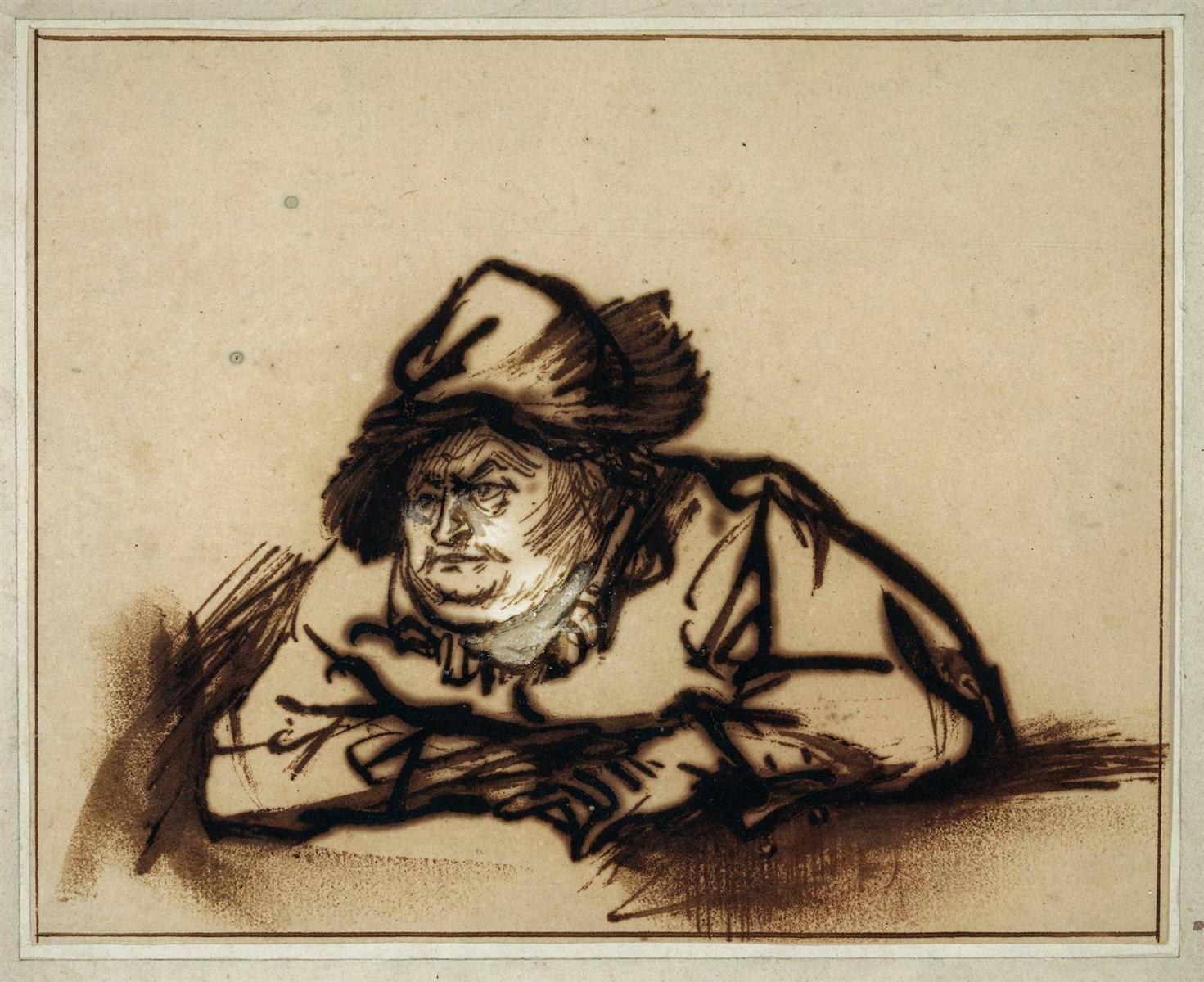
Rembrandt’s “Portrait of Willem Bartholsz Ruyter” (1638) is a sheet that seems to growl before it speaks. The sitter leans toward us across the lower edge of the paper, forearms folded, shoulders humped inside a heavy coat, hat pitched at a rakish angle. The face—round, pugnacious, alert—emerges from a storm of brush and pen marks as if modeled from smoke. A few pale touches catch the bridge of the nose and the pouch of the cheek; darker sweeps harden the jaw and the brim of the hat. The drawing is both portrait and performance: the artist conjures temperament as much as likeness, using the speed and pressure of his hand to reveal the sitter’s weather.
A Composition That Leans Into You
The first sensation is proximity. Rembrandt drags the figure to the very front of the sheet, letting elbows and tunic consume the lower quarter while leaving the upper field relatively bare. That imbalance creates a forward thrust, like a body weight shifting across a tavern table. The diagonal of the arms runs left-to-right, countered by the hat’s plume and the tilted collar, so that the whole figure forms a compact wedge of energy. Nothing in the posture is neutral; the sitter’s stance declares a person used to bearing down on problems—and on people.
The Shortest Path to Character
Rembrandt’s economy of means is radical here. He uses a handful of visual sentences—thick, calligraphic strokes for the coat; wiry, directional hatching for the face; broad, smoky wash for the ground—to build an entire presence. Outlines break and resume; shadows are not filled so much as suggested by a single confident sweep. The restraint makes each decision audible. A darker bite of the brush along the lower lip tightens the mouth into skepticism; a sharp notch at the inner brow turns attention into scrutiny. We watch the portrait think itself into being.
Line, Wash, and the Physics of Weight
Look at the difference between the head and the sleeves. Around the face the pen nibbles and darts, testing planes and features; around the sleeves the brush drops heavier, producing black ribbons that coil and settle like fabric under gravity. This contrast is not just craft, it’s metaphor: intelligence quickens at the face; bulk gathers at the body. The skim of white heightening (chalk or bodycolor) at the chin and cheek raises a little flare of light that keeps the head from drowning in the coat’s darkness. The media collaborate like instruments in a trio: pen for edge, brush for mass, white for air.
The Hat as Stage Architecture
The wide, soft hat is more than costume. It acts like a canopy that frames the eyes and compresses the gaze. Rembrandt drives a heavy contour along its front edge and feathers the interior with sparing strokes, creating a shadow theater under which the eyes burn hotter. The hat also widens the silhouette, adding to the impression that this is a large spirit occupying more than its share of space. A hat brim this emphatic is a kind of punctuation—an opening parenthesis that promises a statement.
Hands That Lock the Pose
The folded hands are drawn with a few decisive marks: knuckles flared into small triangles of light, fingers stacked in a compact lattice. The structure is architectural—like trusses that keep the whole upper body from collapsing forward. Folded arms can signal defensiveness or comfort; here they perform both tasks. They barricade the chest while providing a platform for the head’s thrust. Rembrandt refuses anatomical fuss and gives only what the posture needs: weight, tension, and a touch of impatience in the clenched line.
A Face of Angles and Weather
The sitter’s face is not idealized. Folds at the mouth, a thickened chin, and an uneven moustache produce a physiognomy that is particular rather than polite. Yet the treatment is compassionate. Short, slanted hatches at the temple soften the roundness; a pale highlight slides across the cheek like a thought passing. The eyes are small but insistent, boxed in by quick cross-hatches that intensify their focus. This is Rembrandt’s specialty: he grants the dignity of exactness without the cruelty of caricature. The face appears lived-in, used, trustworthy in its bluntness.
The Sheet as Theater of Process
The drawing bears its making openly. Wash blooms at the lower left where the brush lifted wet; dry-brush scrapes give the coat its abrasive bristle; the pen sometimes cuts the paper like a plow and sometimes glides like a skate. Passages are left intentionally unresolved: the far shoulder dissolves into a dark plume; the lower edge of the coat trails off in scribbles. These “unfinished” areas are not omissions—they are accelerations. We feel the time of the drawing, the sequence of attention as the artist moved: first the head, then the locking arms, then the hat, and only as much of the ground as needed to seat the figure.
Chiaroscuro That Defines Temperament
Light here functions as temperament. It catches the cheek, the tip of the nose, the tufts of hair under the hat, and the small pocket of ruffle at the throat. Everything else—the sleeves, the hat, the background—presses darkly upon those islands of illumination. The resulting mood is not melodrama but concentration. Darkness corrals the attention, forcing the eyes toward the places where thinking happens. The portrait becomes a lantern whose flame is the mind.
Between Portrait and Tronie
The drawing stands at a fruitful border between an individual likeness and a character study (the “tronie” beloved in Dutch art). “Willem Bartholsz Ruyter” anchors the image in a specific name, yet Rembrandt magnifies traits that feel emblematic: stubbornness, shrewdness, the self-possession of a man accustomed to decisions. Viewers who do not know the sitter still recognize the type. That dual identity—someone and anyone—gives the sheet its long afterlife. You meet a person; you also meet a force.
Paper Tone as Atmosphere
The warm, foxed paper and the brown-black ink create a limited palette that behaves like lamplight. Because there is no color to distract, value does all the expressive labor. The middle tone of the paper acts as ambient air; the darks compress volume; the lifted whites spark focus. Rembrandt uses the sheet the way a musician uses silence—everything meaningful happens against it. The empty upper field is not empty at all; it is a pressureless space that lets the figure push forward.
The Sitter’s Psychology in Three Moves
You can read the psychology by stages. First, the forward lean declares engagement, a person coming into your space rather than inviting you into his. Second, the folded arms insist on terms: he will be present on his conditions. Third, the narrowed eyes and set mouth test the viewer. Taken together, these moves produce an encounter rather than a display. The portrait does not offer itself; it challenges you to meet it.
The Energy of Contour
Rembrandt’s contour is a living thing. Along the sleeve it swaggers, fat and confident; along the cheek it tightens into short, nervous tics; around the hat it swells and thins, echoing weight and softness. This variation embodies a central truth of his draughtsmanship: lines do not merely describe edges; they carry the physical properties of what they bound. Soft hat, heavy coat, stubbled chin—each receives a different dialect of the same language.
The Social Studio of 1638
The late 1630s found Rembrandt at the height of his Amsterdam success, surrounded by students and clients, sketching freely between commissions. Sheets like this one feel like salon artifacts—made quickly, perhaps in conversation, perhaps as demonstrations. The informality does not reduce their seriousness. On the contrary, it liberates a kind of accuracy impossible in stiff, commissioned likenesses. The man we meet here would seldom appear in a gilded oil portrait with fruit and drapery; he thrives in ink.
From Ink Blot to Identity
It is enlightening to watch how little a mark can become a face. A thick hook under the lower lip turns mood; three strokes under the eye add fatigue; a single blade of white on the cheek suggests recent air. The transformation from ink blot to identity happens almost alchemically. The sheet invites you to lean close and witness it: where does this become someone? Rembrandt locates the threshold with uncanny precision—often in the triangle between eyes, nose bridge, and mouth corners.
The Frame and the Table
The thin, drawn border that runs near the paper’s edge acts like a case around a specimen. But Rembrandt undermines its tidy function by letting the figure press against it; the elbows appear to rest on that lower rule as on a table. The illusion is charming and sly. The border stops being a frame and becomes furniture inside the subject’s world, another way the drawing invites our bodies into its space.
Kinships and Contrasts in the Oeuvre
Compare this sheet with Rembrandt’s polished etched self-portraits from the same year: velvet caps, controlled hatching, elegant reserve. The “Portrait of Willem Bartholsz Ruyter” leans the other way—toward speed, caricatural boldness, saturating shadow. Both approaches share the same intelligence of looking, but they diverge in rhetoric. One is self-presentation; the other is encounter. Together they map the range of his human curiosity: from the inward theater of self to the outward, sometimes combative, immediacy of another.
How to Look, Slowly
Begin at the eyes. Note the tiny sparks of untouched paper that make them wet. Drop to the nose ridge and feel the switch from hatch to wash. Slide to the mouth and study the corner where a minute thickening changes resolve into skepticism. Step back to read the hat brim’s arc and the heavy arcs of sleeve that echo it at a lower pitch. Now, with your own arms folded, lean the way the sitter leans and feel how the drawing choreographs your body. Return to the cheek’s white glint; hold there until the face breathes.
Why It Still Feels Contemporary
The drawing’s frankness reads like street photography. It refuses cosmetics, accepts asymmetry, and trusts gesture as truth. The visible process aligns with modern taste for authenticity; the compressed space matches our appetite for portraits that confront rather than pose. Most of all, the sheet recognizes a timeless kind of person—the obstinate, intelligent, rough-edged interlocutor—and gives him respectful clarity. We know him; we may be him.
Closing Reflection
“Portrait of Willem Bartholsz Ruyter” is a lesson in how a handful of marks, honestly placed, can make a life present. There are richer portraits and grander sheets, but few that so concisely turn brush pressure into psychology and borderlines into furniture. Rembrandt does not flatter, and he does not mock. He attends. In the end, what remains is a vivid encounter: a man leaning across time, arms folded, waiting to see what you will do next.
