Image source: wikiart.org
First Encounter With A Face In Light
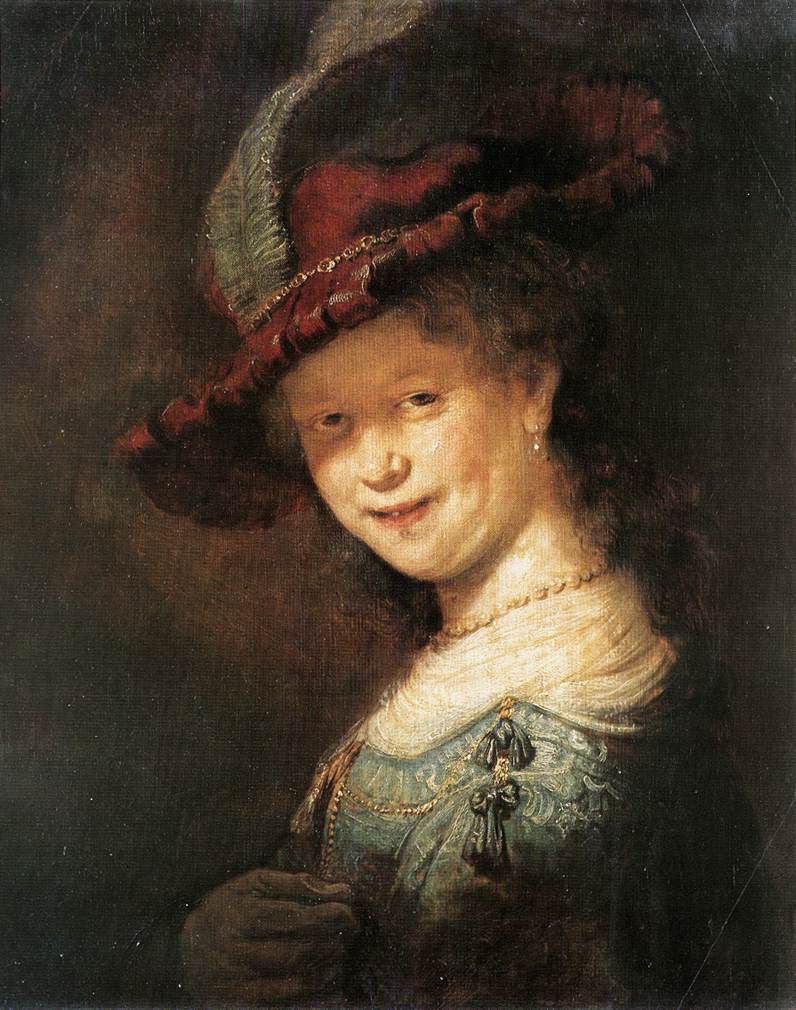
Rembrandt’s “Portrait of the Young Saskia” captures an instant of warmth and mischief, the early glow of a relationship that would shape the artist’s life and art. The sitter—Saskia van Uylenburgh, whom Rembrandt would marry the following year—turns slightly toward the viewer, her head tipped, her mouth just beginning a smile. Light pours across her cheek and the planes of her neck, gathering on the feathered brim of a dramatic red hat and slipping down the satin of a blue-green bodice. The painting’s first impression is intimacy: we are not confronted; we are invited. Rembrandt uses color, costume, and a gentle diagonal of light to make the introduction feel personal.
The Early Amsterdam Moment And A Private World
Painted in 1633, the picture belongs to Rembrandt’s first Amsterdam years, when he was still in his twenties and quickly becoming the city’s most sought-after storyteller in paint. Many portraits from this moment are formal commissions; this one feels different. The sitter is not a civic dignitary but the artist’s chosen companion. The canvas reads as a studio conversation rather than a public appointment. The private world of the couple—costume delights, playful poses, tests of light and texture—enters the picture, and the result is a likeness that announces affection without sacrificing craft.
Composition That Turns Toward Us
The design is simple and effective. The head occupies the upper third, set against a soft, dark ground. The vast red hat creates a shaded canopy that presses the gaze into the lit oval of Saskia’s face. Below, a diagonal runs from the feather’s tip through the chain across the hat, down the curve of shoulder, to the small knot of ribbons near the bodice. The left hand, barely suggested, gathers the composition and returns the eye upward. These lines choreograph attention so that we feel both movement and poise—Saskia seems to have turned to us in mid-thought.
Chiaroscuro As Flirtation
Rembrandt’s light is not brutal; it is playful. A warm beam catches the upper cheek, the brow ridge, the edge of the nose, and the glistening lip. The shadow that slips under the brim is not a void but a whisper that protects privacy. This alternation between reveal and withhold is the visual equivalent of flirtation. The viewer receives enough to read character, but not so much that the mystery is spoiled. In the hollows and edges, the painter keeps the values breathing so that the face feels alive rather than staged.
The Red Hat As Stage
The extravagant hat is more than costume. It is a stage that frames the head and gives the light something to work against. The crimson felt, scalloped and edged with a thin chain, accepts highlights in broken, restrained flashes. A tall feather, worked with elastic strokes, lifts the composition and introduces a cool counter-note that keeps the red from overwhelming the face. The hat’s dark underside compresses values across the eyes, intensifying the small glints that carry Saskia’s look.
Blue-Green Silk And The Grammar Of Texture
Across the bodice, blue-green silk softly pleats and pools. Rembrandt paints the fabric with economical confidence: broader swathes establish plane, then a few judicious glazes and raised touches place seams, embroidery, and tiny bows. Gold chains lie across the garment with believable weight. This grammar of texture—felt, feather, silk, metal, skin—gives the viewer’s eye a repertoire of sensations and demonstrates how the artist uses different kinds of marks for different substances without ever letting technique take the spotlight from the sitter.
A Face Between Laughter And Thought
Saskia’s expression inhabits the middle register in which people are most themselves. The mouth curves gently, the eyes narrow with attention rather than performance. The cheek’s flush suggests recent conversation. Rembrandt places a minute highlight at the moist rim of the lower eyelid and another at the corner of the mouth, small decisions that give the expression its elasticity. We feel we’ve interrupted a living moment rather than been allowed to inspect a mask.
Flesh As Living Climate
Rembrandt builds skin with translucent passages that allow light to seem as if it rises from within. Warm notes concentrate where blood runs near the surface—cheekbone, tip of nose, lower lip—while cooler greys hold structure at the jaw and temple. The neck’s pale planes, gently foreshortened, carry the warm reflection of the dress and the chain. These temperature shifts keep youth believable without sweetness. The result is flesh that breathes the same air we do.
The Jewelry And A Vocabulary Of Spark
Pearls at the ear and neck, a slender chain across the hat, and a ribboned jewel at the bodice add measured flashes. Rembrandt uses these small sparks as punctuation, carefully scaled so they do not shout down the face. Their placement creates a constellation that guides the eye along the painting’s diagonals and then back to Saskia’s glance. The jewelry also signals status and taste, but it is finally the rhythm of light—rather than the value of the objects—that persuades.
Costume Play And The Studio Theater
The picture belongs to a group of works in which Rembrandt and Saskia experiment with dress-up—feathers, chains, exotic fabrics—without tying the image to a specific role. Rather than costuming Saskia as an allegory or historical figure, he borrows the thrill of “studio theater” and lets it energize a portrait that remains stubbornly personal. The result is an honest compromise between fantasy and fact, a playful surface wrapped around a core of direct encounter.
The Hand As A Quiet Signature
At the lower left, Saskia’s hand appears, lightly grasping the edge of her cloak. It is not anatomically proclaimed; it is suggested just enough to feel true. The gesture anchors the body and adds a note of modesty, as though she is gathering herself while turning toward us. Rembrandt loves hands as signatures of temperament. Here, the small, relaxed grip reads as self-possession rather than display.
The Background And The Ethics Of Omission
Nothing in the background competes for attention. A soft dusk, warmer on one side and cooler on the other, gives the figure atmospheric room. This choice of near-emptiness is ethical. The painter refuses to dress Saskia in allegorical props or architectural claims. The space protects her presence, letting the light do the work of meaning. In that restrained air, the portrait feels private rather than staged for a crowd.
Color That Behaves Like Music
The palette is narrow but musical. The red hat supplies the low, sustained note; the blue-green bodice provides a cooler counter-melody; the flesh and soft off-whites resolve the chord. Rembrandt avoids loud saturation, preferring moderated hues that can accept shadow without going black. Because the color is tuned rather than shouted, tiny changes—an extra warm glaze on the cheek, a cooler wash in shadow—change the emotional timbre of the whole.
Brushwork That Records Decisions
Look closely and the surface reveals a spectrum of touch. The feather is written with quick, flexible strokes; the hat’s felt is built with softer, loaded passages; the silk receives long, polishing moves; the face alternates thin veils with firmer, descriptive strokes around eyes and mouth. Rembrandt does not flaunt technique, but he lets the viewer read the sequence of decisions. The painting breathes because each part is painted in the way that part would feel.
The Psychology Of The Tilt
The slight forward tip of the head is the portrait’s quiet masterstroke. It shortens the distance between viewer and sitter, suggests attention, and makes the smile feel audible. The tilt also lets the hat cast a protective arc of shadow, which encourages the eye to look into the face rather than across it. This is intimacy constructed with geometry: a few degrees of rotation turn formality into conversation.
Youth And The Promise Of A Shared Life
Knowing the biography—that Saskia would become Rembrandt’s wife in 1634 and the luminous presence of many later works—intensifies the picture’s feeling of promise. Yet the canvas does not rely on context to move us. Youth is visible in the damp brightness of the eyes, the transparent edge of the ear, the softness along the jawline. The portrait communicates not just attractiveness but readiness, the sense of a person standing on a threshold with confidence.
The Studio As A Laboratory Of Light
The painting is also a workshop document: a record of how Rembrandt studies the behavior of light on different surfaces. The feather catches a crisp rim; felt mutes the gleam into bloom; silk turns it into a long glide; skin absorbs and reflects it in subtler rhythms. Each surface instructs the next, and together they make a kind of visual chord. The lesson is not technical for its own sake; it serves character. Light feels like attention made visible.
Between Private Likeness And Public Image
Even if this picture was not destined for a civic display, it still functions as a statement. Saskia is shown with poise, taste, and a touch of theater—attributes that would have suited a painter’s wife in the competitive Amsterdam art world. At the same time, the smile, the tilt, and the relaxed hand insist on privacy. The painting is a negotiation between the person Rembrandt loves and the image that would help define his rising household.
Edges That Keep The Image Breathing
Edges in the painting are carefully modulated. The hat’s outer rim is firm against the background; the feather’s edges fray delicately; the hairline dissolves into soft ringlets; the contour of the cheek against shadow is neither hard nor vague but negotiates just enough to imply air. These decisions prevent the head from reading as a cutout and keep space moving through the scene, as if the studio’s air had been captured with the face.
Small Signs Of Sound And Touch
Though silent, the image is sensorial. One can almost hear the feather’s dry rasp, the faint jingle of a chain, the muffled rustle of silk as Saskia turns. The small pearl at the ear feels cool; the hat’s felt seems firm; the bodice’s satin looks soft. Because textures are observed with respect, the painting triggers the body’s memory of touch and hearing, and the sitter’s presence seems fuller.
Why The Portrait Still Feels Fresh
The image remains alive because it trusts simple means—light, color, gesture—to carry feeling. It does not mount an allegory, preach a moral, or show off technique. It offers a person in a room, seen with attention and affection. That ethic travels well across centuries. Viewers today recognize themselves in the half-smile and the head’s tilt, in the mix of confidence and curiosity. The painting models how intimacy can be represented without exposure.
Closing Reflection On Light And Likeness
“Portrait of the Young Saskia” is a compact manifesto for Rembrandt’s early portraiture. It shows how splendor can be borrowed from costume and returned to character, how light can reveal without interrogating, and how a single tilt of the head can change the entire moral temperature of a scene. Above all, it demonstrates that likeness is not just a map of features but a measure of attention. Rembrandt pays Saskia the compliment of looking well, and the painting returns that compliment to us by letting us look with the same kindness.