Image source: wikiart.org
Introduction
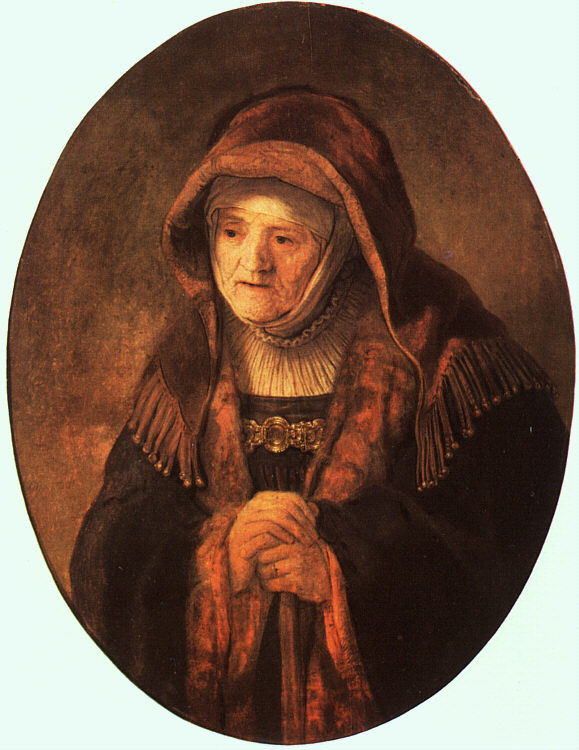
Rembrandt’s “Portrait of the Artist’s Mother” (1639) is a quiet marvel of presence. Set within an oval and bathed in a mellow, emberlike glow, an elderly woman faces us with hands lightly clasped over a walking stick. Her hooded mantle frames a thoughtful face whose wrinkles are rendered not as flaws but as the script of a long life. The painting reads like a conversation carried in low voice: restrained, attentive, and deeply humane. Although small in scale compared to Rembrandt’s grand public commissions from the same decade, it distills his powers—chiaroscuro, psychological insight, and tactile paint—into an intimate image that feels both personal and monumental.
The Subject and the Amsterdam Moment
The sitter is generally identified as Rembrandt’s mother, Neeltgen Willemsdochter van Zuytbrouck, whom he depicted repeatedly in drawings, etchings, and paintings. By 1639 he was firmly established in Amsterdam, moving easily among prosperous patrons and completing ambitious history pictures and portraits. In this setting, a likeness of his mother offered an inward counterpoint to the outward-facing bravura of civic portraiture. It allowed him to suspend public rhetoric in favor of domestic truth. The result speaks not only to filial affection but to a broader Dutch fascination with the moral dignity of age, a theme that Rembrandt, unlike many contemporaries, pursued without sentimentality or satire.
The Oval as a Vessel for Intimacy
The oval format shapes how we read the image. Rather than the architectural stages he uses for patrician sitters, Rembrandt encloses the figure in a soft ellipse that behaves like a handheld miniature enlarged to a devotional scale. The curve suppresses corners and thereby any hint of a room beyond the sitter. We remain with her and her alone. The mantle’s hood echoes the oval’s contour so closely that picture space and garment feel of a piece, as if the world had folded in to protect the figure. This visual cradle invites a reverent gaze; it also encourages Rembrandt’s special economy of design—no distractions, only essentials.
Chiaroscuro as Moral Atmosphere
Light falls from the upper left, catching forehead, cheekbones, the bridge of the nose, and the clasped hands. It then laps gently across the fur edge of the mantle and the small gold brooch that gathers it. Darkness pools at the periphery and in the recesses of the hood, so that the illuminated features seem to emerge from warm dusk rather than lie upon the surface. This is chiaroscuro not for drama but for reverence. The shadow behaves like time: it softens edges, carries memory, and renders the light precious. The key is Rembrandt’s control of value intervals. The leap from the lit cheek to the half tone of the jaw is small; the descent to the deeper shade under the hood is gradual. Those intervals produce a whispering calm.
The Language of Costume
The clothing is sober and richly practical: a lined mantle edged with fur, a coif and undercap, and beneath them a modest collar gathered in fine pleats. The fur trim is indicated with a combination of opaque strokes and feathering that seems to warm under the light. Tassels at the shoulders and a central clasp lend discreet ornament and keep the garment from melting into a formless mass. In seventeenth-century Dutch portraiture, black and brown were not mere austerity; they were stages on which light could play. Here, deep russets and umbers drink the light and return it like embers, sustaining the painting’s autumnal tone. The costume’s restraint also protects the face from competition. Every decorative note guides the eye back toward the gaze and the hands.
The Face as a Ledger of Experience
Rembrandt’s extraordinary empathy is nowhere clearer than in the sitter’s face. The flesh is modeled with warm ochres, honeyed half tones, and thin blue-grays at the temples where the skin cools. Wrinkles around the mouth and eyes are kept supple; they describe skin that has lived and moved rather than stone that has cracked. The mouth’s tiny downturn is offset by the attentive lift at the inner corners of the eyes. This balance yields an expression that is not sorrowful but sober, as if she were mid-thought or mid-prayer. The brow is drawn together lightly, introducing a note of concentration that prevents sweetness from curdling into sentiment.
Hands and the Poise of Humility
The clasped hands form the painting’s second emotional center. Their position is neither tense nor theatrical; the fingers wrap the stick with habitual tenderness. Knuckles swell slightly, veins press faintly at the surface, and the skin carries the same delicate network of wrinkles present in the face. In Rembrandt, hands often disclose what faces withhold. Here they communicate steadiness and a lifetime’s practice of patience. Because they sit just within the brightest band of light, the hands also function structurally: they anchor the lower half of the oval and echo the glow in the face, connecting thought to habit in a single chain of illumination.
Color Harmony and the Warmth of Age
While viewers often call this kind of palette “brown,” Rembrandt weaves a remarkably complex harmony. The hood’s interior sinks toward burgundy; the fur flashes with orange sparks; the mantle flows between clove-dark browns and red earth; the flesh contains peaches, honey, and muted rose. Against these, the coif and inner collar read as cool, slightly gray whites. Because the entire range stays within a warm register, the painting feels like dusk held in a pair of lamps. That warmth does not flatter indiscriminately; it dignifies. The sitter’s age is fully present, yet the chromatic atmosphere confers grace rather than pallor.
Paint Handling and Surface Poetry
The surface reveals Rembrandt’s mature orchestration of different paint languages. He builds the face with thin, translucent layers that allow light to travel through and bounce off the ground, creating life beneath the skin. At the highlights—the bridge of the nose, the lower lip, the tip of the chin—he places thicker, moist touches that catch light physically. The fur is created with abbreviated feather strokes laid wet into wet; the fabric’s broad fields are scumbled in semi-opaque passages so that darks breathe and are never dead. These varied techniques produce a tactile experience: we feel the nap of fur, the dryness of woven wool, the soft slip of aged skin. The result is not illusionism for its own sake but a way to register time in matter.
The Psychology of Distance
Rembrandt chooses a distance that permits intimacy without intrusion. He does not thrust us upon the sitter; the oval hedges the approach. The gaze does not seek to arrest or flatter the viewer; it retains its own path, a little downward and to the side, as if protecting thought. That slight avertedness is powerful. It gives us permission to look while acknowledging that we are guests in a private space. Many portraitists of the period strove to meet the viewer’s eye with assertive confidence; Rembrandt is comfortable granting his sitters emotional privacy. The dignity that results is unmistakable.
Age, Memory, and the Ethics of Looking
The painting’s subject is age, and Rembrandt treats it not as a theme but as a relationship. He refuses the period’s fondness for allegorical props that would use age to preach. There is no hourglass, no extinguished candle, no skull. Instead we have a person who has lived. The ethics of the image lies in that simple acknowledgment. Wrinkles are not symbols but events; the hand’s grip on the stick is not a genre sign but an action. This manner of looking has consequences for viewers. It encourages patience, gentleness, and a preference for truth over flattery—virtues that define Rembrandt’s art at its highest.
A Dialogue with Rembrandt’s Other Maternal Portraits
Rembrandt drew and etched his mother in various guises—reading, praying, in elaborate costume, and as biblical types such as the prophetess Anna. Compared with those exercises, this 1639 painting is sober and un-costumed. It avoids theatrics and keeps temporal specificity. Yet it shares with the earlier studies a fascination with the architecture of the head and the eloquence of hands. The oval format and the close-in framing echo miniature portraits but translated into the painter’s heavier, breathing medium. Seen across his oeuvre, the image reads as a culmination of long observation rather than a single sitting.
The Brooch, the Fringe, and the Small Ornaments of Life
Little details keep the portrait from becoming austere. The gold brooch at the chest, while modest, punctuates the vertical axis and answers the highlight at the nose. The fringe at the shoulders, rendered with short strokes that catch and release the light, introduces a delicate rhythm around the mantle’s mass. The ridged collar, made of fine pleats, registers effort and care in dressing. These are not mere decorations; they are objects worn daily by a particular person. Their presence grounds the painting in domestic reality, a world of garments kept and mended, and thereby deepens the portrait’s tenderness.
The Oval Field as a Luminous Window
Technically, the oval enhances the chiaroscuro. Its edge trims background distractions and allows Rembrandt to mass darkness in a continuous band. That band acts like a reflector; by suppressing peripheral light he increases the perceived brightness of the face and hands without overpainting them. The viewer reads the image as a window cut into shadow through which warmth emerges. The oval also invites the viewer to hold the image mentally, as one might cradle a keepsake. It is a formal decision with psychological force.
Time, Mortality, and Consolation
Like many of Rembrandt’s greatest works, the painting offers consolation without sermon. It acknowledges frailty yet frames it with light. The sitter’s eyes moisten; her mouth thins; her hands bear arthritis’s first rumors. Still, the glow around her head and fingers is unmistakably alive. The consolation this confers is not a promise of youth regained but a recognition that a person remains fully themselves in old age. In an era that prized usefulness, such recognition is radical. The painting grants honor to a life’s late season and teaches viewers to do the same.
Why the Work Still Feels Contemporary
The portrait remains fresh because its compassion is unsentimental. It does not instruct us how to feel; it makes space for feeling. Its palette is warm but not sugary; its light is gentle but not evasive. The artist’s hand is visible—brush marks, impasto, scumbles—yet always in service of perceiving another human being. Contemporary viewers accustomed to photographic exactitude find in Rembrandt not competition but complement: a record of attention so sustained that the painted surface reads like living presence.
Conclusion
“Portrait of the Artist’s Mother” is one of Rembrandt’s most humane achievements of the 1630s. The oval format, ember-warm palette, and masterful chiaroscuro confer an intimate gravity. The face, hands, and modest ornaments are rendered with a tenderness that neither flatters nor judges. Old age becomes here a field of light, and the viewer is asked to look with the same patience the painter gave his subject. The painting’s quiet eloquence lies in its equilibrium: personal yet universal, simple yet technically rich, calm yet alive. It is a lesson in how art can honor the ordinary magnificence of a single human life.