Image source: artvee.com
Introduction
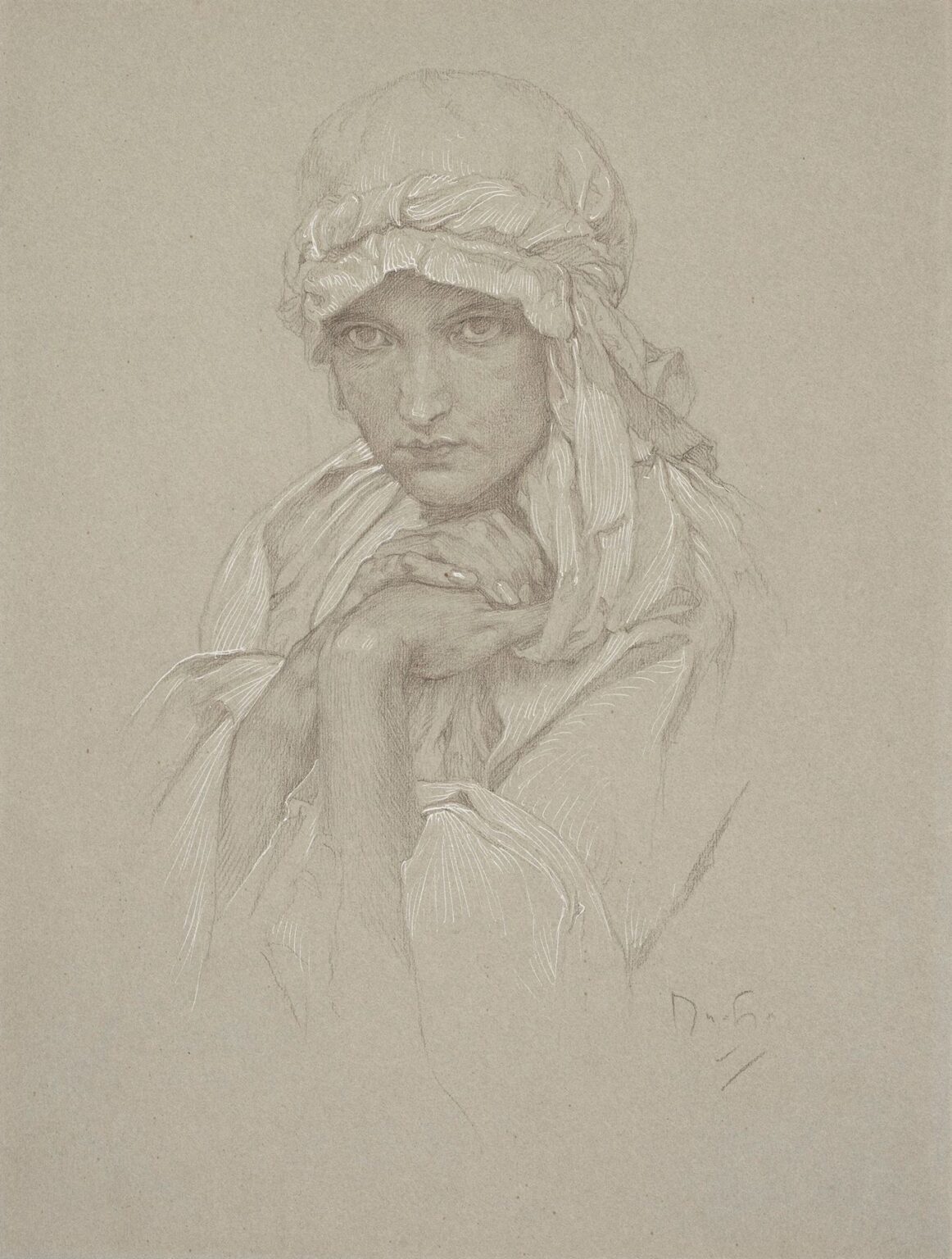
“Portrait of the Artist’s Daughter in Slavic Dress” presents Alphonse Mucha at his most intimate and exacting. The sheet is drawn on cool, toned paper with a restricted duet of graphite and white heightening. From this minimal palette he conjures a presence of striking clarity: a young girl in a gathered kerchief, hands folded beneath her chin, eyes steady and luminous. The drawing reads as a conversation between tenderness and rigor. Every line is measured, yet nothing feels forced. The choice of Slavic costume, the careful staging of the hands, and the deliberate use of the paper’s middle value all fuse into a portrait that is at once familial, cultural, and formally refined.
First Impressions and the Architecture of the Pose
The composition is built around a compact triangle formed by head and forearms. The girl’s elbows are drawn inward; her forearms rise to meet beneath the chin; the clasped hands act like a keystone that locks the structure. This architecture produces a quiet centripetal force that keeps the viewer’s eye circling within the upper half of the page. The shoulders slope away gently and dissolve into the paper, a strategic fading that prevents the lower sheet from competing with the focal zone. The pose is not theatrical. It is a resting attitude, a stillness that carries the gravity of concentrated thought in someone very young.
The Medium and the Logic of Toned Paper
The toned sheet supplies the midtone of the drawing so that Mucha can build form in two directions at once—darker with graphite, lighter with white chalk or gouache. He uses this duality with economy. Graphite defines contour, soft interior shadows, and the delicate fall of fabric; white identifies the strike points of light on the headscarf, the bridge and tip of the nose, the upper knuckles, and the creases of the sleeves. Because the white sits on the surface while the graphite sinks into the fibers, the highlights advance and the shadows settle, giving the portrait a shallow, convincing spatial depth without a full tonal range.
Eyes as the Center of Gravity
The gaze carries the portrait. The irises are dark pools edged with fine halos of light, a tiny optical effect that makes the eyes feel moist and alive. Mucha avoids heavy contour around the lids; instead he nests the eyes within soft graphite crescents, then snaps a single bright touch to the tear-duct edge and the lower lid. The look is direct but not confrontational—alert, inward, and slightly solemn. In a practice famed for serene, idealized women, this unblinking steadiness reads as personal truth rather than archetype.
Hands as a Second Portrait
Mucha’s hands are always eloquent, and here they form a portrait within the portrait. The fingers interlace softly with a few subtle overlaps; the knuckles carry round highlights; the wrists taper with anatomical certainty. Nothing is exaggerated. He chooses a gentle foreshortening so that the hands feel close to the viewer and structurally integral to the face above them. Their stillness echoes the gathered restraint of the expression. In many of Mucha’s decorative panels, hands perform—holding flowers, lyres, or drapery. In this drawing they simply rest, becoming an emblem of composure.
Slavic Dress and Cultural Meaning
The headscarf and blouse are rendered with unshowy accuracy. The scarf gathers at the brow in a ring of puckers where the fabric is cinched, then falls in soft bands along the neck and shoulder. The blouse billows into simple sleeves whose seams and folds Mucha clarifies with parallel strokes of white. These details identify the costume as broadly Slavic without pinning it to a specific village or embroidery pattern. That generality is purposeful. Mucha habitually linked feminine beauty to cultural identity, and the quiet dignity of this attire aligns the sitter with a heritage he revered. The folk elements do not costume her for theater; they carry the weight of memory and belonging.
Light, Value, and the Temperature of the Page
Light drifts from above and slightly left, kissing the scarf’s crests, spilling down the nose, and catching on finger joints. The paper’s cool grey keeps the entire harmony restrained and contemplative. Mucha resists deep shadow. Instead he builds form from thin skeins of graphite that respect the direction of planes. The highlights are cool but, against the neutral ground, they read as genuine light rather than chalky decoration. The value structure is soft enough that the face never hardens; it remains open to subtle readings of mood.
Edges, Pressure, and the Music of Line
The success of the sheet lies in how edges behave. Mucha varies pressure continuously, thickening a contour as it turns from light, relaxing it as it receives illumination, and occasionally breaking it to allow the ground to breathe. Nowhere is the line anxious. It advances with the confidence of someone who knows precisely how little information is required to persuade the eye. The headscarf’s internal folds are a small symphony of strokes that start firm, feather out, and then reappear as highlights, as if light itself were drawing.
The Psychology of Nearness
Cropping places the viewer close. We inhabit the artist’s vantage point, where small choices—how the lower lip catches brightness, how the left eyelid sits a fraction heavier than the right—become significant. The intensity of the gaze feels amplified by that proximity. Yet the portrait does not pry. The sitter is self-contained, and the folded hands create a respectful threshold between her world and ours. The effect is the opposite of the performative stare found in many society portraits of the era. Here, the young subject keeps her own counsel.
Intimacy Without Sentimentality
Because the sitter is the artist’s daughter, the drawing might invite sentimentality. Mucha avoids it. He does not sweeten the features or saturate the sheet with ornament. Instead, affection appears as craft: the delicacy with which he builds the bridge of the nose, the precision of the hand anatomy, the thoughtful distribution of white that never shouts. Parental love manifests as attentiveness. The result honors the child not as an emblem of innocence but as a person with an interior life.
A Private Counterpart to the Public Image
Mucha’s public image is inseparable from Art Nouveau’s arabesques, decorative borders, and allegorical women. This portrait demonstrates the structural groundwork that made those public works persuasive. Remove color lithography and ornate framing, and what remains is a discipline of seeing: clean proportion, rhythmic contour, and the ability to imply volume with the smallest means. The drawing also reflects another strand of his career—the desire to celebrate Slavic identity through faces and dress, a theme that would expand into his later national projects. In that sense, the portrait stands at the confluence of the personal and the cultural.
The Headscarf as Sculptural Form
The scarf delivers some of the drawing’s most exquisite passages. Mucha shapes its crown with nested ovals of highlight and shadow, then allows the fabric to collapse into gentle ridges along the sides. Each ridge is defined by a slender seam of white running between soft graphite planes. These alternating bands create a sculptural rhythm that frames the face without overwhelming it. The scarf’s modest material becomes, in his hands, a study of form worthy of stone.
Comparison with Studio Studies
When set beside Mucha’s life drawings—nudes, hand studies, or theatrical sketches—this portrait reveals a distinct register. The studio sheets often pursue gesture or movement; this portrait pursues stillness. The difference is not merely subject matter but intention. Here, the goal is presence. The energy that elsewhere becomes flowing hair or flying drapery is turned inward, concentrated in the eyes and held by the firm geometry of the pose. The same hand that could animate a coven of witches across rooftops uses identical skills to quiet the world in a child’s steady regard.
The Ethics of Representation
There is an ethical clarity about the drawing. The artist neither idealizes the child into a symbol nor exposes her to scrutiny for effect. He shows what he sees, refined by love and by the craft to capture it succinctly. The hands are strong; the gaze is serious; the dress carries tradition without pageantry. In an age fascinated by spectacle, the portrait models another value: attention as a form of respect.
Material Presence and Signs of Work
Look long enough and the surface reveals faint construction marks—light guidelines at the arms, thin adjustments around the chin, soft erasures that leave a silvery haze. These artifacts of making do not disturb the image; they authenticate it. We see the path from mapping to decision, from tentative scaffolding to confident edge. The signature sits low to the right, small and uninsistent, a final note acknowledging completion without closing the door to the drawing’s living quality.
The Child as Arrow of Heritage
Choosing Slavic dress for his daughter turns the portrait into a quiet declaration. Heritage is not something the artist wears as a costume in public alone; it is what he passes to his child. The folded hands read as concentration, perhaps shyness, but also as guardianship. The costume belongs both to the sitter and to a larger story about language, memory, and belonging that preoccupied Mucha throughout his life. The drawing does not preach this story; it simply lets the fabric speak.
Longevity of Appeal
The sheet’s appeal endures because it refuses topical tricks. It does not rely on elaborate setting or fashionable hairstyle. Its beauty comes from clarity and restraint—qualities time does not erode. Viewers today can approach it as the artist’s contemporaries did: first meeting the child’s eyes, then tracing the drapery’s white glints, then returning to the hands as if to confirm the mood. The drawing sustains repeated looking because it is built from essentials.
Lessons for Draftsmanship
For students of drawing, the portrait offers a compact syllabus. Choose a toned ground to control value economy. Establish strong geometry in the pose. Let contour carry most of the information. Place highlights only where form turns; avoid sprinkling them for sparkle. Keep the background silent so that the figure can breathe. Above all, draw to the point where further marks would add description but subtract freshness. The portrait stops exactly there.
Conclusion
“Portrait of the Artist’s Daughter in Slavic Dress” is a study in how intimacy, culture, and discipline can coexist on a single sheet. Using only graphite and white on grey paper, Alphonse Mucha delivers a likeness that is at once familial, emblematic, and masterfully designed. The triangular pose holds the gaze, the hands ground the emotion, the Slavic dress connects the child to a cherished heritage, and the tonal economy preserves the drawing’s quiet glow. It is a private work that reveals the public artist’s foundation: a command of line, an ear for rhythm, and a profound respect for the human face. Long after its first sitting, the portrait continues to speak softly and clearly, reminding us that the most durable forms of beauty are built from attention and care.