Image source: wikiart.org
Introduction
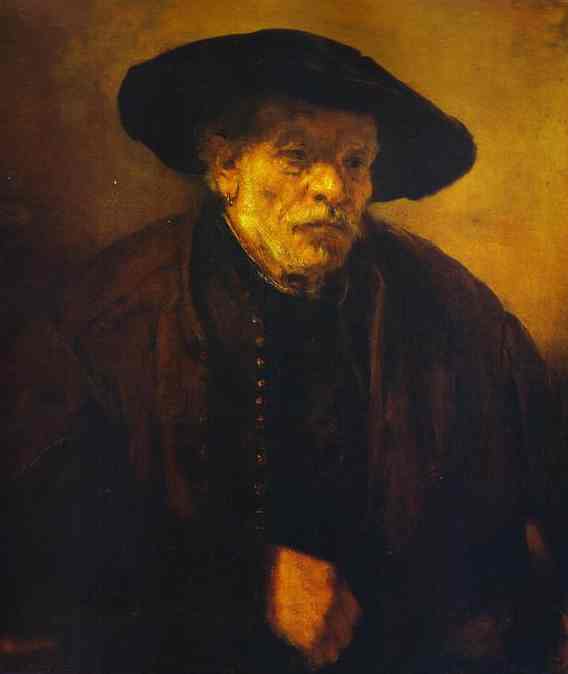
Rembrandt’s “Portrait of Rembrandt’s Brother, Andrien van Rijn” (1654) stands among the most intimate and concentrated images of kinship produced in the Dutch Golden Age. A single figure fills the canvas: an elderly man in a broad-brimmed hat and dark coat, his head slightly bowed, his face caught by a warm, slanting light. The features are unadorned, unflattering, and unmistakably human—creased brow, pitted skin, a beard that blurs into the surrounding dusk. What quickens the painting is not costume or emblem but the gravity of presence. You feel the warmth of the light, the density of the garment, the weight of years. Rembrandt does not mythologize his brother; he recognizes him. The result is a portrait that fuses familial closeness with the painter’s late technical daring: thick, living paint; abbreviated drawing; and chiaroscuro handled like compassion rather than spectacle.
A Family Likeness Anchored in Late Style
The mid-1650s were a period of artistic condensation for Rembrandt. Financial setbacks forced the sale of his grand house and many possessions, and his studio practice shed outward display for inward power. He trusted the fewest means to carry the largest truths. In this portrait of Andrien van Rijn, that late style is fully present. The background is an amber-brown atmosphere rather than a mapped interior; the palette is limited to deep umbers, black, and notes of ruddy orange; the brushwork shifts from buttery impasto on the face to soft, scumbled shadows in the coat; the light grazes rather than glares. The familial subject intensifies these choices. Painting a brother does not invite theatrical invention. It requires the slow courage of looking long at what is familiar and letting it remain itself.
Composition, Balance, and the Architecture of Light
The composition turns on a triangular geometry. The hat forms the broad base at the top edge; the shoulders drop away to create a dark triangle that funnels attention to the face; a small, blazing wedge of exposed hand low at center anchors the lower point, echoing the face’s light and stabilizing the whole. This triangle of illumination is surrounded by a chamber of brown-black quiet that keeps the eye from wandering. The body angles to the left, but the head tilts forward toward the light, creating a counter-movement that enlivens the pose. The gentle turn of the torso and the slight dip of the chin give the portrait its mood: inward, reserved, but alert to a presence just beyond the frame—perhaps the painter himself.
Chiaroscuro as Tender Disclosure
Rembrandt’s late chiaroscuro is less theatrical than empathetic. Here the light seems to arrive from high left, washing across Andrien’s forehead, settling on cheek and moustache, and then softening into the beard. It touches a string of buttons down the coat like faint sparks and explodes briefly on the hand, an unexpected glow that echoes the face’s warmth. Darkness is not threat; it is privacy. The shadow pooled under the hat brim shields the eyes enough to give them depth without draining them of life. The light discloses just what intimacy would allow you to see: not every pore, but the lived relief of a face you know.
The Face as a Map of Experience
Late Rembrandt paints faces as if they were landscapes. Andrien’s brow is a weathered ridge; his cheeks descend in rutted slopes; the moustache and beard break into crumbling edges where thick paint catches light. The nose is a stone promontory; the eye sockets are small, sheltered coves. This topography is not a catalog of age but a record of encounter. Rembrandt builds flesh with translucent veils and local impasto, allowing red undertones to glow through olive half-tones and cooler shadows to temper ruddy passages. That chromatic breathing creates the sensation of blood beneath skin. When you meet the gaze, you meet circulation as well as likeness—the living warmth of a person in a room rather than a mask on a surface.
The Hat, the Coat, and the Grammar of Restraint
Clothing here is grammar, not rhetoric. The broad black hat acts as a canopy that presses the composition downward, framing the face in a penumbra and deepening the eyes. It is painted with broad, economical strokes that record shape and weight without fussy edge-drawing. The coat, a mass of warm darkness, absorbs light the way felt or thick wool does; its long plane makes the small highlights on the buttons and hand feel almost musical. Rembrandt refuses lace, plume, and brocade. Family likeness does not require a stage. Instead, material restraint turns the viewer toward the subject’s inner weather.
The Hand as Echo and Counterweight
That glowing hand near the bottom center does more than balance the composition. It is a second portrait—a proxy for the man’s labor and temperament. The small flare of orange—a mixture likely heavy with earth pigments—repeats the face’s warmth and whispers of activity paused: a gesture interrupted to sit, a thought measured by touch. Rembrandt often allows hands to carry psychological weight equal to faces. Here the hand’s light is a human ember in the dark coat, a reminder that the sitter is not an icon but a body that can work, rest, and feel.
Surface, Substance, and the Memory of Touch
The surface of the picture is alive with decisions. Thick, buttery passages around the cheek catch illumination like mineral flecks; the beard is a web of broken strokes where bristles have dragged pigment into hairs; the hat’s dark is scumbled thinly so underlayers breathe and the plane hums rather than deadens. These textures are not mere flourish. They create a tactile equivalence between paint and material—impasto reads as whisker, scumble reads as nap, thin glaze reads as soft shadow. Because the painting remembers touch, the viewer’s eye can feel—an essential bridge when representation declines to dazzle and chooses to persuade.
A Gaze Between Availability and Reserve
Andrien’s eyes do not challenge the viewer; they regard the painter—and by extension us—with a weathered steadiness. One eye resides more in shadow, the other in light. The slight unevenness avoids the mask-like fixity of conventional portraiture and makes thought legible: a person is looking, not a symbol. The mouth participates in the same ambiguity: neither a smile nor a line of disapproval, but a soft, working rest that could rise into speech or sink into quiet. This in-between state is Rembrandt’s preferred psychological key in the 1650s. It conveys life without rhetoric.
The Background as Breathing Room
The surrounding field, a saturated amber-brown, is neither pure dark nor decorative backdrop. Wiped and glazed, it is a space of air. Its lighter zones near the head relay light into the face; deeper zones behind the coat keep the body advancing. The atmosphere does not crowd the sitter with furniture or emblems. It offers the silence in which character can speak. The effect is a portrait that feels audible—the quiet of a room in which two brothers work out, with paint and patience, the right distance between closeness and respect.
The Ethics of Kinship on Canvas
Portraits of family are a special test of an artist’s ethic. They can slide into flattery or retreat into stiffness. Rembrandt chooses neither. He grants Andrien a dignity that comes from candor. Wrinkles are not smoothed; pores are not fussed; the beard is not perfumed into curls. Yet nothing is cruel. The light is kind; the paint is generous; the pose is relaxed. This combination of truths—exactness without harshness—may be the most persuasive testimony of fraternal regard we have from the period. The artist gives his brother what every sitter desires and few receive: the freedom to remain himself.
Relation to the Tronie Tradition
Although titled as a portrait of Andrien, the picture also converses with Rembrandt’s tronies—character heads executed for the studio rather than for patrons. In tronies, he studies lighting, aging skin, beard textures, and the rhetoric of hats. Here those study habits strengthen likeness. The hat is a soft theater for light; the beard is a laboratory of impasto; the limited palette focuses perception. The painting thus stands at the fruitful intersection of study and affection: a life observed with the tools honed by years of experimentation.
Color Temperature and the Emotional Weather
The painting’s emotional weather is set by temperature. Warmth lives in the face, the hand, and the faint orange glow that pools along the left shoulder; coolness inhabits the socket shadows, the jarred blue-black notes inside the coat, and the deep hollows under the brim. The transitions between warm and cool are not abrupt; they move like breath. This thermal choreography communicates more than likeness; it communicates temperament—steadfast, measured, a life acquainted with work and dusk.
Process Revealed Rather Than Hidden
Rembrandt leaves the evidence of making in plain sight. You can find places where a highlight was pulled with the tip of a loaded brush, others where a passage was wiped and repainted, places where the ground shows through thin paint to animate a dark. Instead of sanding down these histories, he lets them stand. The surface becomes a memory of decisions—edits, hesitations, assertions—that mirror the sitter’s own life of revisions and resolve. In this way, facture becomes meaning.
Comparisons Within the 1654 Cluster
The same year saw Rembrandt produce heads of old men, studies of Hendrickje, and deeply felt domestic etchings. Across this cluster, one feels a consistent method: reduce the stage, enlarge the humanity, make light behave like thought. Compared with the theatrical costuming of earlier decades, these works are sparsely provisioned and emotionally abundant. The portrait of Andrien belongs in that circle, its power drawn not from spectacle but from a closeness that keeps company with another life rather than interpreting it from a distance.
Silence, Breath, and the Implied Sensorium
The image activates senses beyond sight. The hat seems capable of a dry whisper if brushed by a sleeve. The beard looks as if it would rasp softly under the hand. The coat’s dark absorbs sound, making the room quiet. You almost hear the slow rhythm of breath beneath the amber air. Such sensations are the fruit of Rembrandt’s surface variety and his refusal to overarticulate. By leaving edges soft and tones deep, he lets the viewer’s body complete the portrait.
The Viewer’s Vantage and the Social Contract of Looking
We meet Andrien at our own height. The horizon is neither superior nor deferential. The shared level establishes an ethical pact: we will not search for entertainment in his face; he will not posture for us. That equality, rare in seventeenth-century portraiture, is central to Rembrandt’s late humanism. He paints a person in good light and trusts that sufficient.
What the Painting Teaches About Beauty
The beauty here is not the shine of youth but the density of presence. It is the handsome afterglow that care, labor, and survival leave on a face. Rembrandt shows that beauty can be the exactness of rendering married to kindness of light. The portrait encourages a different appetite in the viewer: not for smoothness but for truth that has learned to be gentle.
Legacy and Modern Resonance
Modern eyes find this picture immediate because it declines both courtly emblem and moralizing allegory. It offers a man in a room. The palette’s austerity, the textured facture, the deep background, and the play of warm against cool all anticipate later portraiture that seeks character without ornament—think of nineteenth-century realism and twentieth-century expressionism. Yet the painting remains uniquely Rembrandt because its empathy is not programmatic; it arises from specific looking, from the minute calibration of light across a brother’s face.
Conclusion
“Portrait of Rembrandt’s Brother, Andrien van Rijn” distills the artist’s mature convictions: that the richest subject is a face at arm’s length, that the greatest resource is paint that remembers touch, and that light belongs to compassion more than to theater. The hat shades but does not hide, the coat warms without declaring status, the hand echoes the face like a small ember below a larger flame. Most of all, the picture keeps company with a particular human presence—neither polished nor pitied, simply seen. In an age crowded with images seeking attention, this canvas models a more durable ambition: to meet another life with patience, fidelity, and a light that understands where to rest.