Image source: wikiart.org
Introduction
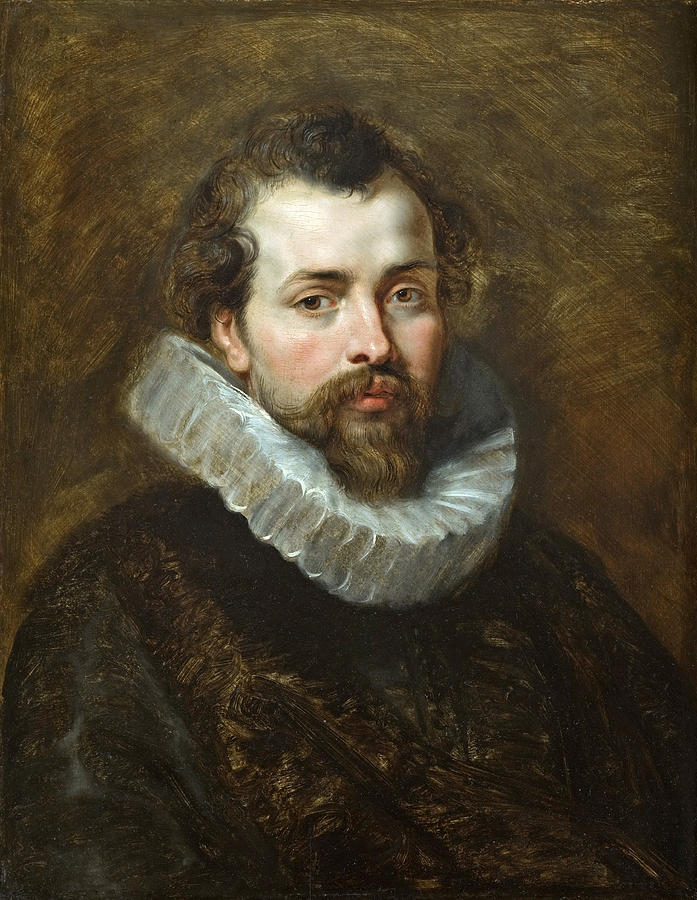
Peter Paul Rubens’s “Portrait of Philip Rubens” (1611) is both a work of filial affection and a manifesto of Baroque portraiture. Depicting the painter’s elder brother, a humanist scholar and municipal official in Antwerp, the canvas condenses erudition, status, and intimate presence into a single, radiant head-and-shoulders likeness. The composition seems simple—face, ruff, dark coat, a smoky ground—but beneath that apparent economy lies a sophisticated orchestration of light, texture, and psychology. The picture demonstrates how Rubens could paint not merely what someone looked like, but how a life had settled on the face in intelligence, patience, and understated authority.
Historical Context and Family Biography
Philip Rubens was more than a sitter of convenience. He was a prominent scholar trained in classical languages, secretary to the city of Antwerp, and a figure within the humanist circles that shaped the intellectual climate of the Southern Netherlands at the start of the Twelve Years’ Truce. The date of the portrait, 1611, places it at the moment when Peter Paul Rubens had recently returned from Italy with an expanded visual vocabulary and had assumed a leading role in Antwerp’s artistic revival. Painting his brother allowed Rubens to synthesize Italian lessons with Northern candor, while honoring a sibling whose counsel and connections were invaluable to his own career. The canvas functions as both private tribute and public image, a face readers of Latin would recognize and patrons of the arts would admire.
Composition and Framing
Rubens truncates the figure tightly, cropping at mid-chest so that the viewer meets the head almost at eye level. The pose is three-quarter, slightly turning from the left, a convention that provides dimensionality without theatrical contrivance. The background is a deep, breathed brown—less a wall than an atmosphere—swirled with broad, elastic strokes that never distract from the face. The sitter is set a little off-center toward the right, allowing the voluminous ruff to counterbalance the mass of the dark costume. This asymmetry avoids rigidity and keeps the portrait conversational: the sitter is turning toward you, not posing for a surveyor.
Light and Chiaroscuro
Illumination falls from the upper left, grazing forehead, cheek, and the curled edge of the moustache with a crisp, cool clarity. The light then feathers as it slips across the ruff, breaking into a lacework of small white accents before sinking into the coat’s velvety depths. Rubens’s chiaroscuro has less of the Caravaggesque theatrical spotlight and more of a Venetian warmth; shadows are translucent, color-bearing, and alive. The effect is incarnation rather than display: the sitter appears to occupy the same air we breathe, with skin that seems warmed by circulating blood, not varnish.
The Face as a Field of Character
The head carries the portrait’s meaning. Philip’s forehead is open and high, the hairline irregular but vigorous, with small curls handling the light like miniature wavelets. The brow is strong but relaxed; the eyes are moist, set deep, and subtly asymmetrical in a way that enlivens the gaze. Rubens places a pinpoint catch-light in each pupil to arrest attention without fetishizing detail. The nose is long, balanced by the moustache’s soft wings, which join a carefully combed, bifurcated beard. The mouth is slightly parted, as if the sitter has just finished a thought or expects a question. This combination of mild alertness and ease gives the portrait a conversational tempo often missing from courtly likenesses. Intellect and kindness register together.
The Ruff as Architecture and Theater of Touch
The ruff is more than fashion; it is an architectural marvel of starched linen that frames the head like a circular stage. Rubens delights in its material truth. He builds the form with broad planes of cool gray white, then crystallizes the serrated edges and internal pleats with small, opaque touches. The paint catches, breaks, and continues in a rhythm that mimics the hand of a laundress and the discipline of starch. The ruff’s luminous ring increases separation between head and ground while echoing the subtle glows on forehead and cheek, creating a halo effect without religious symbolism: the sanctity here is that of cultivated civility.
Costume and Social Coding
The coat is black or a very deep brown, cut in the sober fashion of a learned official. Rubens refuses the temptation to over-describe; there are no embroidered fantasies, only the suggestion of pile and seam. The modesty of the garment focuses attention on the face and the ruff while speaking a social language of restraint, piety, and industry valued in Antwerp. Within this economy of costume, the painter uses brushwork to keep the surface alive: directional sweeps indicate the warp of cloth; scumbles suggest worn sheen at the shoulder; a sudden dark notch implies a fold. These passages reward close looking and affirm that the world of things—however restrained—has tactility and history.
Brushwork and the Breath of Paint
Rubens’s handling here is a masterclass in economy. The face is modeled with fused, wet-into-wet transitions; tones melt into one another as if the flesh were living under the brush. The beard and hair are networks of filaments laid with supple, calligraphic strokes, occasionally loaded with a lighter tone to catch a curl’s rim. The ruff is a mixture of fluid planes and crisp edges placed late to snap its geometry into focus. The background is a storm of loose, confident sweeps that envelop the head like air in a room. The result is a surface that breathes—firm where it must be, suggestive where it can be—exactly the balance that makes Rubens’s portraits feel modern.
Psychological Presence and the Ethics of Looking
Great portraiture negotiates two obligations: it must record likeness and it must render presence. Rubens fulfills both by painting Philip neither as an emblem of learning nor as a private, anecdotal self. Instead, he gives us a man inhabiting his station with humane poise. The gaze meets ours without dominance; the head turns as if in discussion; the mouth’s slight openness invites rather than concludes. The viewer feels let in, not lectured to. This reciprocity constitutes an ethics of looking: we attend respectfully, and the sitter attends back, an exchange of dignity across centuries.
Italian Lessons and Northern Truth
Rubens’s decade in Italy left marks: the sculptural modeling of head and neck recalls monuments he studied; the warmth of color in flesh and the liquid transitions nod to Venetian masters; the confident, animated ruff owes something to Veronese’s fabric bravura. Yet the sensibility is decisively Northern. The textures are tactile, the light tempered, the import understated. Italian grandeur is moderated by Flemish intimacy. The synthesis makes the portrait both public and private, suitable for display in a learned home yet capable of companionable closeness when viewed near.
Comparisons and Workshop Influence
Placed beside later portraits by Van Dyck—Rubens’s most gifted assistant—the “Portrait of Philip Rubens” appears more muscular in paint handling and slightly earthier in tone. Van Dyck would push elegance and elongation; Rubens keeps an honest weight in the head and a physicality in the ruff. Yet the lineage is clear: the attention to the sitter’s inner life, the orchestration of subdued costume against animated flesh, and the belief that a portrait is a social encounter in paint all pass from this canvas into the younger artist’s oeuvre. Within Rubens’s own workshop, the painting sets a standard for the level of finish and psychological depth expected for elite patrons.
The Background as Active Space
Though seemingly neutral, the ground is accomplished. Rubens riffs on a warm, umbered base, then moves the brush in broad arcs that curve around the head. These gestures are not random; they coax the eye to orbit the face and ruff, providing a subtle kinetic field that counteracts any stiffness. The darker lower left recedes behind the shoulder; a lighter sweep behind the ruff lifts the head gently forward. The space is thus neither a flat wall nor a window onto nowhere; it is a painted atmosphere that collaborates with the figure.
Humanist Ideals in Portrait Form
Philip Rubens’s career as a classicist and civic officer is legible in the portrait without overt symbols. The clarity of light implies clarity of mind; the discipline of the ruff and coat corresponds to professional probity; the modest turn of the head suggests a life attuned to conversation rather than proclamation. In an age suspicious of empty display, this visual rhetoric mattered. The painting advances the proposition that learning produces character, not vanity, and that the face bears the imprint of a life spent in letters and service.
Color Harmony and Flesh
Rubens tunes the palette to a restrained chord: umbers and olive-browns in the background, pearly grays in the ruff, warm rose and ochre in the flesh, softened charcoal and cocoa in the hair and beard. Small, strategic notes—an ember at the inner lower lip, a cool glint near the eye, a bluish halftone along the jaw—keep the head from sinking into monotony. This chromatic discipline allows each hue to resonate. Flesh appears alive because it is not a single pink but a conversation of warms and cools that simulate circulation and thickness.
Time, Mortality, and Tenderness
While not a memento mori, the portrait hints at time. The hairline is beginning to retreat; the under-eyes show the faint, soft pads of middle age; the beard carries a whisper of gray. Rubens does not correct these as defects. He paints them with affection, the tenderness of a brother who knows the person beyond the features. The effect is moving: dignity without idealization, authority without hardness, beauty without youth worship.
The Viewer’s Vantage and Encounter
Standing before the canvas, you experience a face at a human distance. The tight crop and life-size scale make the encounter intimate but not invasive. There is room for breath between viewer and sitter, an interval that feels like the space at a study table or a corridor conversation in Antwerp’s town hall. That measured proximity is a hallmark of Rubens’s portrait sense: he places you close enough to appreciate the living texture of paint while honoring the sitter’s reserve.
Function, Ownership, and Display
Painted likely for family or close circle, the portrait would have hung in a domestic setting where visitors of rank and learning gathered. Its task was to affirm bonds—of kinship, of humanist fellowship, of civic trust—while providing company in rooms where the written word preoccupied the day. The work’s durable appeal comes from that original function: it is a face you can live with, a presence that steadies rather than dazzles.
Technique Conserving Likeness
Rubens preserves likeness by avoiding both pedantic detail and generic formula. He maps the skull carefully, aligning ear, eye, and nose with quiet accuracy. He lets idiosyncrasies remain—the slight asymmetry in eyelids, the particular droop of moustache ends, the unique swell of lower lip. These specificities anchor recognition while his broader rhetoric—light, ruff, ground—elevates the image into a type of the learned gentleman. The painting thus performs a double fidelity: to the man and to the ideal he served.
Legacy and Contemporary Appeal
Modern viewers, accustomed to photographic realism, still find the portrait striking because it exceeds description. The face looks back with thought, the paint retains the energy of its making, and the whole resists a single mood. You can read confidence one day, fatigue the next; curiosity in one glance, reserve in another. That openness is why the picture continues to circulate in books and galleries as an exemplar of humane portraiture. It teaches how to see people—through surfaces into character—without pretending to exhaust their mystery.
Conclusion
“Portrait of Philip Rubens” is a compact masterpiece of presence. It marries Italian breadth with Flemish intimacy, architectural ruff with breathing flesh, public dignity with fraternal tenderness. In a world rebuilding its civic culture, Rubens offers a face that embodies its ideals: learned, judicious, and kind. The painting demonstrates how portraiture, at its best, is neither mask nor mirror but conversation—between artist and sitter, between past and present, and, finally, between the person on the canvas and the person who stands before it.