Image source: wikiart.org
Introduction
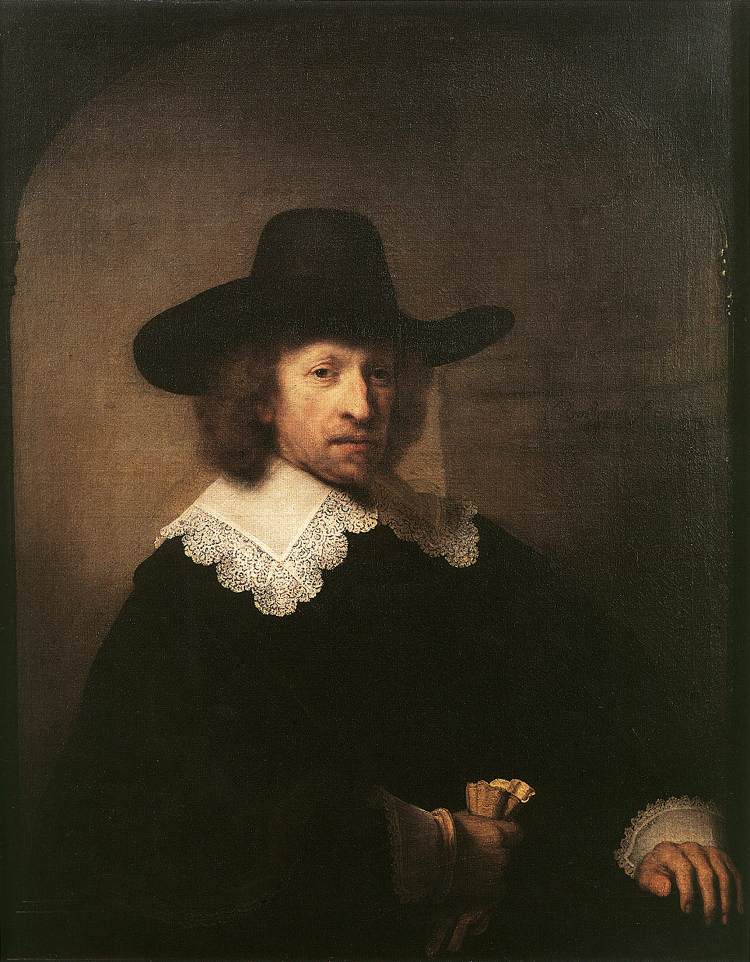
Rembrandt’s “Portrait of Nicolas van Bambeeck” (1641) is a masterclass in how light and psychology can transform a seemingly restrained merchant likeness into a living presence. The sitter, a prosperous Amsterdam cloth dealer and civic figure, faces us in a three-quarter view beneath a broad black hat, his figure anchored by an immaculate lace collar and the discreet glint of cuff and glove. The painting’s dark field is not emptiness but atmosphere: a warm dusk against which Rembrandt calibrates every nuance of skin, lace, and felt. What begins as a record of status becomes, under the artist’s hand, an intimate study of character—alert, reserved, and quietly authoritative.
Composition, Pose, and the Architecture of Reserve
Rembrandt situates Nicolas van Bambeeck within a shallow niche suggested by a soft arch at the left edge. This architectural hint both frames and protects the figure, echoing the sitter’s self-containment. The body turns slightly to the right, while the head rotates back toward the viewer, creating the quintessential Dutch three-quarter pose that invites engagement without sacrificing decorum. The sitter’s right hand rests near the lower edge, holding a glove, while the left hand disappears within the darkness, its cuff catching a thread of light. The diagonals formed by forearm, collar, and hat brim guide attention to the face, whose calm, measuring gaze anchors the entire construction.
Light as a Language of Character
Illumination from the upper left falls across the hat brim and breaks upon the sitter’s face like a quiet tide, sparing in volume but rich in implication. The light describes not only form—the modeling of cheekbone, the shallow groove beside the mouth, the narrow bridge of the nose—but temperament. Nicolas’s eyes do not glitter; they absorb. The subdued sheen on the lace collar and cuffs conveys a man attentive to quality yet uninterested in ostentation. Rembrandt’s chiaroscuro is never theatrically harsh here; it is the kind of light that belongs to counting rooms and council chambers, an environment in which judgment is exercised with steady competence.
The Palette of Black and Its Subtle Variations
Dutch portraiture of the mid-seventeenth century favored black garments as signs of sobriety and virtue. Rembrandt embraces that convention while expanding its chromatic possibilities. The costume’s “black” is, in fact, a symphony of glazes—warm umbers layered over cool blue-blacks, with granular browns along the sleeve where the fabric catches stray light. The hat is a dense, velvety mass that absorbs illumination; the doublet, by contrast, has a softer, brushed surface that reflects a dim luster. These shifts make the body legible within the darkness and give the black costume the richness of a color rather than the flatness of an absence.
The Lace Collar: Discipline and Flourish
If the garment is a field of moderated blacks, the collar is the painting’s white aria. Rembrandt articulates the lace with a net of small strokes and touches of impasto, catching light on each scalloped edge. The collar’s crisp geometry, with its V-shaped fall and shallow frill, forms a visual crossbar beneath the face. It promises reliability: the edges are deliberate, the pattern firm. Yet Rembrandt resists diagrammatic description; he suggests rather than inventories. The lace reads vividly at a distance and dissolves into painterly energy up close—a balance of discipline and flourish befitting a successful merchant.
Hands, Glove, and the Etiquette of Portraiture
The right hand clasps a single glove, its pale leather catching more light than any other object besides the collar. In the visual rhetoric of the day, gloves could signal propriety, wealth, and readiness to act in public life. Here the glove also solves a pictorial challenge: it delivers a pale note low in the composition, counterbalancing the face and preventing the painting from becoming top-heavy. The gesture is measured, neither boastful nor stiff, as if Nicolas has turned from a conversation long enough to be painted, glove still in hand.
The Psychological Register: Alertness without Aggression
Rembrandt’s portraits seldom flatter by smoothing away irregularities; they honor the truth of faces. Nicolas’s gently asymmetrical mouth, the faint downward tilt at one corner, and the slight shadow under the lower lip offer a language of thoughtfulness. The eyes, set under the brim’s shade, engage us directly yet guardedly. This is a man accustomed to appraisal—of cloth, of contracts, of people. Rembrandt captures the readiness of a mind that moves more quickly than his body lets on. There is nothing theatrical here, only the drama of attention.
Pendant Portraits and the Social Frame
“Portrait of Nicolas van Bambeeck” is a pendant to Rembrandt’s portrait of Agatha Bas, the sitter’s wife, painted the same year. Together they perform an elegant social script: he in sober black, she in luminous dress offering a fan; he receding slightly into darkness, she bathed in a softer glow. The pairing clarifies Rembrandt’s sensitivity to gendered conventions without reducing individuality. Nicolas’s restraint complements Agatha’s gracious openness, and the two works share proportional scale and a compatible light so they can converse across a room. In this context the glove, his neat lace, and the centered pose become emblems of steadiness within the household alliance.
Background as Breath and Boundary
The background appears plain, but its tonal gradations are meticulous. Rembrandt lets a warmer brown hover behind the head and hat so that the contour reads crisply, while cooler, darker passages along the right edge deepen the inward turn of the body. The faint arch on the left is both a compositional bracket and a cue to depth, like a stage proscenium that frames the actor without enclosing him. This tender modulation of space lets the portrait breathe; Nicolas does not press against the picture plane, nor does he sink into gloom.
Paint Handling: From Whisper to Statement
The face is built in thin, translucent layers that allow warmth to rise through cool flesh tones, a method that yields Rembrandt’s famed inner radiance. In the collar and cuffs he switches to stiffer, chalky touches that produce crispness. The glove’s highlights are laid with buttery impasto, giving the leather a tangible softness. Feathered edges where the hat meets the background allow shadow to creep into form, eliminating hardness. The aggregate is a vocabulary of marks that move from whisper to statement, always at the service of character.
Costume, Class, and the Values of Amsterdam
Nicolas van Bambeeck’s attire declares him a man of means, education, and civic usefulness. Seventeenth-century Amsterdam prized merchants who combined profit with probity, and the portrait speaks that language fluently. There are no ostentatious chains or velvet capes, no marble columns or draperies muscling for attention. The few luxuries—fine lace, a good hat, the fashionable gloves—are worn with measured confidence. Rembrandt’s treatment aligns the sitter with a class that governed the city through guilds and burgomasters, anchoring personal identity within communal values.
The Hat as a Dramatic Device
The broad-brimmed hat is more than costume; it is a dramatic instrument that shapes how light meets the face. Its lower rim shaves a thin band of shadow across the brow, intensifying the eyes while leaving the nose and mouth fully modeled. It adds breadth to the head, asserting presence without swagger. As an abstract form, the hat’s curve mirrors the arching niche, subtly weaving sitter and setting together. Through such echoes Rembrandt achieves cohesion with minimal means.
A Conversation with Earlier Portrait Traditions
Rembrandt’s portrait responds to, and revises, earlier Netherlandish and Italian models. From the Netherlands he inherits the love of tactile truth—lace that feels touchable, leather that seems to give under pressure. From Italy he borrows the notion of the bust-length figure placed before a neutral ground, a rhetorical format that isolates character from distraction. Yet he turns both sources inward, trading pageantry for thought. The result is a portrait that speaks less of lineage or office than of temperament shaped by civic life.
Time, Mortality, and the Ethics of Seeing
There is a quiet memento mori in Rembrandt’s restrained palette and the glove’s pale note, but it is not admonitory. Instead it is ethical: a reminder that painter and sitter alike are mortal, that likeness is a contract with time. Rembrandt meets that contract by resisting flattering idealization. He paints a man whose power lies in steadiness—the sort of person a city trusts with its accounts and negotiations. The ethics reside in attention itself, in the honest labor of seeing.
The Viewer’s Experience: Distance that Invites Nearness
At first glance, the portrait holds the viewer at a respectful distance. The dark field and composed posture ask us to approach slowly. Yet as we step closer, the varnish of formality dissolves into human texture: the warmth at the ear, the soft swell of cheek, the tiny irregularities of lace rendered with loving economy. This oscillation between social distance and sensory nearness is central to the painting’s power. Rembrandt builds a space where dignity and intimacy can coexist.
Relationship to the Artist’s 1640–1642 Period
The early 1640s were a period of compositional clarity and psychological depth in Rembrandt’s portrait practice. He simplified backdrops, intensified the orchestration of light, and lavished attention on hands and accessories as carriers of meaning. The “Portrait of Nicolas van Bambeeck” sits squarely within this vein. Compared with earlier, more ornamental portraits, it feels distilled; compared with later, rougher canvases, it is taut and refined. It marks a moment when Rembrandt could satisfy the expectations of prosperous patrons while expanding the possibilities of the genre.
Conservation, Surface, and the Glow of Age
The painting’s current surface—its warm tonality and the gentle synthesis of blacks and browns—suggests a sequence of transparent glazes that have matured into honeyed depths. Where highlights retain impasto, particularly on the glove and lace, they stand proud of the surface, catching light as they did in Rembrandt’s studio. Subtle craquelure across the dark field introduces a material rhythm that harmonizes with the sober mood, as if time itself had joined the portrait’s quiet conversation.
Legacy and Influence
This portrait remains a touchstone for understanding how Dutch painters turned the language of commerce into visual poise. Artists after Rembrandt learned from its restraint and from its insistence that wealth could be represented through control of means rather than multiplication of objects. Modern viewers recognize in Nicolas van Bambeeck not a type but a person—thoughtful, slightly guarded, with humor held in reserve. The painting’s influence lies in that recognition: the sense that a face can be both public mask and private weather.
Conclusion
“Portrait of Nicolas van Bambeeck” is a triumph of understatement. Rembrandt composes the sitter with a few carefully chosen elements—broad hat, lace collar, glove, calm gaze—and allows light to do the rest. Every decision serves character: the black costume’s nuanced depths, the collar’s disciplined brilliance, the glove’s pale interruption, the niche’s protective curve. The result is a likeness that feels contemporary in its psychological precision and deeply of its time in its moral poise. In a culture that valued balance and integrity, Rembrandt gives us a man who embodies both, rendered with a sympathy that has outlasted the centuries.