Image source: wikiart.org
Introduction to Portrait of Nicolas Omasur by Bartolome Esteban Murillo
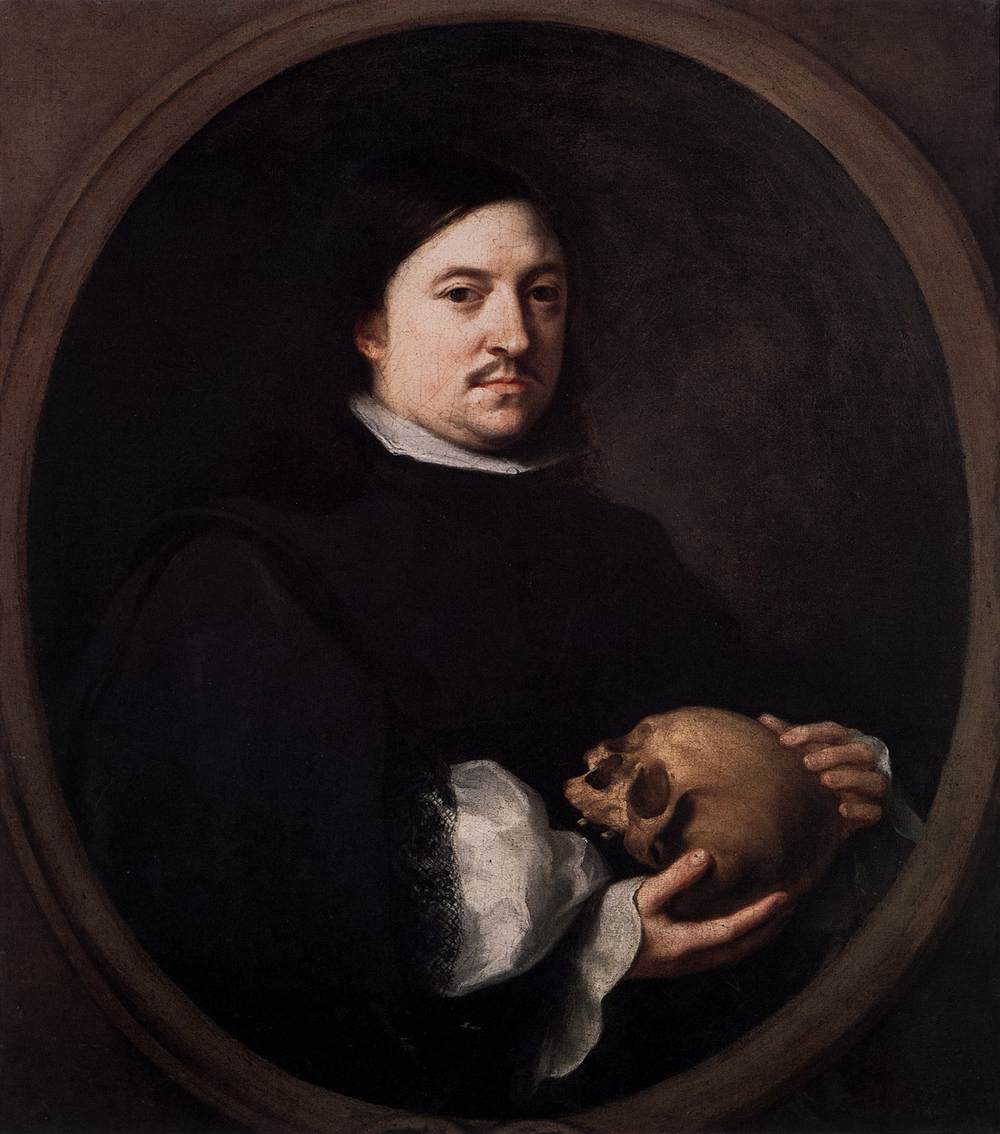
“Portrait of Nicolas Omasur,” painted in 1672 by Bartolome Esteban Murillo, is a striking example of Spanish Baroque portraiture and of Murillo’s mature style. The sitter is presented half length within an oval frame, dressed in sober black, his hands gently cradling a human skull. His calm yet penetrating gaze meets the viewer, while the skull introduces a powerful vanitas theme that speaks about the passing of time and the inevitability of death.
This painting combines psychological insight, social identity and spiritual reflection. Murillo was celebrated mainly for religious works, yet he was also a gifted portraitist who captured the leading figures of Seville. In this work he blends the conventions of formal portraiture with symbolic elements that encourage deep contemplation. The result is an image that is both a likeness of a real man and a timeless meditation on mortality.
Historical Context and the Life of Nicolas Omasur
Nicolas Omasur was a member of the thriving merchant community in seventeenth century Seville. The city was then one of the principal ports of the Spanish empire, linked to trade routes that reached across the Atlantic. Merchants, many of them of Flemish or northern European origin, played a crucial role in its economic life.
By commissioning a portrait from Murillo, one of Seville’s most distinguished painters, Omasur aligned himself with the cultured and prosperous elite. The dark clothing, starched white collar and well groomed mustache all indicate a man of status and refinement. Yet the portrait does more than record material success. By holding a skull in his hands, Omasur presents himself as someone who reflects on the transient nature of worldly fortune, and perhaps on the state of his own soul.
In this way the painting reflects the intense religious atmosphere of Counter Reformation Spain, where meditation on death and judgment was considered an important spiritual exercise. A successful merchant could be admired for his wealth, but he was also expected to cultivate humility before God. Murillo’s portrait captures this duality with great sensitivity.
Composition and the Framing Oval
One of the most distinctive elements of the portrait is the painted oval frame that encloses the figure. Murillo places Omasur within this fictive stone or wooden surround, giving the impression that we are looking through an opening in a wall at a living person. The oval serves several purposes.
Visually, it tightens the composition and focuses attention on the upper body, face and hands of the sitter. The curves of the oval contrast with the vertical fall of the cloak and the horizontal line of the collar, creating a subtle rhythm that guides the eye. Symbolically, the frame can be read as a threshold between the world of the viewer and the interior space of the painting, or even between life and death, an idea strengthened by the presence of the skull.
The figure is slightly off center, leaning gently toward the left, while the skull is held at the lower right. This asymmetry enlivens the portrait and prevents it from feeling static. Omasur’s head is close to the top of the oval, establishing a strong presence, while his hands anchor the composition at the bottom. The result is a stable but dynamic arrangement that keeps viewer interest anchored on the interaction between face and skull.
Light, Shadow and Color
Murillo’s mastery of light and shadow is central to the mood of this portrait. The background is almost entirely dark, a deep brown and black field that recedes into obscurity. Against this darkness, the illuminated face, collar, cuffs and skull emerge with remarkable clarity. The light falls from the left, grazing the sitter’s cheek and forehead, then touching the white linen and the bone of the skull.
This controlled lighting not only models the forms but also creates a dramatic atmosphere. The face is softly lit, with delicate transitions between light and shadow that give a sense of three dimensional presence. The eyes, slightly shadowed yet still gleaming, convey intelligence and introspection. The skull catches a warmer light, its tawny surface contrasting with the cooler tones of the flesh.
Color is used sparingly but effectively. The dominant black of the clothing speaks of sobriety and seriousness. The whites of the collar and cuffs act as highlights, framing the hands and face. Tiny touches of pink in the fingertips and lips suggest living blood beneath the skin. The warm buff of the skull suggests age and dryness, enhancing the contrast between living flesh and lifeless bone. Murillo’s restrained palette reinforces the meditative character of the work.
The Psychology of the Gaze
One of the most compelling aspects of the portrait is the way Omasur looks out of the painting. He does not confront the viewer with aggressive confidence, nor does he withdraw into private contemplation. Instead, his gaze is calm, thoughtful and slightly reserved. The eyes are directed straight toward us, yet the expression is meditative, as if a part of his attention remains absorbed in the skull he holds.
This dual focus creates a layered psychological effect. On the surface, Omasur presents himself as a dignified and self aware individual. At a deeper level, his expression suggests a man who has considered the meaning of mortality and who acknowledges it even while he poses for his likeness. That complexity is what gives the portrait its enduring fascination. The viewer senses a real personality behind the painted surface.
Murillo’s skill lies in capturing this inner life without resorting to theatrical gestures. There are no exaggerated frowns or dramatic hand movements. Instead, subtle details convey character: the slight compression of the lips, the gentle crease between the brows, the firmness yet relaxation of the hands around the skull. Through these details, the sitter appears intelligent, controlled and somewhat introspective, a man who has weighed his responsibilities and his fate.
The Skull as Vanitas Symbol
The human skull is the key symbolic element in the painting. In seventeenth century European art, skulls frequently appear as vanitas symbols, reminders of the fragility of earthly life and the futility of placing trust in wealth or fame. In Spain, where religious orders promoted meditations on death as a path to spiritual renewal, such symbols were especially meaningful.
By asking Murillo to include a skull, Omasur aligns himself with this tradition of memento mori imagery. He does not distance himself from the skull but holds it gently, almost reverently, as one might hold a cherished object or a fragile relic. His hands cradle it in a way that suggests acceptance rather than horror. This relationship implies that he has made peace with the thought of death, or at least that he is willing to confront it directly.
The skull also has a compositional role, balancing the mass of the upper body and drawing attention to the hands. Its rounded contours echo the oval frame and the curve of Omasur’s head, creating a subtle visual echo across the painting. The bone color stands out against the dark cloak, ensuring that the viewer cannot ignore this stark reminder of mortality. Thus, form and meaning work together to make the vanitas message central to the portrait.
Hands, Fabric and the Sensuality of Paint
Murillo devotes considerable attention to the rendering of hands and fabric. The hands are finely observed, with slightly reddened knuckles, subtle veins and soft shadows between the fingers. The nails are short and clean, suggesting a man who is not engaged in manual labor but who is still very much in touch with the physical world. The tenderness of the grip on the skull reveals a sense of care and deliberation.
The clothing is painted with broad yet controlled strokes. The heavy black cloak absorbs the light, its folds indicated by variations in tone rather than sharp outlines. This gives it weight and depth while keeping it subordinate to the more important areas of face and hands. The lace trim at the cuffs is described with quick, delicate touches of white and gray, capturing the sparkle of light on fine threads without overloading the painting with detail.
These details remind the viewer that Murillo is not only a painter of spiritual themes but also a master of material textures. The contrast between smooth skull, soft skin, crisp linen and heavy cloth adds sensory richness to the work. This tactile dimension grounds the lofty meditation on mortality in the tangible reality of the world.
Murillo as Portraitist within the Spanish Baroque
Murillo is often associated with religious scenes and tender depictions of the Virgin and Child, yet his portraits reveal another side of his talent. Spanish Baroque portraiture was shaped by artists such as Velázquez, who emphasized naturalism, psychological penetration and subdued elegance. Murillo shares many of these qualities, but he tends to soften them with a warmer, more intimate approach.
In “Portrait of Nicolas Omasur” he adopts the sober palette and simple background typical of Spanish portraiture, which avoided excessive luxury in favor of moral seriousness. At the same time, his modeling of the flesh and his handling of light give the sitter a gentle humanity. The inclusion of a vanitas symbol aligns the portrait with broader European trends, where scholars, merchants and nobles sometimes commissioned likenesses with skulls, books or hourglasses to signal learning and spiritual awareness.
Within Murillo’s oeuvre, this work stands out as a refined synthesis of local tradition and international currents. It shows that he could adapt his essentially devotional sensibility to the representation of a layperson, presenting a worldly man as a thoughtful Christian conscious of the limits of life.
Spiritual and Moral Themes
Although the painting is a portrait, it functions at the same time as a moral image. The viewer is invited to reflect on the same truth that Omasur contemplates: that wealth, reputation and physical presence are temporary, while the soul’s destiny is eternal. The absence of any luxurious background, objects of trade or symbols of worldly success reinforces this message. Instead of ledgers, ships or merchandise, the only object he holds is a skull.
This choice suggests that Omasur wishes to be remembered not merely as a successful merchant, but as a man concerned with his spiritual state. The portrait becomes a statement of values. It declares that a wise person keeps death in mind, not out of despair but in order to live more rightly. For a devout seventeenth century audience, such an image would encourage penitence, humility and preparation for the afterlife.
The painting can also speak to viewers today. In a world filled with distractions and material ambitions, the calm figure holding a skull reminds us of the importance of perspective. The image encourages a pause, a moment to consider what truly endures when all external achievements fall away.
The Timeless Appeal of the Portrait
“Portrait of Nicolas Omasur” continues to attract viewers because it operates on several levels at once. It is a record of a specific individual from a particular time and place, but it also expresses universal themes of identity, mortality and introspection. The combination of sober design, rich symbolism and subtle emotional depth makes the work enduringly compelling.
Murillo’s restrained but expressive style avoids both sentimentality and coldness. The sitter is neither idealized beyond recognition nor reduced to a mere type. Instead, he appears as a fully realized human being, with his own mixture of pride, reflection and vulnerability. The skull adds a layer of philosophical seriousness without overshadowing the individuality of Omasur himself.
For historians, the painting provides insight into the values and social structures of seventeenth century Seville. For art lovers, it offers a masterclass in Baroque portraiture. For ordinary viewers, it offers a quiet but powerful meditation on the human condition. All of these dimensions contribute to the painting’s lasting significance.
Conclusion
“Portrait of Nicolas Omasur” by Bartolome Esteban Murillo is more than merely a fine likeness of a seventeenth century merchant. It is a carefully constructed visual statement about life, death and spiritual responsibility. Through its oval framing, dramatic lighting, controlled palette and evocative symbolism, the painting brings together the worldly status of its sitter and the eternal questions that underlie human existence.
Murillo’s sensitive handling of the face, hands and skull invites viewers into a space of contemplation. The sitter’s calm gaze reaches across centuries, asking us to consider, as he does, the meaning of our lives in the light of their inevitable end. In this union of personal portrait and vanitas meditation lies the enduring power of the work, and the reason it remains a compelling masterpiece of Spanish Baroque art.