Image source: wikiart.org
Introduction
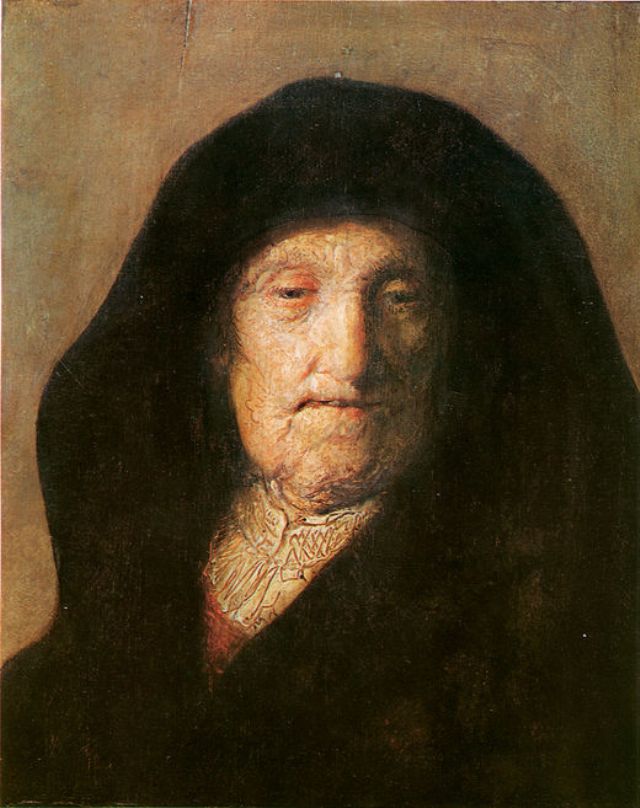
Rembrandt’s “Portrait of Mother of Rembrandt” (1630) is a small painting with the emotional scale of a monument. The sitter, traditionally identified as Neeltgen Willemsdr. van Zuytbrouck, appears wrapped in a dark hood that frames her furrowed face like a soft architecture. A milky light glides across her brow and cheek, pauses at the edge of her mouth, and then dissolves into the warm dusk of the garment. Nothing in the panel feels ornamental; every mark serves the task of describing a life recorded in skin. Made during Rembrandt’s final Leiden years, this study belongs to his family of early tronies—heads painted for expression and character rather than commission—yet it reads with the gravity of filial attention. The work is a meditation on aging, intimacy, and the capacity of light to confer dignity.
The Leiden Context And The Freedom Of The Tronie
In 1630 Rembrandt was still in Leiden, refining the visual language that would power his Amsterdam career. The tronie format gave him freedom from patronal likeness and decorative mandate. He could choose costume for tone, adjust pose for psychological clarity, and orchestrate light as the central actor. In this portrait he selects a plain dark hood and a modest collar with a hint of crimson beneath. The economy frees the eye for the face and allows the artist to test how much truth can be expressed with the fewest means. While many tronies exaggerate character into type, this one resists caricature. The mother is neither icon of piety nor emblem of old age; she is a particular person observed with filial exactness.
Composition As a Sanctuary For The Face
The composition is a lesson in concentration. The dark hood fills the upper field like a semicircle, narrowing the world to a window around the head. The curve echoes the oval of the face and the rounded chin, building a rhythm of nested forms that draws the gaze inward. There is no distracting background, no spatial illusion to dilute presence. The head is fractionally turned and slightly lowered, a posture at once modest and assured. The small panel format intensifies the encounter; we stand within conversational distance, as if the artist has stepped closer to understand how light rests on his mother’s skin. The frame becomes a sanctuary in which time slows and attention has weight.
Light That Reads Like Affection
Rembrandt’s light behaves here like affection. It finds the forehead with a warm, almost pearly brightness; slides over the long bridge of the nose; and collects softly at the cheekbone before fading into the hood’s dark velvet. The illumination is local, as if from a nearby window. It does not dramatize so much as disclose. The light does not seek theatrical contrast; it aims for silence and truth. Because it is restrained, its meanings feel intimate: care, clarity, the patient seeing that family members grant one another when words are unnecessary. The half-shadows around the eyes and mouth are not signs of gloom but of depth, places where thought and breath gather.
The Face As A Landscape Of Time
Look slowly at the skin and the picture transforms into a topography. The forehead is crossed by shallow ridges that soften as they approach the temples. The cheeks hold a web of fine creases; the eyelids appear thin and gently swollen; the upper lip sags a little into the valley between lip and chin. Rembrandt notes everything, but he refuses exaggeration. The lines live in real skin; they do not harden into moralizing emblem. The slightly parted mouth and lowered gaze suggest that the sitter was not posing for a grand moment but simply being herself under a son’s steady eye. The portrait converts the visible effects of time into a narrative of endurance without a word of sentimentality.
The Hood, The Collar, And The Ethics Of Simplicity
Costume here is eloquent in its restraint. The dark hood frames the face like a soft proscenium and drinks light so the flesh can glow. Its surface is painted with broad, quiet strokes; Rembrandt avoids descriptive fuss, letting the garment serve as an atmosphere instead of a subject. Beneath it, a narrow collar edged with stitched pattern lifts at the throat, catching pale highlights that reinforce the column of the neck. A whisper of red at the chest warms the picture’s center of gravity. These decisions keep status and narrative out of the frame. The sitter does not perform class or role; she inhabits personhood.
The Brushwork Of Flesh And Breath
Rembrandt’s handling is frank and varied. He builds the flesh with thin glazes that allow warmth to infuse from beneath, then caps the highest points—the forehead ridge, the upper cheek, the tip of the nose—with opaque, lightly impasted touches that catch real light across the surface. Around the mouth and eyelids he uses minute, tremulous strokes that mimic the fragile texture of aging skin. The hood receives broader, more directionless sweeps, a calm foil to the granular description of the face. A few soft scumbles near the jaw let the ground peep through, keeping the edge alive and refusing the hard silhouette that would shut the head away from the surrounding air. Paint here behaves like breath: variable, responsive, and human.
Chiaroscuro That Protects Dignity
The painting’s chiaroscuro is tight but tender. Darkness settles in the hood and under the chin, yet it never collapses into theatrical black. Transitional half-tones mediate every passage, so the sitter never feels cut out by spotlight. This moderation protects dignity. The face is not yanked forward onstage; it is allowed to rest in its own weather. Even the left side of the face—more submerged in shadow—retains information: a faint eyebrow, the downturned corner of the mouth, the shallow bowl of the eye. The balance suggests an ethical stance: attention without invasion, disclosure without exposure.
Psychology In The Small Decisions
This portrait’s psychology emerges from small decisions rather than overt drama. The eyes look slightly down and inward; the mouth remains relaxed but closed; the chin presses softly into the flesh of the neck. We are in the presence of someone who has learned to keep counsel, to weigh words before offering them. The lines at the corner of the mouth do not read as bitterness but as experience. The painting refuses both the sweetness of sentimental motherhood and the austerity of saintly archetype. Instead it presents a human being whose inwardness commands respect, and whose image is shaped as much by memory as by optics.
The Viewer’s Position And The Contract Of Nearness
Rembrandt places us close, yet he sets terms for the encounter. The hood’s dark edges function almost like curtains, shaping a private space around the head. The lowered gaze signals that we are permitted to look but not to demand a response. That contract of nearness is one of the painter’s signature achievements. It allows the viewer to feel involved without becoming intrusive. We share the artist’s seat at the bedside or window, practicing his discipline of attentive seeing. The painting teaches a way of looking: quiet, unhurried, grateful.
Color Harmony And The Music Of Warmth
The palette appears limited yet sings. Amber, raw umber, and warm gray dominate, enriched by the nearly black hood and the small, insistent red beneath the collar. The flesh tones move from peach at the highlighted cheek to cool rose in the eyelids and nose, and then into muted violets in the shadowed hollows. This controlled harmony makes the skin believable and the mood inward. The single strongest color—red at the chest—glows like a banked coal, hinting at vitality beneath age. The music of the image is low and sustained, never loud, but resonant enough to carry across centuries.
Kinship With Rembrandt’s Early Family Studies
Throughout 1629–1631 Rembrandt made drawings, etchings, and small oils of elders—often believed to be family members—heads bowed, eyes lowered, faces lit like pages of Scripture. This portrait participates in that exploration but adds the particular intimacy of filial relation. Where other “old woman” tronies risk generalization, this panel insists on specificity. The distance between exercise and offering is bridged by the way the paint lingers on the face as if on familiar ground. If we place this work beside the artist’s later images of Saskia, of scholars, and of himself, we can trace a continuous ethic: images are not trophies; they are acts of recognition.
Material Presence And The Beauty Of Imperfection
The panel bears small irregularities—hairline fissures in the paint surface, gentle abrasions near the edges—that suit the subject. Rembrandt does not hide the material truth of his medium any more than he smooths the life from the skin before him. These minor imperfections make the painting feel lived-in, like a family object kept close at hand rather than sealed in a cabinet. The work models a beauty founded not on flawlessness but on candor. The same principle animates the face: the skin’s irregularities register as evidence of having been alive for a long time, not as defects to be airbrushed away.
Theology Of Ordinary Light
Rembrandt often locates the sacred in the way light touches ordinary things. Here the theology—if we may use that word—resides in the untheatrical glow that blesses the forehead and cheek. Nothing miraculous happens; the miracle is that attention itself can feel like grace. The mother does not need a halo; her hood already creates a nimbus of human darkness around which light can do its work. The painting proposes that reverence is a mode of looking rather than a repertory of symbols.
A Portrait Of Aging That Refuses Moralizing
Seventeenth-century art frequently treated age as allegory—Vanitas, Time’s ravages, penitence at life’s dusk. Rembrandt declines that script. He shows age as a fact rich in contour, not a lesson to frighten the young. The cracked texture of skin is neither mocked nor softened into blandness. It is rendered with the same seriousness the artist lavishes on silver or armor elsewhere: as a surface with structural logic, history, and meaning. The effect is humane. Viewers are invited to recognize their future faces not with dread but with recognition.
Why The Image Still Feels Modern
The modernity of the portrait lies in its psychological realism and ethical restraint. It presents a person who could exist in any century: self-possessed, unembarrassed, unconcerned with performing an identity. The minimal setting, the close crop, the monochrome harmony, and the primacy of paint’s material truth anticipate later portrait practices from nineteenth-century realism to contemporary photography. Rembrandt achieves this without sacrificing the period’s craft. The result is an image that resists dating; it remains contemporary because tenderness does.
Enduring Relevance And The Work Of Memory
For many viewers, the picture triggers personal memory: of a parent dozing near a window, of a grandparent whose face seemed to hold a family’s map. That resonance is built into the painting’s structure. The hood isolates the head the way memory isolates a loved one’s features; the soft light recalls the illumination of recollection itself; the small panel feels like something meant to be held. It is as if Rembrandt fashioned not only a likeness of his mother but an object designed for remembrance.
Conclusion
“Portrait of Mother of Rembrandt” is both austere and overflowing. With a dark hood, a modest collar, a hush of color, and paint applied like breath, the artist fashions an image that does not preach or pose. It simply attends. The face is a landscape of time rendered without sentimentality yet saturated with respect. The light is domestic but sacramental; the composition is simple but sheltering; the brushwork is economical but inexhaustible in its nuance. In 1630, before the large commissions and the late self-portraits, Rembrandt already understood that the greatest subjects are those we love enough to see clearly. This small panel has the strength of that understanding, which is why it continues to feel more like a reunion than an encounter.