Image source: wikiart.org
First Impressions: A Quiet Face in a Cloud of Color
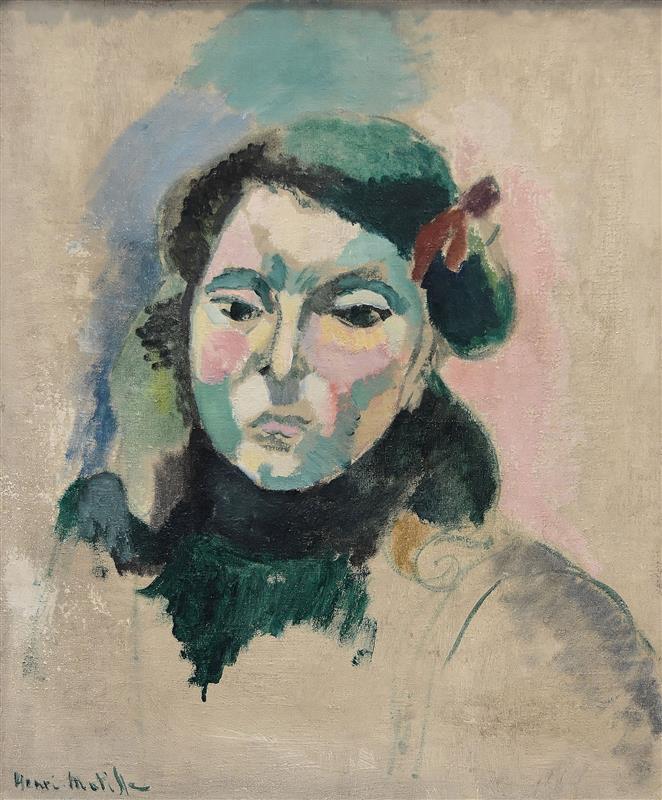
“Portrait of Marguerite” meets the viewer with the directness of a head-and-shoulders likeness and the softness of a color atmosphere. The young sitter’s features are simplified and masked by cool greens and grays, while blushes of pink warm the cheeks and lips. A dark collar anchors the body; a green cap or coiffure with a small crimson accent binds the upper silhouette. Around the figure, the background dissolves into velvety swathes of teal, pearl, lavender, and faint rose, leaving stretches of bare canvas to breathe like unspoken thoughts. The result is an intimate study where likeness is inseparable from color and mood.
Subject and Relationship: Matisse Painting His Daughter
Marguerite Matisse, born in 1894, was one of the artist’s most frequent and sensitive models. Her presence allowed the painter to experiment without the social performance that a commissioned portrait might impose. In this 1907 canvas, Marguerite appears not as a society sitter but as a private companion in the studio. The closeness between artist and subject is felt in the unforced pose, the absence of costume display, and the willingness to leave areas open or unresolved. The picture seems less about presenting a definitive likeness and more about registering how Marguerite’s face emerges from and returns to color.
1907 in Context: After the Fauve Summer, Toward Structure
The year 1907 sits at a hinge in Matisse’s development. Two years earlier, his audacious Fauve canvases had shocked Paris with their saturated hues and chromatic modeling. By 1907, that fire had cooled into a steadier flame. He retained the principle that color can define form, yet he sought greater structural calm and psychological depth. “Portrait of Marguerite” crystallizes this transition. It does not abandon Fauvism; it refines it, reducing the orchestra to a chamber ensemble where a few carefully tuned notes carry the emotion.
Composition and Format: The Head as an Island of Gravity
The composition is focused, nearly iconic. The head occupies the upper center of the canvas and gently tilts toward the viewer’s right, a triangular mass framed by the sweeping curve of the dark collar. Shoulders are only lightly indicated; the emphasis is on the face as a zone of perception and feeling. The background is not a setting so much as a field of forces. Wisps of blue-green halo the head at top left; to the right a rosy cloud answers with warmth. These soft, asymmetrical patches keep the portrait from becoming static and suggest the movement of thought around a calm core.
Palette and Color Logic: Green Shadows, Pink Light
Matisse’s color logic is economical and precise. Cool greens map the deep structure of the face—eye sockets, nose bridge, upper lip—while pale creams and warm pinks bring light to brow, cheeks, and mouth. Rather than mixing shadows to a neutral brown, he lets green speak as shadow and spirit. The choice is not arbitrary. Green, set against pink, generates a complementary vibration that makes the face feel alive without resorting to high contrast. The red sliver in the hair echoes the cheeks and keeps the warm/cool conversation circulating from top to bottom.
Brushwork and Handling: From Veil to Strike
The paint handling oscillates between hushed glazes and decisive, calligraphic strokes. In the cheeks and temple, thin veils allow the ground to show through, lending translucency to the skin. Around the eyes and mouth, single loaded strokes establish contour and expression with startling economy. The dark collar is treated as a thick, velvety mass, its edges frayed by quick flicks that suggest fur or knit without spelling it out. This variety of touch lets one canvas accommodate both intimacy and declaration, whisper and pronouncement.
Light Without Modeling: Illumination as Color Temperature
There is no theatrical spotlight here. Light blooms from the color relationships themselves. The face is not built by gradual chiaroscuro; it is assembled by adjacent temperatures—cool green planes next to warm rose planes—so that edges feel discovered rather than engineered. The effect is a light that is ambient and mental, a soft daylight that seems to come as much from within the sitter’s introspection as from a window.
Drawing by Color: The Line That Doesn’t Lock
Matisse remains a great draftsman even when he avoids explicit contour. The brows, nostrils, and lips are simplified to dark accents, yet they are never used to imprison form. The true drawing lies in the boundaries where one color meets another: green against cream becomes the bridge of the nose; pink against gray becomes the cheekbone. This strategy preserves the painting’s breath. The figure feels held lightly in place, not pinned.
The Role of the Unfinished: Honesty and Air
Large passages of the canvas remain spare, with the ground’s warm neutral tone visible through pearly scumbles. Far from neglect, this is a deliberate method. Unfinished zones serve two purposes: they keep the portrait from becoming heavy, and they record the exact point where Matisse felt he had said enough. The visible ground becomes both atmosphere and timekeeper, a register of the painting’s making and a reminder that intimacy often lives in what is left unsaid.
Costume and Accent: Collar, Cap, and the Red Note
Although the clothing is understated, a few cues carry weight. The dark collar gathers the torso into a compact base, allowing the head to float with clarity. A green cap or hair mass—felt, velvet, or simply a tonal grouping—crowns the cranium and is cut by a single red flourish. That red is small but crucial. It punctuates the top-right quadrant, pulls attention to the hairline where personality often flickers, and, most importantly, extends the warm notes of the face into the upper register of the composition.
Psychological Tone: Reserved, Alert, and Slightly Distant
Marguerite’s gaze is not confrontational. The irises are indicated but not drilled; the eyelids droop lightly, implying thought rather than display. The mouth is set tight, almost pursed, with a suggestion of self-possession that keeps sentimentality at bay. The overall tone is reflective, tenderly detached. Such reserve aligns with Matisse’s aim to portray states of being rather than narrative events. The portrait invites contemplation rather than demanding reaction.
Relation to Earlier Portraits: From Blaze to Murmur
Placed alongside Matisse’s 1905 portraits, this canvas feels like a murmur after a blaze. Compare the chromatic audacity of “Woman with a Hat” or the split-toned daring of “The Green Line” with the delicacy here. In 1905, color was a declaration against convention; in 1907 it is a language with grammar and nuance. The artist has not retreated; he has learned to speak softly without losing authority.
Sculpture’s Shadow: Mass, Axis, and the Head as Volume
Matisse’s parallel work in sculpture during these years informs how the head is conceived. The skull reads as a single rounded volume with a clear axis; the features adhere like planes set upon that mass. Notice how the green on the brow turns smoothly into green at the nose bridge and further into the upper lip’s shadow. This continuity makes the head feel carved rather than filled in. The portrait’s quiet power owes much to that sculptural thinking.
Edges and Transitions: Hard, Soft, and the Rhythm of Perception
Edges here operate like musical phrasing. Hard accents at the eyes and mouth clarify focal points. Softer transitions at the cheeks and jaw let the face merge with atmosphere. The boundary between head and ground sometimes dissolves entirely, especially along the left side where teal washes drift into hair. These lost edges mimic the way attention works: we look hard at one feature and allow the rest to blur. The painting thus models perception itself.
Space and Flatness: A Shallow Stage for a Deep Presence
The portrait keeps space shallow, a few inches forward and back, yet it avoids flattening the face into a mask. Overlaps and value shifts provide just enough depth: the collar sits firmly in front of the chest; the head sits in front of the ground; a faint shoulder curls into the foreground. The result is a living tension between decorative flatness and embodied volume—a hallmark of Matisse’s best work.
Materiality and Touch: What the Surface Tells
From up close, the surface offers a micro-drama of decisions. In the cheeks, thin layers allow earlier hues to glow through, like flesh under skin. The green passages are more opaque, spreading like opaque watercolor to establish the skull’s architecture. Occasional ridges of paint at the brow and lip catch the light, creating highlights that exist as much in the pigment as in the depicted world. Matisse lets the medium speak as matter, not merely as a transparent vehicle.
Gender and Modernity: A Portrait Without Ornamentation
Unlike many turn-of-the-century portraits of young women, “Portrait of Marguerite” resists decorative anecdote. There is no display of lace, jewelry, or interior luxury. The modernity lies in the refusal to define identity by costume, and in the insistence that a face painted in greens and pinks can be both a likeness and a formal invention. Marguerite appears as a thinking subject, not an accessory to domestic splendor.
Silence and Sound: The Music of a Limited Range
Limiting the chromatic range paradoxically increases expressiveness. Greens, pinks, grays, and a few subdued reds compose a palette like a quartet. Within that narrow band Matisse creates harmonies of astonishing delicacy: a cooler green above the eye that warms slightly at the cheekbone; a pink that pales near the ear and intensifies at the lip; a gray that leans blue near the temple and beige at the jaw. The portrait “sounds” quiet because its notes are tuned, not because there are few of them.
The Ethics of Looking: Respect Without Distance
Because the sitter is his daughter, the portrait sidesteps the power dynamics often present in artist–model relationships. The gaze neither consumes nor idealizes. Even the green shadows—so easily caricatured—are handled with care, as if Matisse were saying that seeing truthfully might require unusual colors. The picture proposes that affection and experiment can cohabit the same surface.
Legacy and Resonance: A Seed for Later Interiors and Odalisques
Though intimate and small in scale, the portrait anticipates later achievements. The way the figure emerges from color-fields prefigures the great Nice interiors where people, fabrics, and walls weave into a single chromatic web. The measured balance between line and plane, between mask-like simplification and living presence, will also inform the odalisques of the 1920s, where color becomes a mode of atmosphere and persona rather than mere decoration.
Why the Painting Endures: Likeness as a State of Color
“Portrait of Marguerite” endures because it redefines likeness. To recognize someone is not simply to catalog features; it is to sense the temperature of their presence. Matisse achieves that temperature by orchestrating a few hues with exquisite tact and by trusting that the human face can carry abstraction without losing humanity. The portrait is both a record of an individual and a demonstration of how far painting can go while remaining tenderly true.