Image source: wikiart.org
Introduction: Dignity, Light, and the Quiet Authority of Age
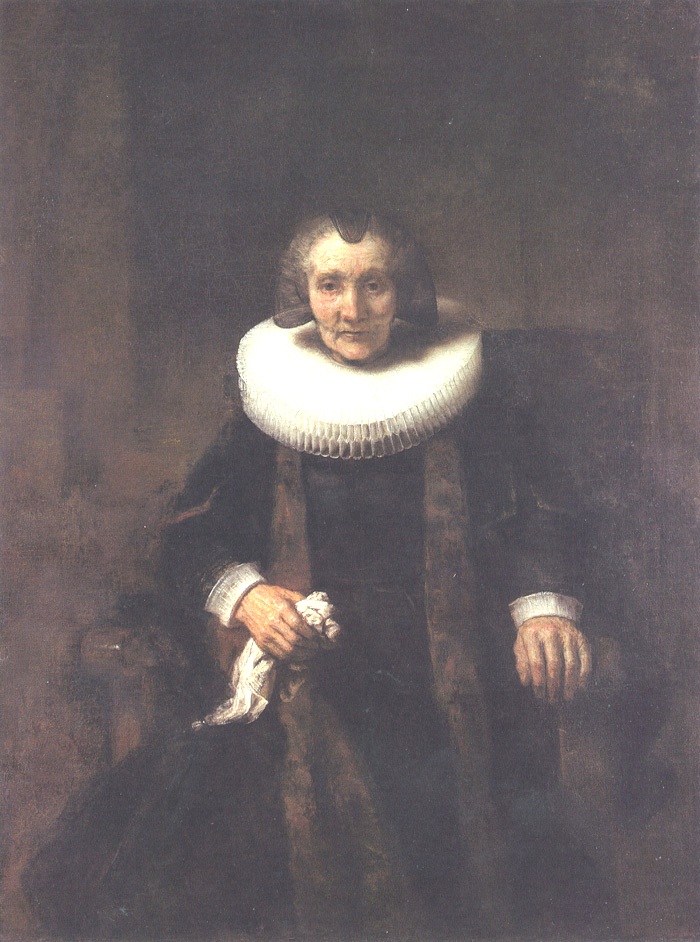
Rembrandt’s “Portrait of Margheride Geer, Wife of Jacob Trip” (1661) is a masterclass in late portraiture, where brushwork and light conspire to turn social likeness into human presence. The sitter enters the viewer’s space without pomp: an elderly woman in a broad, starched ruff sits frontally in a high-backed chair, one hand resting on the armrest and the other loosely holding a folded white handkerchief. Behind her spreads a chamber of dark, breathable air. The painting feels at once official and intimate. It honors status yet refuses flattery, preferring the truth of living skin, capable hands, and a calm gaze that has measured more than one lifetime of change. In this late work, Rembrandt transforms black fabric and white linen into a theater of moral light.
Late Rembrandt and the Moral Weight of Portraiture
By 1661 Rembrandt had weathered bankruptcy, the deaths of loved ones, and a shifting market that favored new fashions in polish and elegance. His response was not retreat but concentration. In portraits from these years he deepened his commitment to the human face as the stage of character. Surfaces grow more tactile, palettes more earthbound, and chiaroscuro more contemplative. “Portrait of Margheride Geer” looks back to the Dutch tradition of sober, black-clad sitters while pushing beyond it: the ruff is as white as ever, the dress as dark, but everything glows with inward life. The painter is less interested in cataloging finery than in revealing virtues—steadfastness, judgment, restraint—that the seventeenth-century Dutch prized and that Rembrandt paints as light itself.
Composition: A Triangle Held by Hands and Collar
The composition organizes itself as a stable triangle. The luminous ruff forms the apex, an architectural disk that frames the face like a halo of cloth. The sitter’s arms slope downward to the chair, creating the triangle’s base at the two hands. This geometry is not academic flourish; it anchors the body, projecting steadiness and repose. The left hand (to our right) settles heavily yet gently on the armrest, articulating the sitter’s physical presence. The opposite hand, more active, gathers a handkerchief whose soft folds echo the ruff’s pleats on a smaller scale. Between these two poles—the firm hand and the soft one—Rembrandt composes a life: decisiveness with mercy, authority with care.
The Ruff: White Architecture and the Optics of Character
The starched collar is the painting’s brightest form and its moral center. Rembrandt builds it from ridged, repeating pleats whose edges catch brilliant highlights while troughs sink into cool grays. Rather than a flat ring, the ruff reads as shallow architecture, turning in space and casting its own shadow across the bodice. That physical precision matters because the collar functions symbolically as well: it is the visible discipline of a household and a life. The white is not chalky; it is translucent, glazed with warm and cool notes so that it seems lit from within. The ruff’s brightness does not compete with the face; it crowns and clarifies it, like a window molding that frames a view.
The Face: Empathy Without Sentiment
Rembrandt brings extraordinary tenderness to the sitter’s face. The skin is modeled with small, varied touches: warm ochres around the cheeks, muted violets and cool grays in the eye sockets, tiny flicks of brighter paint at the tear ducts and on the bridge of the nose. Fine networks of age—creases at the corners of the mouth, soft pouches beneath the eyes—are acknowledged without pedantry. The effect is empathy without sentiment. The mouth is closed but not compressed, suggesting a predisposition to listen rather than to pronounce. The eyes, slightly moist, look directly yet gently outward. This is not courtroom scrutiny; it is maternal attention, firm and humane. In late Rembrandt, likeness is inseparable from ethical presence.
Hands and Handkerchief: The Language of Gesture
Hands in Rembrandt’s portraits frequently carry as much eloquence as faces. Here, the right hand splayed on the chair reads as capable and practical; one senses years of managing estates and household affairs. The left hand that holds the kerchief is more inner-directed—a gesture of self-possession and modesty. The kerchief itself is a small marvel of paint: knotted, folded, and warmed by the flesh tones nearby, it introduces a secondary white that balances the large ruff. Taken together, these elements form a silent sentence: authority rooted in restraint, work tempered by mercy. The portrait suggests that true standing is not an accident of birth but the habit of careful hands.
Costume and Material: Black That Breathes, Whites That Glow
The sitter’s dress—deep brown-black with subtle patterns and fur trimming—demonstrates Rembrandt’s unrivaled ability to orchestrate darks. Instead of a single dead black, he composes a spectrum: warm earths scumbled with cooler umbers, transparent glazes set against opaque passages, and edges feathered just enough to merge fabric with air. The result is black that breathes. Within this velvet environment the whites of ruff and cuffs flash like lanterns. The cuffs, smaller echoes of the collar, carry ridged impastos along their top edges to catch real light in the gallery space, making the painting responsive to the viewer’s movement.
Chiaroscuro: Light as Ethical Weather
The room around the sitter remains indistinct, a field of warm shadow that withdraws for the sake of the person. Rembrandt’s chiaroscuro here is less theatrical than merciful. It neither threatens nor dazzles; it shelters. Light comes from high left, laying a path across brow, nose, and cheek, then catching the ruff and cuffs before dying into the skirt’s depths. The shadows are transparent enough to suggest thickness of air, as if the room itself respected the sitter’s space. This atmosphere allows the portrait to breathe and gives it believable quiet.
Surface and Touch: Paint That Thinks
Up close, the painting reveals a surface alive with decision. The ruff’s pleats are ridged with firm strokes; the face is a knit of tiny, calibrated dabs; the dress is scumbled with broader, dry-brush sweeps that leave the weave of the canvas partly visible. Pentimenti—the ghost of a shifted contour along the shoulder, a softened earlier boundary near the hand—leave evidence of revision. All this tactility matters. Paint becomes a record of a conversation between eye and hand, between living sitter and living brush. The viewer does not merely see Margheride Geer; the viewer feels Rembrandt arriving at her.
Social Identity and Psychological Interior
Dutch portraiture often celebrated civic virtue, marital alliances, and pious sobriety. Rembrandt honors these expectations while expanding them. The painting asserts the sitter’s position—wife of Jacob Trip, part of a powerful merchant dynasty—through the dignified costume and the high-backed chair. But the true revelation is interior: a personality of patience and gravity, compacted by years into a serene core. Rembrandt’s late portraits insist that status without inwardness is spectacle; inwardness without standing is invisible. Here both are present, fused by light.
The Chair and the Architecture of Authority
Furniture in Rembrandt’s portraits is never incidental. The chair’s arms curve forward like small architectural brackets, supporting the sitter’s hands as if they were capital and entablature. Its darkness nearly merges with the background, which allows the hands to emerge as the operative “structure.” Authority, the painting suggests, is not the chair that confers it but the hands that exercise it. This is a deeply Rembrandtian inversion: power is always a matter of touch.
The Palette: Earth and Ember with Measured Highlights
The palette centers on earth colors—raw and burnt umbers, ochres, and a whisper of red lake—tempered by lead white in the ruffs and cuffs. In the face, Rembrandt inflects these earths with subtle blues and greens to cool the shadows, while warming the cheeks and lips with transparent glazes. These minute temperature shifts give life to the skin. Because chroma remains understated throughout, even small highlights have pronounced force. A thin edge of white along the cuff can animate the entire lower half of the painting.
Time, Memory, and the Poise of Stillness
One of the portrait’s great achievements is its sense of time. Nothing moves, yet time is felt: decades condensed into a posture, a lifetime’s habits folded into how a hand rests, how a mouth finds a neutral line that is neither fear nor pride. The stillness invites the viewer to slow down. Rembrandt erases distractions—the room’s details, the seams of clothing, any flamboyance of jewelry—so that the sitter’s history is readable in the most economical signs. The painting is a conversation with time that requires quiet to hear.
Dialogue with Companion Portraits and the Trip Family Legacy
The Trip family commissioned multiple portraits around this period. This canvas resonates with those companion pictures through scale, pose, and tonal gravity, forming a visual family biography. Rembrandt often paired husband and wife portraits so that gestures rhyme across canvases: a hand on a chair might answer a hand on a staff; a ruff’s white might speak to lace on a cuff. In this portrait, the echoes feel like vows—two lives in agreement, positioned to face the world together. The sense of partnership enriches the reading of Margheride Geer’s calm: it is not solitary endurance, but shared stewardship.
The Viewer’s Distance and the Ethics of Looking
Rembrandt positions the viewer at respectful proximity. We are close enough to see the moistness at the eye and the ridge of a knuckle, far enough that the sitter keeps her distance, her dignity intact. This calibrated space is ethical. It refuses the intrusive intimacy of caricature and the chill of public monument, choosing instead a neighborly equality. The portrait asks us to look as one adult looks at another—curious, attentive, without presumption.
Theological Atmosphere Without Didactic Symbol
Though there is no explicit religious attribute, the painting retains a devotional atmosphere. The black dress reads like secular monasticism; the white ruff glows like a ring of thoughtful purity. Rembrandt’s light, which in biblical scenes often signifies grace, here articulates virtue acquired through habit. The absence of moralizing props keeps the focus on lived faith rather than emblem. It is the light on the face, not a book or a rosary, that speaks.
Comparisons with Earlier Dutch Portraiture
Compared with the crisp, enamelled finish of earlier Dutch masters, Rembrandt’s handling is rougher, more like weathered wood than polished stone. But this supposed roughness is profoundly intentional. The broken surface of the paint admits the brokenness of life; the loosened edges allow the person to breathe beyond costume. Where other portraits might brag about wealth through lace and gold, this one whispers about endurance through shadow and light.
Lessons for Painting: How to Build Presence
For painters and viewers alike, the canvas offers practical lessons. Build the face with temperature shifts rather than hard lines; reserve your brightest whites for forms that hold character (here, the ruff, cuffs, and small knuckles); allow black garments to carry surprising variety by layering warms and cools; turn hands into narrative instruments and let fabric echo their gestures. Above all, cultivate patience in looking and in making. Presence cannot be rushed; it must be grown from countless small decisions.
Why This Portrait Endures
“Portrait of Margheride Geer, Wife of Jacob Trip” endures because it converts social portraiture into human encounter. The painting is faithful to costume and convention yet surpasses both. We feel the exactness of Dutch life—the starch of linen, the discipline of black cloth, the geometries of seats and rooms—but more than that, we meet a person: measured, compassionate, and awake. In late Rembrandt, paint becomes a moral instrument. It weighs what matters and lets the rest fall away into dark. That is why, centuries later, this quiet woman still seems to speak.