Image source: wikiart.org
Introduction
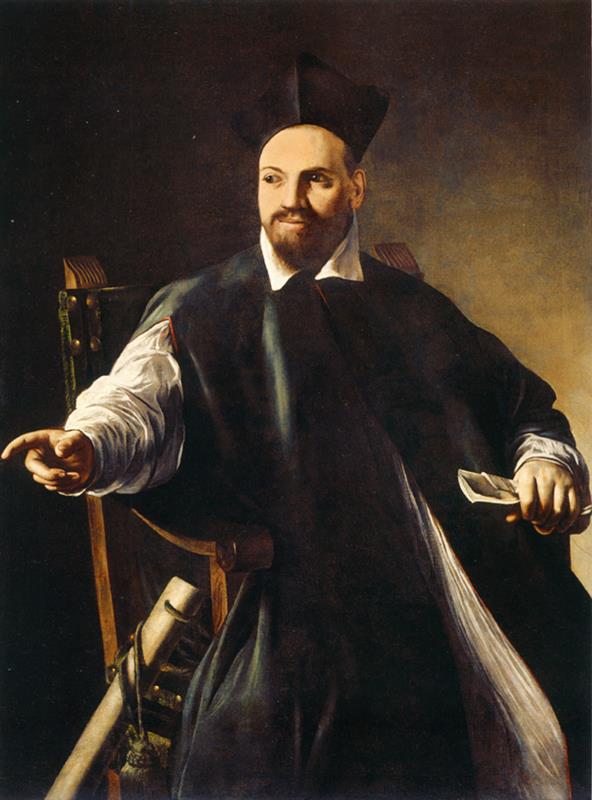
Caravaggio’s “Portrait of Maffeo Barberini,” painted in 1598, is an audacious study of power coming into focus. The sitter, a vigorous prelate in his thirties, turns in a heavy wooden chair and extends his right arm as if issuing a decision in mid-conversation. His left hand, relaxed but ready, holds a folded paper that suggests business not yet concluded. Light flows across the gleaming black mozzetta and the voluminous white sleeves, chiseling the face and hands with luminous authority. Rather than piling up insignia or architectural pomp, Caravaggio stages rank through gesture, proximity, and light, creating a portrait that feels startlingly modern in its psychological immediacy.
Historical Moment
The late 1590s in Rome were years of artistic reckoning. The Counter-Reformation demanded images that were clear, persuasive, and morally legible. Caravaggio, already notorious for painting saints and musicians as people from the street, brought that same radical candor to portraiture. Maffeo Barberini—Florentine by family, Roman by ambition—was an ideal subject for the painter’s new language. Within four decades he would become Pope Urban VIII, but in 1598 he was a rising ecclesiastic whose energy and intelligence called for a portrait that looked forward rather than backward. Caravaggio meets that need by replacing ceremonial fixity with the tempo of a real afternoon in which a man turns, speaks, and decides.
The Sitter and His World
Barberini appears here as a cultivated churchman on the move. The biretta sits neatly on a clean-shaven head, the beard trimmed to a controlled point. The black mozzetta and rochet register as formal, yet the pose is anything but static. He leans into space, eyes alive, body slightly off center as if caught just as he has turned toward someone entering the room. Caravaggio’s talent for reading character through posture is on full display: this is not a man framed by office, but a personality that is actively using it. The portrait hints at the nimble diplomacy and confident patronage that would later shape baroque Rome.
Composition and the Architecture of Command
The composition is a masterclass in diagonals. The sitter’s extended right arm projects forward like a beam, guiding the viewer’s eye from hand to face. The left forearm counters with a shorter diagonal anchored by the paper. These thrusts are stabilized by the massive triangle of the cloak cascading toward the lower right, while the stout staves of the chair brace the figure from behind. Caravaggio keeps the background plain, a warm, absorbent field that refuses spectacle. Power emerges from the body’s geometry rather than from emblem or backdrop, a new architecture in which the person is the building.
Chiaroscuro and the Governance of Light
Caravaggio’s light is purposeful rather than theatrical. It falls from the upper left, clarifying the forehead, cheek, and beard; it glances off the white cuffs and lays a satin sheen upon the black silk. Shadows pool under the armrest and within the folds of the garment, making the lit areas feel carved and immediate. The extended hand receives a concentrated highlight that grants it primacy in the narrative of the moment. Even the folded paper becomes a small reflector, returning a cool note to the composition. The painter thus uses light as rhetoric: what matters is illuminated; what supports is subdued.
Color, Fabric, and Tactility
The palette is limited to deep blacks, warm browns, restrained reds, and the punctual brilliance of white linen. Far from monotonous, the black is a chorus of textures—glossy along the cloak’s ridge, matte within heavy recesses, nearly blue in the brightest skims. The sleeves are built from milky whites veined with grey, swelling with air and movement, a study in clerical grandeur that remains human in its creases. The biretta’s dull velvet absorbs light, crowning the head with a practical sobriety. Caravaggio’s fabric realism is not decorative bravura; it is the physical register of office inhabited without fuss.
Gesture and the Drama of Decision
The portrait’s electricity lies in gesture. The right hand is extended with the forefinger almost, but not quite, pointing. It is the hand of a man who indicates, authorizes, or redirects rather than scolds. The left hand’s grip on the paper is relaxed, as if the business it contains is already mentally resolved. The head turns toward the implied interlocutor with a look that is half welcome, half reckoning. Caravaggio’s refusal of frozen pose allows the viewer to feel the small theater of authority: a decision is being made, and we are inside its radius.
The Chair as Stage
The heavy wooden chair is more than a prop. Its square arms and riveted plates acknowledge the institutional furniture of Roman power while also offering a counterpoint to the sitter’s motion. The timber’s diagonal braces echo the thrust of the arm, and a cylindrical scroll or staff tucked beside the seat adds a secondary motif of authority. Caravaggio paints the chair with carpenterly respect, letting its worn surfaces and structural logic ground the composition in a world of use rather than display.
Psychological Realism
Caravaggio’s portraits breathe because their faces think. Barberini’s eyes do not glaze at a fixed point; they attend. The slight rise of the brows, the generous set of the mouth, and the angle of the cheek signal a man engaged in conversation rather than one posing for posterity. Even the beard participates in expression, catching light along its edges like speech catching breath. The painter avoids the temptations of flattery—no powdered ideality, no porcelain skin—choosing instead a credible physiognomy that makes authority persuasive because it is human.
Paper, Message, and the Politics of Reading
The folded paper in the left hand and the apparent paper tucked under the right forearm serve as subtle emblems of literacy and administration. They stand for the world of briefs, letters, and decrees through which early modern power flowed. Caravaggio renders them with minimal strokes—the merest planes of tone and edge—trusting the viewer to supply their import. In this, the painter redefines portrait attributes: not trophies or allegories, but tools and tasks.
Space and Proximity
The figure occupies a shallow stage that pulls him into our space. The extended arm collapses the distance between sitter and viewer, an effect heightened by the chair’s frontal arm projecting toward us. We are not looking at a remote dignitary framed by colonnades; we are standing at the edge of his desk. This proximity is central to the portrait’s modernity. It acknowledges the intimate scale at which power is exercised—conversation range, where a nod or a fingertip can change outcomes.
Technique and Paint Handling
Caravaggio’s method is economical and decisive. Large tonal blocks establish the cloak’s mass; brisk, controlled strokes articulate the white shirt’s pleats; soft transitions model the face with a sculptor’s logic. Highlights are placed with sparing precision: on the knuckle, along the nose bridge, at the beard’s curve, on the rim of the paper. The paint never becomes fussy. Even the sheen on the black silk is constructed not from laborious glazing but from confident alternations of value that allow the eye to complete the illusion of polish.
Comparisons and Evolution
Set beside the 1597 portrait of Barberini, this later version enlarges the scale of presence. The earlier likeness shows a composed reader; the 1598 canvas shows a man acting in real time. The evolution mirrors Caravaggio’s broader trajectory from careful observation to fully dramatized encounter. The painter has learned how to make a portrait perform without sacrificing truth, how to turn a chair into a proscenium and a hand into a line of dialogue.
Power Without Pomp
One of the portrait’s enduring virtues is its disciplined refusal of pomp. There are no coat-of-arms, no marble pilasters, no curtained vistas. Authority is conveyed by the coherence of body, mind, and light. This restraint aligns with a Counter-Reformation ethic that valued clarity and function, and it anticipates the baroque ideal in which the human figure, honestly observed, becomes both doctrine and drama. The sitter’s charisma is not manufactured by emblem; it arises from attention to the person.
The Viewer’s Role
Caravaggio positions the viewer as an interlocutor whose arrival has prompted the sitter’s turn. The extended hand acknowledges us; the open expression invites response. This participatory structure converts the portrait from image to encounter. We do not decode symbols so much as navigate a social moment. The painting thus teaches the etiquette of looking at power: draw near, attend to hands and eyes, speak when invited.
Time and the Pulse of the Scene
The portrait contains an internal clock. The turn of the torso implies a movement that began just before the picture and will continue just after. The paper suggests business just completed or about to begin. The open hand measures the beat between utterance and assent. Caravaggio paints that beat, that second of suspended action, and the viewer feels the pulse of decision like a soft percussion in the wrist.
Influence and Afterlife
This portrait helped set a template for seventeenth-century ecclesiastical portraiture: a shallow, tenebrous ground; decisive, forward-projecting gesture; fabrics painted for truth, not display; faces engaged with a present listener. Later artists across Italy and beyond would adapt this grammar to bishops, cardinals, and statesmen, seeking the same balance of dignity and immediacy. The image also prefigures the modern photographic ideal of catching officials mid-gesture, the candid moment that persuades more deeply than formal pose.
How to Look
Approach the painting along the vector of the pointing hand and let your gaze settle on the eyes. From there trace the triangular circuit—down the gleaming slope of the cloak, across the stacked planes of the chair, and back up the left arm to the folded paper. Notice how small accents—the softened highlight on the knuckle, the narrow glint on the cuff, the faint sheen along the biretta—keep the portrait vibrating without noise. Step back and receive the whole as a single chord of black, white, and warm brown held together by the rhythm of a turning body.
Conclusion
“Portrait of Maffeo Barberini” captures authority at the speed of life. Caravaggio pares away rhetoric to reveal the mechanics of command: an attentive face, a decisive hand, a body that leans toward the moment. Light describes these facts with an almost judicial clarity, polishing the satin, warming the flesh, and letting darkness do the dignifying work of silence. In one glance the viewer understands why this man could move through Rome with effectiveness and why, years later, he would ascend to the papacy. The portrait endures because it turns power into presence, inviting us not merely to look at rank but to meet a person exercising it.