Image source: wikiart.org
First Sight Of A Face Framed By Linen And Light
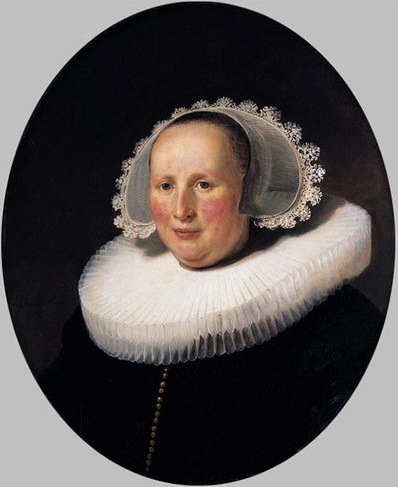
Rembrandt’s “Portrait of Maertgen van Bilderbeecq” offers a meeting that feels both ceremonial and intimate. Within an oval field, the sitter’s head turns slightly to the right, her eyes calmly receiving the viewer. A vast cartwheel ruff—starched, pleated, and brilliant—encircles her like an engineered halo, while a translucent cap edged with lace softens the skull’s contour. The dark gown withdraws into breathable dusk so that face and linen can carry the image. What first reads as sumptuous costume quickly becomes an architecture that focuses attention on a living mind.
An Oval That Works Like A Locket
The oval format is more than a shape; it is a device for intimacy. It compresses the field, trims away distractions, and guides the eye in a continuous circuit around head, ruff, and cap. Unlike a rectilinear stage, which can invite narrative props and deep perspectives, the oval behaves like a locket—private, portable, and designed for contemplation. In that chamber of attention, the sitter’s slight turn and the gentle angle of her shoulders produce a vibration between poise and approach, as though conversation has just begun.
Light As Measured Authority
Illumination arrives from the upper left with the equanimity of daylight. It clarifies the planes of forehead and cheek, warms the nose’s bridge, and falls in pearly gradations across the pleated circumference of linen. Shadows are never punitive: they possess the weight of air, not the threat of void. This measured light is crucial to the portrait’s temperature. It allows fabrics to prove their substance, skin to record breath, and the sitter to retain her dignity without theatrical effects.
The Cartwheel Ruff As Architecture Of Brightness
The ruff is a masterpiece of engineering rendered in paint. Each pleat grips light at its ridge and releases it toward a softer center. Rembrandt resists counting folds; instead he organizes them into comprehensible groups, sharpening the outer rim where white collides with darkness and relaxing the inner slopes where linen turns away. The result is a ring that acts like a structural pedestal for the head and a reflective instrument that diffuses brightness across the upper body. In a culture that prized order and cleanliness, the ruff becomes a civic emblem carved out of light.
The Cap’s Translucent Halo
By contrast, the cap proposes tenderness. Its fine lawn hovers between fabric and air, admitting background tones through its veil while a crisp lace fringe scallops the ear. Highlights along seams and edges describe construction without pedantry. This second ring, softer than the ruff below, performs a diplomatic task: it mediates between flesh and darkness, between civic discipline and personal warmth, keeping the head readable from all sides.
Black That Contains Color
At first glance the gown seems simply black, but closer looking reveals a symphony of restrained chroma—cool bottle greens in shadow, plum-browns near the chest, quiet blue-blacks grazing the sleeves. These undertones keep the garment present as matter, not void. They also provide a counterweight to the linens’ brilliance so that the portrait reads as atmosphere rather than silhouette. Rembrandt’s “black” is always populated; it hosts light the way a room hosts breath.
Flesh As Living Climate
Rembrandt paints skin as if it were weather. Thin, translucent layers allow light to seem as though it rises from within rather than resting on top. Warm honeyed notes settle at cheekbones and forehead; cooler greys firm the jaw and the sides of the nose; a modest bloom warms the lips. The face is neither porcelain nor polish; it is living tissue participating in the room’s light. Age is recorded without emphasis: soft fullness along the cheek, slight settling around the mouth, an even, alert gaze.
Eyes That Attend, Not Perform
The psychological register is the portrait’s quiet triumph. Maertgen’s eyes meet ours levelly. Pinpoint highlights wet each pupil; a gentle moisture collects along the lower lids; the brows lift neither in surprise nor in severity. The gaze attends rather than performs, as if the sitter were acknowledging a guest with calm attention. Rembrandt trusts this middle register of feeling—composed, alert, humane—to carry more truth than melodrama ever could.
The Social Language Of Dress
Seventeenth-century Amsterdam read clothing as a public text, and Maertgen’s ensemble is eloquent. The immaculate ruff, the clean cap, the sober gown, and the discreet earring speak of prosperity disciplined by Calvinist ideals of order and modesty. Yet the painting is not a costume display. Rembrandt shows how the ensemble supports personhood: the ruff lifts the head, the cap shelters it, the gown frames it, and all conspire to let a face be plainly seen.
The Ethics Of Omission
Rembrandt includes only what the portrait needs. There is no window loudly declaring the light source, no column, curtain, or ledge competing for attention. The background is a breathable dusk that protects the sitter’s privacy. This ethic of omission keeps the eye on the interplay of light and substance, and on the psychology of a person present in a room rather than paraded through allegory.
The Rhetoric Of Black And White
Seen across a room, the painting reads as a noble duet between black and white. Up close, each side of the duet proves richly inflected: the black hosts chromatic undertones that move under the light; the white contains a scale from chalk-bright rim to pearl-grey recess, with warm reflections where skin tints linen. This duet is the visual analogue of the culture’s moral imagination—restraint as a platform for virtue, clarity as a species of beauty. Rembrandt translates that rhetoric into paint without preaching.
Brushwork That Records Decisions
The surface, though calm, is alive with varied touch. Short, parallel strokes articulate pleats; lifted points pick out lace scallops; scumbles soften edges where cap meets air; lucid glazes knit the cheek’s transitions. Nothing is showy for its own sake. Each decision answers the same question: how little must be done here to tell the truth about this substance under this light? That economy is why the painting feels precise and effortless at once.
The Psychology Of The Turn
The composition carries a subtle contrapposto. The body faces near frontal; the head inclines gently to the right. This small turn is the difference between an identity plate and an encounter. It implies that Maertgen has just adjusted to meet the viewer, that the portrait is a moment of address rather than a static emblem. The ruff’s radial pressure amplifies this sense of forward tilt, as if repeated folds are urging the head slightly toward us.
Time Held With Tender Exactness
The portrait’s temporal claim is quiet but firm. The linens announce recent laundering and careful starching; the cap sits with unruffled freshness; the skin’s bloom is moderated by adulthood. We sense a particular hour in a particular season of a life. Rembrandt preserves that specificity without anecdote, allowing the image to act as both record and meditation—a person and a presence.
The Civic Ideal Made Personal
Amsterdam’s mercantile republic prized prosperity tempered by humility, splendor disciplined by conscience. This portrait embodies the ideal on a human scale. Maertgen’s attire assures the viewer of means and order; her bearing confers intelligence and steadiness. Rembrandt never lets the civic ideal dissolve the person; rather, he lets the person fulfill the ideal by simply being seen truly.
The Cap And Ruff As Instruments Of Space
The two concentric garments do spatial labor. The cap pushes a halo of air behind the head and softens the transition into shadow; the ruff thrusts the head forward into our space, foreshortening into darkness at the sides and drawing us gently to the face. Together they turn the oval into a chamber rather than a flat frame, so that sitter and viewer seem to share the same atmosphere.
Material Truth And The Intelligence Of Paint
Rembrandt’s materialism is ethical: he wants paint to behave like what it describes. Linen is built through fine ridges and soft valleys; skin through translucent veils; metal through concise glints; velvet darkness through thin, absorptive passages. Because each thing is painted according to its nature, the whole feels trustworthy. The eye believes the materials and, by extension, believes the person.
A Background That Protects Dignity
The plain ground is not a failure of invention; it is a deliberate courtesy. By withholding narrative ornaments, the painter refuses to conscript Maertgen into allegory or spectacle. The darkness is the silence around speech; it lets the portrait’s voice carry. In this restraint lies modernity: the image grants the sitter privacy even as it offers the viewer clarity.
The Viewer’s Place In The Etiquette Of Looking
The portrait positions us at conversational distance. The oval edge behaves like a respectful threshold—we may look, but not intrude. Maertgen meets this attention with even regard. The exchange models a humane etiquette: the viewer brings focused attention, the sitter offers presence, and the painter mediates with light so that both dignity and recognition are preserved.
Why The Painting Still Feels Contemporary
Many historical portraits feel bound to their costumes. This one does not, because its central energies—truthful light, calibrated edges, breathable space, and a gaze that attends—remain relevant. It trusts simple means and honors the sitter’s privacy. In a culture of overexposure, the picture’s confidence in restraint reads as fresh. It proposes that beauty is a function of attention and that character can be communicated without noise.
Reading The Face As Quiet Geometry
Rembrandt maps the head with soft geometry. The forehead’s dome catches a plane of cool light; the nose’s bridge supplies a steady line; rounded cheeks descend toward the ruff’s arc; the mouth is set with unpretentious firmness. He allows structure to imply temperament—capable, orderly, humane—so that expression does not need to shout. The face remains legible at distance and endlessly interesting up close.
The Small Drama Of Ornament
The single earring, tiny and golden, offers one of the painting’s sharpest highlights. It punctuates the cap’s lace with a note of metal and warms the skin beside it. Such a small drama matters because it anchors the portrait’s humility to a token of pleasure. The light that glances off the earring is the same light that reveals the sitter; ornament and person share illumination without competition.
Living With The Picture: The Sensation Of Air
Stand before the painting and it feels aerated. The cap’s edges feather into space; the ruff’s pleats pump brightness forward; the gown withdraws in low, cool breaths. That sensation of air—of being in the same room—is the mark of Rembrandt’s observational patience. He paints not only objects but the climate that makes them visible, and that climate is what viewers remember when they recall the sitter’s presence.
An Early Amsterdam Summit Of Craft And Conscience
Dated 1633, the portrait belongs to Rembrandt’s early Amsterdam period, a moment when he harnessed the city’s taste for finery to his own devotion to truth. He could dazzle with lace and satin, but he never forgot that portraiture is a compact of recognition. In Maertgen van Bilderbeecq he finds the summit of that balance: splendor disciplined by clarity, likeness animated by air, and dignity expressed in the quiet conversation between light and face.
Closing Reflection On Presence Framed By Light
“Portrait of Maertgen van Bilderbeecq” endures because it builds a world where personhood is sovereign. The ruff constructs an architecture of brightness; the cap adds a tender halo; the gown keeps gravity; the oval gathers attention; the face accepts all of it and returns our look with level intelligence. Nothing shouts. Everything speaks. In a few square feet of linen, flesh, and dusk, Rembrandt stages an encounter that feels as courteous and convincing today as it did nearly four centuries ago.
