Image source: wikiart.org
Introduction
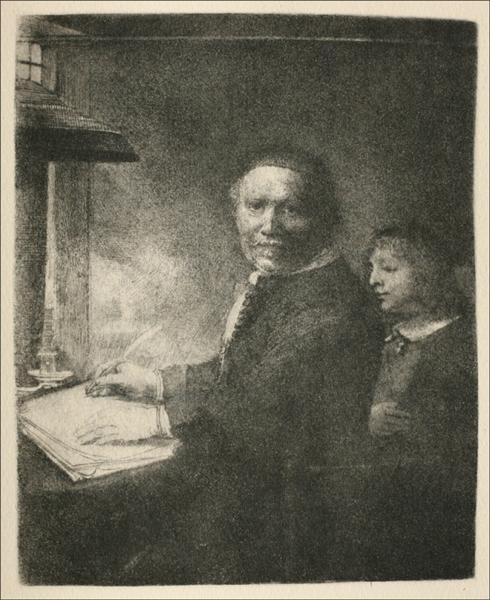
Rembrandt’s “Portrait of Lieven Willemsz van Coppenol” (1653) is among the most compelling artist-to-artist encounters of the Dutch Golden Age. The sitter was Amsterdam’s celebrated master of penmanship, a virtuoso calligrapher whose demonstrations drew crowds and whose flourishing scripts adorned civic documents and private albums. Rembrandt meets this public performer not with pomp but with the intimacy of a night visit. The image—an etched and drypoint portrait enriched with velvety plate tone—shows Coppenol at his desk, a quill poised over a large sheet as a boy stands just behind him. A lamp at the far left pools light on paper and cheek, leaving much of the room dissolved in a respectful dark. The feeling is half studio, half chapel: the devotion of work, the glow of concentration, and the quiet exchange between masters of different tools.
A Composer Of Lines Portrayed In Lines
Few subjects suited Rembrandt’s etching needle more perfectly than a calligrapher. Coppenol made lines sing; Rembrandt makes lines breathe. The medium becomes the message. The sitter’s identity is inseparable from the mark-making that brings him into being. Look closely at Coppenol’s head: quick networks of etched strokes define brow and cheek, while drypoint burr softens the shadow that curls under the jaw. The hand holding the pen is modeled with restrained contour, its knuckles caught by miniature highlights where the plate was wiped a touch cleaner. The paper before him is an expanse of brilliant blankness, a theater where the two artists are about to collaborate—Coppenol with ink, Rembrandt with light.
The Drama Of Light And Attention
The portrait’s light does not explode; it concentrates. Its source is a shaded lamp, rendered with a few rectangular strokes and a bright wedge of reflection on the support. The lamp funnels luminance onto Coppenol’s open sheet and then up across his face, as if thought were rising from practice. The boy’s head receives a gentler spill, tucking him into the conversation without stealing focus. Deep shadow fills the rest of the room like a soft, protective fabric. Rembrandt’s chiaroscuro here is more than pictorial effect; it is a psychology. It keeps distraction out and honors the sacredness of making.
Composition As Working Conversation
Rembrandt composes the sheet as a triangular exchange: lamp and paper at left, Coppenol’s face at center, juvenile observer at right. The calligrapher’s turned body stitches these points together—the left hand steadying the paper, the right hand lifting to write, the head pivoting just enough to acknowledge the viewer. This interplay produces the feeling that we have entered mid-lesson or mid-demonstration. Coppenol’s glance meets us not as an interruption but as inclusion, as if to say, “Watch the stroke; see how the light teaches the hand.” The young assistant echoes our role, learning by nearness and by the generous exposure of process.
The Hands That Make A World
Rembrandt understood hands as biographies. Coppenol’s are precise but not fussy, sinewy rather than soft. The working wrist aligns with the page like a compass point; the relaxed left hand anchors the stack of paper with the quiet authority of habit. By refusing ornamental detail—no exaggerated tendons, no theatrical splay—Rembrandt dignifies craft. The boy’s hands, barely suggested, rest in readiness, a counterpoint to the master’s purposeful grip. Together they speak the grammar of transmission: skill steadied by repetition, attention apprenticed to example.
Paper, Tools, And The Material Culture Of Writing
The desk loads the foreground with meaning. We see layered sheets, their edges catching light like steps of a staircase. A quill rises, not yet dipped; an inkwell glints in the lamp’s circumference; the pen rest and blotting tools merge into the tabletop’s tone. Rembrandt does not inventory these objects as trophies; he puts them to work as characters. Paper becomes a luminous field, the place where Coppenol’s reputation lives. The lamp is both literal illumination and emblem of insight. The tools read as extensions of the sitter’s reach—the same way the etched needle is extension of Rembrandt’s eye.
Portraiture Of Intellect Rather Than Status
Although Coppenol enjoyed celebrity, Rembrandt avoids the trappings of civic portraiture. There are no architectural niches, no heraldic devices, no table carpets or drapery baroque. The calligrapher wears sober clothing, the collar barely catching light. The painter cares less about rank than about focus. Identity emerges not from costume but from activity. It is a portrait of intellect—of a mind that moves through the hand into a line. That emphasis aligns with Rembrandt’s larger project in the 1650s: to reveal character by staging work, not by piling symbols.
The Boy As Mirror And Future
Who is the youth—apprentice, assistant, son, or fascinated visitor? Rembrandt chooses ambiguity and, in doing so, gives the figure allegorical reach. The boy functions as mirror and future. He mirrors our spectatorship, leaning in to learn. He also embodies the next generation of makers who will inherit the discipline of the line. His face, bathed in softer light, carries that receptive openness that Rembrandt loved to paint in Titus or in anonymous studio youths. The calligrapher’s slight bodily turn toward the boy suggests mentorship without proclamation.
Plate Tone And The Atmosphere Of Work
The portrait’s characteristic velvet comes from plate tone—the thin film of ink Rembrandt intentionally leaves on the copper when wiping before printing. This tone settles in the corners and open fields, warming the darks and giving the air a tobacco-colored density. Against this atmosphere the illuminated paper flares like an idea just about to be phrased. Plate tone also allows Rembrandt to create gradients without cross-hatching: the back wall recedes delicately, the lamp’s halo is felt rather than drawn, and Coppenol’s coat reads as weighty cloth without overwrought detail. The effect is wonderfully modern; the print breathes like a room where a lamp has been burning for hours.
The Psychology Of The Glance
Coppenol looks out from the pool of light with an expression at once alert and hospitable. The eyes are narrowly ringed, the brow relaxed, the mouth softened by the slight upward press of the cheek. It is not the stare of a sitter holding still; it is the glance of a performer used to addressing an audience while his hand continues its task. Rembrandt captures that double-consciousness perfectly: attention to the page, and attention to the onlooker. The result is intimacy without exhibitionism—a crucial line that both men, accustomed to demonstrations of craft, understood.
Calligraphy And Etching: Sister Arts
Calligraphy and etching share disciplines: pressure control, flow, timing, and the courage to leave a mark unedited. Rembrandt’s lines here carry the assurance of someone who understands the calligrapher’s compact between brain and muscle. Where Coppenol’s letters would swell and taper, Rembrandt’s strokes thicken or fade; where a flourish would tie one form to the next, Rembrandt lets a shadow tie hand to page to lamp. The print becomes a tacit duet. You can almost hear the scratch of nib on paper answered by the whisper of the needle across copper.
Time Of Day, Time Of Life
The lamplight makes evening probable, and evening folds metaphor into the image. This is both the hour of work extended beyond daylight and the phase of life when mastery condenses into mentoring. Coppenol, not a young man here, keeps the late shift not for gain but for love of the line. The boy’s presence underscores the handoff. Rembrandt often uses time of day to deepen human truth: dawn for wonder, afternoon for labor, evening for inward conversation. This picture is all conversation—between arts, generations, and the self that works and the self that is watched.
A Portrait Crafted For Reproduction
Because the portrait is an etching, it was designed to be printed in multiples, circulating Coppenol’s likeness much as his ornate scripts circulated his reputation. Rembrandt embraces the reproductive nature of the medium without flattening character. He knows that repeated impressions will vary in tone and burr as the plate wears; he uses that variability as expressive range. Early pulls, rich with burr, heighten the night atmosphere; later ones, cleaner and crisper, emphasize the calligrapher’s features. The portrait thus becomes a living document, changing slightly with each viewing, like handwriting that never quite repeats.
Silence, Sound, And The Texture Of Concentration
Good prints summon sound. Here we hear the steady tick of the lamp’s flame, the rasp of quill across fine paper, the soft shift of a coat as the master lifts his arm, a faint intake of breath from the boy. Rembrandt evokes this auditory intimacy without drawing a single sonic symbol. He achieves it by the density and release of marks: packed hatching around the lamp base telegraphs low mechanical hum; open paper on the sheet signals the dry hush before ink; the softened dark behind the figures quiets the room. The print invites the listener in the viewer.
Close Looking At Key Passages
Attend to the pen point: two glinting pinpricks define its tip, so tiny that one might miss them, but they root the entire composition in operating craft. Trace the contour of the lamp’s shade: a single, slightly bowed stroke along its lower edge tells us metal exists, catching and cutting light. Study the boy’s eye: it is a shadow-warmed almond with a faint highlight and the barest notch for an eyelid, yet it conveys eagerness. Look at Coppenol’s cuff: a short ladder of pale bars suggests stitched edge and worn cotton, evidence of long use. Observe the book or sheaf under the main sheet: its corners are round from handling, the paper thick, the edges a little proud; Rembrandt loved such truthful fatigue. These small, accurate touches build the portrait’s credibility brick by brick.
Relationship To Rembrandt’s Other Portraits Of Coppenol
Rembrandt depicted Coppenol more than once, including a larger, more formal etched portrait in which the calligrapher brandishes an enormous pen and an inscription sprawls theatrically across the plate. The 1653 night interior is subtler, more inward. Where the grand version turns skill into public spectacle, this sheet turns it into devotion. Together they form a diptych of persona and person: the demonstrator and the worker, the flourish and the breath between strokes. The pairing reveals Rembrandt’s sensitivity to the different rooms a single life can inhabit.
Why This Portrait Still Feels Contemporary
Contemporary audiences recognize this scene immediately: a maker at a desk, nocturnal light, a student watching, the mix of solitude and shared attention. It could be a designer at a laptop, a poet over a notebook, a coder in a dark studio. The tools have changed; the posture of devotion has not. Rembrandt captures the evergreen dignity of focused labor and the joy of transmitting a craft—values that resonate as powerfully in digital culture as they did in a world of quills.
Conclusion
“Portrait of Lieven Willemsz van Coppenol” is Rembrandt’s hymn to the line and to those who live by it. It gathers lamp, paper, quill, master, and apprentice into a chamber where light makes time slow down and where the hand becomes mind’s instrument. By leaning on the expressive powers of etching—elastic line, burr’s soft halo, and generous plate tone—Rembrandt composes not just a likeness but a state of being: alert, patient, and companionable. The image honors a famous calligrapher without grandstanding, showing him at the very moment fame is earned again—the instant before ink touches paper. That is why the portrait continues to move viewers: it allows us to witness work turning into meaning.
