Image source: wikiart.org
A First Encounter With Gravity And Grace
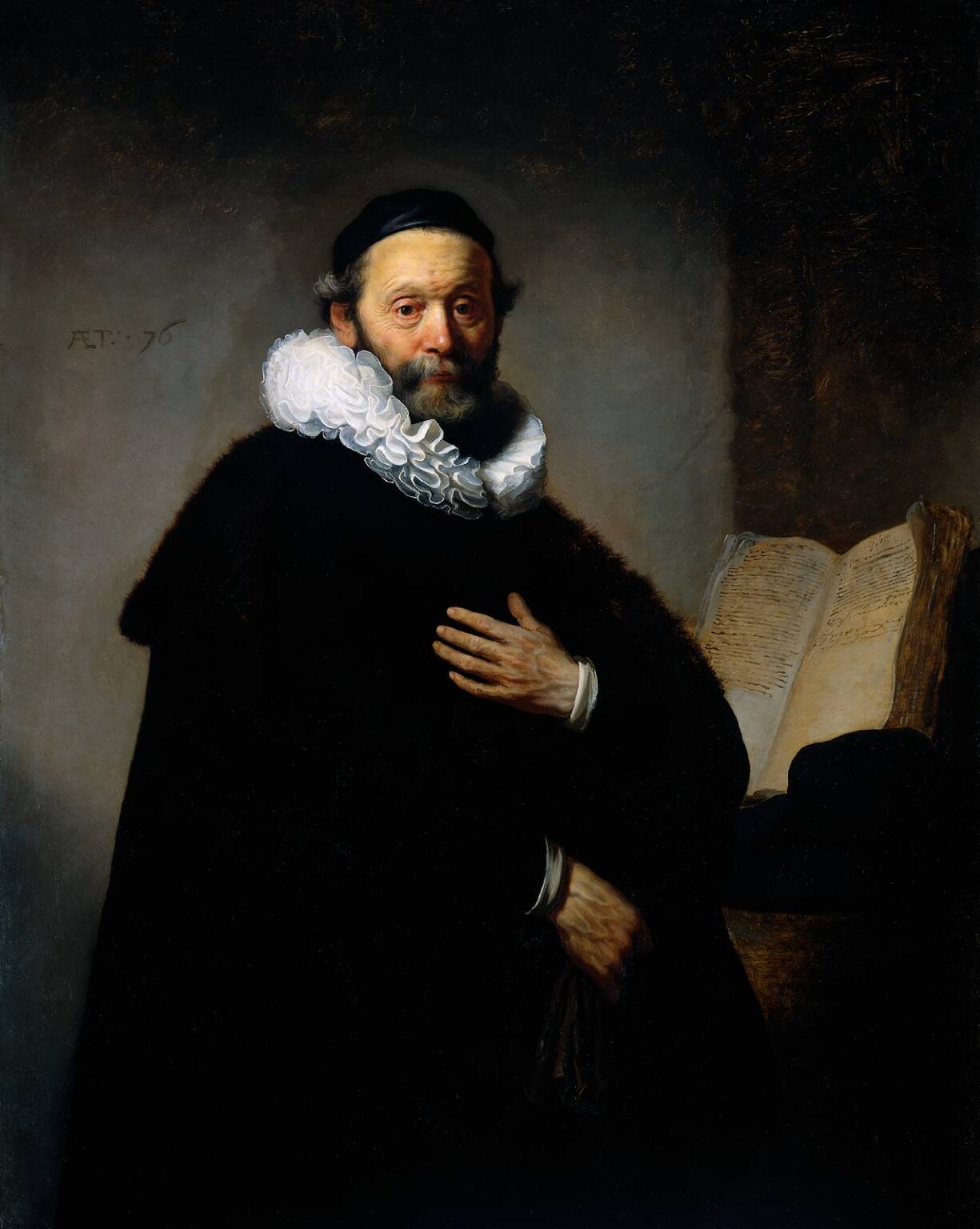
Rembrandt’s “Portrait of Johannes Wtenbogaert” introduces a man whose presence is both learned and gentle. Standing before a soft, grey-brown wall, the Dutch theologian meets the viewer with a lucid, slightly sorrowful gaze. A brilliant ruff blooms at his neck like white surf against the dark sea of his fur-lined robe; a scholar’s cap rests on thinning hair; one hand crosses the chest while the other gathers the garment near the waist. Beside him, an open folio book leans on a table, its pages inscribed with compact script, angled so that we sense—rather than read—the labor of a lifetime. The scene is not theatrical. It is a carefully lit conversation between light and conscience, text and touch, intellect and humility.
The Historical Figure And The Choice Of Moment
Johannes Wtenbogaert was a prominent Remonstrant minister and spiritual leader in the Dutch Republic, known for his pastoral authority and his role in the theological controversies that shaped the early seventeenth century. Rembrandt paints him at roughly seventy-six years old, the age discreetly inscribed to the left. Instead of dramatizing the public champion or embroiled polemicist, the artist chooses the private and reflective statesman of faith. The portrait fixes the moment after a thought and before a word, the interval in which knowledge turns into counsel. This choice loads the stillness with tension—the tension of a lifetime of judgment condensed into a single regard.
Composition As A Moral Geometry
The design is triangular and stable. Wtenbogaert’s head forms the apex, framed by the ruff’s bright ellipse. The base stretches between the two hands: the right resting lightly at the chest, the left anchoring the robe. The open book forms a counter-triangle on the right, its diagonal rising toward the sitter’s head, as if reason and memory were offering their service to the living mind. Rembrandt leaves a luminous breathing space on the left wall, a counterweight to the darker niche where the book sits. This geometry keeps the eye moving along routes that reinforce the portrait’s meditation: from the man to the pages, from text back to character.
Light That Judges Without Wounding
Illumination pours from the upper left, clearing the brow, warming the nose and cheeks, and laying exquisite highlights on the fingers. The ruff’s scallops turn that light into a visible music, while the fur robe drinks it into a deep, respectful hush. Shadow here is not punitive; it is shelter. The book’s page edges catch a dusky glow, the ink lines warm to sepia, and the scholar’s cap holds a quiet, dense darkness that protects thought. The overall effect is judicial clarity: enough light to reveal truths, enough shadow to honor privacy.
The Ruff As Engine Of Brightness And Authority
Rembrandt renders the ruff as a kinetic ring of folded linen, less a fashion than a device for distributing radiance. Its edges are crisp where they cut against the robe; its valleys are pearly where light fades. It lifts the head physically and metaphorically, functioning as a collar of office for a man whose authority is moral rather than ceremonial. The painter avoids counting every pleat; he orchestrates groups so the form breathes as one object, transforming a potentially fussy accessory into a dignified architecture.
Hands That Confess A Life Of Counsel
The right hand over the breast is a quiet pledge, a gesture of sincerity that also reveals the anatomy of age: tendons articulate like chords, warm light pools across knuckles, and a network of soft veins rests beneath translucent skin. The left hand gathers the robe with practical economy, a scholar’s hand accustomed to documents and parishioners alike. These hands speak the biography the face implies—patience, discernment, and the habit of weighing words before releasing them.
The Open Book And The Ethics Of Text
Rembrandt declines to specify the book’s title or script in full; he paints the idea of a read life. The splayed quire, the crease near the gutter, the soft warping of paper near the edges, and the angled placement all collaborate to evoke study rather than display. The book is not a prop that proves learning; it is a partner in thought. Its diagonal points toward the head, and its muted glow answers the ruff’s brilliance, as if received knowledge and living judgment were distinct lights that harmonize.
Facial Topography And The Weather Of Years
The theologian’s face is mapped with tender exactness. Age has thinned the cheeks and carved modest valleys beside the nose, yet blood still lifts a quiet color into the skin. The eyes, rimmed with moisture and set beneath brows that turn slightly askance, carry the weight of pastoral attention. There is no theatrical smile, no imposed sternness. The mouth is relaxed but alert, the lips curved into the faintest question. Rembrandt’s small, decisive touches at the tear ducts and lower lids lend a human fragility that argues for compassion as a form of wisdom.
Color As Temperature More Than Chroma
The palette is deliberately narrow—ebony, ivory, umber, and the warm-grey economy of a real room. Yet within that restraint, temperature modulates eloquently. Honeyed lights on the face melt into cooler half-tones along the jaw; the fur robe harbors bluish whisperings in its depths; the pages carry warm ochres and smudged browns that feel handled. Because color does not shout, the viewer can hear subtler voices—silence, breath, the soft rasp of paper, the whisper of linen.
The Scholar’s Cap And The Crown Of Modesty
The small black cap sits lightly, almost self-effacing, a counter to ceremonial hats of state. It compresses values across the top of the head so the forehead emerges as the plane of thought. Rembrandt’s soft gradations mark crown and brim without turning the cap into a silhouette; it is felt as a gentle canopy for a working mind rather than a badge.
Chiaroscuro As Spiritual Atmosphere
Rembrandt’s chiaroscuro is less a trick than a theology. Light rises, not blasts; shadows receive rather than swallow. This atmosphere embodies the minister’s vocation: to bring clarity without violence, to comfort without obscuring truth. Notice how the brightest note is the ruff, not the face, so that dignity frames character rather than eclipses it; how the book’s shadowed page is still legible, a visual argument for mysteries that can be understood without being exhausted.
The Psychology Of Orientation
Wtenbogaert is turned toward the open book but looks out to meet the viewer, a dual orientation that encapsulates the life of a public theologian. One commitment pulls him toward texts; another pulls him toward people. This compositional two-mindedness suggests a man who reads in order to address, whose authority is located between page and neighbor. The right hand on the chest seals the circuit: knowledge entering conscience before becoming speech.
Material Truth And The Ethics Of Paint
Everything in the scene behaves convincingly under light. Linen breaks and gleams like starched fabric; fur swallows shine into velvet dusk; paper fibers catch at the brush in a way that feels tactile; flesh records thin blood and tendons with unembarrassed honesty. Rembrandt’s fidelity to materials is not pedantry. It is a moral stance: when paint tells the truth about things, the portrait can tell the truth about persons.
The Inscribed Age And The Poem Of Time
At left, a small inscription reads “Æt: 76,” converting biography into a terse epigram. Rather than announce triumph over age, the portrait embraces it. The painter grants elderliness its own beauty—the chalice translucency of skin, the softness of grey in beard and hair, the slowed but articulate hands. In an era that honored experience, Rembrandt makes age not merely visible but luminous.
The Silence Of The Room
Listen with your eyes and the painting has sound. Pages rustle faintly in memory, linen whispers against fur, the gentle scrape of a stool leg seems possible. But the loudest presence is the silence that holds these imagined noises—the quiet in which reflection occurs. Rembrandt builds that silence with his unadorned background, a wall that hosts light like breath, and with the generous spacing around the figure. The room’s restraint allows the sitter’s mind to be heard.
Theological Controversy And Pastoral Tone
Though Wtenbogaert’s life was entangled with doctrinal conflicts, the portrait refuses polemical pose. There is no index finger raised, no scroll of theses unfurled. Instead, the pastoral core—conscience, consolation, counsel—is placed at the forefront. Rembrandt’s decision feels deliberate: to represent the kind of authority that survives disputes because it is rooted in care for persons. The result is a spiritual portrait rather than a partisan one.
The Hands And The Measure Of Speech
Returning to those hands, it is hard not to think of them shaping sermons, blessing parishioners, turning pages, or steadying the aged. The right hand across the chest holds speech in check for a heartbeat; the left anchors the body in the world. They measure the distance between thought and utterance, saving the portrait from easy rhetoric. If the open book suggests doctrine, the hands insist upon tact.
Edges That Breathe
Rembrandt modulates edges to keep air moving. Against the grey wall, the ruff’s outer rim bites crisply; at the robe’s perimeter, contours soften into the shadows they help create. The book’s page edge is firm where light strikes and dissolved where the paper tips away. These subtle calibrations prevent the figure from becoming a pasted cutout and sustain the sensation that viewer and sitter share a real atmosphere.
The Signature Of Early Amsterdam Mastery
Painted in 1633, the portrait belongs to Rembrandt’s early Amsterdam ascendancy, when he balanced luxurious handling with psychological depth. Here, bravura in the ruff and hands is disciplined by empathy in the face; the prop of an open book becomes an agent of meaning; light is at once naturalistic and moral. The painter’s confidence is total, but his touch remains humble—a fitting tribute to a subject whose public stature was matched by pastoral gravity.
Why The Portrait Still Speaks
Modern viewers, far from the theological storms of the Dutch Golden Age, recognize themselves in this image because it is about how knowledge becomes kindness. The painting honors study without fetishizing it, authority without swagger, and age without condescension. Its calm palette, breathable chiaroscuro, and humane gaze model a kind of leadership that is desperately contemporary: learned, gentle, attentive, and true.
A Closing Reflection On Light, Text, And Conscience
“Portrait of Johannes Wtenbogaert” is a meditation on the traffic between page and person. The open folio glows like a reservoir of memory; the ruff crowns the head with ordered light; the hands negotiate the passage from thought to speech; the face receives the world with conscientious attention. Rembrandt turns fabric, paper, and skin into instruments tuned to the same key—clarity tempered by mercy. Nothing here shouts; everything speaks. In the end we leave not with a catalog of details but with the sense of having been well met by a good mind.