Image source: wikiart.org
Introduction
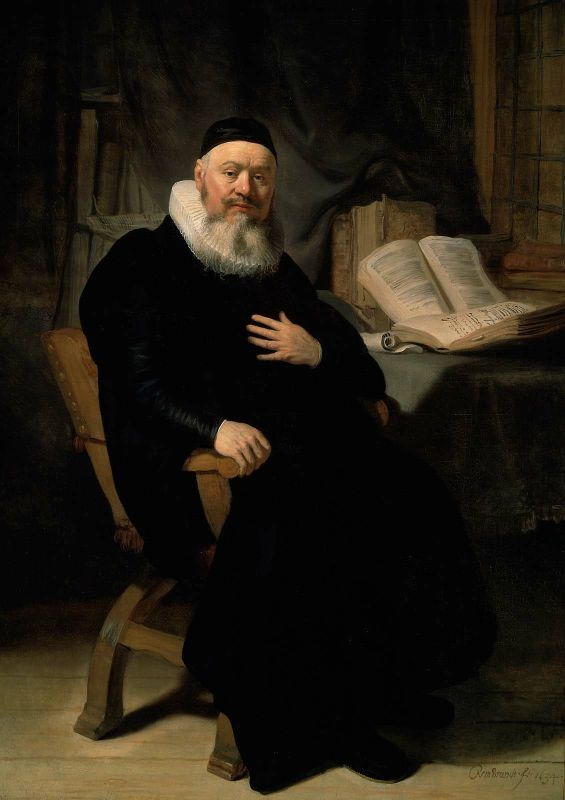
“Portrait of Johannes Elison” is a commanding image from 1634, created at the moment when Rembrandt had freshly settled in Amsterdam and was rapidly becoming the city’s most sought-after portraitist. The sitter, a respected English-born minister serving a Dutch Reformed congregation, is presented seated in a wooden armchair within a study lined by books, draperies, and a window that breathes a hushed interior light. The painting’s grandeur lies not in spectacle but in the sober orchestration of black clothing, silver beard, parchment pages, and a hand posed over the chest as if affirming conviction. It is a portrait that joins public office to private gravity, granting the viewer a sense of a life grounded in scripture and conscience.
Historical Moment
The year 1634 belongs to Rembrandt’s early Amsterdam phase, a moment defined by the influx of mercantile wealth and a civic culture that prized visible integrity. Portraits of ministers and their spouses satisfied a growing appetite for images that expressed moral authority without ostentation. In this setting Rembrandt perfected an idiom that dignified black attire and white linen, extracting from modest means a world of nuance. The painting of Johannes Elison stands within this context and forms a pendant with the companion portrait of his wife, Maria Bockennolle. Together they demonstrate how an artist in his late twenties could fulfill the decorum required by sitters of stature while nurturing an inward drama that would become his signature.
The Sitter and His Role
Johannes Elison sits not as a detached scholar but as a pastor whose authority is both intellectual and pastoral. The open folios on the table testify to learned labor and the public text that underwrote preaching and counsel. His cap, ruff, and sober robe mark his office within the Reformed community, and his calm gaze places the viewer at a respectful distance. The hand placed upon the chest is not theatrical piety; it is a steadying gesture that fuses thought, speech, and character. Rembrandt’s insight is to build an entire portrait around the quiet eloquence of this gesture, letting it organize light and space as surely as it organizes meaning.
Composition and the Architecture of Space
The composition balances the weight of the seated figure against a counter-mass of table, books, and drapery. The chair turns diagonally so that the sitter becomes a sculptural presence modeled in the round rather than a flat façade. The table forms a horizontal podium where the large volumes open like fanfolds of light, their creamy pages reflecting illumination back toward the beard and collar. Behind, a curtain drops in sober folds that both frame and deepen the setting while a window lattice sketches a geometry of moral order. The entire room lives within a restrained perspective whose lines converge softly, creating a space that is believable yet contemplative.
Light as Narrator
Light enters from the left and moves through the room as if enacting a narrative of vocation. It climbs the page edges, threads through the beard, catches the knuckles of the resting hand, and grazes the cheek with a warm, humane clarity. Shadows are generous but not oppressive; they retain a soft brown undertone that preserves air between forms. The black robe yields low highlights along the sleeve and at the knees where fabric banks over the chair’s edge, while the collar gathers light into a crisp white ledge that sets the head in relief. This measured illumination never deserts the face, but it never isolates it either. The picture becomes a single organism of light in which study, posture, and thought belong to the same climate.
Color and Tonal Economy
The palette is reduced to an eloquent quartet: deep blacks, creamy off-whites, warm flesh, and muted browns. Within this economy, Rembrandt finds extraordinary range. The robe’s blacks are not a blank; they grade from velvety depths to satin glints that reveal the body beneath. The collar and pages modulate from cool pearly tones to warmer ivories, with the beard providing a bridge where light feathers across hair. The tablecloth surrenders quiet greens and greys that keep the painting from sinking into monotone. Flesh tones—especially around the eyes, nose, and mouth—contain restrained warmth, avoiding the cosmetic; the color of life is present, but it never competes with the moral temperature of the scene.
The Study Table and the Books
The open folios are more than attributes; they do structural work. Their leaning planes create a counter-sweep to the sitter’s torso, and their bright pages transmit light into the composition. Rembrandt resists fussy detailing of letters or borders. Instead, he uses slight ridges of paint to suggest thickness and the swell of bound paper. The rolled scrolls at the table’s edge and the closed volumes piled beneath whisper the continuity of reading, writing, and preaching. The books’ presence turns the room into an arena of thought without diminishing the living person who inhabits it.
The Chair and the Grounding of the Body
The armchair, with its angled runners and brass tacks, anchors the figure and telegraphs a quiet physical reality. The sitter leans slightly into the armrest, a subtle weight that makes the portrait tactile. Rembrandt pays attention to how light skims the chair’s polished edges and warms the wood where the sitter’s hand rests. The floorboards receive a pooling of light near the feet that prevents the lower field from dissolving into darkness, and the splayed legs of the chair articulate a stance of steadiness. Every element contributes to a narrative of grounded authority.
The Hands and the Language of Gesture
Rembrandt’s portraits often read like essays on hands. Here the right hand lies open upon the chest, fingers relaxed, as if pinning a thought before speech. The left hand rests on the chair arm, its simple curve echoing the arc of the beard. The fingernails are quietly touched, the knuckles rounded without exaggeration, and veins are suggested with the lightest tonal ebb. Their positions establish a rhythm that travels from chest to arm to book, staging a triangle of mind, body, and text. This choreography makes the painting legible at human speed, the pace of breath rather than theater.
Texture and Material Truth
The painting’s sensory persuasiveness arises from Rembrandt’s ability to translate materials into brush. Linen becomes crisp because edges are caught with upright strokes that hold light; hair becomes soft because pigment is feathered wet-into-wet and then tightened with dry strands; leather and wood gleam where glazes are floated over darker grounds. The pages turn luminous through thin, milky layers set against warm shadows. Even the dark drapery in the background avoids deadness; it carries a faint nap that admits light. This accuracy is not pedantry; it is respect for the world the sitter inhabits.
Psychological Presence
Beyond props and pose, the painting’s heart is the face. Johannes Elison looks outward with a sober, approachable intelligence. The eyelids carry the weight of age without fatigue; the mouth turns with a hint of benevolence; the brow relaxes, neither furrowed nor bland. Rembrandt tends the passages around the eyes and lips with special care, building them from small, translucent strokes that maintain moisture and temperature. The beard, a bright frame across the chest, participates in the psychology too, hiding any hint of insistent smile and keeping the expression within the realm of composure. The face, like the room, is at peace with its duties.
Dialogue with the Pendant Portrait
In the companion portrait of Maria Bockennolle, white linen and a broad hat ring the head like a disciplined aura; here the minister’s collar performs the same task with clerical firmness. Her poised hands and broad skirt create a quiet amplitude; his seated pose and study table create a quiet depth. The pendants enter into marital conversation: she offers domestic steadiness and social grace; he offers learned counsel and public voice. Rembrandt designs cross-rhymes between them—shared light direction, matching tonal hierarchies, commensurate dignity—while giving each image autonomy. Together they express not only a union but a household’s identity under God and city.
Theology and Ethical Atmosphere
Dutch Calvinist portraiture often eschews allegory and overt symbols in favor of lived virtue. This painting embodies that preference. The books do not shout doctrine; they sit open as tools. The gesture at the chest does not proclaim sanctity; it records a habit of sincerity. The black robe does not erase the man; it concentrates attention where it matters. The whole atmosphere suggests a theology of plain truth: God is honored not by gold and marble but by work, study, and conscience. Rembrandt does not preach; he lets the room and the face conduct their own quiet homily.
Brushwork and Decision
Although the finish is refined, the surface reveals a painter who thinks with his brush. Adjustments around the hand—tiny pentimenti of knuckle and sleeve—attest to live decision-making. The beard carries strands that flicker into the collar and then recede, as if Rembrandt calibrated softness until the breath of the sitter felt right. On the pages, thin paint allows the ground to warm the paper from beneath, a choice that keeps the whites from looking chalky. Such decisions accumulate into a sense of inevitability: everything appears placed, not manufactured.
The Background and the Window
The window lattice at left is a minor actor with major consequences. It suggests a civic interior rather than an abstract studio and introduces a geometry that quiets the curtain’s soft cascade. The suggestion of daylight coming through that lattice underwrites the plausibility of the brighter passages and enlivens the entire tonal structure. The drapery, conversely, keeps the space contemplative and muffles any draft of narrative. Rembrandt often used such curtains to tune darkness; here it behaves like an organ pipe for tone, deepening the key in which the painting speaks.
The Experience of Scale and Viewing
Encountered at full size, the portrait surrounds the viewer with deliberate slowness. The large body of black robe claims the lower field, insisting that attention climb toward the face and books; the pale floor acts as a quiet apron that separates the viewer from the sitter’s feet; the sustained midtones at the back prevent the space from bursting outward. From a distance the picture reads as a triad of masses—robe, collar-beard-face, table-books—while at arm’s length it resolves into a moving field of strokes and glazes. Rembrandt builds for both distances, ensuring immediate legibility and long-term rewards.
Legacy and Enduring Appeal
The portrait stands as a robust example of how Rembrandt could adapt international portrait conventions to Dutch values. It is grand without pomposity, intimate without informality. Ministers, merchants, and matrons of the period sought exactly this blend: visible honor attached to quiet self-respect. Today the painting remains persuasive because it honors the intelligence of viewers. It trusts that we can read light on linen, the weight of a hand, the gleam of a page, and arrive at character. Few works demonstrate more clearly how a painter can turn restraint into amplitude.
Conclusion
“Portrait of Johannes Elison” transforms a modest interior into a stage for integrity. Through a limited palette, a lucid architecture of light, and paint that understands the nature of things—cloth, hair, wood, paper—Rembrandt makes sobriety radiant. The sitter appears as a man balanced between study and service, between book and congregation, between the quiet of the room and the public voice beyond it. The painting is more than a likeness; it is a meditation on vocation, rendered with the warmth and clarity of an artist already in command of his powers.