Image source: wikiart.org
Introducing “Portrait of Jan I Moretus” by Peter Paul Rubens
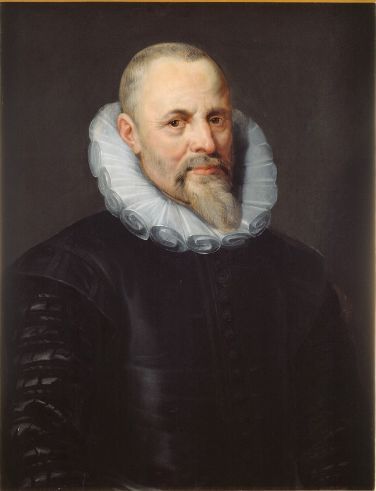
“Portrait of Jan I Moretus” by Peter Paul Rubens is a striking image of quiet authority. The canvas presents Jan I Moretus, head of the famous Plantin-Moretus printing house in Antwerp, as a composed middle aged man dressed in severe black, framed by a spectacular white ruff. Rubens strips away decorative background elements and focuses almost entirely on the sitter’s presence. The result is a portrait that feels both intimate and monumental, a meeting between two pillars of Antwerp’s cultural life: the painter and the printer.
Jan I Moretus stands before a dark, neutral backdrop that pushes his figure forward. He is shown in three quarter view, turned slightly toward the viewer’s left. His expression is steady, his eyes alert and thoughtful. A carefully trimmed beard and moustache frame his mouth, and the receding hairline at the crown emphasizes his mature age. The luminous ruff that circles his neck acts like a halo of folded paper, subtly hinting at his connection to the world of books.
At first glance the painting seems reserved, even austere. Yet as the eye lingers, a complex character emerges. Rubens’s handling of light and texture brings out both the firmness and the sensitivity of Jan Moretus’s personality. It is a portrait that celebrates not only the man himself but the larger world of humanist scholarship and the printed word that he helped to shape.
Jan I Moretus and the world of the Plantin press
To understand the significance of this portrait, it is helpful to recall who Jan I Moretus was. Born Jan Moerentorf, he married Martina Plantin, daughter of the influential printer Christophe Plantin, and eventually took over the Plantin printing house. Under his leadership the Plantin-Moretus press became one of the most important centers of book production in Europe, known for its scholarly editions of classical, scientific, and religious texts.
Rubens moved within the same intellectual and commercial circles as the Plantin-Moretus family. The printer and the painter shared clients, patrons, and friends among Antwerp’s humanists and wealthy merchants. The printing house distributed engravings after Rubens’s designs, and the workshop’s books helped spread Counter Reformation ideas that Rubens often visualized in his altarpieces.
“Portrait of Jan I Moretus” can therefore be seen as more than a private likeness. It is also a tribute to the collaboration between word and image in early modern Antwerp. By painting the printer with such care and dignity, Rubens acknowledges the crucial role of the book trade in shaping the culture of his time. The sitter is not a soldier or nobleman. He is a craftsman and businessman whose influence over European thought came through ink and paper.
Composition and the power of restraint
The composition is remarkably simple. Moretus is placed slightly off center, his torso angled away from us, his head turned back in our direction. The background is a smooth, dark field with no architectural frame, curtain, or symbolic objects. Rubens resists the temptation to surround the sitter with the tools of his profession. No printing press, no bookshelves, no typeset blocks appear in the painting.
This deliberate restraint focuses our attention on the man himself. The strong vertical axis of his body grounds the image, while the oval of the ruff and the rounded shape of his head give the composition a subtle circular rhythm. The dark costume merges with the background, creating a sense of depth and allowing the face and ruff to stand out.
The overall effect is one of calm equilibrium. There are no dramatic gestures, no sweeping diagonals, no restless movement. Instead the portrait radiates concentrated stillness. Rubens often painted explosive battle scenes and swirling clouds of angels, yet here he demonstrates his ability to create tension and interest through very limited means. The drama is internal rather than external, located in the slight tilt of the head and the interplay between eyes and mouth.
Costume, ruff, and social status
Jan I Moretus appears in the sober black dress typical of prosperous burghers in the Low Countries during the late sixteenth and early seventeenth centuries. The heavy, lustrous fabric of his doublet and coat absorbs light, registering only soft highlights along seams and folds. This restrained color choice conveys seriousness and modesty, values prized in the mercantile culture of Antwerp.
The most visually arresting element of Moretus’s attire is the crisp white ruff that encircles his neck. Composed of repeated folded segments, it resembles a series of rolled scrolls or pages. Rubens paints each fold with delicate attention to the play of light and shadow, capturing the stiff yet fragile quality of starched linen. The ruff serves as a visual counterpoint to the dark costume, framing the face and creating a sense of refinement.
This fashionable collar also speaks to the sitter’s status. Such elaborate ruffs required significant material and labor, signaling wealth and respectability. At the same time, the white purity of the ruff hints at moral ideals associated with the learned and pious bourgeois class. In the context of Jan I Moretus’s profession, the circular crown of folded white linen almost reads like an emblem of his life among pages and paper.
The face of a printer and humanist
Rubens’s most impressive achievement in this portrait lies in his depiction of Moretus’s face. The features are sharply defined yet softly modeled, with subtle transitions between light and shadow. A high forehead, receding hairline, and small, neatly trimmed beard emphasize his middle age. The lines around his eyes and mouth suggest experience and thoughtful scrutiny rather than fatigue.
The eyes themselves are key to the painting’s psychological depth. Moretus looks directly at the viewer, but his gaze is not confrontational. It is observant, measuring, perhaps slightly wary. This is the gaze of a man accustomed to examining proofs, contracts, and manuscripts with careful judgment. There is a quiet intelligence in his expression, a sense that he weighs words and people before he commits to them.
Rubens avoids any hint of flattery. The nose is somewhat bulbous, the cheeks slightly hollow, the skin texture varied. Yet there is a real warmth in the portrayal. The slight upturn at the corners of the mouth suggests a restrained friendliness, as if Moretus might smile more openly in another moment. Rubens captures the mixture of reserve and approachability common among successful businessmen who must balance authority with negotiation.
Light, surface, and painterly technique
Light in “Portrait of Jan I Moretus” is carefully controlled. It comes from the upper left, illuminating the sitter’s forehead, cheekbones, and ruff. The dark background receives almost no direct light, which makes the highlights on flesh and fabric appear all the more luminous. This contrast brings Moretus into sharp relief without resorting to theatrical spotlight effects.
Rubens’s brushwork varies across the painting. In the face, it is finely blended, with little evidence of individual strokes. This smoothness allows for precise modeling of form and nuance of expression. In the ruff, the strokes become more visible, following the curves of the folds and creating a sense of crisp texture. In the costume, broader, softer strokes suggest the sheen of black fabric without dwelling on every detail.
This variety of handling shows Rubens’s mastery in directing attention. He lavishes detail where it matters most, in the face and collar, and keeps the rest understated. The viewer’s eye is naturally drawn to the areas of sharper focus, guided by the painter’s invisible hand.
Rubens and the tradition of Northern portraiture
“Portrait of Jan I Moretus” sits at an interesting crossroads between Flemish and Dutch portrait traditions. Northern Europe had a long history of sober, carefully observed portraits of merchants and civic leaders. Artists like Hans Memling and later Frans Hals and Rembrandt painted sitters in dark clothes against simple backgrounds, emphasizing character over decorative surroundings.
Rubens, who had studied Italian art and was known for grand historical scenes, adapts this Northern sobriety to his own Baroque sensibility. The restrained composition and limited color range align with Netherlandish portrait conventions. Yet the subtle warmth of flesh tones, the delicate orchestration of light, and the psychological richness of the expression reflect Rubens’s broader artistic ambitions.
Compared with the more flamboyant portraits of aristocrats Rubens produced for foreign courts, this image is modest in scale and program. That modesty suits both the sitter’s class and the cultural values of Antwerp’s patriciate. It shows Rubens’s flexibility and his capacity to tailor his style to the social context and expectations of his patron.
A portrait of partnership between art and print
The relationship between Rubens and Jan I Moretus was not purely personal. The Plantin-Moretus press played a crucial role in disseminating engravings based on Rubens’s paintings. These prints allowed his compositions to circulate across Europe, reaching audiences who would never see the original canvases. In turn, Rubens’s designs enhanced the prestige of the printing house.
Seen in this light, the portrait becomes a celebration of collaboration. The printer whose presses multiplied images now becomes the subject of a master painter’s singular, unrepeatable image. The interchange of creativity runs both ways. Moretus’s work preserved texts and images for future generations, while Rubens fixed Moretus’s own likeness for posterity.
The painting also hints at the broader alliance between visual art and the written word during the Baroque period. Books, engravings, and paintings all served to communicate religious, political, and scholarly ideas. By focusing on the calm, reflective face of a printer rather than on a dazzling display of wealth or power, Rubens suggests that true cultural authority lies in the quiet labor of those who manage and disseminate knowledge.
Dignity, introspection, and the spirit of Antwerp
At its core, “Portrait of Jan I Moretus” is a study in dignified introspection. There are no obvious signs of religious ecstasy or dramatic emotion. Instead the painting captures the poised confidence of a man who has found his place in the world and fulfills it with steady responsibility.
This attitude reflects the broader spirit of Antwerp’s civic elite. The city was a major center of commerce and culture, where merchants, printers, and artists combined entrepreneurial drive with humanist education. Success depended on both practical skill and intellectual refinement. Moretus embodies this blend. His sober black clothing suggests discipline, while the ruff and thoughtful gaze hint at cultivated taste and learning.
Rubens’s respectful treatment of the sitter echoes this ethos. The portrait does not exaggerate or idealize, yet it raises the sitter above the everyday by placing him in a timeless, shadowy space. The viewer encounters Jan I Moretus not in the bustle of the printing workshop but in a moment of composed stillness, as if he had stepped out of time for a single sitting. The image thus becomes a visual testament to the values of industry, literacy, and moral seriousness that defined Antwerp’s golden age.
Legacy and contemporary relevance of the portrait
Today, “Portrait of Jan I Moretus” holds interest on several levels. For art historians it represents a crucial document of Rubens’s activity as a portraitist among his immediate circle in Antwerp. For historians of the book, it provides a rare, vivid image of one of the key figures in early modern printing.
For contemporary viewers more generally, the portrait offers a reflection on the people behind the circulation of ideas. In a digital age where texts and images spread instantly and often anonymously, the painting reminds us that historically such circulation depended on identifiable individuals who took responsibility for what they produced. Jan I Moretus’s steady gaze can be read as the look of someone who knows that every page leaving his press reflects his judgment and reputation.
The painting also speaks to the enduring value of thoughtful work. There is no sense of haste or distraction in Moretus’s demeanor. He appears fully present, grounded, and self-aware. In a culture often dominated by speed and surface impressions, Rubens’s image of a reflective printer in dark clothing and a bright ruff can feel unexpectedly modern. It quietly proposes that true influence may come not from noise and spectacle but from careful attention to words, images, and the people who bring them into the world.