Image source: wikiart.org
Introduction to “Portrait of Jacqueline Van Caestre Wife of Jean Charles De Cordes”
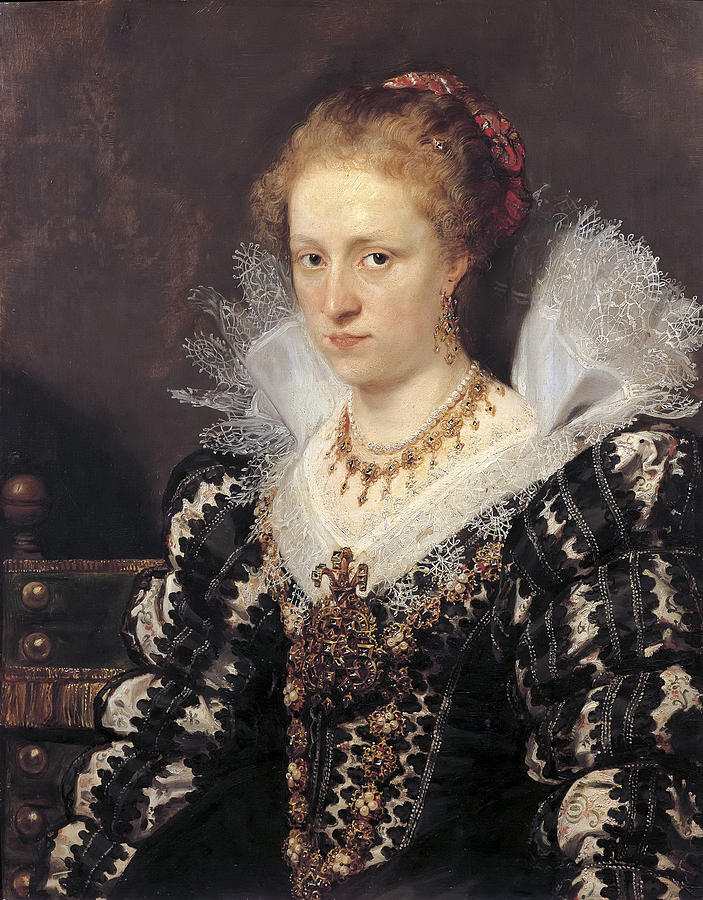
Peter Paul Rubens’ “Portrait of Jacqueline Van Caestre Wife of Jean Charles De Cordes” is a superb example of early seventeenth-century aristocratic portraiture. The sitter appears three-quarter length, turned slightly toward the viewer, her pale face glowing against the dark background and the complex patterns of her sumptuous dress. Rubens captures not only the splendor of Flemish noble fashion but also the quiet, intelligent presence of a woman fully aware of her rank and responsibilities.
While the exact date of the painting is unknown, stylistic clues place it among Rubens’ mature Antwerp portraits, when he was at the height of his powers as both court painter and chronicler of the local elite. The portrait is at once a display of wealth and a nuanced psychological study, showing how Baroque portraiture served both social ambition and personal remembrance.
Historical Context and Identity of the Sitter
Jacqueline Van Caestre belonged to the prosperous Flemish nobility. Her marriage to Jean Charles de Cordes linked two important families whose fortunes were rooted in trade, landownership, and connections to the Habsburg court. Commissioning a portrait by Rubens was a way to affirm this status visually.
In the early seventeenth century, portrait pairs of husband and wife were common. Rubens painted Jean Charles de Cordes as well, and the two works were likely designed to hang together in a family residence. They conveyed lineage, alliance, and stability—vital values in a period marked by political upheaval and religious conflict in the Low Countries.
Within this context, Jacqueline’s portrait is not merely an image of personal vanity; it functions as an instrument of dynastic representation. The luxury of her attire, the commanding yet restrained pose, and the painter’s careful attention to heraldic and decorative details all reinforce her role as matriarch and guardian of family honor.
Composition, Pose, and Framing
Rubens composes the portrait with a quiet but powerful geometry. Jacqueline sits slightly off-center, angled toward the right, yet her gaze meets the viewer directly. This three-quarter pose allows Rubens to show the intricate construction of her dress while emphasizing the subtle turn of her shoulders and neck. The result is a natural, unforced elegance rather than stiff formality.
The background is dark and plain, with only a hint of a chair’s carved finials and upholstery emerging on the left. This spareness directs attention squarely onto the sitter. There is no distracting architectural setting or symbolic still life; Jacqueline herself, her face and costume, are the entire subject.
Rubens frames the head within the white lace ruff and the reddish hair ornament, creating a visual halo. The triangular shape of her upper torso, widening toward the broad, decorated bodice, anchors her vigorously in space. This structure conveys stability and authority while leaving room for the delicate nuances of expression in the face.
Costume as a Statement of Rank
One of the most striking aspects of the portrait is Jacqueline’s elaborate costume. She wears a black dress embroidered and slashed with silver or white, a fashionable contrast that highlights the sculptural volume of the sleeves and bodice. The black fabric, likely expensive silk or velvet, signifies wealth and social standing; in many regions, rich blacks were among the most costly colors to produce.
The bodice is adorned with an extraordinary jeweled ornament, perhaps a family piece passed down through generations. Its symmetrical form, studded with pearls and colored stones, draws the eye to the center of her chest, echoing and reinforcing the centrality of her person within the portrait. Below it, the vertical row of decorative elements leads the viewer’s gaze downward, emphasizing the long, controlled lines of her figure.
Around her neck she wears layered chains and a necklace composed of small dangling elements that catch the light. Matching earrings and hairpins further attest to the family’s wealth and to the sitter’s taste. Rubens paints these jewels not as flat symbols but as sparkling, three-dimensional objects, using tiny highlights to suggest facets and reflections.
Through this carefully rendered costume, the portrait articulates Jacqueline’s social identity. She is a woman of means and distinction, presented with all the magnificence deemed appropriate for her rank, yet her demeanor remains composed rather than ostentatious.
The Lace Ruff and Textural Mastery
The wide, standing lace ruff around Jacqueline’s neck is a marvel of Rubens’ meticulous observation. Each tiny loop and scallop of lace is suggested with flickering brushstrokes, not mechanically detailed but convincingly alive. The ruff frames her face like a sculptural collar, separating the delicate skin tones from the darker fabrics below.
This neckwear also signals the sitter’s participation in the very latest fashion. Fine lace was a luxury commodity, often imported and extremely costly. Rubens revels in the challenge of rendering such delicacy in oil paint, differentiating between the stiff, starched outer ruff and the softer, semi-transparent inner layer that brushes her chin.
Beyond simple display, the ruff helps to define Jacqueline’s character. It creates a sense of distance and propriety—a literal and metaphorical buffer that keeps the body from the viewer’s reach. In this way the portrait balances intimacy of gaze with formality of attire, acknowledging both the sitter’s humanity and the dignity of her status.
Light, Color, and Painterly Technique
Rubens uses light in this portrait with subtlety and control. A gentle illumination from the left falls across Jacqueline’s face, throat, and upper chest, creating a luminous zone against the dark background. This light reveals the smooth modeling of her features, the slight flush in her cheeks, and the reflective surfaces of jewelry and lace. Shadows sculpt the nose, eye sockets, and the curve beneath the lower lip, giving her head believable volume.
The color palette is relatively restrained: blacks, whites, creams, touches of gold, and the warm tones of skin and hair. Yet within this limited range Rubens finds an extraordinary variety. The blacks of the dress contain hints of deep blues and browns; the whites of lace and ruff alternate between cool and warm notes to capture both shadow and highlight; the flesh tones shift from rosy pink on the cheeks to paler hues on the forehead and neck.
His brushwork reveals a master’s confidence. Seen up close, the lace and jewels are created by quick, economical touches, almost abstract. From a normal viewing distance, these marks cohere into convincing detail. The skin is painted more smoothly, with carefully blended transitions, ensuring that the face remains the primary focus. This interplay of textures—smooth flesh, crisp lace, gleaming gems, and velvety fabric—adds sensuous richness to the image.
Facial Expression and Psychological Presence
Perhaps the most compelling feature of the painting is Jacqueline’s expression. Her eyes look directly outward, meeting the viewer with a quiet, measured gaze. There is no overt smile, yet the corners of her mouth suggest a restrained softness rather than severity. The overall impression is of intelligence, self-awareness, and a certain reserve.
Rubens avoids idealizing her features. The nose is slightly prominent, the lips natural rather than prettified, the skin marked with the faint textures of real flesh. This realism gives the portrait credibility as a likeness and enhances the sitter’s individuality. She is not a generic noblewoman but a specific person with her own temperament.
At the same time, Rubens imbues the face with a calm inner light. Jacqueline appears composed, self-possessed, perhaps a little guarded. The direct gaze invites curiosity: what thoughts lie behind those observant eyes? This psychological depth is a hallmark of Rubens’ portraits; he strives not only to depict external appearance but to hint at the inner life of his sitters.
Social Role, Gender, and Representation
The portrait also reflects contemporary expectations of noblewomen. Jacqueline is shown seated, partially turned, hands implied but not emphasized. Her body language is controlled and modest. The extravagant costume and jewelry proclaim her family’s prosperity, yet her demeanor asserts dignity rather than frivolity.
In the early seventeenth century, women of her station played crucial roles in managing households, estates, and marital alliances. Portraits like this one affirmed their importance within family networks, even as they upheld ideals of decorum and chastity. The high neckline of the dress, the enveloping ruff, and the secure hairstyle all signal propriety. Rubens respects these conventions while giving Jacqueline a strong, individual presence.
By commissioning such a portrait, Jean Charles de Cordes and Jacqueline herself participated in a visual culture that linked female virtue with controlled elegance and pious responsibility. The absence of overt religious symbols might suggest that her moral character is conveyed through comportment rather than iconography.
Rubens’ Portrait Style and Italian Influences
Rubens’ approach to portraiture was shaped by his time in Italy, where he studied the works of Titian, Veronese, and other Venetian masters. From them he learned to combine rich color and texture with psychological insight. In Jacqueline’s portrait, one can sense the influence of Titian’s female portraits in the warm flesh tones and the interplay of luxurious fabrics.
However, Rubens also brings a distinctly Northern sensibility. The meticulous rendering of lace and embroidery, the subtle textures of wood and metal on the chair, and the precise description of jewelry reveal the Flemish tradition of detailed observation. He blends Italian painterly freedom with Netherlandish precision, resulting in a portrait that is both lush and exact.
Compared with some of his later, more flamboyant portraits, this work feels measured and intimate. There is no dramatic landscape or swirling drapery, only the quiet drama of character and costume. This restraint suits the sitter’s dignified bearing and the likely domestic context in which the painting originally hung.
The Setting and Implied Narrative
Though the background is almost bare, a few elements hint at the sitter’s environment. The partial view of a chair with turned finials suggests a well-appointed interior, perhaps a reception room or private chamber. The dark, neutral wall avoids distraction while implying the safe, inward-looking world of the household.
The way Jacqueline leans slightly toward her right, with her arm resting casually, gives the impression that she has paused momentarily from conversation or reflection to sit for Rubens. The portrait seems less like a frozen emblem and more like a captured moment in an ongoing life. This sense of immediacy strengthens the viewer’s connection to her, even across centuries.
There is no overt narrative—no book, no instrument, no pet—but the combination of costume, posture, and gaze tells its own story of status, personality, and time. We see a noblewoman poised at the intersection of private identity and public representation.
Legacy and Modern Appreciation
Today, “Portrait of Jacqueline Van Caestre Wife of Jean Charles De Cordes” continues to fascinate viewers for the intimacy it offers with a long-gone world. Through Rubens’ artistry, Jacqueline’s presence feels remarkably fresh: her gaze is as penetrating now as it was for those who first entered the family gallery centuries ago.
Art historians study the painting to understand fashion, jewelry, and social customs of the Flemish elite, while also appreciating it as a benchmark of Baroque portrait technique. For general audiences, the work’s appeal lies in the tension between regal display and human vulnerability. Beneath the armor of lace and gold, we sense a thoughtful woman, aware of being looked at, aware of the significance this image will hold for her family.
The portrait also contributes to a broader understanding of women’s representation in early modern art. Far from passive adornments, sitters like Jacqueline participated actively in shaping how they wished to be remembered. Rubens’ sensitivity to her individuality ensures that the painting is not simply a monument to wealth, but a lasting tribute to a particular human being.
Conclusion
“Portrait of Jacqueline Van Caestre Wife of Jean Charles De Cordes” showcases Peter Paul Rubens’ remarkable ability to unite luxurious surface with psychological depth. Through a carefully constructed composition, masterful handling of light and texture, and an unsentimental yet sympathetic depiction of the face, he transforms a social commission into a compelling work of art.
The elaborate costume and jewelry proclaim Jacqueline’s status as a noblewoman, while the calm, direct gaze reveals intelligence, restraint, and inner strength. The painting captures the values of its time—family honor, decorum, and the power of visual representation—yet it speaks across centuries by presenting a person whose presence remains vivid and engaging.
As viewers linger over the shimmering lace, the gleam of gold, and the subtle play of light on skin, they encounter not just an artifact of Baroque culture but a portrait of enduring humanity.