Image source: wikiart.org
Introduction: Authority Tempered by Light
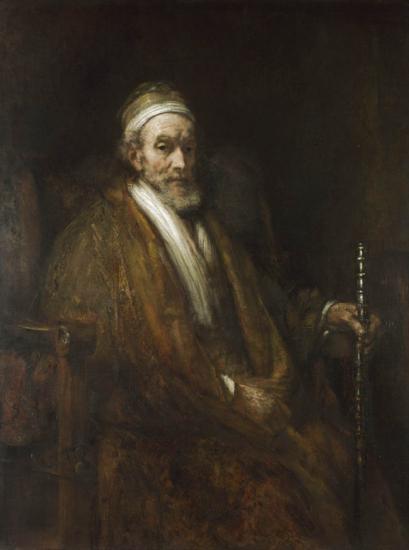
Rembrandt’s “Portrait of Jacob Trip” (1661) presents a seated Dutch magnate wrapped in layered browns and off-whites, his right hand resting on a finely turned cane, his body reclined into an upholstered chair that seems to emerge from darkness. The face is the picture’s furnace: calm, weathered, and alert. A high, soft light enters from the left and writes its way across brow, cheek, scarf, and sleeve, while the rest of the room becomes a chamber of breathable shadow. In a single, unforced image, Rembrandt fuses wealth and gravity, civic responsibility and private thought. This is not a courtly likeness that performs status; it is a conversation with character conducted in paint.
Jacob Trip and Amsterdam’s Patrician World
Jacob Trip belonged to one of Amsterdam’s elite merchant families whose fortunes were made in iron, armaments, mining, and international trade. The Golden Age city depended upon such men for its shipping fleets, civic projects, and cultural patronage. By the 1660s, however, the Republic’s prosperity was braided with uncertainty—wars strained budgets and reputations, and the old patrician codes were tested by a new, complicated economy. Rembrandt situates Trip inside this climate not with ledger books or harbor vistas but through bearing: the measured tilt of the torso, the guarded hand on the cane, the open but unsmiling gaze. The painting becomes a document of leadership at rest yet ready—authority that does not need to shout.
Composition: Pyramid, Axis, and the Logic of the Chair
The portrait’s architecture is classical and clear. Trip’s robed body creates a broad pyramid whose apex is the face. Two structural lines stabilize the whole: a diagonal from the illuminated forehead down across the scarf and into the right wrist, and a vertical from that wrist down the cane toward the lower edge. The chair’s arm at left forms a counterweight—one horizontal that balances the cane’s assertive vertical. These elements produce a poised stillness: the sitter’s mass feels anchored, the eye’s movement choreographed but unforced. By placing Trip slightly to the left of center, Rembrandt leaves a pocket of dark air to the right, an optical buffer that enhances the sitter’s presence without resorting to scenic background.
Chiaroscuro as Civic Rhetoric
Rembrandt’s late chiaroscuro is more humane than theatrical. Light behaves like judgment and mercy, revealing what matters and letting the rest be hinted. In this canvas the beam strikes the left forehead and cheek, grazes the bridge of the nose, softens along the lips and beard, and then runs down the scarf where white threads lift into little ridges. The cane receives a compact constellation of highlights—enough to describe turned rings and polished metal—but never enough to compete with the face. Darkness is active, not empty: it gathers behind the sitter to form a cushion of authority, coaxing the toned whites forward so they read as character rather than costume.
Color Harmony: Earth and Bone, Gilt and Ash
The palette is restrained and resonant. Umber, raw sienna, and bituminous browns build the robe and chair; broken whites and grays articulate scarf and sleeve; fainted golds hover inside the robe’s worn lining; desaturated olives and smoky blacks knit the room together. Because chroma is muted, temperature and value carry expression. Watch the warm note that blooms at the cheekbone, the cooler whites in the scarf’s interior, the warmer fleck atop the cane’s knob, the near-black where the chair’s upholstery sinks away. Every shift is purposeful, a tone poem of responsibility rather than ornament.
The Cane and the Language of Objects
Trip’s cane is not simply an accessory; it is a structural and psychological device. As a vertical, it holds the portrait’s right edge; as a symbol, it speaks of age, rank, and mobility within the civic sphere. Rembrandt describes it with a sparing exactness—beads of reflected light climb its length like punctuation—yet avoids fetishizing material. The message is clear: objects here serve the human fact. Wealth confirms authority only when it rests in a hand that uses it well. The same ethic governs the depiction of fabric and chair. They are rich, yes, but they exist to make a room for the face.
Surface and Brushwork: Touch as Biography
The surface reads like a record of touch. Across the robe Rembrandt drags a wide, loaded brush that leaves tracks of pigment reminiscent of worn wool. The scarf is built with short, lifted strokes that catch actual light and therefore mimic thread. The chair’s arm emerges from scumbles, as if rubbed into being by the painter’s rag. In the face, handling tightens to glazes and elastic marks: a soft veil to knit planes, a firmer ridge for the nose’s crest, a small, decisive touch to secure the glint at the inner eye. The picture rewards proximity; its textures convince not by finicky detail but by the right kind of pressure in the right places.
The Face: Attentive Calm without Flattery
Trip’s expression is the heart of the work. The eyes look slightly aside, not evasive but thinking; the mouth rests in a line that leans toward patience rather than severity; the brow is open yet trained by years of decision. Rembrandt refuses the two easy solutions of portraiture—heroic polish and caricature. Age appears as softened transitions, not counted wrinkles. Intelligence appears as depth in the half-tones around the eyes, not as graphic insistence. The painter’s compassion is hard-earned: he grants the sitter the dignity of not being explained, only seen.
Costume and Social Code: Sumptuousness Translated into Weight
Trip’s clothes announce status but never swagger. The robe’s deep, dulled browns suggest thickness and expense without sparkle. The long scarf draws the eye back to the chest and throat, reiterating vertical authority, while providing a luminous counter to the dark robe. There may be a ring or faint chain, but if so it is subdued—folded into tone, not pushed into display. The cumulative effect is a translation of luxury into weight and warmth. The garments lend breadth to the silhouette and gravity to the person, as if Rembrandt were converting money into substance before our eyes.
Space and Background: A Chapel for Responsibility
Behind the sitter spreads Rembrandt’s late “brown air,” a field of deep, modulated shadow that feels like volume rather than backdrop. Within this atmosphere forms appear to breathe. It reads as a chapel for responsibility: a quiet in which public burdens can rest a moment without becoming private spectacle. The small wedge of clearer tone at right implies a wall or unlit panel but never coalesces into architecture. The portrait therefore lives outside a specific room and inside a moral one.
Gesture: The Poise of the Right Hand
Observe the right hand on the cane. It is not clenched; it is held. Tendons show lightly under the skin; the thumb’s pad rests, not presses, on the handle. Such restraint contains the portrait’s psychology: control without strain. The left hand, largely suppressed in the lower half-light, keeps the body’s balance but declines eloquence so that the face and right hand can carry the conversation. Rembrandt was a choreographer of hands; here he uses them to articulate steadiness rather than spectacle.
The Ethics of Late Style
By 1661 Rembrandt had abandoned the glossy finish popular among elegant patrons. His brushwork became frank, his chiaroscuro more discriminating, his palettes earthier. The change was not merely stylistic; it was ethical. This painting exemplifies that ethics. Truth is allowed to appear textured; light operates as care rather than spotlight; status is translated into steadiness. When one compares this portrait to earlier civic likenesses—all satin sheen and inventory detail—the difference is clear. Rembrandt is less interested in showing what a man owns than showing how a man bears what he owns.
Process and Revisions: Edges that Think
Look closely at the contour along Trip’s left sleeve and you find softened restatements where the painter trimmed a harder edge to let air slip between arm and chair. At the scarf, strokes of pale tone sit over darker grounds, last-minute calibrations to keep the face central. Even the cane’s highlights appear to have been placed late, balancing the composition once the head’s authority was fully established. These pentimenti—visible changes—are the portrait’s conscience. They show how likeness, for Rembrandt, is reached not by formula but by a series of empathetic decisions.
Comparisons: A Pair and a Tradition
Jacob Trip’s portrait has a traditional partner: the “Portrait of Margaretha de Geer,” his wife, often shown seated, soberly dressed, and bathed in the same humane light. Together they belong to the Dutch double-portrait convention, yet Rembrandt loosens that tradition from stiff symmetry and moralizing gesture. He gives each sitter a separate interiority and builds a bridge between them through shared light and atmosphere. Within Rembrandt’s broader oeuvre, the painting resonates with the late “Apostle Paul,” the introspective self-portraits, and the images of civic figures seen without pomp. The through-line is attention: persons rendered with the same care regardless of role.
The Viewer’s Distance and the Work of Looking
The painting sets us at conversational distance. We are close enough to see the scarf’s strokes and the small glints on the cane; far enough that the head reads as a whole. Because the gaze is slightly averted, viewers are free to look without the chore of responding—an unusual and generous compositional choice. The image asks for a gradual reading, moving from light to half-tone to shadow, from fabrics to flesh, from symbol to person. The slower the looking, the more authority condenses; the sitter’s calm begins to infect the room.
Meaning in Materials: Wealth as Shelter, Light as Measure
Rembrandt lets materials carry meaning without preaching. Thick robes act as shelter from the cold of the world; the chair confers rest earned by labor; the cane measures age but also steadies it; white scarf and sleeve stand for clarity inside the responsibilities of rank. Light verifies all of this. It touches each material differently—glancing from silk, soaking into wool, resting on skin—thereby granting a hierarchy that privileges the human over the accessory. When the eye returns to the face after traveling this circuit, the underlying claim is clear: the worth of office is the person who bears it.
The Psychological Temperature: Composure after Experience
Trip is neither triumphant nor burdened beyond bearing. He appears as someone acquainted with consequence and accustomed to decision. The eyebrows carry a slight fatigue; the mouth, a discipline of speech; the shoulders, an ease that has been earned. That temperature—composure after experience—is a hallmark of Rembrandt’s late portraits. The painter resists the celebratory peak and the melodramatic pit; he chooses the steady summation of a life mid-sentence.
Relevance and Modern Appeal
What gives the painting its contemporary power is not costume history but ethics. We recognize here a form of leadership that is neither branding nor pose: humility that does not cancel authority, wealth that behaves as stewardship, intelligence that listens. In a world saturated by image management, this sober, textured presence feels bracing and trustworthy. Designers study the orchestration of near-monochrome into richness; photographers borrow the high-window light; executives recognize a posture worth emulating.
Why the Portrait Endures
“Portrait of Jacob Trip” endures because it refuses to confuse detail with depth. Its success is not in the inventory of things but in the calibration of light and touch to a human being. The chair, cane, scarf, and robe stage the drama, but the drama is quiet: a face that keeps its own counsel while consenting to be seen. Rembrandt’s late method—ethical chiaroscuro, tactile brushwork, earth harmonies—transforms what could have been a public-relations object into a durable conversation with character. The longer one keeps company with the painting, the more it returns: new warmths in the browns, new authority in the small whites, new patience in the gaze.
Conclusion: Presence Without Pose
In 1661 Rembrandt gathered earth pigments, a humane beam of light, and a lifetime of attention to make this portrait of Jacob Trip—merchant, citizen, and human being. The sitter occupies his chair the way a trustworthy person occupies responsibility: fully, calmly, without show. The face accepts time’s texture; the hands command without clenching; the room makes space for thought. Nothing is superfluous; everything is telling. It is the kind of image that dignifies both sitter and viewer, asking us to measure power not by brilliance of surface but by steadiness of presence.