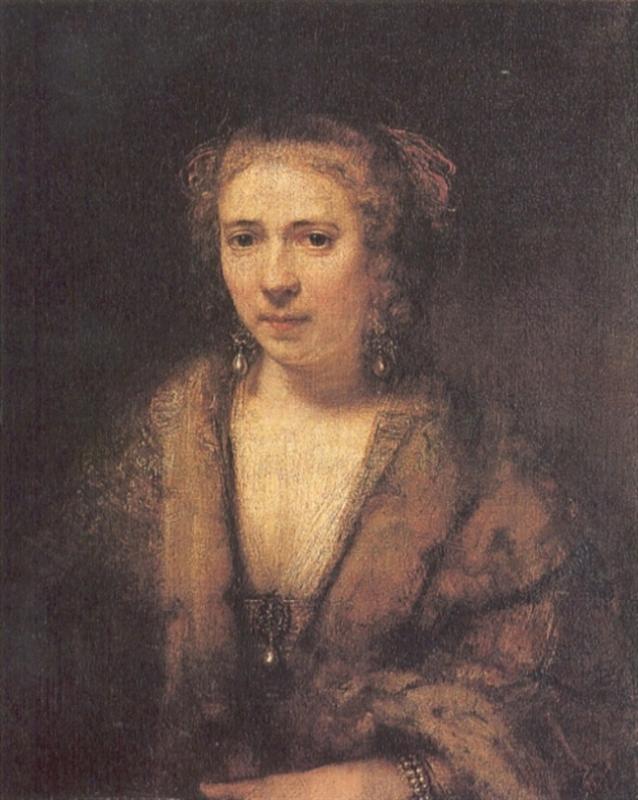
Image source: wikiart.org
Introduction
Rembrandt’s “Portrait of Hendrikje Stoffels” (1654) is one of the most intimate paintings of the Dutch Golden Age. It presents the woman who, by the mid-1650s, had become the artist’s closest companion, model, and anchor—not as an emblem or allegory but as a quietly luminous presence. She sits in half-shadow against a brown, breathing ground, her face turned toward the light with an expression that mingles shyness, steadiness, and inward warmth. The painting’s power lies in its understatement. Nothing theatrical distracts: no elaborate background, no emblematic props. Instead, Rembrandt uses a muted palette, soft transitions, and selectively enlivened highlights to let the viewer feel the temperature of a room and the nearness of a person. It is both a likeness and a confession of affection, a record of looking that has learned how to attend without intruding.
The Life Behind the Image
Hendrikje Stoffels entered Rembrandt’s household in the early 1640s, first as a maid and soon after as a partner and muse. By 1654, she had borne the artist a daughter and was the center of his domestic life. The portrait belongs to a year of astonishing productivity in which Rembrandt also painted “Bathsheba” and a sequence of searching heads—works that reveal a new freedom of handling and a deepened emotional register. Hendrikje appears in several of these pieces, but here the staging is exceptionally spare. The image seems grounded in the realities of their shared Amsterdam interior: modest light, close quarters, the hushed dignity of ordinary hours. That ordinariness is the painting’s argument. Rembrandt renders companionship itself as a subject worthy of the greatest care.
Composition and the Architecture of Nearness
The composition centers the head and upper torso in a compact pyramid. Hendrikje’s body turns slightly away while her face pivots back toward the viewer, establishing a gentle counter-movement that energizes the stillness. The hand at the lower edge and the small clasp at her breast create minor anchors that steady the triangle. Surrounding this structure is Rembrandt’s characteristic chamber of warm, dark tone. Because the background carries no descriptive detail, our eye is not tempted to wander; it learns to dwell. The figure occupies just enough space to feel immediate without crowding the frame. The result is nearness—an intimate distance measured not in feet but in shared air.
Light as Tender Recognition
Rembrandt’s light arrives softly from the left and rides across Hendrikje’s forehead, cheek, and the bridge of her nose before sliding down to animate the throat and the edge of her dress. This is not the stark chiaroscuro of his earlier years; it is a domestic glow, like lamplight filtered through linen. The illumination never hardens into spotlight. It wraps, reveals, and then yields to shadow, allowing the face to keep its privacy. Even the highlights on the pearl earrings are modest glints rather than glitter. Light here is a form of attention: patient, affectionate, and scrupulously humane.
Color, Texture, and the Weather of the Room
The palette is restrained: earthen browns, muted ochres, soft rose-flesh, and the faintest cool notes in the half-tones. The fur-trimmed jacket is built from warm, broken strokes that produce a nap you can almost feel. Underpainted browns breathe through subsequent layers so that the garment reads as weight rather than decoration. The chemise at the décolletage catches a pale vertical flicker, a small flame of paint that lends the torso quiet life. Rembrandt’s color does not shout. It warms the space, calibrating an emotional weather akin to late afternoon: unhurried, attentive, and receptive.
Face as Lived Experience
Rembrandt’s treatment of Hendrikje’s face is at once candid and tender. He permits asymmetry: one eye set a fraction lower, a slight drift at the mouth’s corner, the subtle swell of cheek where the skin holds light a little longer. These are the physiognomies of a specific person rather than an idealized beauty. The gaze meets ours without bravado—there is self-possession, even a hint of reserve, but no guardedness. We sense conversation paused rather than a pose struck. This psychological poise is the hallmark of Rembrandt’s late portraits. He paints not faces in the abstract but people in the middle of being themselves.
The Language of Brush and Edge
Close looking reveals a choreography of touches. The face is knit from thin, semi-opaque layers that allow small temperature shifts to register as living skin. The jacket, by contrast, is painted more broadly; Rembrandt drags loaded strokes across the surface so that paint stands up and catches light like threads of fur. Edges are strategically “lost and found.” Around the hair and shoulders forms dissolve into the ground, while contours around the cheek and hand are sharpened just enough to guide attention. This selective clarity suggests how sight works in a dim room: the mind finishes what the eye begins, and the unimportant recedes without fuss.
Costume, Ornament, and Social Temperature
Hendrikje is clothed warmly, with a fur-trimmed wrap and a dress whose clasp and pearls indicate modest prosperity. Rembrandt refuses jewel-box dazzle. The earrings’ highlights are tiny; the clasp is a few decisive strokes that flicker rather than shine. Everything serves the greater social temperature of the picture: comfort, dignity, and reserve. The low neckline, common in contemporary dress, opens a luminous triangle of skin that balances the head and activates the torso without sliding into display. Rembrandt’s ethic is clear—ornament may frame a person, but it must never eclipse the person.
Intimacy Without Sentimentality
Because Hendrikje was the artist’s companion, one might expect a sentimental veil. Rembrandt avoids it. The picture’s affection rests in clarity, not sweetness. He paints the slight puffiness beneath the eyes and the small crease at the mouth, and he allows a hint of wariness to survive inside the welcoming gaze. The painting loves by registering truth. It stands against fantasy, affirming that the real person in the quiet room is better than any emblem of ideal beauty.
The Décolletage and the Ethics of Looking
The tender modeling of the chest and throat has drawn attention since the seventeenth century. In the same year, Rembrandt painted “Bathsheba,” whose sensuous surface ignited debate about propriety. Here the exposed skin is neither coy nor provocative. It is rendered with sobriety, a softly lit plane that unifies head and body and gives the figure warmth. Rembrandt’s approach instructs the viewer in a way of looking: attentive, grateful, unpossessive. The painting neither sensationalizes nor hides; it trusts mature seeing.
A Portrait Tied to Daily Life
Unlike court portraits with theatrical backgrounds, this painting feels grounded in domestic rhythm. The slightly loosened hair ribbons, the resting hand, the fur’s practical warmth all suggest a life in progress—a break in chores or conversation rather than a staged sitting. That everydayness is key. Rembrandt dignifies the ordinary hours, implying that to honor them in paint is to honor the person who lives them.
Echoes Across Rembrandt’s Work
Hendrikje’s face and presence echo through Rembrandt’s mid-1650s work. In “Bathsheba,” she becomes the subject of a biblical drama transposed into flesh and inwardness. In small etchings of the Holy Family and in other intimate heads, her features appear as studies in light and mood. The 1654 portrait stands near the center of this constellation: less narrative than “Bathsheba,” more deliberate than the quick sketches, it balances naturalism with formal dignity and fixes the visual vocabulary—soft light, warm ground, sober ornament—that would characterize many of Rembrandt’s late portraits.
The Background as a Room of Silence
The dark ground reads as an acoustic space, a chamber that holds and returns the quiet of a voice. Its warm tonality keeps the darkness from becoming harsh. Rembrandt leaves faint currents of scumble and undertone so the background feels like breathable air rather than an abstract void. This silence is thematic. It says that the sitter’s presence is enough—that a person and a room can meet and make meaning without added rhetoric.
Comparison with Contemporary Female Portraits
Many Dutch portraits of women from the 1650s favor crisp satin, ample lace, and a decorous gaze presented under bright, even light. Rembrandt’s vision is different. He chooses textured, touchable fabrics, darkens the chamber, and shapes the face with a living gradation that refuses porcelain perfection. The resulting mood is less public and more confiding. Where some contemporaries record status, Rembrandt records nearness.
The Gaze and the Social Contract
Hendrikje’s eyes make a compact with the viewer. They accept attention, ask for fairness, and offer nothing that feels performative. It is a social gaze rather than a courtly one—neighbor to neighbor, companion to companion. That compact is the painting’s quiet power. We are not dazzled or interrogated; we are acknowledged. The portrait teaches that mutual recognition, not spectacle, is the highest form of looking.
Material Presence and the Sense of Touch
Rembrandt’s surfaces invite touch without tempting it. The fur looks warm, the skin cool, the pearls hard and small, the hair softly gathered. This sensorium is achieved not through bristling detail but through weighted strokes and carefully tuned color. The painting persuades because it accords with bodily memory: we know how these things feel, so we trust what we see.
Time Held Gently
Although a still image, the portrait contains duration. The softened edges and layered paint imply minutes that pass as the artist looks and adjusts, as Hendrikje breathes and shifts slightly. That temporal quality separates the picture from photographic exactness and aligns it with companionship—being with someone long enough to perceive without hurry. Rembrandt captures not a moment snatched but a time shared.
The Question of Morality and Reputation
Hendrikje’s relationship with Rembrandt scandalized some contemporaries, yet the portrait refuses gossip. It offers a moral argument through aesthetics: honesty, warmth, and respect can be painted. There is nothing salacious, nothing puritanical—only an adult human presence meeting another adult presence across a modest room. By displaying the dignity of the sitter, the picture dignifies the relationship without pleading its case.
Influence and Afterlives
The quiet fire of this portrait has influenced generations who seek to paint people rather than types—Goya’s informal court portraits, Velázquez’s intimate heads, and modern painters who prefer felt light to describing every seam. Photographers, too, have learned its lesson: move closer, dim the background, let the face model itself gently, and trust the sitter’s attention to carry the frame. The work endures because it translates a private affection into a public standard for humane looking.
Conclusion
“Portrait of Hendrikje Stoffels” is Rembrandt’s art at its most personal and most universal. With restrained color, compassionate light, and surfaces that breathe, he transforms a domestic interval into a durable image of presence. The painting honors a woman by resisting spectacle and by letting truth—of skin, fabric, mood, and gaze—suffice. We feel the warmth of the fur, the hush of the room, and the delicacy with which attention moves across a beloved face. In a culture that often confuses importance with noise, this portrait proposes another measure: intimacy held with respect. It is a picture that asks for quiet and repays it with company.