Image source: wikiart.org
Introduction to Portrait of Fra Zumel Francisco
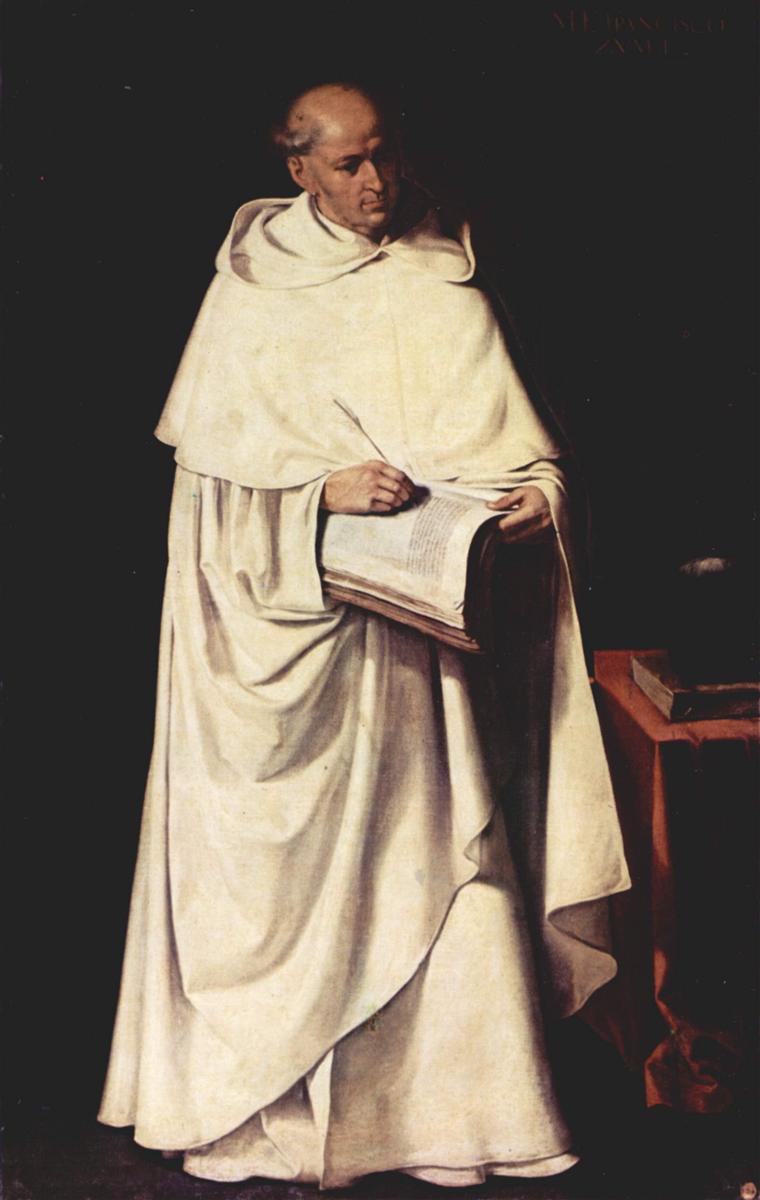
Francisco de Zurbaran’s “Portrait of Fra Zumel Francisco,” painted in 1633, is a quiet yet commanding exploration of monastic identity, scholarship, and spiritual gravity. The work shows a solitary monk in gleaming white habit, standing against a deep, featureless darkness. In his hands he holds a large open book and a quill, caught in the act of writing or annotating. Nothing distracts from the figure. The backdrop is almost entirely black, and the only additional objects are a table, a closed book, and an inkpot barely visible at the edge of the composition.
This apparent simplicity is deceptive. With subtle variations of light, gesture, and fabric, Zurbaran creates a portrait that is at once intensely physical and profoundly spiritual. Fra Zumel Francisco appears not as a generalized holy man but as a specific individual, shaped by learning and discipline. At the same time, his white habit and absorbed pose present him as an ideal of the monastic scholar, a human embodiment of contemplation in action.
Historical and Religious Context
Fra Zumel Francisco was a theologian and monk associated with one of the strict religious orders that flourished in seventeenth century Spain. The white habit suggests an order such as the Mercedarians or a reformed branch dedicated to penitence and charity. In this period, Spain’s religious houses were powerful centers of education, prayer, and social assistance. Monks and friars were expected not only to cultivate personal holiness but also to engage in teaching, preaching, and writing.
Zurbaran worked closely with monastic patrons, especially in Seville and the surrounding region. Many of his commissions came from monasteries that sought to decorate their cloisters and chapels with images of their founders, saints, and learned members. Portraits like this one were not just records of appearance. They functioned as visual models for the community, embodying virtues of obedience, humility, and study.
The year 1633 falls within a moment when the Catholic Reformation encouraged clear doctrinal teaching and strong spiritual discipline. A learned monk who devoted his life to writing and teaching would be an especially valued figure. By presenting Fra Zumel Francisco with book and pen, Zurbaran affirms the vital role of intellect in the service of faith.
Zurbaran and Monastic Portraiture
Francisco de Zurbaran is often associated with dramatic images of saints in intense prayer or ecstatic vision. Yet he was equally skilled as a portraitist, especially when his subjects were monks or clerics. His monastic portraits combine close observation of physical detail with a restrained, contemplative mood. He does not indulge in psychological theatrics. Instead, he builds character through posture, gesture, and the quiet play of light on simple garments.
In “Portrait of Fra Zumel Francisco,” this approach is evident. The monk stands in full length, but his pose is relaxed rather than stiff. He seems caught at a moment of thought, looking away from the page as if reflecting on a phrase he has just written. The face is individualized with subtle lines and a slightly furrowed brow, suggesting age and experience. At the same time, the sweeping curves of the white habit give the figure a monumental presence, lifting him above ordinary portrait convention into the realm of iconic representation.
Zurbaran’s portraits often balance personal likeness with a sense of timeless vocation. Fra Zumel Francisco is clearly one man, yet he also represents the ideal of the studious monk. Through this dual nature, the painting speaks both to the community that knew him and to viewers across centuries who see in him an archetype of disciplined, reflective life.
Composition and Pose
The composition is built around a tall vertical axis. Fra Zumel Francisco occupies almost the entire height of the canvas. His body is slightly turned to the viewer’s left, creating a three quarter view that reveals the volume of the habit. The head is inclined modestly downward, and the gaze follows the line of the open book. This gentle diagonal from head to hands activates the figure without disturbing the overall calm.
One hand supports the heavy book at waist level, the thick pages fanning outward. The other hand holds a quill poised above the text. The positioning suggests that the monk has paused mid sentence, perhaps considering the next word or contemplating the meaning of his own commentary. This moment of suspension between thought and inscription draws the viewer into the inner life of the sitter.
Behind the monk, a small table appears on the right side of the composition. Its red cloth and the closed book resting upon it introduce a modest note of color and geometry. The table’s angular lines contrast with the soft curves of the habit, emphasizing the human figure as the dominant element. The deep black surrounding these forms strips away any unnecessary detail, focusing attention on the relationship between person, book, and light.
The White Habit and the Drama of Light
One of the most striking aspects of the painting is the treatment of the white monastic habit. Zurbaran was a master at rendering textiles, and here he uses the habit as a vehicle for his skill and as a symbol of spiritual purity. The garment cascades in broad folds from the shoulders to the floor, creating a complex pattern of curves and planes.
The artist bathes the habit in a clear, directional light that falls from the left. Highlights strike the rounded shoulders, the upper chest, and the front of the skirt, then soften into mid tones and warm shadows in the recesses of the folds. These variations transform the habit into a sculptural form, giving the monk a statuesque solidity. At the hem, the fabric gathers in heavier creases that anchor the figure firmly to the ground.
Although the habit is technically white, Zurbaran modulates it with delicate shades of cream, gray, and faint beige. This subtle chromatic range prevents the garment from appearing flat and also hints at the physical reality of a robe that has been worn and used in daily monastic life. The habit thus functions as both symbol and object, simultaneously suggesting spotless purity and the humility of ordinary cloth.
Facial Expression and Inner Life
The face of Fra Zumel Francisco is rendered with careful realism. He appears middle aged or slightly older, with a high forehead, receding hairline, and firm chin. The skin is painted in warm flesh tones that contrast gently with the cool whites of the habit. Shadows under the cheekbones and around the mouth lend volume to the features without harshness.
His expression is calm and concentrated. The eyes are directed downward toward the open book, though not fixed on any one line. This suggests that he is thinking as much as reading, engaged in an interior dialogue. The slightly pursed lips and the angle of the head convey seriousness but not severity. There is a hint of gentleness, as if the monk’s intense vocation is balanced by a measured temperament.
Zurbaran avoids dramatic emotion. There is no sign of ecstatic vision or torment. Instead, he presents a man whose holiness is expressed through constancy and diligence. The psychological interest of the portrait lies in this sustained focus, as if we are witnessing a lifetime of reflection condensed into a single moment of quiet attention.
Books, Writing, and the World of Study
The objects associated with Fra Zumel Francisco tell a clear story about his role. The large open book in his hands signals his identity as scholar and theologian. Its pages are carefully marked with lines of tiny script, giving the impression of a densely written text such as a treatise or commentary. The angle of the book allows the viewer to glimpse these lines without reading them, emphasizing the idea of study rather than specific content.
The quill he holds underscores his function as writer, not merely reader. He is actively contributing to the tradition he studies. In the seventeenth century, theological writings from monastic scholars played a crucial role in shaping sermons, teaching, and ecclesiastical decisions. By portraying Fra Zumel Francisco in the act of writing, Zurbaran records this intellectual labor as an integral part of religious life.
On the table behind him rests another closed book, its presence hinting at the larger world of texts that surround his daily routine. Together, these books form a visual shorthand for the library, classroom, and study where he spends his time. In a culture that revered learning as a service to God and Church, these objects would have been read as signs of dignity and responsibility.
Space, Background, and Spiritual Focus
The background of the painting is nearly pure black. There are no visible walls, windows, or architectural details. This absence of surrounding space serves several purposes. First, it isolates the figure and his immediate tools, allowing them to stand out with maximum clarity. The viewer has no choice but to focus on the monk, his habit, and his book.
Second, the dark void suggests a spiritual dimension rather than a specific physical room. Fra Zumel Francisco seems to stand in a space of contemplation, removed from everyday clutter. The darkness absorbs any sense of time of day or literal location, making the portrait feel timeless.
Finally, the contrast between the luminous white habit and the black background creates a powerful visual drama associated with Spanish Baroque painting. The effect recalls Caravaggesque tenebrism but applied in a more serene register. The monk emerges from the darkness like a figure of light, embodying the notion that divine truth shines within the obscurity of the world.
Emotional Tone and Contemplative Atmosphere
Despite the technical brilliance of the fabric and the monumental stance, the overall tone of the painting is quiet and introspective. There is no movement, no narrative event. The viewer senses not action but duration a long habit of study and reflection condensed into a still image.
The careful balance of light and shadow, the clean lines of the habit, and the stability of the pose all contribute to an atmosphere of order and calm. This order mirrors the intellectual and spiritual discipline of the monastic life. Fra Zumel Francisco appears fully at home within his vocation, neither struggling nor distracted.
For a viewer standing before this painting in a cloister or church, the image would work as a silent exhortation. It invites imitation of the monk’s concentration, his modest bearing, and his commitment to learning. The painting does not shout its message. It communicates through quiet persistence, much like the slow work of reading and writing that it depicts.
Technique, Detail, and Zurbaran’s Craft
From a technical standpoint, “Portrait of Fra Zumel Francisco” reveals Zurbaran at the height of his powers. The paint handling remains controlled and precise, with careful transitions between light and shade. Edges are firm where necessary, such as along the hem of the habit, yet softened in areas like the facial contours and the folds of the robe.
The artist’s sensitivity to volume is especially impressive. The habit wraps around the body in a way that suggests its underlying anatomy, even though the thick fabric conceals all trace of limbs. The sense of weight and stability in the figure results from this accurate modeling.
Details are economical but telling. The pages of the book show faint lines of text. The quill catches a small highlight. The tabletop and closed book are rendered with just enough precision to be convincing, while remaining subordinate to the main figure. This restraint demonstrates Zurbaran’s discipline as a painter. He knows when to elaborate and when to simplify.
Legacy and Meaning for Modern Viewers
Today, “Portrait of Fra Zumel Francisco” continues to appeal to viewers who may know little about the historical person. The painting offers a compelling image of a life dedicated to thought and spiritual study. In an age filled with constant distraction, the monk’s steady focus feels both distant and strangely attractive.
The portrait also speaks to broader questions about knowledge and devotion. It suggests that intellectual work can be a form of prayer, that reading and writing can participate in the search for truth. The combination of humble habit and heavy book reminds us that scholarship, when integrated with faith, is not a prideful activity but a service.
For admirers of Zurbaran, the painting is an essential example of his ability to transform a simple figure in white into a powerful symbol. It stands alongside his images of monks, martyrs, and saints as a testimony to the spiritual depth he found in the quiet corners of religious life.
Conclusion A Monument to Quiet Scholarship
“Portrait of Fra Zumel Francisco” by Francisco de Zurbaran is more than a likeness of a seventeenth century monk. It is a monument to the union of contemplation and study, a visual tribute to the quiet labor of writing and reflection that sustains the life of the Church. Through a restrained palette, a strong contrast of light and dark, and a sensitive rendering of the white habit, Zurbaran turns a solitary figure into an enduring symbol of spiritual intelligence.
The monk stands in silence, book cradled in his arms, pen ready to resume its movement across the page. The dark background withdraws, leaving him alone with his thoughts and his text. In this space, time seems suspended. The viewer is invited to join him in that pause, to share in the stillness from which understanding and devotion arise.
Centuries later, the painting continues to speak to anyone who values the patient work of learning and the depth that can be found in a life shaped by prayerful study. In the calm presence of Fra Zumel Francisco, Zurbaran offers a serene but powerful vision of what it means to be fully committed to both knowledge and faith.