Image source: wikiart.org
Introduction to Portrait of Fra Gonzalo de Illescas
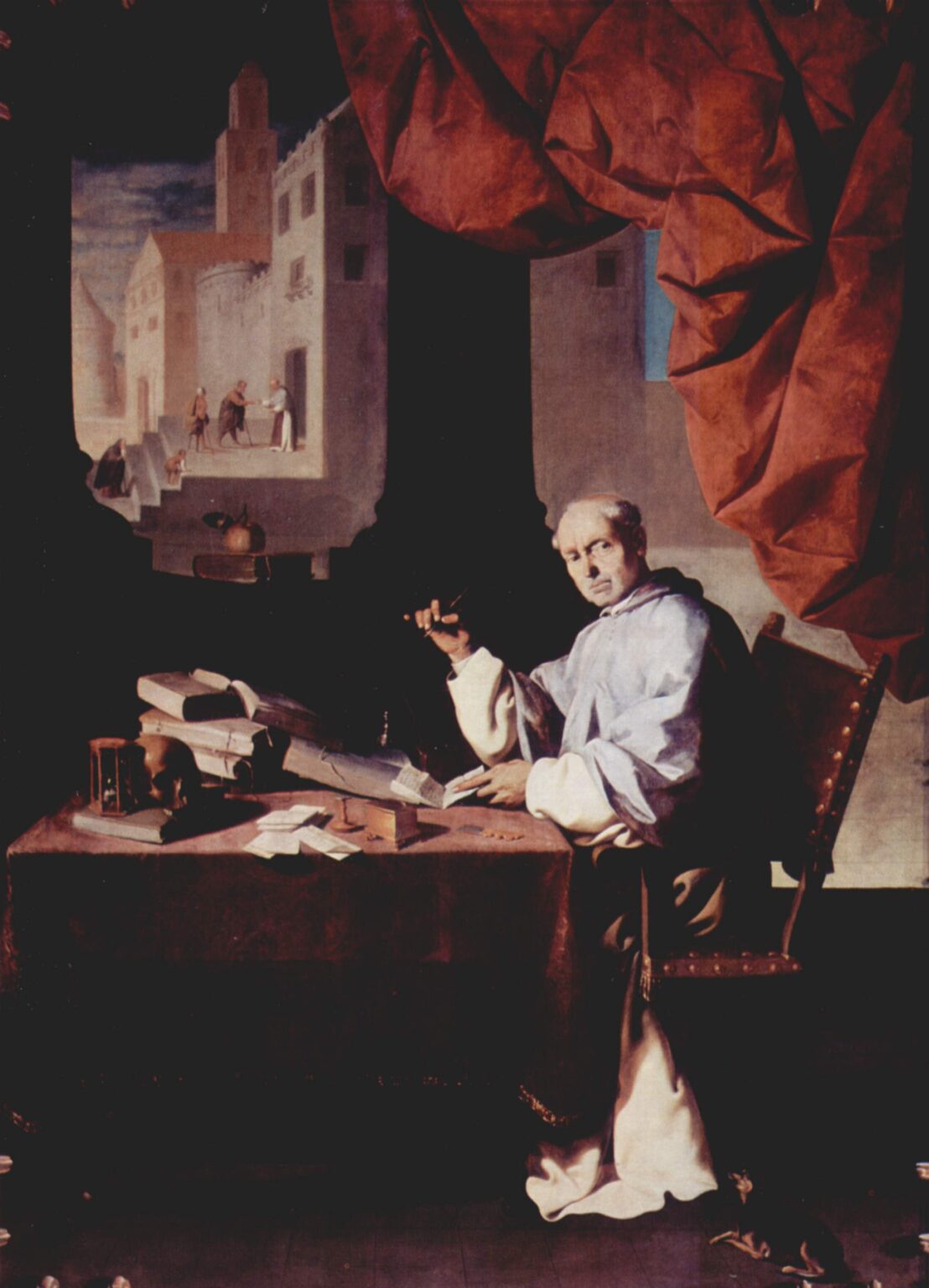
Francisco de Zurbaran’s “Portrait of Fra Gonzalo de Illescas,” painted in 1639, is one of the most intriguing intellectual portraits of the Spanish Baroque. Rather than presenting a monk in simple devotional prayer, Zurbaran shows Fra Gonzalo seated at a heavy table covered with books, papers and symbolic objects, his pen paused in mid sentence as he turns to confront the viewer. Behind him a huge red curtain sweeps across the upper part of the canvas, opening onto an architectural vision that hangs like a framed scene on the wall. The result is a complex image that blends portrait, still life and narrative into a single meditative space.
This painting offers a rare glimpse into the world of scholarly monastic life in seventeenth century Spain. Fra Gonzalo appears as a writer and historian as well as a man of prayer. The objects around him suggest the themes of time, mortality and the weight of memory, while the distant vignette of buildings and figures hints at the historical events that occupy his thoughts. Zurbaran’s mastery of light and shadow, along with his characteristic sense of quiet intensity, turns this seated monk into a powerful symbol of the contemplative intellect at work.
Historical and Religious Context
Fra Gonzalo de Illescas belonged to a monastic community, most likely the Carthusians, whose white habit Zurbaran paints with loving attention. These orders valued silence, study and liturgical prayer. Their spiritual life demanded not only personal devotion but also intellectual work such as copying manuscripts, writing chronicles and preserving the memory of the order. Portraits of prominent monks served both commemorative and exemplary purposes. They honored the subject while offering a model of learning and piety to future generations.
By 1639 Zurbaran was already renowned for his paintings of monks and saints. Commissions from religious houses provided a large part of his livelihood. In this portrait he expands the scope of monastic imagery. Instead of placing the monk in a purely spiritual setting, he situates him in a study that feels surprisingly contemporary, filled with volumes, letters and writing tools. The portrait reflects a culture in which scholarship was viewed as a path to holiness, and in which the written word played a central role in preserving the faith.
The painting also belongs to the broader tradition of learned portraits in Europe, where scholars, theologians and humanists were often depicted surrounded by books. Zurbaran adapts this secular convention to the monastic environment, emphasizing that intellectual labor, when guided by humility, can be a form of service to God.
Composition and Spatial Architecture
The composition of “Portrait of Fra Gonzalo de Illescas” is carefully structured to guide the viewer’s eye through several layers of meaning. In the foreground the table forms a large horizontal block that anchors the scene. It is covered with a reddish cloth, whose deep color echoes the massive curtain above. The monk sits at the right side of the table on a wooden chair with brass studs, his body turned three quarters toward the viewer. His white habit catches the light, making him the brightest form in the lower half of the painting.
The background is largely dark, but the darkness is punctuated by two dramatic elements. On the right, the curtain sweeps diagonally from the top, its folds hanging heavily above the monk like a stage drape. On the left, a rectangular opening reveals an architectural scene bathed in pale daylight. The buildings are rendered in muted tones of cream and gray, with small human figures engaged in everyday actions.
This interplay between the dark interior and the luminous exterior scene creates a sense of depth and complexity. The portrait becomes not just an image of a man at his desk, but a window into his mental world. The viewer senses that the events depicted in the architectural vignette are the subject of Fra Gonzalo’s writing, and that the curtain, half drawn back, invites us to glimpse something usually hidden.
Light, Color and the Theatrical Curtain
Light in this painting functions both descriptively and symbolically. A strong but focused beam seems to enter from the left, illuminating Fra Gonzalo’s face, hands and habit, as well as parts of the table and books. The white of his cowl and sleeves glows with cool highlights, creating a striking contrast against the dark background. This contrast isolates the figure, giving him an almost sculptural presence and emphasizing his role as the spiritual and intellectual center of the painting.
The curtain above is rendered in deep red, with sharp folds and angular shadows. Its theatrical quality suggests a stage, reinforcing the sense that the scene contains a drama of the mind. Yet the curtain does not fully open. It forms a canopy over the monk, both sheltering him and separating him from the outside world. The color red can evoke passion, sacrifice and authority. In this context, it may allude to the intensity of the inner life and the seriousness of the work he undertakes.
The architectural vignette on the left is painted in softer, cooler tones, washed in a gentle daylight that contrasts with the dramatic interior. This contrast not only creates spatial depth but also sets up an emotional distance. The outside world is calm and almost anonymous, while the interior is charged with concentration and symbolic weight.
The Figure of Fra Gonzalo de Illescas
Fra Gonzalo himself is portrayed with a mixture of realism and idealization. His face is mature, with thinning hair and lined features that speak of years of study and responsibility. Yet his expression is alert and penetrating. The eyes look directly at the viewer, not with vanity, but with a kind of steady appraisal, as if he has been interrupted in the midst of thought and now weighs the viewer as another subject of reflection.
His right hand holds a quill pen poised above an open book or manuscript, while his left rests near another volume. The posture suggests a moment of pause. He has been writing, perhaps recording events or composing a theological text, and now turns to engage the viewer. This simultaneous sense of interruption and continuity gives the portrait a dynamic quality. The work goes on, even as the painting captures a brief instant within it.
The white habit, voluminous and crisp, drapes around his body in precise folds. Zurbaran’s ability to render cloth is legendary, and here the habit takes on a symbolic dimension. It stands for purity, discipline and the renunciation of worldly concerns. Yet it also emphasizes the physical reality of the man, whose arm and shoulder shapes are clearly modeled underneath. The monk is no ghostly figure, but a living, embodied person whose spiritual life is deeply connected to material realities.
The Writing Desk as Still Life of the Mind
The table in front of Fra Gonzalo is laden with objects that form a still life of scholarly contemplation. Stacked books, some open, some closed, testify to the breadth of his reading. Loose papers lie scattered, hinting at drafts, notes and correspondence. An inkwell and quill stand ready for use. On one side sits an hourglass, its sand flowing from one chamber to another. Beside it rests a human skull.
These objects are not mere accessories. They articulate the themes of time, mortality and the accumulation of knowledge. The hourglass marks the passing of time and the limited span of human life. The skull serves as memento mori, a reminder that all earthly achievements, including scholarship, will ultimately be judged in the light of eternity. Their placement beside the books suggests that learning is valuable only when framed by an awareness of mortality and the need for spiritual wisdom.
Zurbaran paints each object with characteristic clarity. The wood of the hourglass frame, the sheen on the skull, the textures of paper and leather all receive careful attention. This careful realism draws the viewer into close observation, mirroring the patient study that Fra Gonzalo himself practices. The still life becomes an extension of his mind, materially representing the concepts he wrestles with in his writing.
The Narrative Scene in the Background
One of the most intriguing features of the painting is the architectural scene on the left wall. It looks like a framed panel or perhaps a fresco. A cluster of buildings with towers and crenellated walls stands under a cloudy sky. In front of one doorway a group of small figures interacts, possibly as part of a historical episode. Another figure stands on a staircase with a dog at his feet.
This vignette likely represents an event from the life of the monastic community or from a historical chronicle that Fra Gonzalo is composing. It may depict an act of charity, a significant meeting or the founding of a house. The precise identification is less important than its function within the painting. It visualizes the subject matter of his writing and shows how the monk’s interior study is rooted in concrete events and places.
The way the architectural scene is framed, with its lower edge shaped like a shelf supporting a small still life of vessels, reinforces its status as an image within the image. It is both part of the painted world and at one remove from it, just as the historical past is both present in memory and distant from the writer who records it. Zurbaran thus creates a layered structure of reality: the real space of the study, the mental space of scholarship and the remembered space of history.
Symbols of Time, Death and Contemplation
The painting is saturated with symbolic references that invite meditative reading. The hourglass and skull have already been mentioned as signs of time and death. The books and papers evoke knowledge and the written word. The curtain suggests both revelation and concealment. The architectural scene connects memory with place. Together, these elements articulate a theology of time.
Fra Gonzalo sits at the intersection of temporal and eternal concerns. His work as historian or chronicler requires him to pay close attention to dates, events and human actions. Yet the presence of the skull and hourglass reminds him that all these events occur under the shadow of mortality. The monk must approach his task with humility, conscious that his own life, like the sand in the glass, is passing away.
The painting thus becomes a visual sermon on the contemplative use of time. It suggests that true wisdom lies not in accumulating facts, but in reading history in the light of eternity. The skull does not inspire despair, but sobriety. The books alone cannot save, but they can become instruments of grace when ordered toward deeper understanding of God’s work in the world.
Psychological Insight and Baroque Spirituality
Zurbaran’s portrait reveals a keen psychological sensitivity. Fra Gonzalo’s direct gaze and firm posture suggest a man of strong character and disciplined mind. Yet there is also a hint of vulnerability in the slight tightening of the lips and the careful placement of the hands. He appears fully aware of the gravity of his responsibilities and the limits of his own strength.
This blend of confidence and humility fits well within the spiritual climate of seventeenth century Spanish monasticism, which valued both obedience and interior honesty. The portrait does not idealize the monk into an abstract saint. Instead, it shows a real person engaged in a demanding vocation. The viewer senses his fatigue, his concentration and perhaps his solitary struggle to articulate the truth.
The darkness surrounding the figure can be read as a metaphor for the mystery that envelops human understanding. The monk works by the light given, yet much remains in shadow. In this way the painting echoes the writings of mystics such as John of the Cross, who spoke of knowledge acquired through not knowing. Fra Gonzalo’s calm persistence at his desk suggests a participation in that paradoxical journey.
Zurbaran’s Style in the Late 1630s
By the time he painted this portrait, Zurbaran had fully developed the hallmarks of his mature style. Strong contrasts of light and shadow model forms with sculptural solidity. Surfaces are rendered with a tactile realism that makes cloth, wood, paper and skin almost tangible. At the same time, his compositions are stripped of unnecessary detail, focusing on essential relationships.
In “Portrait of Fra Gonzalo de Illescas,” these qualities appear in a more complex narrative and intellectual framework than in many of his earlier monastic portraits. The combination of still life, architecture and figure demands careful balance. Zurbaran masterfully arranges these elements so that no single one overwhelms the others. The viewer can spend time on the face, the desk, the curtain or the background scene, yet always returns to the central presence of the monk.
The painting also shows Zurbaran’s affinity with contemporary theatrical design. The curtain and the staged arrangement of objects recall the world of drama, yet he turns this theatricality to contemplative ends. The study becomes a kind of spiritual stage on which the drama of thought unfolds.
Legacy and Contemporary Relevance
Today, “Portrait of Fra Gonzalo de Illescas” holds interest for both art lovers and those drawn to intellectual history. It offers a vivid image of the scholarly monk as a figure who bridges the worlds of memory and devotion. The painting reminds modern viewers that behind many historical chronicles and theological treatises stand real individuals who labored patiently at desks, surrounded by books and symbols of mortality.
For contemporary audiences accustomed to digital devices and rapid information, the image of Fra Gonzalo with quill and hourglass may carry nostalgic overtones. Yet it also poses questions about the depth and purpose of our own engagement with knowledge. Do we, like him, integrate study with awareness of time and responsibility, or do we treat information as mere accumulation?
The painting invites a slower, more reflective way of looking. Its many subtle details reward repeated viewing. As one notices the tiny dog at the monk’s feet, the vessels on the shelf beneath the architectural scene, or the delicate play of light on the papers, one becomes part of the contemplative process that the portrait celebrates.
Conclusion
Francisco de Zurbaran’s “Portrait of Fra Gonzalo de Illescas,” painted in 1639, stands as a remarkable synthesis of portraiture, still life and historical narrative. Through a carefully arranged study interior, dramatic lighting and a wealth of symbolic objects, the artist presents a monk whose vocation lies at the intersection of scholarship and spirituality. The skull and hourglass, the books and letters, the architectural vignette and the enveloping curtain all contribute to a nuanced meditation on time, memory and the quest for wisdom.
At the center of it all sits Fra Gonzalo, pen in hand, turning toward the viewer with a steady, thoughtful gaze. His presence embodies the ideal of the contemplative intellect, deeply rooted in monastic discipline yet engaged with the concrete realities of history. Zurbaran’s painting continues to speak across the centuries, inviting viewers to consider how their own work and study might become, like his, an offering shaped by humility, attentiveness and the awareness of mortality.