Image source: wikiart.org
Introduction to “Portrait of Andres de Andrade-i-la Col”
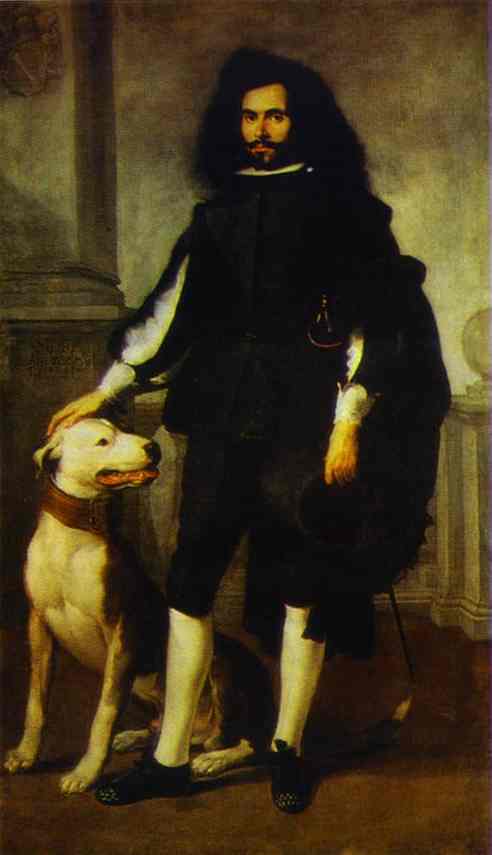
“Portrait of Andres de Andrade-i-la Col,” painted by Bartolome Esteban Murillo around 1660, presents a commanding image of a seventeenth century Spanish nobleman standing beside a powerful dog. Full length, frontal, and nearly life size, the sitter occupies the center of the composition with calm authority. His long dark hair frames a pale, sharply modeled face, while his black costume and cape contrast dramatically with his white stockings and cuffs. One hand rests firmly on the dog’s head, the other holds a broad-brimmed hat.
This portrait is not simply a record of appearance. Murillo uses pose, setting, costume, and animal companion to construct a complex image of class, character, and aspiration. The painting combines the gravitas of Spanish court portraiture with the warmth and humanity that characterize Murillo’s style, revealing both the social role and the inner presence of Andres de Andrade-i-la Col.
Historical and Social Context
Murillo worked in Seville during the height of the Spanish Baroque period, when portraiture served as an important tool for asserting status and identity. Although he is best known for religious scenes and images of ordinary people, Murillo also produced portraits for wealthy patrons, merchants, and members of the local elite. These portraits often reflect the values of honor, dignity, and restrained elegance that shaped Spanish society in the seventeenth century.
The sitter, Andres de Andrade-i-la Col, appears to belong to this urban nobility. His long, carefully arranged hair, fine clothing, and self assured posture indicate a man of high standing. The presence of the large dog reinforces an image of wealth and authority, since such animals required resources to feed, train, and maintain. In a society that placed great importance on lineage and public image, a formal portrait like this would have helped secure the sitter’s place within the social hierarchy and preserve his memory for future generations.
Murillo’s approach differs from the more rigid court portraits associated with artists such as Velazquez. Rather than placing his sitter in a stark, empty space, Murillo allows architectural hints and the presence of the dog to create a more personal atmosphere, suggesting not just rank but individual temperament.
Composition and Spatial Structure
The composition is strikingly vertical, matching the tall proportions of the canvas. Andres de Andrade stands upright, located slightly to the right of center. His body forms a strong vertical axis from head to feet, stabilizing the scene. The dog occupies the lower left quadrant, its body angled diagonally with its head turned toward the viewer. This diagonal creates movement and counters the vertical rigidity of the human figure.
Behind the sitter, Murillo suggests architectural elements: a column, perhaps a ledge or pedestal, and a wall that recedes into neutral space. These features provide a sense of solidity and place without distracting from the central figures. The background is kept relatively subdued in tone, allowing the dark costume and pale skin of the sitter, as well as the light fur of the dog, to stand out sharply.
Murillo controls the viewer’s gaze through the arrangement of lines. The verticality of Andres’s stance draws the eye upward to his face, while the extended arm and hand resting on the dog’s head lead the gaze down toward the animal. From the dog’s alert expression and muscular body, the eye returns along the angle of its back to the man’s legs and back up again. This visual loop binds man and animal into a single unit and emphasizes their connection.
The Poise and Costume of Andres de Andrade-i-la Col
The sitter’s pose radiates controlled assurance. He stands with weight distributed evenly, one leg slightly forward, suggesting readiness without tension. His shoulders are relaxed but not slack, and his head is held high, indicating confidence and awareness. The direct gaze engages the viewer without aggression. Murillo captures the equilibrium between aristocratic pride and personal introspection.
The costume is an essential part of the portrait’s meaning. Andres wears black garments that reflect the austere elegance favored by the Spanish upper classes. The black doublet and breeches are tailored to the body, emphasizing a lean, upright figure. Over them drapes a voluminous black cloak that adds gravitas and extends his silhouette. Black in this context signifies seriousness, piety, and noble restraint rather than mere somberness.
In contrast, white stockings and cuffs provide striking accents. The stockings highlight the straight lines of his legs and suggest refinement and cleanliness. The lace at his cuffs and collar adds a touch of delicacy to the otherwise austere outfit, hinting at fashionable taste. Tiny details such as the decorative shoes and the elegant sword hilt at his side signal wealth and readiness for self defense, as befitted a gentleman of status.
Murillo paints the textures of fabric with remarkable sensitivity. The cloak absorbs light in soft folds, while the stockings and lace reflect it more sharply. This interplay of matte and sheen surfaces grounds the figure in reality and enhances the sense of tactility.
The Dog as Symbol of Loyalty and Power
The large dog is not a casual accessory. It plays a crucial symbolic and compositional role. With its muscular body, broad head, and attentive expression, the animal suggests strength, vigilance, and loyalty. The leather collar around its neck indicates it is well cared for and under the control of its master. Dogs in portraiture frequently symbolize fidelity and constant companionship, reinforcing the idea of the sitter’s steadfast character.
By placing his hand firmly yet gently on the dog’s head, Andres signals both affection and dominance. The gesture shows a man who commands loyalty and also knows how to nurture it. The dog’s upward gaze and slightly open mouth give it an animated presence, as if ready to respond to the slightest cue. This dynamic reinforces the sitter’s authority and energetic aura.
Visually, the dog’s pale fur contrasts with the sitter’s dark costume, bringing light to the lower half of the canvas. Its solid form balances the vertical figure and fills space that might otherwise feel empty. In this way, Murillo uses the animal both as a symbolic companion and as an essential compositional element.
Light, Color, and the Baroque Atmosphere
Murillo employs a controlled yet expressive use of light to model forms and create atmosphere. A soft light falls from the left, illuminating the sitter’s face, the front of his clothing, and the dog’s head and shoulders. Shadows fall to the right and behind, allowing the figures to stand out from the neutral background. This directional lighting is typical of Baroque painting, where chiaroscuro is used to emphasize volume and drama.
The color palette is relatively restrained. Blacks, whites, and warm browns dominate, with subtle touches of muted color in the background architecture and the sitter’s flesh tones. This limited palette intensifies the impact of the few saturated hues present, particularly the warm tones in the dog’s fur and the subtle reddish undertones in the sitter’s complexion.
Because the costume is largely black, Murillo must rely on delicate variations in tone and reflected light to avoid flatness. He succeeds in giving the cloak and doublet a sense of depth and weight, using glimmers of light along edges and folds to suggest movement and structure. The dog’s fur, rendered with softer, broken strokes, contrasts with the smooth surfaces of the fabric, creating a rich textural dialogue.
Psychological Depth and Character
Beyond external markers of wealth and rank, the portrait conveys psychological depth. Andres de Andrade’s face is sharply defined, with dark eyes, prominent nose, and full beard. His expression is serious, almost stern, yet not cold. There is a hint of introspection in the eyes, as if he is conscious of being observed and is evaluating the viewer in return.
Murillo does not flatter excessively. Small details such as the strong lines around the mouth and the slightly weary look in the eyes suggest a man who has faced responsibilities and perhaps struggles. These marks of experience lend credibility and individuality to the portrait, lifting it beyond generic elegance.
The relationship between the man and his dog adds another layer of character. The hand resting on the animal, combined with the calm attitude of both, suggests that Andres is not only a figure of authority but also one capable of steady companionship and emotional connection. This humanizing element aligns with Murillo’s broader interest in empathy and warmth, seen throughout his religious and genre works.
Architectural Setting and Social Identity
The setting, though understated, contributes to the sitter’s identity. The hint of a column and architectural ornament suggests an interior or a courtyard belonging to a substantial home. These elements imply stability, culture, and social standing. Murillo avoids overcrowding the scene with objects. A globe, relief, or classical motif may appear subtly in the background, hinting at learning, travel, or engagement with the wider world, but such details are kept secondary.
By situating the figure in this dignified yet restrained environment, Murillo underscores the sitter’s status while leaving the focus firmly on his presence. The background exists to support rather than overshadow him. It also situates him within the world of urban nobility, a class that valued both traditional honor and contemporary sophistication.
Relation to Spanish Baroque Portraiture
This portrait fits within the broader tradition of Spanish Baroque portraiture, yet it bears Murillo’s distinctive imprint. Spanish portraits of the period often emphasize sobriety, dark clothing, and an almost sculptural clarity of form, traits associated with Velazquez’s images of Philip IV and other court figures. Murillo adopts similar conventions: the dark costume, limited palette, and frontal stance tie the work to that lineage.
However, Murillo brings a softer, more approachable quality. His handling of light is gentler, less harsh than some court portraits, and the presence of the dog introduces a warmth rarely seen in the most formal royal images. Rather than an aloof icon of authority, Andres appears as a powerful yet accessible human being.
The painting also demonstrates Murillo’s ability to move between religious and secular subjects without losing his sense of harmony and empathy. The same sensitivity that animates his Madonnas and scenes of children informs his depiction of this aristocratic sitter. In this way, “Portrait of Andres de Andrade-i-la Col” builds a bridge between elite representation and Murillo’s broader humanistic concerns.
Contemporary Resonance and Interpretation
For modern viewers, the portrait offers insight into how individuals used art to shape their identity in the seventeenth century. The deliberate choices of costume, pose, setting, and animal companion reveal what qualities Andres wanted to project: authority, loyalty, wealth, and a controlled yet vigorous masculinity.
At the same time, the painting invites reflection on the enduring human desire to be remembered as more than a name. Murillo captures not only outward signs of status but also the inner concentration of a man aware of his responsibilities and public image. The dog at his side serves as a reminder that status is entwined with relationships of loyalty and trust.
The portrait may also prompt contemporary questions about how we present ourselves today, whether through photography, social media, or professional portraits. Like Andres de Andrade, people still use images to communicate strength, sophistication, and personal values. Murillo’s painting shows that this impulse has deep historical roots.
Conclusion
“Portrait of Andres de Andrade-i-la Col” stands as a powerful example of Bartolome Esteban Murillo’s skill in combining social representation with psychological insight. Through a balanced composition, nuanced use of light, and careful attention to costume and gesture, Murillo transforms this aristocratic sitter and his dog into a vivid presence that transcends time.
The painting speaks of honor, authority, and loyalty, yet it also hints at vulnerability and inner reflection. It reveals how portraiture in seventeenth century Spain functioned both as a declaration of status and as a subtle exploration of character. More than three centuries after it was painted, this portrait continues to engage viewers with its blend of dignity, intimacy, and quietly compelling narrative.