Image source: wikiart.org
Introduction: Dignity In A Quiet Beam
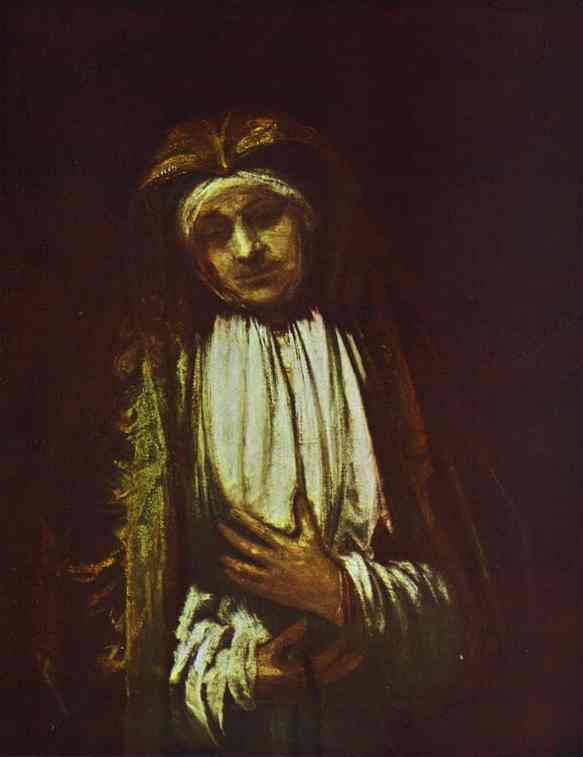
Rembrandt’s “Portrait of an Old Woman” (1660) is a small, late masterpiece that turns age into presence. A figure stands in a field of brown air, hooded and wrapped, her downcast gaze soft but awake. Light descends from the left, catches the forehead and cheek, slides across a white bodice, and settles on a hand pressed gently to the chest. Around that light, darkness collects like a hush. No furniture, no heraldry, no anecdote distracts. The portrait asks for a simple, rigorous kind of looking—the kind that honors a person without spectacle.
Late Rembrandt And The Ethics Of Seeing
By 1660 Rembrandt had left behind the polished bravura that made him famous in the 1630s. Bankrupt and out of fashion with clients who preferred a silken finish, he developed a late style grounded in restraint: earthbound palettes, shadow as breathable atmosphere, surfaces that keep the record of touch. He painted saints and beggars, sons and apostles, queens and conspirators, always with the same humane concentration. This old woman—whether a model from his circle, a client of modest means, or an allegorical “Mater Dolorosa” reinterpreted in secular terms—belongs to that ethic. She is seen with tenderness and without pity, as if the painter knew that the most eloquent truth is often the quietest.
Composition: A Triangle Of Calm Framed By Shadow
The body forms a compact triangle: the white breastcloth creates the luminous center; the dark hood defines the apex; the forearms and clasping hands settle into the base. The head tilts forward and slightly left, moving the brightest planes into the light while leaving the far cheek and eye to the charity of shadow. That asymmetry is crucial. It prevents the image from becoming a mask and gives the face a living turn—an angle of thought rather than a studio pose. The vertical sweep of the mantle at the left edge balances the diagonal created by the bowed head and lowered hands. Within this simple geometry a whole biography seems to breathe.
Light And Chiaroscuro: Illumination As Mercy
Rembrandt’s chiaroscuro in late work is not theatrical flash but moral climate. In this painting the beam is small, warm, and tactful. It records texture—linen that glows, hood that absorbs, skin that remembers weather—without demanding confession from the sitter. Darkness serves as privacy, not menace. It shelters the old woman’s reticence while allowing enough illumination to recognize her. The shift from light to half-tone over the cheek and nose is so gentle that a viewer feels time passing across the surface, as if the day itself agreed to be considerate.
Color And Tonal Harmony: Earth, Honey, And Ash
The palette is a harmony of umbers, raw siennas, and olive browns, anchored by the chalky whites of the bodice and cuff. Skin carries warm honeyed notes around the cheek and nose, cooled by soft olive grays in the shadowed temple. The hood’s brown is variegated—cool along the crown, warmer where the edge catches light, greened where it meets background air. Because chroma is restrained, value and temperature bear the expressive load. Warmth concentrates at the face and hands; cooler notes settle into garment and ground. The result is a climate of consolation—serious, steady, and free of display.
Surface And Brushwork: Paint That Remembers Cloth And Skin
The surface records a hand unafraid of material truth. The mantle and hood are laid with long, absorbent strokes that simulate the nap of worn fabric. Along the edges Rembrandt drags a drier brush, letting undercolor grain through to suggest fray. The white bodice is a small marvel of broken impasto: short, loaded touches that catch gallery light and read as soft, thick linen. In the face, handling tightens—thin, elastic glazes knit earlier marks into living complexion; a few heavier ridges along brow and nose give the planes their authority. No passage is fussy. Everything seems decided, then forgiven, then decided again—late Rembrandt’s rhythm of revision visible as grace.
The Hands: A Sentence Without Words
One hand rests against the chest, fingers relaxed, thumb tucked—an eloquent gesture that carries the portrait’s tone. It is not melodrama; it is acknowledgment. The gesture can read as devotional, as fatigue, as a quiet assent to being looked at. The other hand, half-occluded, supports the first, completing a closed circuit of calm. Rembrandt often lets hands carry the moral subject of a painting; here they say what the mouth does not: I am present, and I will be still.
The Face: Age As Character, Not Theme
The old woman’s face refuses caricature. Wrinkles are not counted; they are felt as soft crossings where light hesitates. The eyelids are heavy but not defeated; the mouth rests in a line that can turn toward kindness. The features are described with structural economy: nose presented as a turning plane rather than a contour, cheek as a graded field rather than a bag of detail. This economy creates dignity. Age appears as character—texture of a life preserved by attention—not as thesis about decline.
Costume And Identity: Habit Of Modesty
The hood and mantle recall Rembrandt’s frequent borrowings from monastic wardrobes kept in his studio. Here the costume is not a literal vow; it is a visual metaphor for modesty and inwardness. The white breastcloth becomes the canvas’s bright heart—both a spotlight for the face and a symbolic plainness. No jewelry interrupts. If the portrait is of a specific woman, her social rank remains gracefully uninsisted. If it is a devotional type, it is one humanized by the absence of religious emblems. Either way, the clothing serves character rather than fashion.
Background And Space: A Chapel Of Brown Air
Behind the figure lies the late-Rembrandt chamber: no architecture, just a living dusk. Subtle scumbles keep the darkness from turning into a dead flat; the viewer senses air, temperature, breath. That air is the portrait’s chapel. It quiets the world so that the old woman’s presence can gather. Because it names no particular room, the painting can live anywhere—on a museum wall, in a private study, or in a viewer’s memory—without losing its authority.
Process And Revisions: Edges That Think
Pentimenti remain visible. Along the near shoulder a softened contour hints at an earlier, stronger line reduced to let air flow. Around the hand, the cuff appears restated—brighter paint laid over a cooler underlayer to bring the gesture forward. The hood’s edge shows hesitations where the brush searched for the just-right transition from fabric to shadow. These traces matter. They remind us that truth in paint, like truth in life, arrives through adjustment rather than decree.
Kinships Across Rembrandt’s Late Work
Set this portrait beside the “Mater Dolorosa” variants of the same years, or beside the quiet faces of apostles and old men by a window, and kinships appear. In each, light behaves ethically; surfaces speak of touch; emotion is held, not thrown. The old woman’s bowed head echoes the bowed saints without borrowing their scriptural burden. She becomes part of a larger project: an art that rescues personhood from the noise of status and anecdote.
Psychological Reading: Consolation Without Sentiment
What does the image feel like? Not sorrowful exactly; not pious exactly. It feels consoled. The downcast eyes imply neither shame nor despair but a willingness to remain with one’s thoughts. The hand at the chest reads as self-possession more than fragility. The portrait grants the sitter her privacy and grants the viewer permission to keep theirs. That mutual courtesy is the picture’s abiding warmth.
Theological Undertone Without Emblems
Although devoid of overt iconography, the painting hums with spiritual undertone. Light acts like mercy—small, steady, sufficient. Darkness acts like protection—deep enough to guard, not so deep as to hide. The hand to the chest becomes a universal gesture of recognition: of one’s limits, of one’s gratitude, of one’s place in the order of things. In late Rembrandt the sacred often appears as kindness in depiction. This portrait is a quiet example.
Material Symbolism: Linen, Flesh, And Time
Materials in the image speak symbolically without preaching. Linen—bright, thick, honest—stands for cleanliness of life, the humility of daily maintenance. Flesh, modeled with glazes that let earth colors breathe through, stands for time lived without disguise. The hood’s frayed edge is the place where use and dignity meet. Paint is the medium that allows all this to register. Rembrandt’s pigments—earths and whites, a few old golds—belong to the very ground from which the metaphor rises.
The Viewer’s Place: A Seat At Conversational Distance
The picture positions us as if across a small table. We are close enough to see the ridges of paint on the cuff and the soft crest of highlight at the bridge of the nose, far enough to keep the sitter’s privacy intact. Because the eyes are lowered, we are not compelled to perform. The painting meets us with presence rather than demand—a rare and restorative experience in any century.
Modern Resonance: A Counter-Image To Performance Culture
In a world saturated with curated personas, this old woman’s unperformed selfhood feels radical. She is interesting because she exists, not because she advertises. Designers study the portrait for its orchestration of near-monochrome into richness; photographers study its one-window light; painters study its refusal to confuse detail with truth. Ordinary viewers, meanwhile, find in it a companion for quiet rooms.
Lessons In Looking And Making
Spend time with the canvas and it teaches. It shows how a narrow palette can sing when value and temperature are tuned; how a single, well-placed highlight can anchor a plane; how the difference between edge and no-edge can describe weight better than a thousand lines; how a gesture minimal as a hand to the chest can carry more psychology than an array of props. It argues, finally, that compassion is a skill of the eye.
Why The Painting Endures
“Portrait of an Old Woman” endures because it generates trust. The painter trusts the sitter enough to look without agenda; the sitter trusts the painter enough to be seen without defense; the painting trusts the viewer enough to forgo spectacle. That triad gives the image its gravity. It does not strive for our admiration; it earns it by being faithful to a human presence.
Conclusion: The Freedom Of Being Simply Seen
Rembrandt’s late portrait gathers light on a face and hands, lets darkness keep the rest, and in that economy finds everything necessary. The old woman’s lowered gaze, the resting hand, the tender exchanges of brown and white make a room where attention feels like care. The picture does not tell us her name or history. It tells us she is worth the time it takes to see her. That is the kind of truth that survives fashions, scandals, and centuries—and the kind of truth Rembrandt came to paint at the end.