Image source: wikiart.org
Introduction
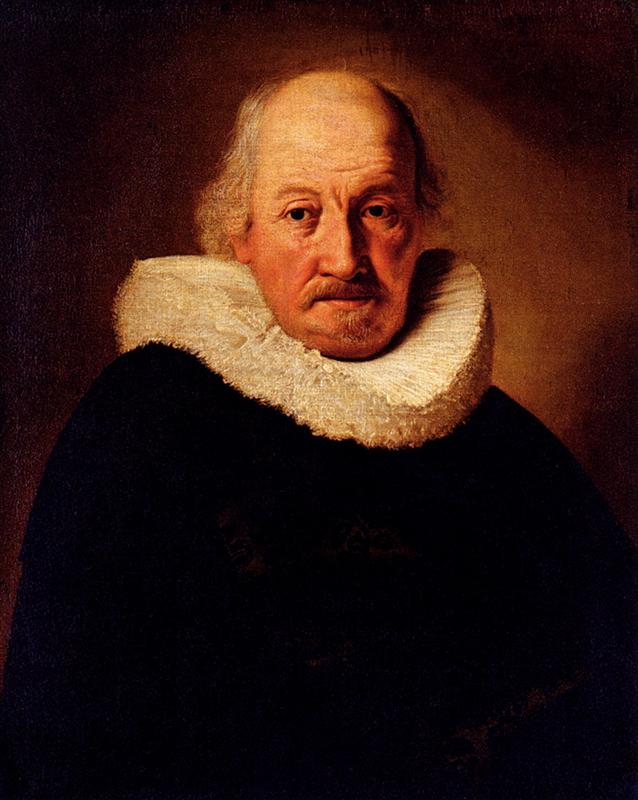
Rembrandt’s “Portrait of an Old Man” is a concentrated encounter with a living presence rather than a display of status. The sitter, turned three-quarter toward the viewer, is encircled by a luminous ruff that frames the face like a soft halo while the rest of the costume dissolves into a deep brown dusk. The head is the picture’s true subject—the geography of a lifetime expressed in flesh, bone, and attentive light. Throughout the painting Rembrandt balances candor with compassion, using a restrained palette and economical composition to elevate an ordinary likeness into a timeless meditation on character.
Composition That Centers a Life
The composition is purposefully spare. The figure occupies the central band of the canvas, with shoulders truncated to prevent distraction and the head held in an oval of warm illumination. Rembrandt places the eyes just above the midline, establishing an intimate but respectful distance. The sitter’s gaze addresses us directly, yet nothing feels confrontational; a slight asymmetry of the shoulders and the soft curve of the ruff temper the forwardness of the stare. The background is a continuous envelope of dark air, mottled just enough to imply space but not so descriptive as to anchor the portrait in a specific room. This compositional economy focuses the entire drama on the face and the mind that animates it.
Light as a Form of Respect
Light is the portrait’s tender voice. It enters from the upper left and falls gently across brow, nose, cheek, and the lower lip, where a tiny highlight suggests moisture and breath. The ruff, with its myriad folds, receives the light like a shallow basin, returning it upward toward the face. Shadows are never brutal; they recede like hush, allowing the sitter to retain privacy even as he is revealed. Rembrandt’s hallmark is the honesty of his light. It does not flatter by erasing age, but it dignifies by showing the beauty of lived texture—the thinning hair at the temples, the soft pouch beneath the eye, the crease that runs from nose toward the mouth. Every plane is described in a slow gradation, as if the painter were moving his hand across the sitter’s features with patient deliberation.
Palette and Tonal Harmony
The color world is restrained and resonant. Warm earths—raw umber, burnt sienna, and ocher—compose the skin and background, while muted ivory, cool gray, and creamy whites create the ruff’s choreography of light. The black costume is not a dead mass; it is a living field of deep browns and olive blacks, breathing through subtle modulations that echo the portrait’s overall calm. Because chroma is subdued, temperature sets the emotional register. Warmth glows in the flesh and is caught by the ruff’s edges; cooler notes settle into the shadows and the far side of the face, producing a spacious balance in which the viewer can linger without fatigue.
The Ruff as Architectural Frame
The ruff is an architectural device in addition to being a record of fashion. Its scalloped circumference arcs like a soft amphitheater around the face, amplifying expression and catching light without stealing attention. Rembrandt refuses the temptation to fetishize texture. He renders the lace with a mixture of thin, translucent veils and a few crisp touches that imply stitching, reserving high contrast for the inner edge where fabric meets skin. This discipline keeps the ruff from becoming a virtuoso distraction and integrates it instead as a luminous pedestal upon which the head quietly rests.
Anatomy of a Face
The sitter’s face is a landscape studied without haste. Rembrandt reads the skull’s structure beneath the skin—the frontal bone’s rise, the cheek’s plane slipping into the zygomatic hollow, the square chin softened by age. Eyelids are painted with that uniquely Rembrandtesque empathy: slightly heavy, moist, edged with minute impasto that catches light like a last bead of tear. The irises hold tiny, asymmetric sparks; each eye is a different little world, just as in life. The mouth is relaxed but closed, suggesting self-possession rather than reserve. The nose, rendered with controlled warmth, leads the gaze downward to the ruff and back up again to the eyes, establishing a quiet visual loop that sustains viewing.
Psychology Without Theater
Rembrandt’s psychology is never stagey. He refrains from supplying narrative props or rhetorical gestures. The old man’s expression shifts as we look: initially firm, then reflective, finally sympathetic. The portrait invites us to imagine the sitter’s thoughts without dictating them. This open-endedness emerges from the painter’s ability to hold contradictory cues in balance. The eyes are alert yet kind, the mouth resolved yet soft, the posture upright yet unguarded. The portrait communicates a lifetime’s worth of disciplined attention—the look of someone who has served, worked, deliberated, and now meets the viewer as an equal.
The Ethics of Restraint
A striking feature of the painting is its refusal to be impressed by its own craft. Even where Rembrandt could have dazzled—those thousands of ruff pleats, the lustre in the fabric—he chooses tact over flourish. This restraint heightens truthfulness. Because nothing is pushed, everything convinces. The face does not need to shout to be heard; its credibility grows with each minute of viewing. Rembrandt’s ethic here mirrors the sitter’s bearing: a modest authority that trusts in substance rather than spectacle.
Age as Illumination, Not Burden
The painting treats age as a kind of light. Wrinkles are recorded not as memento mori but as lines of experience. The thinning hair at the temples, small vessels near the nose, subtle sag at the jaw—these are not morbid details; they are the evidence of a life that has steadied into clarity. The sitter’s eyes, framed by the history written in the skin, become brighter by contrast. Rembrandt suggests that time simplifies a person to essentials, and he paints those essentials with the respect ordinarily given to saints and scholars.
The Background as Breath
The background functions like air rather than wall. The tonal field moves from warmer brown near the light source to cooler, darker notes toward the edges, creating a soft envelope around the sitter. This envelope keeps the head legible at every distance and encourages the viewer to attend to minute subtleties in expression. Occasionally small tonality shifts occur behind the ruff, suggesting that the painter worked wet-in-wet, feathering transitions to prevent the figure from feeling cut out. The space is thus both physical and psychological: a quiet room in which meeting can occur.
Brushwork, Surface, and the Intelligence of Paint
Close viewing reveals Rembrandt’s celebrated control over surface. The face is built from small, semi-opaque strokes that preserve half-tones and allow under-paint to glow through, giving skin that living, translucent quality unique to his portraits. The ruff displays a different touch: scumbled whites and creamy ridges that catch real light and throw it back to the viewer. The dark garment is broader in handling, with sweeps that describe mass rather than detail. Paint is allowed to remain paint, and it is the very palpability of the medium—those thin glazes, those thicker passages—that lends the sitter his immediacy.
The Gaze and the Viewer’s Role
Rembrandt positions the sitter’s pupils so that they seem to intersect with the viewer’s gaze slightly to one side of center. This small offset creates a conversation rather than a confrontation. We are not pinned; we are received. As we move, the highlights on the irises appear to shift, a phenomenon produced by the interplay of glossy paint and surrounding shadow. The effect is that of a living presence following our position gently, as a courteous host might. The painting thus choreographs mutual regard and makes the viewer an active partner in the portrait’s unfolding.
Costume, Status, and Social Context
The sober black garment and generous ruff were hallmarks of upper-middle-class Dutch respectability, particularly among civic regents and prosperous merchants. Yet Rembrandt downplays status to foreground character. Unlike certain commissioned portraits where costly lace and jewels sing loudly, here finery is the servant of the face. The sitter’s prosperity appears as context, not message. We know he is a person of consequence, but we are invited to care first about his humanity. This approach aligned with the ethos of the Dutch Republic, where Protestant modesty and civic virtue prized inner worth over ostentation.
A Dialogue with the Artist’s Broader Oeuvre
This painting belongs to the great family of Rembrandt portraits where light becomes the voice of compassion. It converses with the early Leiden likenesses in which characterization is already strong and anticipates the late, velvety images whose shadows speak almost as eloquently as the faces. It shares the gentle truth-telling seen in works like “Portrait of Jan Six” and “Portrait of a Rabbi,” and the luminous economy of many self-portraits where the artist gives his own aging face the same unwavering attention. Examined alongside those works, “Portrait of an Old Man” clarifies Rembrandt’s method: build character from light and touch, not from theatrical inference.
The Rhetoric of Silence
A potent quality of the portrait is its quiet. No prop rattles, no curtain rustles, no architecture murmurs. This hush is not emptiness; it is chosen silence. In that silence the sitter’s voice—his mental presence—becomes audible. The portrait seems to listen to him, and we find ourselves doing the same. Many paintings demand applause; this one solicits respect. The longer we keep company with the old man, the more companionable he becomes, as if his calm were contagious.
Time Embedded in the Surface
Rembrandt paints time in two registers. The first is biographical—age on the face. The second is painterly—the sequence of layers, revisions, and glazes visible on the canvas. Tiny pentimenti around the jawline and ear hint that he adjusted the contour as he sought the most truthful silhouette. Thin warm glazes unify the complexion, while cooler, more opaque touches bring out the ruff’s sculptural logic. The surface is thus a ledger of decisions, and those decisions echo the sitter’s own history of choices. The portrait feels complete because it has been honestly argued into being.
Humanism at the Core
Above all, this is a humanist painting. It insists that the value of a person lies not in title or spectacle but in a face attended to with patience. The artist’s empathy is rigorous: he neither flatters nor exposes; he understands. In a culture that often equates importance with noise, the portrait models the power of quiet regard. That is why the painting remains modern; its values—clarity, dignity, restraint—are permanently contemporary.
How to Look, Slowly
To see the portrait fully, allow the eye to travel slowly across its architecture. Begin at the highlight crowning the forehead and ride the gentle descent of light down to the eyes. Notice how the lids and the tiny pockets beneath them round into shadow. Pause at the corner of the mouth and attend to the thin, warm edge of the lower lip. Now let your gaze fall to the luminous ruff and feel how its repeating folds push the face forward into presence. Slide back up along the far cheek where the form softens into air and return to the eyes; you will find them changed, deeper for the journey. This is how Rembrandt intends the portrait to work—through cycles of attention that reveal new subtleties with each pass.
Enduring Relevance
“Portrait of an Old Man” endures because it captures truths that outlast fashion. Every culture knows elders who carry a community’s memory in their faces. Every viewer recognizes the mixture of fortitude and vulnerability, of warmth and weariness, that age can bring. The painting offers such recognition without sentimentality. It dignifies the sitter by the very intensity of attention it gives him, and in doing so it dignifies the viewer, granting us participation in the same ethic of regard.
Conclusion
Rembrandt’s portrait distills the essence of his art: a devotion to the human face, a mastery of light as moral speech, and a painterly language that is both frank and tender. The ruff frames the subject without vanity, the background shelters him without erasing him, and the gaze meets ours with steady intelligence. In this balance of clarity, restraint, and sympathy, “Portrait of an Old Man” becomes more than a likeness. It becomes a conversation across centuries, inviting us to practice the same patience with one another that Rembrandt practiced before his sitter.