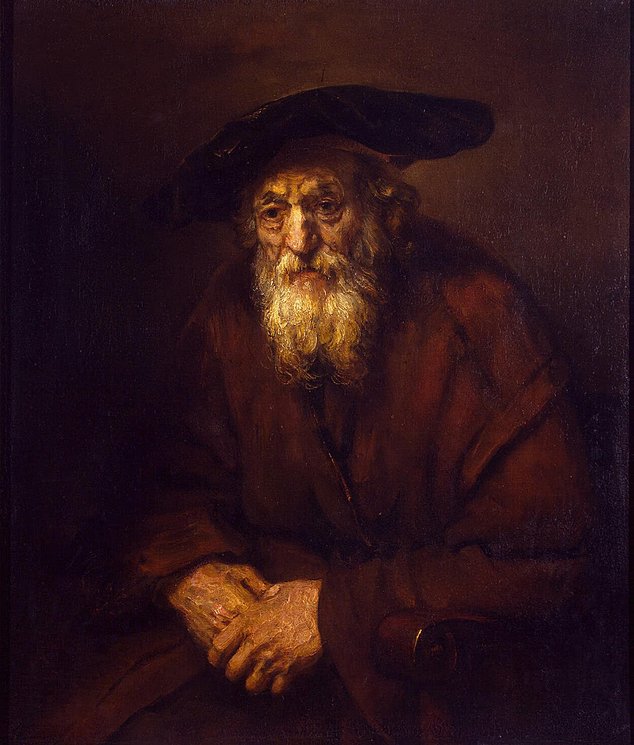
Image source: wikiart.org
Introduction
Rembrandt’s “Portrait of an Old Jew” (1654) is an intimate meditation on age, memory, and spiritual gravity. The painting strips portraiture to essentials—head, hands, and a cloak pooling into darkness—so that a single face becomes a landscape of time. With earth-bound reds and umbers, a slow, ember-like light, and brushwork that alternates between vaporous softness and rough, tactile marks, Rembrandt renders not only what a person looks like but how it feels to be with him. The sitter’s identity is uncertain, yet the painting communicates character with startling specificity: patience, sorrow carried without bitterness, and a dignity that glows from within rather than shining from external rank or ornament.
Amsterdam, 1654, and the Human Neighborhood of the Picture
The year 1654 finds Rembrandt in Amsterdam’s bustling Jewish quarter as a frequent observer and neighbor. Sephardic and Ashkenazic communities had made the city a rare haven in Europe; Rembrandt drew and painted their elders, scholars, and traders not as ethnographic curiosities but as fellow citizens. The closeness shows. This canvas belongs to a sequence of late portraits and tronies in which the artist, beset by financial strain yet creatively unbound, pursues psychological nearness over social display. “Portrait of an Old Jew” places the viewer within arm’s length of a person who seems to breathe in the same dim air. The painting is not an illustration of “type,” but an encounter.
Composition and the Architecture of Gravity
The composition is a triangle of weight and inwardness. A broad, dark cap flattens into a canopy that lowers the visual ceiling and focuses attention downward. The cloak gathers into a heavy mass that fills the lower half, its folds simplified into broad planes of reddish-brown. Between these two dark fields the face emerges, a small, fiercely alive center. Hands interlace near the bottom edge and anchor the form—knuckles lit by a quiet, persistent glow, veins and tendons indicated with a few hard strokes. Nothing distracts: no desk, no halo, no accessory. The architecture of the design teaches the mood of the sitter—pressed by life, warmed by an inward fire, steady.
Light That Describes Thought
Rembrandt’s light arrives as if from a low source at the left, then dilates slowly across brow, nose, and beard before yielding to shadow. It is not a theatrical spotlight; it is the weather of reflection. Notice how the eye sockets retain softness even where highlights sit—the painter refuses glitter in favor of moist presence. The beard catches broken sparks of paint, its wiry clumps flickering like coals. Hands absorb a cooler light, making them feel bone-hewn and real, the instruments of a life that has worked and prayed. The entire illumination reads as recognition: the world discovering a face worth watching.
Color, Temperature, and the Furnace of Earth
The palette is restricted to warm earths—oxides, umbers, and lakes—countered by small cooler grays in the skin’s shadows. This chromatic austerity yields richness rather than monotony. The cloak’s reds pulse like slow heat; the flesh carries a honeyed pallor where light lingers; the background melts into a smoky walnut that wraps the sitter like a room. Such color forms a moral climate. The painting opts for human warmth over courtly brilliance, depth over sparkle, lived material over ostentation.
Brushwork, Texture, and the Evidence of Life
Up close, the painting is a field of decisions. Rembrandt drags the brush almost dry over the cap to achieve a suede-like dulled sheen. He lays thicker paint on the ridge of the nose and the bridge of the brow, letting it catch light physically as well as optically. The beard is a tangle of strokes—some thin and stringy, others scumbled—producing the sense of hair that has grown stubborn with age. In the cloak, long sweeps and sudden directional changes carve planes that read as weight rather than textile description. These marks are not virtuoso display for their own sake; they are ways of making matter behave like meaning.
The Face as a Map of Time
Rembrandt never tidies away time. The sitter’s eyelids hang with the gravity of years; the cheeks slacken without collapse; the mouth’s corners are soft, not clenched. A thin sheen moistens the eyes, and tiny highlights on the lower lip make breath plausible. The nose is slightly bulbous—all specificity, no caricature. Asymmetry supplies humanity: one eye rides a touch higher than the other, the beard thickens more on one side, and the hat tilts as clothing does in real life. These imbalances rescue the picture from formula and place it in the realm of recognition—someone, not anyone.
Hands as Biography
The clasped hands are the painting’s second face. Their position is not nervous; it is settled. The fingers interlace loosely, thumbs resting in mutual support, as if the body remembers this posture from long hours of listening. Rembrandt touches bone, tendon, and vein with sparing emphasis so that the hands feel articulate without becoming anatomical studies. In portraits across his career, hands name vocation—merchant, scholar, soldier. Here they name endurance. They are hands that have held texts, tools, children, grief.
Nearness Without Intrusion
The viewer’s vantage is intimate yet respectful. The sitter looks slightly downward and aside, neither challenging nor avoiding. The gaze is the social key: we are admitted to proximity but not encouraged to interrogate. Rembrandt offers companionship, not spectacle. This nearness allows small things to count—the frayed edge of a cuff, the dark half-moons of shadow under the nails, the way beard hair strays over the cloak like ungovernable time.
Cultural Dialogue and the Ethics of Representation
Within Amsterdam’s plural cityscape, Rembrandt’s images of Jewish neighbors have the texture of lived encounter. He resists masquerade and sentimentality. In this painting the man’s Jewishness is present in physiognomy and costume but not paraded; it is one aspect of personhood within a larger field of age, feeling, and mind. The artist’s ethic is simple: specificity is respect. By rendering this elder with such attention, Rembrandt asserts that the dignity of a community can be communicated through the dignity of one face.
Space, Silence, and the Sound of the Picture
The background is not a void but a resonant quiet. Its dark, brown-violet hush absorbs the world’s chatter so the sitter’s inner voice can be heard. Painters often use empty grounds to elevate rank; Rembrandt uses silence to elevate presence. The result is auditory: you can almost hear the soft rasp of breath, the faint rub of wool, the unhurried tempo of a long afternoon. The painting functions like a room where you would lower your voice.
Comparison with Other Late Portraits
“Portrait of an Old Jew” stands near Rembrandt’s late self-portraits and his studies of aged scholars. Compared with the sharper frontal confrontations of those self-portraits, this picture is more yielding, the light less combative, the surface more porous. Where some contemporaries chased jewel-like finish and descriptive bravura, Rembrandt aims for persuasion: does the painting feel true? The truth here is quiet and capacious. It leaves room for memory to enter.
The Inner Narrative
Though static, the painting hints at a story. The hands suggest a pause after speaking, or before it. The eyes hold the color of thinking after listening. The slightly forward lean reads as someone who has moved toward a companion to say something weighty and then—perhaps—decided to wait. Rembrandt sets us inside that pause. In the space between words the person becomes most visible.
Theological Hum of the Image
Without religious symbols, the picture hums with spiritual gravity. Light attends age with mercy; clay-toned colors recall the earth from which we come; the downward gaze carries the tilt of prayer without performing it. Whether or not the sitter is a scholar or a lay elder, the painting makes a claim: wisdom is a way of being in light, not a set of decorative attributes. The aura is ethical rather than miraculous.
Material Presence and Modern Eyes
Today, viewers often marvel at how modern the painting feels—its limited palette, its open edges, its refusal of finish where finish would add nothing. But the modernity is simply Rembrandt’s honesty about perception. We see the world as patches that cohere, as light that clarifies and then falls away, as faces that move even when they are still. The canvas records that experience directly. It meets contemporary eyes not by prediction but by fidelity to looking.
The Afterimage
When you leave the picture, what remains is not the beret or even the beard but the temper of the gaze and the warmth that surrounds it. The afterimage is a human temperature—an ember-light that persists in the mind. That persistence explains why this painting has stood as a touchstone for portraitists across centuries: it proves that a deep likeness is a relationship, not a compilation of traits.
Conclusion
“Portrait of an Old Jew” distills Rembrandt’s late art to its human core. A head and hands emerge from warm darkness; light discovers, caresses, and accepts; paint speaks in whisper and rasp; and a person sits before us with the moral weight of unremarkable grandeur. The canvas teaches an art of attention—how to look at age with tenderness, how to let a face carry a world, how to make silence hospitable. In an era eager for spectacle, the painting’s enduring power lies in its refusal to shout. It asks only that we come close, slow down, and recognize a neighbor.