Image source: wikiart.org
Introduction
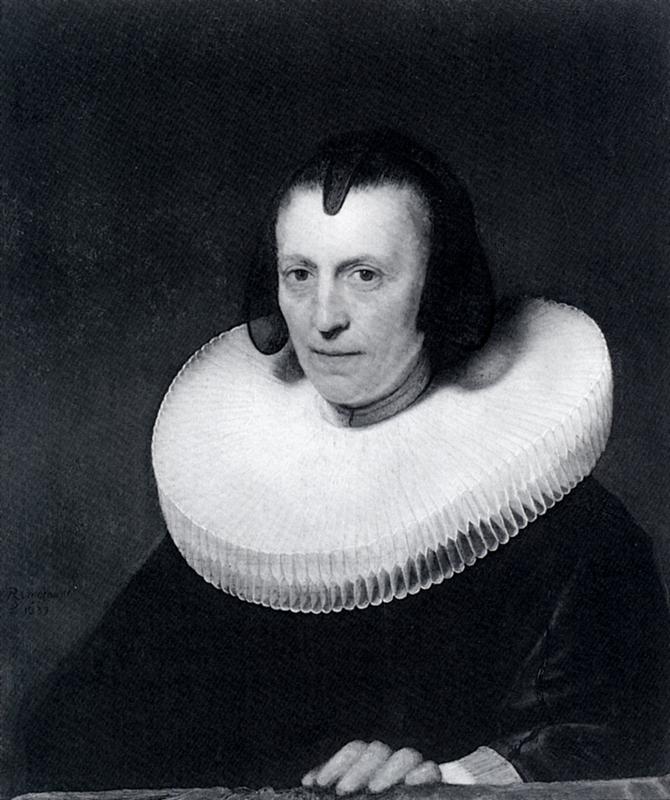
Rembrandt’s “Portrait of Alijdt Adriaensdr” (1639) is a masterclass in restraint and presence. The sitter, a Dutch matron, occupies the foreground with a calm, frontal poise, her face set within the halo of a broad, pleated millstone ruff. Nothing here is superfluous: a dark ground, the sober arc of sleeve and shoulder, the margin of a tabletop, and the quiet emphasis of clasped fingers. From this limited vocabulary Rembrandt constructs a likeness that feels immediate and searching. The painting shows how dignity can be built from light, line, and disciplined tone rather than ornament. It is the pictorial equivalent of a measured voice in a quiet room.
The Sitter and the Dutch Ideal of Respectability
Little is recorded publicly about Alijdt Adriaensdr beyond her name and the date of her portrait, yet Rembrandt conveys a great deal about her place in Amsterdam’s mercantile society. The millstone ruff and austere dress identify her with a Calvinist culture that prized piety, moderation, and civic responsibility. Portraits of this community tend to avoid flamboyant color and theatrical settings; they honor steadiness and propriety. Within that framework Rembrandt locates individuality. He allows the ruff and dark gown to state the social code, then turns to the face and hands to reveal a particular woman—alert, self-possessed, and inwardly alive.
Composition and the Architecture of the Ruff
The portrait’s compositional engine is the monumental circle of the ruff. Its crisp, radiating pleats form a luminous disk that stabilizes the entire design. Against the enveloping dark, the ruff behaves like a private architecture—a portable colonnade of paper and starch—that frames the head as if it were a sacred relic. Rembrandt uses this bright circumference to orchestrate the viewer’s movement: the eye enters at the collar’s edge, travels along the pleats, and arrives inevitably at the face. The ruff’s lower arc also echoes the half circle of the wrists and tabletop, binding upper and lower halves into a single rhythm.
The Face and the Logic of Light
Rembrandt builds Alijdt’s head with an exquisite modulation of values. Light touches the forehead, cheekbones, nose, and chin, gently receding along the jaw and into the shadowed temple. These transitions are never abrupt; they move like breath. The eyes are set back into their sockets, moist with small highlights that keep them awake without glazing them. The mouth is closed but mobile, with the faintest hint of asymmetry that betrays a poised personality rather than impassive decorum. The painter’s perennial gift is to make flesh look inhabited; the skin carries warmth, thin cools at the temple, and a slight translucency at the ears. The head seems not painted on the surface but formed within a living atmosphere.
Hair, Cap, and the Formal Severity of the Silhouette
The sitter’s hair and cap work as a single silhouette that slips under the ruff’s inner circle like a dark cowl. Rembrandt refuses frizz or ornamental play; the cut is severe, the outline disciplined. This suppression of flourish is deliberate. The dark mass pushes the face forward and sharpens the geometry of light. At the brow a small point of hair intrudes to mark the vertical axis, a quiet punctuation that keeps the head from dissolving into symmetry. Everything supports the central task: to present a mind housed within a strict costume.
Hands, Table Edge, and the Ethics of Gesture
Rembrandt’s portraits often hinge on what the hands are doing. Here the fingers rest at the painting’s lower right, softly interlaced on the table’s edge. The gesture is modest and readable: no display of rings, no rhetorical pointing, only the confirmation of calm. The hands anchor the portrait structurally by echoing the ruff’s bright arc in a minor key, and they anchor it morally by suggesting composure. Their placement over the table’s lip is not casual; it pulls the sitter into our space and turns the portrait from a remote icon into a social encounter, as if we had paused across from her during a visit.
Chiaroscuro and the Quiet Theater of Value
The portrait’s drama lies not in narrative but in value. A dark background holds steady like a stage curtain; a directional light enters from the left and concentrates on the ruff and face; the gown absorbs rather than reflects. The range is narrow yet eloquent. Rembrandt understands that within limited means, precision matters more than abundance. He tunes the ruff’s whites across dozens of grays—cool where the pleats turn away from the light, warmer where they face it—so that the circle glows without ever breaking into glare. The face sits at a softer brightness than the ruff, ensuring that illumination remains believable and that character, not costume, commands our look.
The Millstone Ruff as a Painter’s Problem
No accessory in Dutch portraiture challenges painters more than the millstone ruff. Its repeated pleats invite mechanical treatment and risk stealing attention from the face. Rembrandt resolves both problems by varying the pleat widths subtly, breaking edges where they turn, and allowing brushwork to soften at the ruff’s far side. He also choreographs the ruff’s brightness to serve the head. The clearest, hardest edges sit near the chin and jaw, where the collar must separate the face from the dark gown. Elsewhere edges relax, allowing our attention to drift back to the eyes. In short, the ruff becomes a tool for emphasis rather than an obstacle to it.
Palette, Pigment, and the Aesthetics of Restraint
Although the portrait reads from reproductions as a restrained monochrome, Rembrandt likely organized a finely balanced palette. Flesh combines warm ochres with transparent lakes; the ruff mixes lead white with subtle cool modulations; the gown sits in deep browns and blue-blacks that gather light without reflecting it. The background is not a dead black but a layered field with temperature shifts that prevent the figure from appearing pasted on. This calibration of near-neutrals creates a tonal music in which the smallest change—an edge warmed, a shadow cooled—carries expressive weight.
Paint Handling and Surface Intelligence
Rembrandt’s brushwork here is disciplined and selective. The face is knit with thin, elastic layers; the eyelids and nostrils take small, decisive touches; and the mouth’s softness is achieved with a gentle drag of the brush that avoids line. The ruff alternates precise, almost calligraphic ridges with scumbled passages where the pleats turn away. The gown is painted in broader, quieter sweeps that accept darkness as their medium. These varied languages of paint create a hierarchy of attention: ophthalmic detail at the eyes, measured clarity at the ruff, and large, breathing fields elsewhere. The surface reads as calm from a distance and astonishingly alive up close.
Pose, Distance, and the Social Contract of Portraiture
Rembrandt chooses a frontal or slightly turned pose at a distance that honours decorum while permitting intimacy. We are neither held at arm’s length nor invited into familiarity. The sitter meets us fairly, with the straightforwardness expected in a culture that valued plain dealing. The table edge and hands offer a point of orientation within our space; the dark background prevents narrative intrusions. The contract is clear: this is a woman defined by duty, standing, and conscience, and the painter’s task is to render those qualities visible without spectacle.
Character and the Whispering Signs of Personality
Within the strict costume Rembrandt finds the individual. The eyes carry a low flame of humor and intelligence; the mouth’s corners hold steady without meanness; the cheeks retain life even in shadow. There is self-command here, but not hardness. The portrait suggests someone accustomed to responsibility—perhaps a wife, widow, or regentess—who understands the weight of public opinion yet does not live by it. These readings arise not from symbols but from the painter’s commitment to minute, truthful observation: the way the lower lid softens, the way the chin rests, the way the neck tenses slightly as posture is maintained.
The Signature, Date, and the Artist’s Confidence
Rembrandt signs and dates the portrait discreetly along the lower left, a habit of the late 1630s when his confidence and market were secure. The notation is a quiet assurance that what looks simple is difficult. In 1639 he balanced large public commissions with private likenesses; in both arenas he pursued the same aim—to capture life with the most economical means. The signature is not a boast but a witness to that ethic of concentration.
Relationship to Other Female Portraits of the Period
Set beside contemporary portraits by painters such as Frans Hals or Bartholomeus van der Helst, this canvas reads as more inward. Hals delights in animated brushplay and lively expressions; van der Helst polishes surfaces to silvery finish. Rembrandt chooses contemplation. His surface is measured, his backgrounds dark and absorbing, his ruffs sculptural rather than sparkling. The difference is not merely stylistic; it marks a distinct philosophical approach to likeness. Where others relayed social vivacity, Rembrandt sought the weather of the soul.
The Ruff and the Theology of Modesty
In Calvinist Holland, clothing was moral rhetoric. The millstone ruff and plain gown announced modesty, order, and respect for community standards. Rembrandt honors that rhetoric but refuses to let it swallow humanity. He paints the ruff as shield and halo—both protective device and luminous frame—so that modesty becomes not repression but a space within which the face can shine. The painting thus participates in a cultural theology of modesty while insisting on the irreducible reality of the person.
The Table as Threshold Between Viewer and Sitter
The small strip of tabletop along the bottom is one of the portrait’s quietest and most effective devices. It establishes a threshold that both separates and connects. On one side is our world; on the other, hers. The hands resting there bridge the gap. Without this ledge the sitter would risk floating; with it, she occupies our space without stepping out of her own. The table thus embodies the central challenge of portraiture: turning encounter into image while respecting distance.
Time, Age, and the Refusal of Flattery
Rembrandt does not smooth age or dramatize it. The skin records time’s soft labor; the gaze holds experience without bitterness. In an era when many portraits pursued the fiction of unchanging youth, this truthfulness is striking. Yet the painting is not clinical. By sheathing the face in a patient light, the artist converts factual description into a form of regard. Viewers do not count wrinkles; they meet a life.
Why the Portrait Still Feels Modern
Modernity here lies in the union of clarity and empathy. The painting presents an individual within an austere code and invites us to see beyond that code without mocking it. Its surface is frank about paint—pleats are brushstrokes, shadows are layered glazes—yet the illusion of presence is complete. Contemporary viewers, accustomed to photographs, find in Rembrandt something photographs rarely supply: the record of attention. Every transition of value and edge is a decision, and those decisions accumulate into character.
Conclusion
“Portrait of Alijdt Adriaensdr” embodies Rembrandt’s mature art: the measured theater of light, the intelligence of surface, and the commitment to seeing a person within the strictures of culture. The ruff becomes architecture, the dark gown becomes atmosphere, the hands become a point of human contact, and the face—calm, alert, and fully present—becomes the organizing center around which everything coheres. The painting proves that grandeur does not require spectacle. It requires seriousness of looking and kindness of mind.
