Image source: wikiart.org
Introduction to “Portrait of Abraham Ortelius”
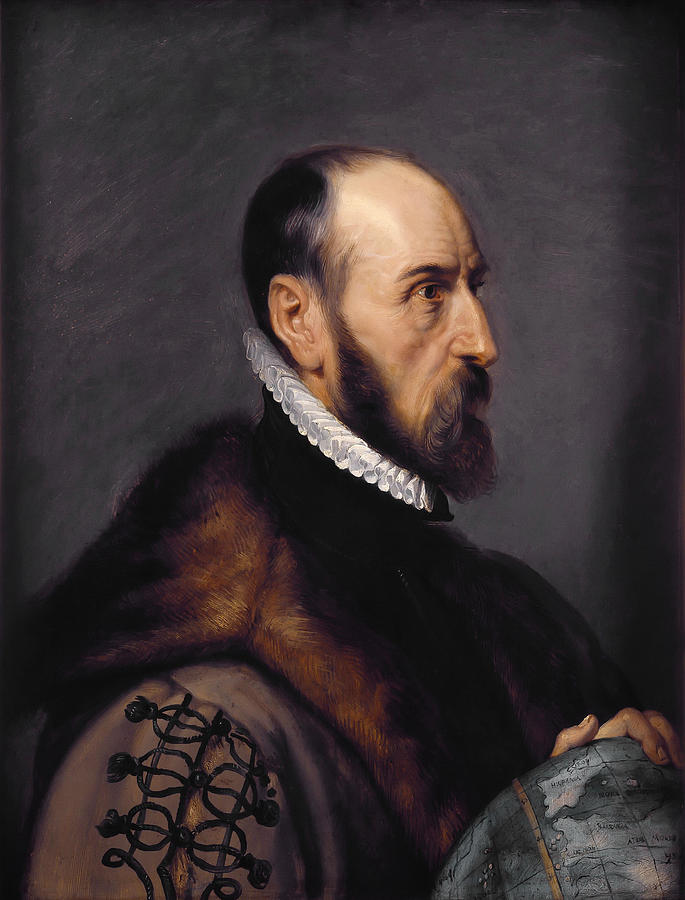
“Portrait of Abraham Ortelius” by Peter Paul Rubens is a dignified and quietly powerful depiction of one of the great cartographers of the sixteenth century. In this half length profile the elderly Ortelius turns to the right, his thoughtful eyes fixed on an unseen horizon. He wears a luxurious fur lined coat and a stiff white ruff, while his right hand rests gently on a globe. Against a neutral, dark background, every detail of his face, costume, and gesture acquires symbolic weight.
Rubens was still a young artist when he painted this portrait, yet the work already demonstrates his gift for combining psychological insight with sophisticated design. Ortelius is not presented as a generic scholar. He emerges as a specific individual whose life has been shaped by travel, study, and the contemplation of the world. The globe at the bottom right serves as both attribute and metaphor. It identifies Ortelius as a cartographer and suggests that his mind ranges across continents and seas even as his body remains still.
Abraham Ortelius and the World of Humanist Cartography
To understand the painting it is helpful to recall who Abraham Ortelius was. Born in Antwerp in 1527, he became one of the most influential map makers of the early modern period. His great work, the “Theatrum Orbis Terrarum,” published in 1570, is often considered the first modern atlas. It gathered maps of many regions into a single coherent book, making geographical knowledge accessible to scholars, merchants, and rulers.
Ortelius belonged to a network of humanist intellectuals who combined classical learning with contemporary science. He was acquainted with figures such as Gerardus Mercator and the printer Christophe Plantin. His interests extended beyond geography to include history, archaeology, and philology. By the time Rubens portrayed him, Ortelius was a respected elder of Antwerp’s learned community.
Rubens himself grew up in this intellectual milieu and later worked for Plantin’s heirs. Painting Ortelius allowed him to pay homage to a man whose atlases shaped the way Europeans imagined the world. The portrait thus embodies a dialogue between art and science, image making and map making, both of which extend human vision beyond the here and now.
Composition and the Classical Profile
Rubens adopts a profile view for this portrait, a choice that evokes classical coins and Renaissance medals. The sitter’s head is turned sharply to the right, his eye in almost perfect side view. This profile format gives the image a sense of clarity and restraint. It emphasizes the strong structure of Ortelius’s head and focuses attention on his distinctive nose, high forehead, and carefully trimmed beard.
The figure occupies most of the canvas, with the dark ground leaving only a narrow margin around him. He is shown from about the chest upward, wrapped in his heavy coat. The lower right corner is reserved for the globe, which presses close to the edge of the picture as if about to roll into the viewer’s space. This placement subtly reinforces the idea that Ortelius’s work touches the larger world beyond the frame.
The profile orientation does not prevent Rubens from suggesting depth. Light falls from the left, catching the cheekbone, temple, and ruff, and then receding into the shadow of the neck and shoulder. The contour of the head is crisp against the background, yet the modeling within that contour is soft and nuanced. The overall effect is one of contained energy and quiet authority.
The Face of a Scholar and Traveler
Ortelius’s face is the psychological center of the painting. Rubens renders it with extraordinary sensitivity. The skin is thin and slightly sallow, indicating age, yet it remains firm. The receding hairline and bald crown reveal the passing of time, while the close cropped beard reinforces the impression of order and discipline.
The eye, though shown in profile, conveys keen intelligence. It is slightly narrowed, as if Ortelius is weighing what he sees. His lips are closed, neither smiling nor frowning, suggesting a temperament that is reflective rather than theatrical. One senses that this is a man more accustomed to study and conversation than to public oratory.
Subtle lines at the corner of the eye and mouth hint at decades of concentration and responsibility. Rubens avoids caricature. He neither idealizes Ortelius into a timeless sage nor exaggerates his age. Instead, he embraces the particularity of an elderly scholar whose knowledge has been earned through long experience. The resulting image inspires respect without lapsing into remote aloofness.
Costume, Fur, and Signs of Status
The clothing in the portrait carries important messages about Ortelius’s social position. He wears a dark doublet with elaborate black embroidery on the visible sleeve. Over this he dons a coat lined with luxurious brown fur that envelops his shoulders and chest. Around his neck is a fashionable white ruff, crisply painted in sharp triangular folds.
These garments indicate wealth and prestige. Successful cartographers in Antwerp were not merely scholars. They were also entrepreneurs who sold their atlases to princes and merchants. The fur and ruff place Ortelius among the city’s prosperous elite. At the same time, the subdued colors and lack of decorative jewelry keep the focus on intellectual rather than ostentatious status.
Rubens handles the textures with great care. The fur appears soft and dense, catching light along its edges. The ruff is crisp and cool, rendered with small strokes that suggest stiffened linen. The embroidered sleeve contrasts with both, its swirling black patterns echoing the complex lines that Ortelius might have traced on his maps. Costume here is not mere illustration. It becomes a visual analogy for the sitter’s professional life and personality.
The Globe as Attribute and Metaphor
Perhaps the most striking symbolic element in the painting is the globe that Ortelius holds. Resting beneath his right hand, it emerges from the lower edge of the composition with just enough of its surface visible for the viewer to recognize coastlines and meridians. Its presence immediately identifies the sitter as a geographer.
The way Ortelius touches the globe is revealing. His fingers are not clenched around it in a gesture of domination. Instead, they rest gently, almost protectively, on its surface. This touch suggests stewardship rather than conquest. Ortelius is a student of the world, not a conqueror of it.
On a deeper level the globe serves as a metaphor for the scope of his mind. While his body is confined within the narrow space of the portrait, his thoughts and maps roam across continents and oceans. The sphere also evokes the Christian idea of a created world ordered by divine design. As a humanist scholar, Ortelius might be seen as deciphering that design through geography and history.
Visually, the cool grays and blues of the globe balance the warm browns of the coat and the pinkish tones of the face. It provides a subtle counterpoint that anchors the lower portion of the painting while reinforcing the thematic emphasis on exploration and knowledge.
Color, Light, and the Mood of Reflection
Rubens employs a restrained palette in this portrait, relying on modulated browns, blacks, grays, and skin tones, with only the white ruff providing a sharp highlight. This limited color scheme suits the intellectual subject. It avoids distractions and allows the viewer to focus on form and expression.
Light plays a central role in shaping the mood. It comes from the left and slightly from above, illuminating the forehead, nose, and cheek of Ortelius. The light also skims the fur and ruff, creating a subtle halo effect around the head and neck. The right side of the face and shoulder recede into gentle shadow.
This chiaroscuro modeling lends the image a sense of three dimensional solidity. It also contributes to the atmosphere of quiet contemplation. The dark background isolates the figure, suggesting an interior space of thought. There are no windows, furniture, or landscape to distract the eye. The portrait becomes almost meditative. It invites the viewer to join Ortelius in the calm pursuit of understanding.
Rubens’s Approach to Portraiture
Although Rubens is best known for grand altarpieces and mythological scenes filled with multiple figures, he was also an exceptional portraitist. In “Portrait of Abraham Ortelius” he demonstrates his ability to adapt his dynamic style to the demands of a single sitter.
The portrait reveals several hallmarks of Rubens’s approach. First is his emphasis on the living presence of the subject. Even in profile, Ortelius appears alert and engaged. The subtle suggestion of breath and thought separates this image from more rigid Renaissance portraits. Second is Rubens’s interest in psychological character. He does not only show what Ortelius looked like but also hints at how he thought and felt.
Third, the painting shows Rubens’s ability to balance realistic detail with painterly freedom. The textures of fur and ruff are convincing, yet closer inspection reveals brisk, confident brushstrokes. The dark background is not a flat void but a gently varied field that echoes the movement of the figure. This combination of accuracy and vitality is a key feature of Rubens’s mature style.
Humanism, Geography, and the Image of the Scholar
The portrait of Ortelius belongs to a broader cultural phenomenon in which scholars and scientists became subjects worthy of artistic celebration. In earlier centuries, religious figures and nobles dominated portraiture. By the time Rubens painted Ortelius, humanist scholars had gained increasing recognition as important contributors to society.
Ortelius is shown not with an emblem of noble lineage but with a tool of intellectual labor. The globe symbolizes knowledge rather than birth. His fur coat and ruff indicate material success, yet the primary focus remains on his mind and works. This shift reflects the values of a mercantile city like Antwerp, where trade, printing, and scholarship intersected.
The portrait also hints at the global consciousness emerging in Europe during the late sixteenth and early seventeenth centuries. As explorers charted new routes and lands, cartographers like Ortelius synthesized their findings into maps that reshaped Europeans’ understanding of space. Rubens’s painting acknowledges this transformation. It presents Ortelius as a mediator between viewers and the expanding world beyond Europe.
Timelessness and Mortality
While the portrait exudes dignity and composure, it also subtly reminds the viewer of human mortality. Ortelius is portrayed in advanced age. His hair is thinning, his skin shows signs of wear, and his expression carries a seriousness that suggests awareness of life’s transience.
The sober palette and absence of ornament reinforce this sense. There is no architectural backdrop or landscape that would place the sitter in a specific location. Instead, he seems suspended in a neutral space that could belong to any moment. This creates a paradoxical effect. The portrait aspires to timelessness even as it records the marks of time on a human face.
In a way this tension mirrors Ortelius’s own work. Maps attempt to fix a changing world in stable lines and names. Yet coastlines shift, empires rise and fall, and knowledge evolves. Rubens’s painting captures the man who tried to bring order to that flux, while gently suggesting that even the greatest geographer remains subject to the limits of human existence.
Legacy and Modern Appreciation
Today “Portrait of Abraham Ortelius” appeals to viewers for multiple reasons. Art lovers admire its elegant balance of form, color, and character. Historians appreciate its glimpse into the world of early modern science and humanism. Map enthusiasts recognize in the globe a tribute to a pioneer whose atlas shaped the way generations visualized the earth.
The portrait also resonates with contemporary values that esteem curiosity, research, and global awareness. In an era of digital maps and satellite images, it is intriguing to contemplate the quiet concentration of a scholar who drew coastlines by hand and assembled information from scattered reports and voyages. Rubens’s image preserves the human face behind those monumental efforts.
For many viewers, the painting encourages reflection on how knowledge and power relate. Ortelius’s calm, almost humble demeanor contrasts with the vast world he charted. He embodies an ideal of scholarship grounded in patience and responsibility, rather than conquest. This perspective remains relevant in discussions about the ethics of exploration and the representation of global space.
Conclusion
Peter Paul Rubens’s “Portrait of Abraham Ortelius” is a masterful exploration of character, status, and intellectual achievement. Through the profile pose, rich costume, symbolic globe, and nuanced modeling of light and shadow, Rubens crafts an image that honors the celebrated cartographer while inviting viewers to ponder broader themes of discovery, knowledge, and mortality.
Ortelius appears as both an individual and a type: a specific Antwerp humanist with his own history and personality, and a representative of those thinkers whose work enlarged the mental horizons of Europe. The painting’s restrained elegance and psychological depth exemplify Rubens’s skill as a portraitist and his sensitivity to the cultural currents of his time.
Centuries later, the gaze of Abraham Ortelius still meets ours across the canvas. His hand still rests on the globe, suggesting both familiarity and wonder. In this still moment captured by Rubens, the world of maps and the world of painting come together, reminding us that the pursuit of understanding, whether through lines on paper or strokes of paint, is one of humanity’s most enduring adventures.