Image source: wikiart.org
Introduction
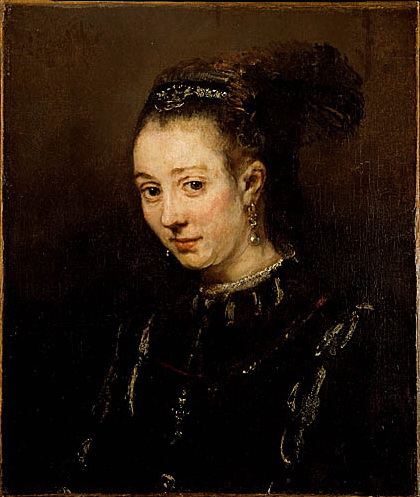
Rembrandt’s “Portrait of a Young Woman” (1655) is an intimate demonstration of how the master could summon a living presence from a dark field with the fewest possible means. The sitter is not a princess or a public celebrity; she is an individual offered to us in half light, her head inclined, her mouth poised between shyness and curiosity. The background is a softly breathing brown; the dress absorbs light more than it reflects it; the earrings and hair ornament deliver just enough sparkle to establish a social register. What endures is the sense of encounter. The canvas does not shout its virtuosity—it lets us discover it at the pace of a conversation.
A Composition Built For Nearness
The portrait is composed as a simple bust-length, slightly turned to the viewer’s right, with the head placed just off center so that the face falls squarely within the brightest zone. This small misalignment is crucial: it prevents stiffness and creates a gentle torque through the neck and shoulders. The visible shoulder on the right rises in a modest arc, giving the head a stable perch; the far shoulder melts into darkness, allowing the face to advance as the true subject. Rembrandt crops close enough to let the sitter’s personality eclipse any architectural or emblematic setting. By denying a detailed background, he composes a space that feels as private as the breath between one sentence and the next.
Chiaroscuro As Emotional Architecture
The lighting is a hallmark of Rembrandt’s late manner. Rather than a sharp spotlight, we receive a warm, directional glow that rolls across the forehead, cheek, and lower jaw, leaving the eye sockets delicately shaded and the temple softly receding. The transition from light to shadow is long and humane; it reads not as drama but as caress. This chiaroscuro is a form of architecture: it builds the skull, hollows the cheeks with discretion, and edges the lips with a micro-gleam that suggests living moisture. The light also performs a psychological task. Because it opens the planes of the face while withholding the corners of the room, we instinctively pay attention to what matters—her expression—and we experience the rest as protective privacy.
Palette And The Music Of Restraint
The color range is narrow and orchestral. Earthy browns, umbers, and warm blacks make the ground and garment; muted flesh tones, laced with small pulses of red lake at the lips and ears, establish vitality; a restrained use of lead-tin yellow in the jewelry and hair ornament introduces quiet high notes. This limited palette produces a low, resonant chord against which tiny changes register like melody. One notices the blush just under the eye, the cooler tone where the jaw meets the neck, the warmer notch at the inner corner of the mouth. The result is not chromatic poverty but a cultivated austerity that keeps the portrait from becoming a costume piece and lets it remain, first and last, a person.
Brushwork That Thinks Out Loud
Rembrandt’s paint handling moves between declaration and whisper. In the face, strokes shorten and interweave, producing a supple surface where transitions are felt rather than seen. The brow and cheek carry a faint impasto that catches room light, animating the face as the viewer shifts position. The background is brushed more broadly, with visible sweeps that give the dark a grain—like velvet that remembers touch. On the dress, scumbled passages suggest a cloth whose threads drink light. Over this nearly matte field, he flicks small, bright touches to indicate chain-links, bead reflections, and the crisp edge of a lace insert. The alternation of thick and thin, rough and sleek, becomes its own narrative about what the painter wishes to proclaim and what he chooses merely to imply.
Costume, Jewelry, And The Politics Of Modesty
The garment is dignified, not ostentatious. Its dark tone and absorptive surface place it firmly in the social world of respectable comfort rather than the parade of luxury. Yet Rembrandt grants the sitter a few bright privileges: a jeweled hair piece catching the highest light, pendant earrings that tremble against the neck, and a narrow chain or brooch anchoring the bodice. These ornaments do not proclaim wealth; they punctuate personhood. They also serve formal ends. The hair ornament establishes the portrait’s apex and keeps the head from dissolving into the ground; the earrings introduce a downward rhythm that leads the eye to the soft hollows of the neck; the bodice jewel, tiny and firm, prevents the torso from flattening into shadow. In Rembrandt, accessories are never mere markers of status—they are instruments that tune the composition.
The Gaze And The Poetics Of In-Betweenness
The sitter’s gaze is directed slightly off to the side rather than squarely at us, and her mouth is shaped as though she has just listened and is considering her reply. This in-betweenness—between sentences, between us and somewhere just beyond—creates a current of life that a fixed stare would freeze. The eyes themselves are handled with extraordinary economy: a soft dark for the pupil; a warmer crescent that implies the turn of the globe; a pinhead of higher light that avoids glitter. Because the highlights are modest, we attend to the thought behind the eyes rather than the optics of shine. The gaze feels alert, courteous, and reserved, a social stance consistent with the portrait’s modest costume and restrained palette.
Hair And Skin As Twin Textures
The hair is drawn back and ornamented, leaving tendrils that catch the higher light around the temple and ear. Rembrandt makes these curls with decisive, slightly raised strokes—enough substance to catch light, thin enough to remain airy. Skin is treated quite differently. Here the paint is kneaded into seamless gradations, then subtly scored by the tiniest marks to suggest pores and the faint topography of age and expression. The contrast between the crispness of hair and the yielding softness of skin increases the sensation of proximity. You do not merely see her; you feel the distance a hand would travel across a cheek into a coil of hair.
The Psychology Of Tilt And Turn
The head’s inclination is the portrait’s psychological engine. Tilted slightly forward and toward the viewer’s right, it yields without submission. That tilt transforms the sitter’s expression from potentially aloof to engaged; it invites without pleading. The neck’s gentle turn stretches one side and compresses the other, producing asymmetric shadows that keep the face dynamic. Even the alignment of the earrings participates: the nearer one hangs more visibly, catching light; the farther one glints just enough to confirm the turn. These micro-coordinations make the portrait feel like a real-time event rather than a posed diagram.
The Background As Breathing Room
Rembrandt’s backgrounds often read as pure darkness until you look longer. Here, the brown field is modulated—warmer near the face, cooler towards the upper edges—creating an atmospheric recession that affirms space without articulating it. A slightly lighter zone hovers behind the head, not as a literal halo but as an optical cushion that helps the silhouette stand free. Because the ground is not perfectly smooth, the image never ossifies; it vibrates gently, as if air were moving around the sitter. The background’s generosity ensures that the smallest facial inflection remains the portrait’s true spectacle.
Late Rembrandt And The Art Of Radical Simplicity
By 1655 Rembrandt had settled into a late style characterized by radical simplification and emotional density. “Portrait of a Young Woman” exemplifies this maturity. There is no elaborate architecture, no moralizing inscription, no parade of textures for their own sake. The painting trusts that an attentive gaze under good light is sufficient subject for great art. Where earlier portraits by contemporaries offered flawless polish and fashionable detail, Rembrandt offers time—the time he spent looking, the time the sitter spent holding still, the time we are asked to give in return. The image becomes a compact between the living and the painted.
Comparison Within The Rembrandt Portrait Family
Place this canvas beside Rembrandt’s grander likenesses of 1654–1656 and a distinctive note emerges. Compared to “Jan Six,” whose sweeping gesture and sumptuous red cloak advertise status, this young woman speaks softly and privately. Compared to the weathered faces of old men that Rembrandt painted with architectural authority, her features are closer to lyric poetry—subtle, melodic, inward. Yet the family resemblance is unmistakable: all are rendered with the same compassionate scrutiny, the same preference for truth over flattery, the same belief that character, not costume, is what dazzles.
The Viewer’s Role And The Social Contract Of Looking
The portrait sets up an etiquette between sitter and viewer. We are allowed close—closer than polite society might permit—yet the darkness around her and the restraint of her expression construct an envelope of privacy. Our part is to approach quietly, to register the orchestra of small decisions that produce her presence, and to resist the urge to demand more narrative than the picture offers. The experience is akin to being introduced to a thoughtful stranger at a calm gathering. One knows immediately that she is interesting; one also understands that interest must be earned.
Texture, Tactility, And The Body’s Memory
Rembrandt’s surfaces are never merely visual; they seem calibrated to memory’s touch. The slightly built-up highlights on the cheek and nose catch real room light, making the face feel potentially warm. The matte body of the dress reads like cloth brushed in a single direction. The tiny points of paint that form the earrings behave like metal in miniature. Because each material is rendered with the right kind of resistance, our bodies are covertly recruited into looking; we recall how velvet drinks light, how skin absorbs and reflects, how metal flashes and then goes dull. This tactile sympathy deepens our attachment to the person who wears these materials.
Time, Age, And The Refusal Of Cosmetic Idealization
Although titled as a portrait of a young woman, the face is not smoothed into ideality. The skin carries real modeling; the lower eyelid is gently weighted; the mouth holds a trace of asymmetry as it bends into thought. Rembrandt’s refusal to polish away these realities avoids two traps: sentimentality about youth and the anonymous perfection of fashion. Youth here is not a blank promise but a stage in a particular human life. The result is a portrait that feels honest without being clinical, tender without being indulgent.
Reading The Emotion Without Forcing It
What, finally, does she feel? The painting will not be pinned down. There is friendliness, perhaps a touch of bemused reserve, the faintest hint of melancholy around the eyes that so often creeps into faces when a session goes quiet. Rembrandt’s triumph is to encode an emotion that moves even as we look—like the changing weather of a conversation. The image resists the false certainty of a single caption and instead offers a durable ambiguity that keeps viewers returning.
Why The Painting Still Reads As Contemporary
Contemporary portrait photography and painting often adopt Rembrandt’s lighting, but it is his ethics of attention that make this canvas feel current. The portrait invites a mode of looking—slow, respectful, tactile—that counters the era’s quick scan. It models a way to meet another person without either idealizing or consuming them. In an age of overexposed images, this young woman’s half-lit face restores mystery as a moral good.
The Legacy Of Quiet Mastery
“Portrait of a Young Woman” reminds us that Rembrandt’s genius did not depend on monumental narratives or dazzling crowds. He could, with dark ground and a few bright touches, make a room fall silent while a single face becomes the whole world. The legacy of such quiet mastery is twofold: it shows later artists how little is needed to achieve depth, and it instructs viewers in the kind of attention that art, and people, deserve.
Conclusion
This painting is a distillation of Rembrandt’s late credo: look truly, light gently, speak softly, and let character write the script. The head’s subtle tilt, the modest jewelry, the restrained palette, the intricate rhythms of thick and thin paint—each decision converges on a humane aim. We do not leave with a story about wealth or rank; we leave with the feeling of having met someone. That feeling, protected by shadow and upheld by light, is the work’s lasting brilliance. Rembrandt gives us a young woman with privacy intact and presence undeniable, and in doing so he gives us a lesson in how art can honor the dignity of a stranger.