Image source: wikiart.org
A First Glimpse Of Motion Caught In Paint
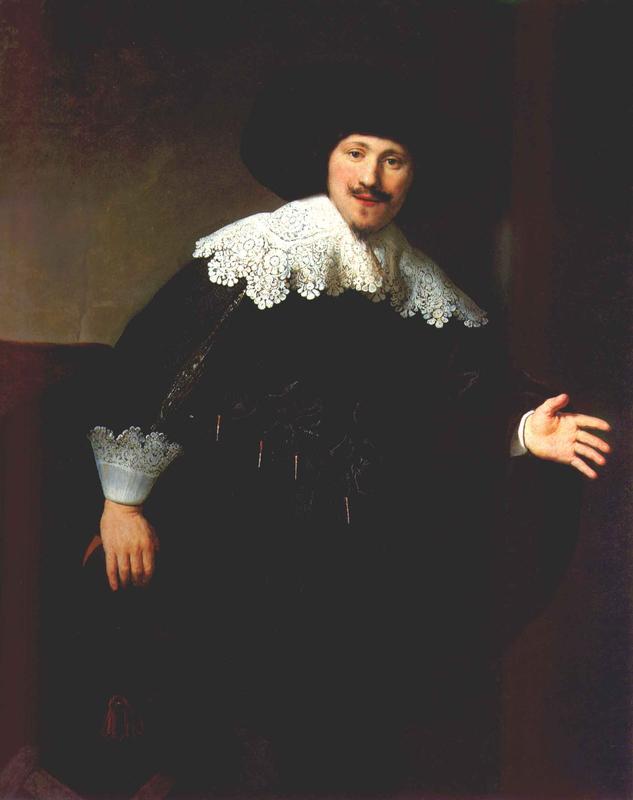
Rembrandt’s “Portrait of a Seated Man Rising from His Chair” stages one of the most subtle dramas in seventeenth-century portraiture: the instant when repose becomes action. The sitter is turned three-quarters toward us, body angled forward with his right hand extended as if greeting a guest or preparing to step into conversation. A broad, lace collar breaks like foam across the black sea of his costume; a felt hat casts a soft eclipse over the forehead; cuffs glitter at the wrist where the hand exits darkness into light. The figure is not frozen but caught mid-transition, and Rembrandt turns that transition into the true subject of the painting.
Composition That Converts Space Into Invitation
The composition is asymmetric and deliberately open on the right, where the man’s extended hand and empty air form a vestibule the viewer can imaginatively enter. On the left, a darker wall and the faint diagonal of the chair back stabilize the figure’s weight. These opposing forces—opening and anchoring—create a hinge at the sitter’s torso. The body leans from a center of gravity that we feel as much as see; the chair is almost unnecessary because the pose itself holds the story of “rising.” The hat’s wide brim builds a horizontal counterbar above the luminous collar, and the mass of black garment gathers beneath like a reservoir, so that the head and hands can glow without being disembodied.
The Moment Between Politeness And Agency
Rembrandt captures a moment of social choreography: the instant a gentleman rises to greet, to speak, or to depart. Nothing is grand; everything is courteous. The right hand opens with an easy arc, fingers relaxed, thumb lifted in a gesture that suggests welcome more than command. The left hand, still near the chair, remembers seatedness even as the torso rejects it. This is the psychology of threshold—an interior self readying to become public. The portrait becomes a meditation on how identity moves through space, not by rhetoric but by a series of small, consequential adjustments.
Chiaroscuro That Reads As Air, Not Trick
Light enters from the upper left, a calm and consistent beam that models the head, collar, and cuffs while allowing the hat and coat to keep their sober depth. The black costume is not a hole; it is a field of tempered blues and browns that drink light variably, revealing sleeve, waist, and skirt in quiet relief. By letting light fall with such unforced logic, Rembrandt avoids theatrical spotlights and achieves a believable room. Chiaroscuro here is not spectacle but atmosphere—the kind of intelligible darkness in which a face and a gesture feel native.
The Lace Collar As Theater Of Brightness
The sitter’s ruff is an engineered brightness whose scallops and openwork turn illumination into music. Rembrandt resists fussy enumeration of each stitch; he orchestrates groups of forms with sharper accents where lace meets shadow and softer notations where folds roll away. The collar’s job is architectural: it lifts the head, frames the face, and provides a luminous shelf from which the gesture of rising can launch. Its complexity is subordinated to the body’s movement, so that the eye reads fabric as support rather than diversion.
The Hands As Instruments Of Intention
Hands carry the painting’s rhetorical force. The right hand is a declaration without insistence, a palm that registers neither demand nor apology. Its modeling is precise where light hits bone and tendon, looser as fingers recede into shadow. The left hand, closer to the body, stays quieter—tucked into the darker plane near the chair, cuff edge glowing like a small comet. Together they plot the itinerary from private thought to social action: gather yourself, offer yourself.
The Hat And The Ethics Of Modesty
The broad black hat serves both costume and conscience. It dampens glare, preventing the forehead from shining with vanity; it presses the gaze downward just enough to avoid brazenness. Rembrandt keeps its surface alive with mild gradations so we feel crown and brim, not a pasted silhouette. The hat turns the head into a contained chamber of thought, a dome of privacy under which expression can remain dignified even in the midst of motion.
The Face In The Middle Register
Rembrandt gives the sitter a warm, responsive face—eyes alert beneath the brim, mouth carrying the hint of a smile. This middle register of expression is his signature in commissioned portraits from the early 1630s: not sternness, not theatrical mirth, but an approachable gravity. The flesh is layered in translucent passages that let warmth appear to come from within; slight cools at jaw and under-eye keep structure sound. The expression implies a person in conversation, not on display, which strengthens the painting’s conceit of rising to meet someone.
A Black Garment That Breathes
Seventeenth-century black could be an abyss; Rembrandt turns it into weather. The coat and doublet are built with long, coherent strokes that describe plane and fall without exhausting detail. Here and there a wet scumble catches a low light; along the sleeve a faint pattern or stitched dot refracts illumination in tiny rhythms. Because the garment is convincing as matter, the movement of the body inside it becomes credible. We believe the sitter has weight, friction, breath.
Architecture Barely There, Yet Persuasive
The room is scarcely described: a strip of wall, the hint of a doorpost or column to the right, the chair back emerging like a dark fin from the sea of garment. This parsimony is strategic. The space serves the act. It grants just enough context to keep the figure from floating, then withdraws, letting the body’s vectors direct the scene. By resisting narrative furnishings, Rembrandt keeps the social meaning of the gesture universal; the man could be rising anywhere hospitality is valued.
The Psychology Of Greeting
The painting teaches the eye to read greeting as a choreography of small parts. The torso leans without hurrying; the feet—though unseen—are implied by the balance of knees and hips; the right shoulder lowers so the hand can open; the head inclines slightly to soften approach. Nothing is forced. The courtesy feels innate, suggesting a sitter whose identity is continuous across moments: seated, he is ready; rising, he is the same person, simply more available.
Early Amsterdam Rembrandt And The Invention Of Lively Portraiture
Painted in 1633, the work belongs to Rembrandt’s early Amsterdam period, when he energized commissioned portraits with narrative touches that remained within decorous bounds. Rather than pose clients as fixed emblems of status, he allows them to breathe—to adjust a glove, tip a hat, turn to meet a voice. This painting is among the clearest formulations of that ambition: movement as the guarantor of life. It satisfied patrons who wanted dignity and artists who wanted truth.
Color As Temperature, Not Parade
The palette is restrained—ebony clothing, milk-white lace, flesh warmed by honey and rose, a background of brownish air—yet within those limits Rembrandt composes a climate. Warm notes gather around cheeks and lips; cooler, greener blacks temper the garment’s masses; the lace holds a spectrum of whites from chalky edge to pearly shadow. Because there is no chromatic shouting, tiny temperature shifts carry expressive weight, and the portrait keeps its timbre of calm readiness.
The Chair As Silent Partner
Though barely visible, the chair is the painting’s silent partner. A sliver of carved back and a lower patch of darker value take responsibility for the action’s plausibility. We understand that a seat is behind the figure, the fulcrum from which he rises and to which he might return. Rembrandt trusts the viewer’s imagination to complete the furniture, reserving paint for the human event. It is a form of respect for the audience: show the necessary, imply the rest.
Edges That Pulse Like Breath
Edges are calibrated to the body’s rhythm. The hat’s brim is crisp against the lighter field, then softens into the darker right; the lace collar bites sharply into the black, then dissolves where it folds under the chin; the outstretched hand holds a firm contour around thumb and forefinger, losing focus along the little finger as it recedes. These decisions prevent the figure from reading as cutout and infuse the portrait with the sensation of shared air.
Gesture As Social Signature
The right hand does not merely move; it signs. Its openness declares a social ease that was prized in Amsterdam’s mercantile republic—a readiness to transact not only goods but regard. In this sense, Rembrandt paints civic character as much as individual likeness. The sitter’s welcome is also the city’s: enter, be met, do business honorably. The portrait turns a private commission into a public emblem without losing intimacy.
The Micro-Drama Of Sleeve And Cuff
At the wrist, where sleeve gives way to lace, a small drama of textures unfolds. Dotted silk or satin catches pinprick lights; the cuff’s starched edge lifts crisp and cool; the hand exits with the warmth of living skin. This triad—fabric, linen, flesh—repeats at collar and hat brim, building a rhythm that carries the eye from point to point while keeping the movement of rising coherent. Rembrandt’s pleasure in such passages is palpable, but he never lets virtuosity eclipse intention.
The Face As Fulcrum Of Trust
For all the sophistication of composition and handling, the portrait’s persuasive power depends on the face’s credibility. It is open, slightly amused, and confident without swagger. The sitter does not sell himself; he is present to receive. That quality of trustworthiness is Rembrandt’s great gift to his patrons and to us. The painting teaches that character can be represented without sermonizing, simply by allowing a person to own his space with grace.
Time Held At The Edge Of Speech
The scene lives in the half-second before words leave the mouth. You can almost hear the intake of breath, the soft scrape of chair legs, the whisper of lace settling. Rembrandt stops time at this fecund instant so that we can examine what makes human interaction humane. He finds dignity in preparation, not just in declaration, and makes the beginning of a greeting equal in weight to grander historical moments.
Why This Portrait Still Feels Modern
Contemporary viewers recognize themselves in the painting’s choreography. We, too, move from private to public dozens of times a day, rising to greet, to present, to engage. The portrait’s refusal of theatrical heroics, its trust in minimal means, and its commitment to truthful light keep it fresh. It is a study in presence rather than performance, and presence remains timelessly compelling.
Closing Reflection On Motion, Manners, And Meaning
“Portrait of a Seated Man Rising from His Chair” condenses Rembrandt’s early mastery into a single, lucid idea: a life is visible in how a person moves through ordinary courtesies. The hat protects modesty; the lace organizes light; the black garment holds gravity; the chair and the room yield just enough context; the hands speak. Out of these elements, Rembrandt composes not a static likeness but an unfolding one, proof that painting can hold motion without blur and character without noise. The moment is small; the recognition is large.