Image source: wikiart.org
Introduction
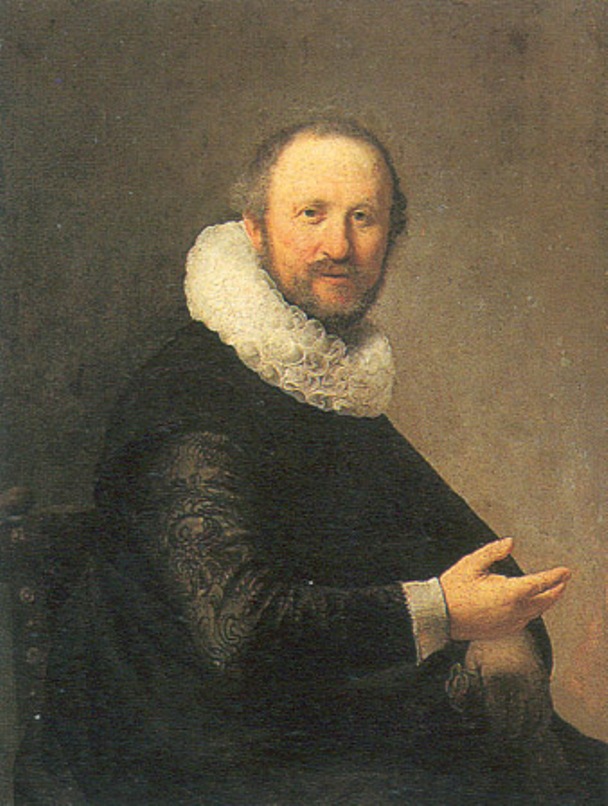
Rembrandt’s “Portrait of a Seated Man” from 1632 presents a poised sitter whose presence unfolds through quiet light, measured gesture, and the tactile play of fabrics. The man sits angled to the right, one hand resting at his midsection and the other open in an inviting, almost conversational pose. A brilliant ruff crowns the shoulders like a halo of lace, while a dark garment—its sleeve subtly patterned—absorbs the surrounding light into a velvet hush. Painted during Rembrandt’s first Amsterdam year, the picture embodies the city’s taste for dignified portraiture and the artist’s growing mastery of psychological immediacy. It is a lesson in how little a portrait needs to say to tell us a great deal.
Amsterdam, 1632: A Portrait Market in Bloom
Amsterdam in the early 1630s was a republic of merchants, magistrates, and guilds whose prosperity generated an appetite for likenesses that affirmed status without ostentation. Black clothing, immaculate linen, and restrained backgrounds were the visual grammar of civic virtue. Rembrandt had just moved from Leiden and quickly adjusted his style to this market. He moderated the theatrical chiaroscuro of his Leiden period into a steadier studio light and polished his surfaces to meet urban expectations while preserving an observational intensity that set his portraits apart. “Portrait of a Seated Man” shows the alliance between patron and painter at its most seamless: the sitter projects sober authority; the artist supplies luminous presence.
Composition and the Theater of the Seat
The seated pose shapes the painting’s calm. Instead of a standing swagger, we find a stable triangle formed by torso, forearm, and open hand. The chair back is scarcely visible, yet its dark upright establishes a vertical counter to the body’s curves. The sitter’s head occupies the upper third, framed by a pale, breathable background that brightens around the face and dims toward the margins. This controlled gradient nudges the figure forward without resorting to harsh contrast. The composition is intimate rather than grand—scaled to the distance of conversation. We feel we have entered a room and been granted a respectful audience.
The Ruff as Architecture and Light Engine
The millstone ruff, rendered with extraordinary delicacy, acts like a small amphitheater of light. Its serried folds catch illumination and send it softly into the face. Rembrandt avoids icy whiteness; instead he mixes cool and warm grays so that the highlights sparkle without detaching from the atmosphere. The ruff’s circular thrust stabilizes the head, while its crisp edge contrasts with the matte depths of the coat. In Amsterdam portraiture, the ruff announced order and cleanliness. Here it does more: it becomes the painting’s optical and architectural cornerstone, a disciplined coronet for the sitter’s thought.
The Sleeve, Pattern, and the Pleasures of Texture
Rembrandt lavishes attention on the right sleeve, where a faint brocade emerges from shadow. The pattern is not loudly declared; it glints and recedes as our eye adjusts to the half-tones. This quiet richness tells us as much about the sitter’s means as any overt emblem would, but it does so with tact consonant with Reformed sensibilities. The cuff, with its cool, starched edge, marks the hinge between garment and hand and gives rhythm to the lower quadrant. Texture becomes character: a person who dresses with care but not display, a person whose refinement is legible only to those who look closely.
Light, Tone, and the Atmosphere of Thought
Light falls from the upper left, striking the forehead, cheek, and the front planes of the ruff, then tapering into gentle shadow along the far cheek and shoulder. The background is a warm neutral, faintly mottled, which allows Rembrandt to sculpt the head with the subtlest value shifts. The result is an atmosphere not of drama but of thought—light as attention rather than spotlight. The face glows without glare; the hands are readable but secondary; the costume withdraws into depth. This hierarchy directs our looking exactly where the painting’s meaning lives: in the sitter’s gaze and the understated eloquence of his gesture.
The Hands and the Language of Gesture
The open right hand is a portrait in itself. Palm turned slightly upward, fingers eased into a natural curve, it suggests conversation, explanation, or welcome. It neither demands nor pleads; it offers. The left arm, less insistent, tucks closer to the body, anchoring the pose and balancing the composition. Rembrandt’s portraits often hinge on such handwork. Here the open palm enacts the sitter’s social role—perhaps as magistrate, merchant, or elder—someone who speaks with measured authority and who explains rather than commands. Gesture becomes ethos.
Face, Features, and Psychological Presence
Rembrandt models the face with layered half-tones that keep the skin tender and alive. The beard and mustache are spared, not overdrawn; tiny strokes catch the wiry edges where hairs meet light. The eyes are steady, with small highlights that animate without sparkling excessively. There is a suggestion of smile in the mouth’s corners, a hint of humor or warmth that cohabits with self-possession. The sitter seems present rather than posed, caught mid-awareness rather than frozen into emblem. This balance between dignity and approachability is the signature of Rembrandt’s early Amsterdam portraits.
The Ethics of Restraint
Everything in the painting champions restraint—limited palette, plain background, controlled gesture. Yet the effect is not austere. Restraint becomes generosity, leaving space for the viewer to complete the person behind the likeness. In a culture that prized modesty, the portrait demonstrates how decorum could coexist with individuality. The man’s identity emerges from tiny departures within rules: the patterned sleeve admitted into an otherwise dark garment, the ruff’s lively edge, the hand that opens a little more than protocol requires.
Color Weighed in Tones
Although color is subdued, it is far from absent. Warm olives and brownish violets circulate through the ground; the blacks of the coat house blue undertones that keep the mass from going dead; the ruff carries honeyed notes among the grays; flesh tones mingle rose, ochre, and a touch of cool green that seats the head within the surrounding air. Rembrandt aligns these colors under a coherent tonality so that the whole reads as a single breath. The portrait is a masterclass in color used to support tone rather than to compete with it.
Brushwork and Surface
The handling in 1632 remains comparatively smooth, yet variety abounds. Dry, slightly dragged paint across the ruff and beard creates a crystalline shimmer, while the sleeve’s pattern is fused into the surrounding dark with softer, more pliant touches. The background, though apparently plain, bears the faint record of broad, leveling strokes that keep it alive. This orchestration of textures translates into a choreography of attention: crisp around the face and collar, gentled over the hands, absorbed in the garment’s depths.
The Seat as Social Ground
The hint of chair back on the left is more than a prop. It grounds the sitter in domestic or civic space, a reminder that portraits like this lived in homes, regent rooms, and guild halls where people read them as statements of belonging. The sitter is at ease on that seat; his open hand suggests he speaks from it. The pose thus implies a social role fulfilled not in battlefield or court but in rooms where deliberation and counsel matter. The portrait persuades us to trust the man we meet.
Comparisons with Other 1632 Portraits
Within Rembrandt’s 1632 output—portraits such as Marten Looten or the young self-portraits—“Portrait of a Seated Man” shares the calm studio light, the disciplined blacks and whites, and the fascination with what a hand can say. Where Marten Looten’s document foregrounds civic paperwork, this painting places rhetoric in the hand alone. The faces rhyme in their lively half-tones and candid gazes, yet each sitter occupies the pictorial space differently: Looten stands, pressing forward; this man sits back, receiving and replying. The contrast reveals Rembrandt’s sensitivity to how posture modulates presence.
Identity and the Limits of Biography
The sitter’s precise identity may be debated, but the portrait secures a truth deeper than names. Rembrandt fixes the unrepeatable geometry of features, the rhythm of light across brow and cheek, the relation between ruff and beard, the way one hand opens and the other rests. These specifics constitute identity in paint—evidence that a particular life sat in a particular light and regarded the world in a particular way. The picture honors the idea that portraiture preserves not only appearance but the feel of being with someone.
Meaning Without Emblem
Many portraits of the era sprinkle symbolic objects—globes, books, instruments—to denote profession or learning. Rembrandt chooses parsimony. He trusts light, face, and a single hand to tell the story. Meaning emerges from the way the sitter inhabits his clothes and space. The open hand performs generosity; the patterned sleeve hints at cultivated taste; the ruff’s discipline speaks of self-command. The painting demonstrates how portraiture can be both simple and rich, its symbols absorbed into the body itself.
Condition, Viewing, and Presence
In works like this, balance depends on the depth of blacks and the crisp warmth of the ruff. When preserved and well lit, the dark garment retains breathable depth rather than flat opacity, and the collar glows with pearly dimension. The optimal viewing distance is conversational—close enough to feel the weave of paint at the ruff’s edge, far enough for the tonal architecture to lock into a single, poised presence. The painting rewards patience; with time, the quietest passages begin to sing.
Legacy and Resonance
“Portrait of a Seated Man” exemplifies why Rembrandt transformed Dutch portraiture. He neither flatters nor chills; he honors civic decorum while delivering a living human being. The picture’s lasting power lies in its equilibrium: public dignity and private warmth, formal clarity and tactile nuance, simplicity of means and depth of presence. It shows how a painter can make a life legible without fuss, allowing light to do the most eloquent talking.