Image source: wikiart.org
Introduction
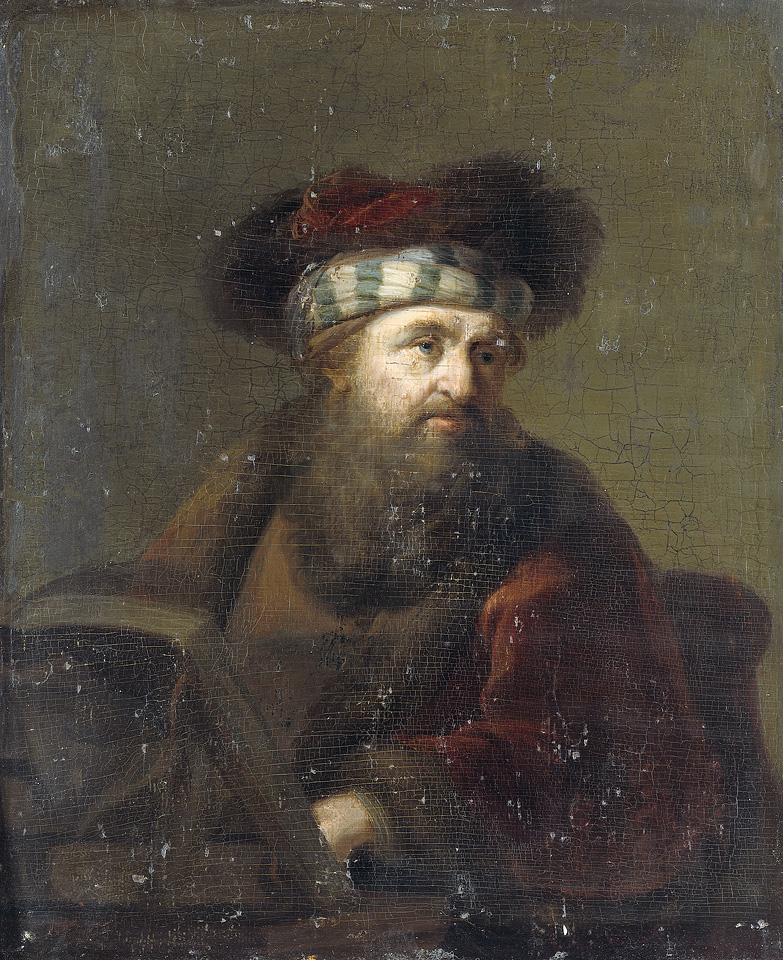
Rembrandt’s “Portrait of a Rabbi” presents a luminous, deeply humane image of learned devotion. The sitter, bearded and wrapped in a heavy robe, turns slightly in three-quarter view beneath a striped headcloth and a dark, plumed cap. He sits at a reading stand whose angled plane enters the picture from the lower left, implying the presence of sacred texts just beyond our sight. Against a subdued olive-brown ground, the face receives a warm wash of light that brings out the planes of the brow and the soft pouch beneath the eye. The painting distills scholarship, age, and spiritual gravity into a single moment of quiet attention. In this analysis, the composition, light, color, brushwork, and iconographic cues all reveal Rembrandt’s distinctive empathy for figures of learning and faith.
Composition That Stages Thought
The composition is a subtle theater of inwardness. Rembrandt anchors the figure along a diagonal from the lower left corner—where the lectern begins—to the illuminated forehead at upper right. This slanted architecture guides the eye from the tools of study to the mind that uses them. The elbow and forearm describe a low triangle that stabilizes the pose and keeps the body grounded, while the head tilts in a shallow counter-curve that lifts the attention back toward the imagined page. The right margin remains a dark reserve, a hush that protects concentration rather than an empty space. Nothing extraneous competes with the face and its immediate companions—cloth, beard, and wood—so that cognition becomes the subject of the picture.
Light As The Language Of Reverence
Rembrandt’s light carries the moral tone of the painting. It reaches the sitter obliquely, glancing across the brow ridge, the bridge of the nose, and the upper cheek before dissolving into the tawny depths of the beard and robe. A small highlight collects on the inner corner of the eye, where moisture makes a pinprick of brightness. The headcloth’s pale stripes catch lower, cooler light and send it back toward the face, so that illumination seems to arise from within the scholar’s sphere. Shadows are gentle and breathable; they never swallow the sitter, but enfold him, converting the background into a chamber of contemplation. This is not theatrical chiaroscuro—it is a reverent clearing of visual space around a mind at work.
The Reading Stand And The Page Beyond The Frame
The angled reading stand in the foreground is more than furniture; it marks the presence of study without forcing the text into the viewer’s gaze. We do not read over the sitter’s shoulder. Instead, we are placed beside him, slightly lower, like a student or a visitor welcomed into the study. The stand’s oblique plank becomes a visual runway that brings us inward, and the dark seam where its edges meet the table echoes the furrows in the beard. Material parallels like these bind object and figure together, reminding us that scholarship is embodied—hands, eyes, paper, wood, and lamp-like light.
Palette, Temperature, And Tonal Calm
The palette is a resonance of earths: warm umbers and siennas in the robe and beard; olive and bark-brown in the background; a tempered brick red blooming in the sleeve; cool gray-whites in the striped headcloth. Because color saturation is moderate, temperature and value do most of the expressive work. Warm notes pool where life pulses—cheek, temple, knuckle—and cooler notes temper the outer mantle and background, ensuring restfulness. The overall harmony is low and steady, like a viol in a quiet room. That sonic metaphor is intentional, for Rembrandt uses color not to decorate but to sustain a mood of meditative continuity.
Fabric, Fur, And The Tactility Of Study
The robe’s heavy nap is described with dragged, fibrous strokes that catch light in shallow ridges, creating the sensation of worn, warm material. The headcloth receives a different touch: thinner paint, calligraphic bands, and small scumbles that imply weave rather than count threads. Beard and hair merge with robe and shadow in places, then separate again where a flick of a loaded brush lays a shining strand across darkness. Rembrandt allows matter to remain matter. The painting seems to say that piety lives in textures as much as in texts—the roughness of cloth, the weight of wool, the cool wood under the wrist.
The Face As A Field Of Experience
The sitter’s face is frank and sympathetic. A broad forehead with thinning hair testifies to time spent thinking; the eyelids rest heavily but not sleepily; the lower lids puff slightly as if from long hours of reading. The nose is strong yet softened by warm light; the mouth withdraws without bitterness. Rembrandt’s sympathy reveals itself in the way transitions are handled: no ridge or crease becomes a caricature, and no imperfection is hidden. The artist studies the person before him as one scholar contemplates another—patiently, without haste, believing that truth lies in careful attention.
Psychology Without Rhetoric
The portrait does not try to dramatize holiness or intellect through exaggerated gesture. Instead, it shows what reflection looks like when unperformed. The head is tilted by the smallest degree, as though the sitter were in the midst of thinking through a line of commentary and turned, briefly, as if to listen. The eyes neither challenge nor avoid the viewer; they acknowledge and then return inward. This balanced bearing produces a welcome paradox: the sitter is intensely himself and yet quietly representative of learned elders across centuries. We can imagine him as a rabbi, as the title suggests, but also as any teacher who has spent a lifetime reading, judging, and guiding.
The Headcloth, Feathers, And The Poetry Of Non-Specific Time
Rembrandt’s costume choices often float between historical eras. The striped headcloth and dark plume provide a broad cue of Eastern and learned dress without tying the sitter to a single decade or locale. This non-specificity is not evasive; it is generous. It keeps the portrait legible as a picture of religious scholarship while preventing it from shrinking into a mere fashion plate. The picturesque cap, with its soft, dusky feathers, adds a passage of loose, lively brushwork to counterbalance the quiet monumentality of the robe. These accents act like grace notes in a slow movement.
Space, Silence, And The Ethics Of Restraint
The background is a soft, olive-toned field that refuses to declare architecture. By withholding walls, windows, or shelves of books, Rembrandt permits the figure to carry the whole narrative. Silence becomes a compositional element. That silence is ethical as well as aesthetic. It keeps the sitter from becoming a vehicle for the painter’s virtuosity; it gives him room to exist without spectacle. We meet a person, not a display. In a broader cultural sense, such restraint honors the dignity of religious life, which often occurs outside of public performance.
Brushwork And The Intelligence Of Paint
Across the painting, Rembrandt varies pressure, load, and speed to evoke tactile realities and mental states. On the face, small, semi-opaque touches knit together to form living half-tones; on the robe, longer, dragged strokes leave embers of light along their ridges; on the headcloth, quick linear dashes describe warp and weft; in the plume, a few hungry dry-brush arcs breathe air into the feathers. Thin glazes warm the cheek and cool the temple, while more buttery passages along the nose and brow catch real light and return it to the room. Paint is allowed to show its appetite and its mercy—qualities that echo the sitter’s own mixture of discernment and kindness.
Iconography And The Scholar’s Vocation
Although no explicit textual emblem is visible, the painting carries unmistakable signs of learning and faith: the lectern; the enveloping robe; the meditative posture; the gentle but firm cast of the eye. The title “Portrait of a Rabbi” may have been assigned later, yet it resonates with the image’s ethos. Rather than present a cleric in official regalia, Rembrandt gives us a learned elder in the workshop of thought. The emphasis rests not on authority as power but on authority as responsibility—the responsibility to read well, to judge fairly, and to speak with care.
Humanism At The Core Of Devotion
Rembrandt’s art is often described as profoundly humanist, and this painting exemplifies that quality. Devotion here is not theatrical ecstasy but concentrated humanity. The scholar’s mind is honored by the way his body is painted—flesh warmed by light, clothing thick enough to work in, hands capable of turning pages and holding ideas. The human is not a distraction from the sacred; it is the place where the sacred becomes visible. In this union of matter and spirit, the portrait offers its most contemporary lesson: dignity is granular, living in the details of how we regard one another.
The Viewer’s Position And The Work Of Looking
Rembrandt seats the viewer at a respectful oblique, neither frontal nor furtive. We are invited into the space of study without being asked to intrude. The angled stand gives our eye a path; the diagonal of the arm halts us at the threshold of the book; the turn of the head returns us to the face. This choreography urges a pace of viewing akin to reading: move forward, pause, reconsider, return. The painting is itself a teacher of attention, and by following its cues we learn to look slowly enough for meaning to gather.
Comparisons Within Rembrandt’s Oeuvre
“Portrait of a Rabbi” converses with Rembrandt’s many scholars and apostles, his images of St. Paul with quill in hand, and the late portraits where the artist studies age with incomparable sympathy. In those works, book and page often play major roles; here, the mere intimation of a text suffices. The soft pyramid of light around the head recalls several late self-portraits, where character rather than costume is sovereign. The warm, saturated shadowing relates to his Jewish neighborhood portraits and to the tenderness he brings to depictions of Simeon or St. Peter, suggesting a consistent ethic: intellectual and spiritual labor deserve a generous light.
Time Written In The Surface
The varnish, craquelure, and worn passages visible across the picture tell another story—that of a painting that has lived, been handled, and endured. Far from diminishing the effect, these marks of time correspond to the sitter’s lived texture. They remind us that paintings, like people, acquire histories on their skin. The work’s present condition, with its softened edges and slightly muffled darks, amplifies the mood of seasoned experience that the portrait communicates.
Theological Ambience Without Insistence
The painting’s spiritual mood is unmistakable yet unforced. There is no halo, no overt miracle—only the steady warmth of light over a face given to thought. For viewers of faith, the portrait will read as a companion image to prayer and study. For others, it will stand as an affirmation of attention as a human value in its own right. Rembrandt’s genius lies in making a room where these readings can coexist without strain.
How To Look, Slowly
Begin at the forehead’s bright arc and drift down the brow to the small highlight nested in the eye. Trace the bridge of the nose to the shadowed wing and feel it dissolve into the beard. Move across the cheek where warm glaze meets cooler half-tone, then descend to the elbow and along the reading stand to the lower left. When you look back, the face will seem newly alive, brighter for having traveled through the robe’s earth and the book’s wood. Repeat this circuit and the portrait will unfold like a paragraph read aloud—steady, persuasive, full of quiet authority.
Conclusion
“Portrait of a Rabbi” is a model of Rembrandt’s mature virtues: compositional tact, a light that behaves like compassion, a palette that warms without boasting, and a brush that tells the truth of matter while protecting the dignity of the sitter. It honors scholarship without turning it into spectacle and spirituality without removing it from the human. In its calm balance of presence and privacy, the painting offers an image of learned devotion that feels as contemporary as it is historical. We leave the picture with the taste of its silence—a silence that is not emptiness, but the living space in which thought and faith can breathe.