Image source: wikiart.org
A First Meeting With a Poised Presence
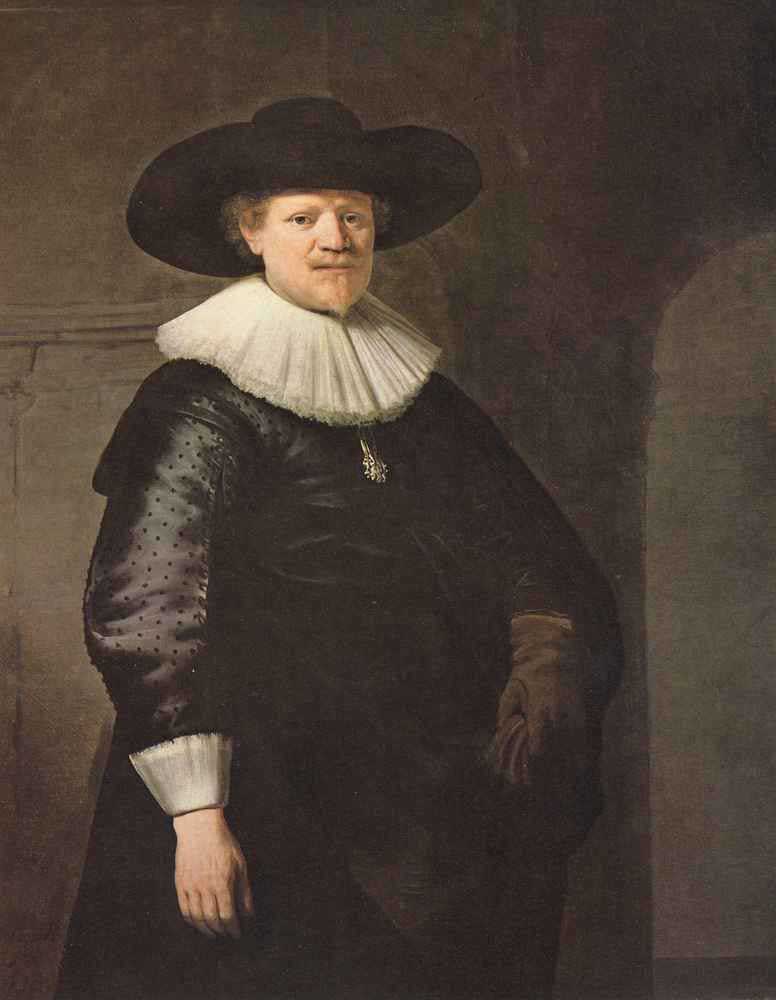
Rembrandt’s “Portrait of a Man (possibly the poet Jan Harmensz Krul)” presents a figure of sober assurance framed by the disciplined grandeur of Dutch fashion in the early 1630s. The sitter stands three-quarter length against a reserved architectural backdrop, his wide-brimmed hat casting a gentle eclipse across his brow, his immaculate ruff erupting in crisp white pleats, and his black satin ensemble gathering the room’s light into a soft, lustrous tide. The hand at left drops in relaxed readiness while the right forearm, gloved, rests at his hip, a gesture of possession and composure. Rembrandt designs the encounter as both introduction and demonstration: we are introduced to a particular person and shown how light, cloth, and paint can cohere into authority without noise.
The Architecture Of The Composition
The canvas is organized with the clarity of a sonnet. A near-vertical axis runs through the head, ruff, and torso, stabilized by the hat’s black disk and anchored by the garment’s dark mass. A quiet counter-rhythm moves diagonally from the left hand to the gloved right, returning the eye to the pale face. The background—bare stucco and a shadowed passage—functions like stage architecture, implying a civic interior without distracting detail. Rembrandt keeps figures and ground in a steady conversation: the sitter occupies space rather than floats before it, and the space breathes enough air to keep the portrait from feeling sealed.
Light As A Measured Authority
Light falls from high left, a calm beam that polishes the ruff into a fan of brilliance, warms the forehead and cheek, and crawls in small pearls across the satin sleeve. This is not theatrical illumination; it is judicial. It describes the truth of surfaces and the dignity of presence without exaggeration. The hat’s underside compresses values over the eyes, preserving privacy while letting the gaze remain lucid. The result is a portrait that feels lived-in: a person in a room, not a figure pasted into darkness.
The Wide-Brimmed Hat As Canopy And Counterweight
The hat is a compositional canopy that unifies the upper field. Its generous brim establishes a horizontal counterweight to the vertical torso, and its velvet shadow concentrates light on the face and ruff. Rembrandt avoids flattening the hat into a single void; he aerates it with subtle gradations that reveal crown and brim as physical volumes catching diffuse light. The hat’s dignity is not ornamental—its restraint teaches us how to see the whole painting, with emphasis on order rather than display.
The Ruff As Sculpted Light
The starched linen ruff is a small architecture of light and shadow. Each pleat is a rib that lifts brightness forward and tucks cool greys into its folds. Instead of fussing over every channel, Rembrandt orchestrates the forms in broad, legible groups, sharpening edges where they meet the black doublet and loosening them as they roll toward shadow under the chin. The effect is sculptural vitality: the ruff supports the head like a pedestal of bright air, while also bouncing illumination up into the lower face.
Black Satin And The Poetry Of Restraint
The garment is a rehearsal in how black can be chromatic. Tiny constellations of highlights stud the sleeve, describing a patterned fabric whose surface catches light in disciplined points. Across the torso, long, low-value strokes articulate planes without breaking the garment’s unity. The black reads not as absence but as depth, layered with cool blues, plum undertones, and quiet browns. In this sea of controlled darkness, the ruff’s white and the flesh’s warmth stand out with consequential clarity, exactly as Rembrandt intends.
The Hands As Signatures Of Character
Hands announce temperament. The left hangs unforced, fingers slightly bent as if a conversation has paused; it speaks of ease within formality. The right hand, encased in a glove, rests at the hip with understated assertion. The glove is not merely accessory; it signals readiness to enter or leave, a portable threshold between public and private. Rembrandt paints both hands with economy, reserving crisp attention for knuckles and glove seams while letting the rest dissolve into atmospheric suggestion. The balance suggests a sitter confident in his boundaries.
Face, Expression, And The Middle Register Of Feeling
The face is composed without stiffness. Lips gather into a small, firm line that avoids severity; the eyes, level and attentive, meet ours with civility. There is no dramatic smile, no manufactured gravitas. Rembrandt works in the middle register of feeling, where humanity is most legible: a person addressed, returning attention. Subtle salmon tones animate cheek and nose, cooler greys support shadowed planes, and micro-highlights at the lower eyelid’s moist rim keep the gaze alive. The painter’s refusal of spectacle allows intelligence to register without theater.
Costume As Social Language
Every element of dress carries social meaning in 1630s Amsterdam. The wide-brimmed hat and ruff belong to a civic vocabulary of respectability; the satin speaks of means; the glove and pendant add nuance without ostentation. If the identification as Jan Harmensz Krul is correct, the attire signals a poet who participates fully in urban decorum while pursuing art. Rembrandt translates that social code into paint with scrupulous respect, neither fetishizing fabric nor minimizing its communicative role. The sitter is not drowned by costume; he is contextualized by it.
The Pendant And The Point Of Bright Emphasis
A small pendant drops at the sternum, catching light like a punctuation mark in the long sentence of black. Its metal spark is precisely scaled—enough to hold a moment’s attention, not enough to steal it. This single bright point anchors the torso and quietly affirms the sitter’s standing. Rembrandt often uses such studied accents to modulate the viewer’s path through the image, insuring that attention returns to the face after grazing the garment’s pleasures.
The Psychology Of Pose And Turn
The body’s oblique turn away, with the head returning toward the viewer, establishes a dynamic without melodrama. It suggests interruption—someone called by name, turning with polite readiness. The shift lets the garment’s volumes perform their slow choreography while the mind remains the true center. This is portraiture as conversation, not display; the sitter offers presence rather than performance.
The Background As Room For Breath
The background’s planar architecture—bare wall, faint molding, and the suggestion of a recess to the right—supplies depth and breath. The space holds the figure at human scale and opens a corridor of air that prevents the black ensemble from crushing the picture’s atmosphere. Rembrandt’s backgrounds in 1633 are often modest theaters for light; here, the offstage void to the right swallows shadow just enough to make the sitter’s lighted presence more decisive.
Technique That Records Decisions Rather Than Tricks
Close viewing reveals a surface where decisions are legible. In the ruff, loaded impastos mark crisp edges; in the satin, thin glazes admit the canvas’s tooth to simulate sheen; in the hat, scumbles soften transitions around the crown. Brushwork is not the subject, but it is the vehicle for truth: different touches for different textures, all subordinated to a unified tone. The painting shows confidence without bravura for its own sake—an ethic that keeps character primary.
The Early Amsterdam Moment And Rembrandt’s Ambition
The year 1633 finds Rembrandt newly established in Amsterdam, winning commissions with a blend of psychological acuity and material splendor. He relishes costume and light but refuses to let them dethrone personhood. This portrait exemplifies the balance: outer polish, inner calm. Whether the sitter is Krul or another prosperous citizen, the artist delivers what the city prized—dignity, clarity, and a persuasive likeness—while also imprinting his own philosophy of seeing: describe what is there, admit air, respect mystery.
The Hat’s Shadow And The Mercy Of Omission
The partial shadow cast by the brim protects the sitter from overexposure. It keeps the forehead’s planarity from blaring and gives the eyes a chamber where glints appear meaningful rather than decorative. Elsewhere, Rembrandt practices a similar mercy of omission. He does not count every pleat; he does not narrate every seam; he suggests what the mind already knows. This restraint grants the viewer’s imagination an honorable role and prevents the portrait from turning into an inventory.
The Rhetoric Of Black And White
The image is essentially a duet between black and white. The black carries depth, weight, and civic sobriety; the white carries cleanliness, clarity, and order. Flesh mediates, warming both into life. By anchoring the composition in this duet, Rembrandt speaks in a language his patrons understood—a Calvin-inflected aesthetics where restraint is the stage for virtue—while still allowing rich painterly effects to satisfy the eye.
Gesture Of The Glove And The Social Body
The gloved right hand does more than punctuate fashion. It is a metaphor for the social body—the self armored for public contact, tactful, measured, and ready to step into the street. The ungloved left hand, pale and relaxed, hints at private ease within public form. Rembrandt often composes such small dialectics to give portraits a psychological undercurrent: the person who lives within the citizen, the private life inside the uniform of civility.
The Face As Quiet Fulcrum
For all the pleasures of hat, ruff, glove, and satin, the face remains the quiet fulcrum. Rembrandt stabilizes the entire design around its calm geometry. The cheek’s subtle round, the mouth’s measured line, the eyes’ middle focus—these are the “soft centers” that make the rest intelligible. The painting is less a fireworks display than a tide, rising and falling from this steady shore of personhood.
A Possible Poet And The Imprint Of Mind
If the sitter is indeed Jan Harmensz Krul, the portrait’s composure takes on literary resonance. The clarity of gaze, the modest reserve, the ordered dress—these become the outward grammar of a mind tuned to measure and cadence. Even without confirmed identity, the suggestion is apt: Rembrandt paints a man whose quiet suggests interior weather, someone comfortable letting thoughts arrive before words.
Why The Portrait Feels Contemporary
Modern eyes meet this figure with immediate recognition because the painting privileges presence over trophy. It avoids aristocratic theater and instead offers a person in enough formal costume to declare context but not enough to command the scene. The palette’s restraint, the light’s honesty, and the refusal to over-explain revive a standard of dignity that reads freshly today. The work models how representation can honor a self without consuming it.
Closing Reflection On Rembrandt’s Art Of Measured Grandeur
“Portrait of a Man (possibly the poet Jan Harmensz Krul)” distills Rembrandt’s early philosophy of portraiture: splendor disciplined by conscience, resemblance animated by air, and authority expressed through light rather than noise. The hat shelters mystery; the ruff organizes brightness; the black satin absorbs the room’s weather; the hands register ease and readiness. Above all, a face meets ours without tactics. The painting does not demand admiration so much as invite respect, which is the more durable achievement.
