Image source: wikiart.org
Introduction to an Enigmatic Early Portrait
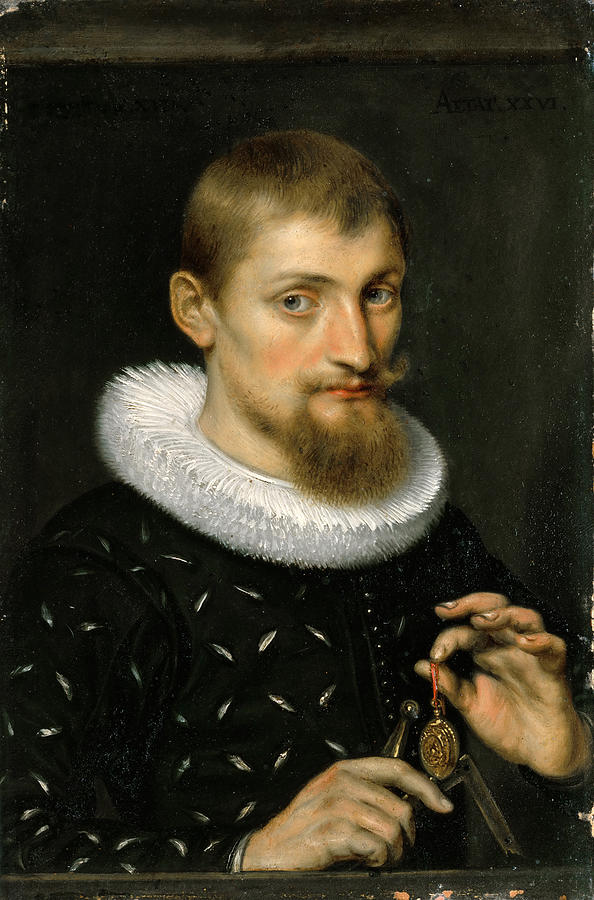
“Portrait of a Man, Possibly an Architect or Geographer” (1597) stands among the most intriguing works of Peter Paul Rubens’s youth. Painted in Antwerp just before the artist’s decisive Italian sojourn, it captures a young professional whose instruments and bearing hint at architecture, surveying, or cosmography. Rather than staging a grand allegory, Rubens uses quiet means—velvety light, poised gesture, and cool psychological distance—to announce his command of portraiture at the cusp of the Baroque. This early likeness is not merely a record of face and fashion. It is a study in intellectual identity, a compact essay on how tools, textiles, and touch can articulate a life of the mind.
Composition and the Stage of the Half-Length Portrait
Rubens frames the sitter as a half-length figure against a deep, neutral ground. The head occupies the upper third, turned three-quarters toward the viewer, while the hands enter from below to animate the foreground ledge. The composition is pyramidal in essence—head as apex, shoulders as base—and stabilized by the crisp oval of the ruff. Within this quiet geometry, Rubens choreographs a delicate counterpoint of diagonals. The right hand delicately presents a medal or medallion suspended by a red cord; the left hand steadies a divider or compass that angles toward the lower right. These diagonals guide the eye in a gentle loop: from the sitter’s frank gaze to the bright ruff, down to the gilded disc, across the glinting instrument, and back up the sleeve to the face.
The background is a vaporous darkness rather than a defined interior. By refusing architectural context, Rubens ensures that the tools and the body carry the narrative. The result is a portrait that feels at once private and emblematic—a man suspended in a reflective moment, defined not by his environment but by what he holds.
Light, Shadow, and the Illusion of Presence
Illumination falls from the upper left, modeling the planes of forehead, nose, and cheek with creamy transitions. The light is not theatrical; it is calibrated to reveal personality through texture. Skin glows with a living translucency, especially around the ear and the bridge of the nose, where thin glazes suggest blood beneath the surface. The beard is articulated with succinct, calligraphic strokes that lift slightly against the light, giving the hair real tactility. The ruff, a feat of controlled bravura, captures light in its pleated edges and bounces reflections onto the jawline, separating head from ground without the hardness of a drawn contour.
On the dark doublet, small elliptical highlights pick out a woven, tufted pattern. Rubens resists over-description: he gives enough glints to convince, then lets the eye complete the cloth. The divider’s metal legs catch pinpoints of light, while the gold medal, warmer and more saturated than anything else on the panel, becomes a visual anchor. Everything is organized to make the sitter appear almost touchable, yet slightly reserved, an effect that underscores the intellectual poise of the subject.
The Psychology of the Gaze
The sitter’s eyes look not quite straight at the viewer but slightly past, a classic portrait strategy for suggesting contemplation. The mouth is closed, the lips thin, with a faint upward tension that can read as self-control rather than smile. This restraint is characteristic of Northern portraiture, yet Rubens inflects it with warmth. The slight softening at the corners of the eyes, the alertness of the eyebrows, and the relaxed placement of the hands suggest a person used to exact thinking but not without human ease. The portrait thereby avoids caricature of the scholar as stern and aloof. Instead, it offers a meditation on concentration at rest—a mind between calculations.
Identity Through Objects: Architect, Geographer, or Both
The most conspicuous attributes are the divider or compass and the hanging medal. A divider is the great polyvalent sign of measure: indispensable to architects for drawing plans, to surveyors for taking bearings, to mathematicians for geometry, and to cosmographers for charting celestial and terrestrial relationships. In the sixteenth century, the same instrument stood at the crossroads of science and craft, emblematic of a new confidence that the world could be grasped by number and proportion. Held casually but knowingly, it communicates practiced skill rather than borrowed symbolism.
The medal, gently presented rather than worn, invites interpretation. Medals in this period often commemorated patrons, learned societies, or rulers; they could also bear personifications of virtues or allegories of knowledge. Its presentation implies affiliation: the sitter shows what he belongs to or honors—perhaps a guild of surveyors, a civic commission, or a patron who made professional work possible. The red cord adds a note of ceremony and hierarchy. Whatever its exact inscription, the medal operates as a second signature beside Rubens’s own, a seal of standing within an educated milieu.
Fashion, Status, and the Language of Textiles
Clothing in this portrait speaks fluently. The high, starched ruff, rendered with crisp penumbra and cool highlights, was a costly and time-consuming accessory, signaling prosperity, cleanliness, and urban sophistication. The doublet’s dark, glossy fabric—likely black silk or a wool-silk blend—was fashionable and expensive in the Low Countries, where black signified sobriety and wealth. The discrete pattern of embroidered or cut details across the garment offers a rhythm of light that keeps the torso from flattening into shadow. Rubens is attentive to the sociological message: this is a man of means, educated, perhaps officially appointed, whose profession requires both precision instruments and the public performance of respectability.
Hands as Instruments of Thought
Rubens famously loved painting hands, and in this work they become secondary portraits. The right hand’s thumb and forefinger pinch the medal’s cord with absolute control—no strain, no flourish—suggesting habitual handling of delicate things. The left hand cups the divider at its hinge, not by the points or legs, in a way that an experienced user would grip it while pausing to think. The fingernails are trimmed and clean. Subtle veins and tendon shadows describe an anatomy trained to careful work. Through the hands, the portrait communicates that intellect here is tactile, not abstract—thinking through measuring, grasping, and presenting.
An Early Rubens Between Mannerism and Naturalism
Dated 1597, the painting surfaces at the seam between Northern Mannerism and the emergent Baroque naturalism that Rubens would help lead. The proportions are elegant; the head is slightly elongated; the features are refined. Yet the modeling is already supple, the flesh convincingly alive, the textures responsive to light. The background’s subdued atmosphere allows the sitter to expand into real space rather than remain a decorative silhouette. Rubens learned from local masters who prized clarity of design and polished finish, but he is already softening edges, blending halftones, and orchestrating a chromatic unity that belongs to Venice as much as to Antwerp. This tension—design versus sensation—gives the portrait its vibratory life.
The Ethics of Measurement and the Humanist Ideal
The portrait’s iconography echoes a broader humanist ideal: knowledge disciplined by measure. In the sixteenth century, architecture and cosmography were not merely practical trades; they carried moral claims. The compass embodied order, ratio, and the belief that the world is intelligible. By aligning the sitter with instruments of measure and a medal of affiliation, Rubens presents a civic humanist: a person whose private skill benefits public life by shaping buildings, mapping territories, or advising on infrastructure. The ruff’s cleanliness, the poised hands, and the controlled gaze all reinforce an ethic of precision and responsibility.
The Medal as Narrative Pivot
While small, the medal concentrates much of the painting’s narrative pressure. Rubens positions it against the darkness so that it reads clearly without overwhelming the face. Its circular perfection answers the divider’s geometry, and the red cord injects a pulse of warm hue into the otherwise cool orchestra of blacks and whites. The sitter does not wear the medal; he shows it. That decision transforms the portrait from simple likeness to declaration. The man is saying, in effect, this is the measure by which I live or the community to which I pledge my skill. The image thus becomes a compact performance of loyalty and expertise.
Texture, Paint Handling, and Workshop Intelligence
The picture reveals a young painter already confident in differentiating textures. Skin receives thin, breathable layers that let undercolor warm through; hair gets short, directional strokes; the ruff uses crisp hatchings over darker underpaint to sculpt edges; the doublet is built with small, loaded touches that catch the light like thread knots. The background is thin and smoky, a foil that can be adjusted rapidly to set the figure forward. Such economy suggests workshop intelligence: Rubens already knows where to spend labor and where to imply. The paint handling conveys not only representation but time management—the awareness of how to achieve maximum effect with controlled effort.
The Silent Ledge and the Tradition of the Painted Frame
At the bottom, a narrow ledge functions like a fictive frame. The sitter’s hands and tools rest upon or project over it, establishing a threshold between picture and viewer. This device, inherited from Netherlandish portraiture, intensifies presence and invites a sense of encounter. It also has thematic force: the ledge is where thought becomes action, the place where mind meets the world in instruments, medals, and touch. Rubens uses the ledge to remind the viewer that the sitter’s knowledge is not sequestered; it leans outward into civic life.
Antwerp and the Culture of Measurement
Antwerp in the late sixteenth century was a nexus of trade, cartography, and print culture. Mapmakers, instrument makers, and architects shared workshops and patrons; mathematicians wrote manuals for artisans; merchants demanded accurate charts and measured plans. Within this milieu, a portrait advertising mastery of measurement would be legible and prestigious. Whether the sitter is an architect responsible for façades and fortifications, a geographer engaged in mapping, or a learned surveyor involved in property and water management, his identity resonates with the city’s economy and intellectual heartbeat. Rubens, ever attuned to the aspirations of patrons, encapsulates that civic pride in a single poised figure.
Comparisons to Later Rubens Portraits
Rubens’s mature portraits often swell with richer color, grander settings, and broader handling, yet the seed of his later achievement is clearly visible here. The psychological directness, the nuanced hands, and the care for textiles anticipate later likenesses of diplomats, scholars, and nobles. What differs is the register of voice. In 1597, Rubens speaks in a measured mezzo piano rather than in the operatic crescendos of the 1620s and 1630s. The restraint suits the subject: an intellectual whose prestige rests on exactitude rather than spectacle. That fitness of style to sitter is already one of the artist’s gifts.
The Rhetoric of Modesty and Self-Presentation
The portrait constructs a paradox of modest display. The sitter is richly dressed but not ostentatious; he presents a medal but does not flaunt a chain; he shows a divider but does not brandish it. Even the ruff, though crisp, stays within sober scale. This rhetoric of modesty would have been culturally valued. It communicates trustworthiness and competence—qualities crucial for professions that handle money, measure land, or plan structures. Rubens calibrates every cue to project dependable authority rather than aristocratic splendor.
Time, Youth, and the Inscription of Age
The sitter appears in his twenties, with a neatly trimmed beard and hair cropped short. In some early portraits of the period, inscriptions of age or date appear near the top edge. Whether or not such a marking exists on this surviving version, the painting itself functions as an age inscription: the bloom of skin, the directness of eye, and the nervy energy of the hands communicate youthful mastery. Rubens, himself a young artist, likely felt affinity with this poised beginning—the sense of career at the threshold, identity carefully assembled, future achievements implied.
The Space Between Science and Art
What makes this portrait unusually modern is the shared territory it maps between scientific practice and artistic representation. The divider, a tool for drawing exact lines, is here depicted with painterly sensitivity; the medal, a minted object of relief and profile, becomes a tiny theater of light. Conversely, the painter borrows from the sitter’s world: he measures proportions, calibrates tones, and constructs harmony through ratio. The portrait thus stands as a self-reflexive statement about the unity of making—how the disciplines of art and architecture, painting and geography, converge in the act of measured attention.
Conservation, Condition, and the Pleasure of Close Looking
The panel’s dark ground and high-contrast textiles make conservation especially important, since later varnishes can dull the subtleties of black-on-black modeling. When well preserved, the painting rewards proximity. Minute transitions around the eyelids, the slight rosiness beneath the beard, the hairline’s soft irregularity, and the delicate break of light on the medal’s rim all confirm an artist engaged in micro-decisions. The portrait encourages slow viewing: the longer one looks, the more one discovers small negotiations between abstraction and description that give the image its living quality.
Legacy and Contemporary Relevance
Although rooted in a specific professional culture, the portrait speaks across centuries. It stages a question still relevant today: how does one present a life of expertise to the public? The sitter answers with measure, affiliation, and composure. In an era that often confuses visibility with value, Rubens’s early portrait suggests a different ideal of professional identity—quiet mastery articulated by tools, touch, and the integrity of gaze. The work remains compelling because it offers neither boast nor mystery for its own sake, but a lucid account of what a disciplined life looks like.
Conclusion: A Young Master’s Likeness of Measured Intellect
“Portrait of a Man, Possibly an Architect or Geographer” condenses Rubens’s early brilliance into a clear, resonant statement. The painter composes a world from darkness, dives into texture with economical touch, and constructs character through the choreography of eyes and hands. The sitter, poised between tool and medal, becomes an emblem of ordered knowledge at the threshold of the seventeenth century. Long before Rubens orchestrated vast mythologies and court pageants, he mastered the intimate theater of a single human presence. In this painting, he honors the dignity of craft and calculation, showing that the measure of a person can indeed be rendered in light, cloth, and the calm geometry of a compass held just so.