Image source: wikiart.org
Introduction
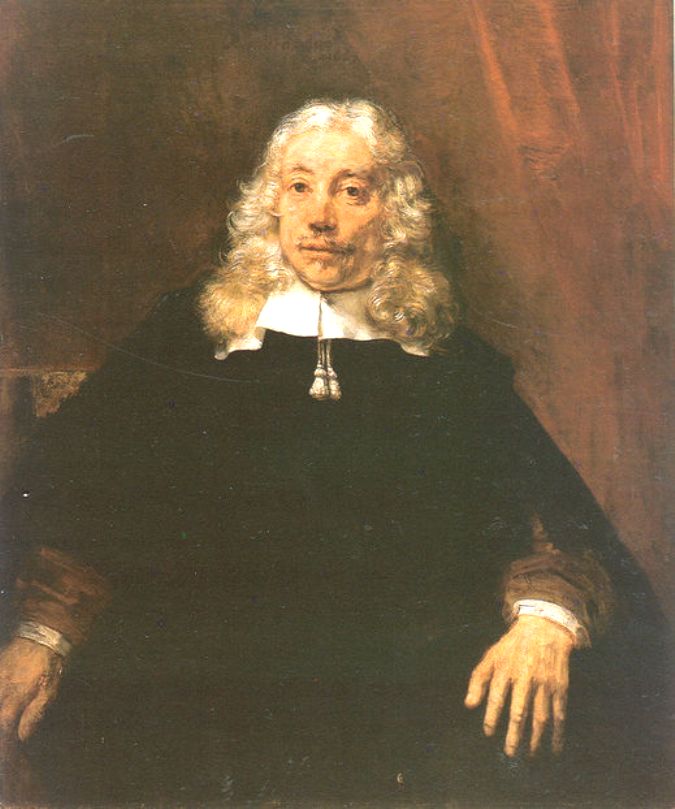
Rembrandt’s “Portrait of a Man” from 1667 stands among the distilled achievements of his final years, when costume, setting, and description recede so that inward life can come forward. The sitter appears seated, turned slightly toward us, his long silver hair falling over a brilliant white collar that interrupts the mass of a dark coat. A warm curtain arcs behind the head like an abstracted backdrop; the hands, especially the right, descend toward the lower edge with a frankness that commands attention. Nothing clamors, yet everything matters. The painting is less a display of status than a meditation on presence: how a body occupies space, how light places thought upon a face, how age writes itself into the texture of skin and the grain of paint.
Late Style And Historical Moment
By 1667 Rembrandt had survived bankruptcy, personal loss, and the vicissitudes of taste. Fashionable portrait commissions in the slick, courtly manner had largely passed him by. What remained—and what intensified—was his commitment to truth-telling through paint. The late canvases abandon glitter in favor of value, temperature, and touch; they prefer intimacy to proclamation. “Portrait of a Man” exemplifies this late ethic. The sitter, likely a prosperous burgher or learned professional, wears the sober black that signals dignity in the Dutch Republic, but Rembrandt’s interest lies in the human life inside the garment. He chooses a pose of ease rather than ceremony, allowing the head and hands to speak with unforced authority.
Composition And The Architecture Of Presence
The portrait is constructed on a simple, powerful geometry. The head sits near the upper center beneath the soft canopy of the drapery, while the torso spreads into a dark, triangular mass that anchors the figure in the chair. The hands create a secondary base, the left tucked back in shadow and the right descending boldly toward the viewer. This structure produces a stable pyramid, yet it avoids stiffness because Rembrandt curves the curtain and lets the long hair flow, generating gentle rhythms that soften the geometry. The sitter’s right shoulder drops slightly, tilting the axis and lending the pose a human, unposed quality. The design feels inevitable, as if the man has fallen into his natural arrangement and the painter has simply honored it.
Light, Shadow, And The Ethics Of Illumination
Light in this painting functions like a tactful conversation partner. It arrives from the left, touching forehead, cheek, nose, and the luminous collar before withdrawing into a velvety dusk that swallows coat and chair. The warm curtain behind the head catches enough light to frame the face without competing with it. This hierarchy is moral as well as optical. Rembrandt concentrates brightness where character resides—the thinking brow, the listening eyes, the mouth poised at rest—and lets darkness protect the rest. The portrait thus avoids both flattery and exposure. The viewer is invited to attend closely without feeling that the sitter’s privacy has been violated.
Palette, Temperature, And Tonal Music
The palette is orchestral within restraint. Deep browns and near-blacks, mixed from umbers and bone blacks, form the ground upon which the whites and warm notes sing. The collar’s white is not a single tone but a chord: warm, buttery passages where light thickens; cooler, bluish whites where reflected light off the curtain tempers the glare. The flesh is built from pinkish ochers and delicate gray half-tones that give the cheeks their bloom and the eyes their moist, living edge. The curtain carries a burnished copper warmth that keeps the whole from sinking into monotony, and it throws a faint reflected glow back into the hair. This calibration of cool and warm values is where late Rembrandt locates his coloristic daring; he does not need saturated hues when temperature and value can carry emotion.
Brushwork And Material Presence
Up close, the surface reads like a record of thought. In the hair, Rembrandt drags a loaded brush, the bristles separating into fine ridges that mimic the texture of curling strands. Around the eyes and mouth, tiny dabs and soft scumbles model the transition from light to shadow with uncanny naturalism, avoiding pedantic contour. The collar receives firm, confident strokes laid wet-in-wet so that linen seems freshly smoothed by the hand. The right hand is a marvel of economy: small impastos at the knuckles, tender glazes along the backs of fingers, and a warm undercolor peeking through where the flesh thins. The coat and chair are almost abstract, a field of broad, dark passages that resist description and thereby make the face and hands more eloquent. The painting never hides that it is paint; it trusts the viewer to let matter become likeness.
The Hands As Character
Rembrandt often makes hands as significant as faces, and this portrait is no exception. The prominent right hand broadcasts steadiness and lived experience. Its relaxed spread suggests calm possession of self rather than grasping authority. The visible veins, subtle swelling at the joints, and slight rotation of the palm announce age without insistence. The left hand, half-submerged in shadow, completes the rhythm without clamoring for attention, like a secondary voice supporting the melody. Through these hands, the sitter emerges as a person comfortable with weight, with time, and with the quiet responsibilities of his station.
Face, Expression, And Psychological Depth
The face is gentle but alert. The eyelids droop slightly, yet the gaze is clear; the mouth tucks inward with a hint of wryness; the mustache and soft whiskers catch micro-highlights that quicken the expression. Rembrandt’s subtle asymmetry animates everything: one eye receives a breath more light than the other; one corner of the mouth sits a fraction higher; the nose’s bridge carries a warmer note on its lit side. These small departures from balance keep the face in motion. The sitter does not perform for us; he inhabits his own thoughts, and we are allowed to witness them crossing the features like passing weather.
Costume, Ornament, And The Language Of Dignity
The attire is Puritan in its sobriety: dark coat, broad white collar fastened by a simple clasp, cuffs barely visible under heavy sleeves. In seventeenth-century Amsterdam this was the visual grammar of respectability and civic seriousness. Rembrandt relishes the collar’s role as a light-catcher and the cuff’s little flags of illumination that punctuate the darkness near the hands. The absence of lace, chain, or ostentation is deliberate. The portrait communicates rank through carriage and presence rather than through finery. It favors the dignity of work and thought over the swagger of display.
Space, Setting, And The Poetics Of The Indeterminate
The background is a blend of abstract staging and subtle suggestion. The warm drapery offers a soft architecture that prevents the head from floating against emptiness; a patch of chair back at the lower left anchors the body in the world. Beyond these hints, Rembrandt declines to describe environment. The choice universalizes the image. The man might be met in a council chamber or in a private study; the mood is the same. By suppressing anecdote, the painter focuses attention on the encounter itself, transforming a social portrait into a sustained act of looking.
Technique, Layers, And The Time In The Surface
Rembrandt’s late practice leaves time legible in the paint. The likely sequence begins with a warm ground that sets the overall tonality. Broad middle tones map the coat and drapery. The head and hands are built with semi-opaque passes that allow underlayers to breathe through, followed by glazes to deepen shadows and high impastos to strike light. In areas like the right hand and collar, one senses near-contemporaneous touch—wet paint worked into wet, the strokes still lively. In the drapery, thin veils unify the field. Pentimenti appear where the edge of the sleeve softens or the line of the chair adjusts, evidence of thinking in the act. The painting is not the product of a single sitting; it is the sediment of decisions, and its surface preserves that history.
Comparison Within The Oeuvre
Placed beside Rembrandt’s portraits of the 1630s, with their crisp surfaces and polished lace, this 1667 painting is a different art. It communes more with the late self-portraits and the quiet narratives such as “The Return of the Prodigal Son,” where gravitas arises from restraint. The technique is closer to sculpture than to drawing: forms are modeled by accreted pigment, not circumscribed by line. The psychology is more inward. In the earlier period he often dramatized personality through gesture and accessories; in the late period he lets the smallest inflections do the work—one breath of light on an eyelid, one softening at the mouth.
The Viewer’s Distance And The Dance Of Perception
The portrait solicits a particular way of looking. From across a room, its contrasts organize themselves into a serene, authoritative presence—the white of collar and hair floating against a dark field, the hand glimmering below. At medium distance, the brushwork emerges, and the face loosens into a mosaic of minute decisions. Up close, the painting nearly dissolves into abstract marks—skids of bristle, ridges of impasto, translucent skins of glaze—only to reassemble when you step back. This oscillation between matter and likeness is where the work’s vitality resides. It never lets the viewer settle into passive consumption; it asks for attention, patience, and a willingness to move.
Humanism, Aging, And The Ethics Of Representation
One of the great achievements of late Rembrandt is his refusal to treat age as a defect to be smoothed away. “Portrait of a Man” honors the sitter’s years without dramatizing them. The light accepts the crow’s-foot and the thinning, silvery hair; the paint acknowledges the slackening of skin at the jaw. Yet there is no pathos and no caricature. Dignity arises from candor. The painting thereby participates in a broader humanism that sees value in the lived face and the capable hand, and that treats portraiture not as advertisement but as recognition.
Why The Painting Feels Contemporary
Despite its seventeenth-century attire, the picture’s sensibility feels modern. It avoids emblem and rhetoric; it trusts the encounter between viewer and subject; it lets process show; it respects ambiguity. Those are contemporary values. The sitter seems not pinned to a historical moment but suspended in the larger time of human attention. Many painters since—Goya, Courbet, Sargent, Freud—found in Rembrandt permission to let facture carry meaning and to render personality through the temperature of light and the truth of touch.
Practical Viewing Notes
If you meet the painting in person, begin with the hands. Note how little Rembrandt needs to suggest bone and tendon, how a smear of warm tone and a ridge of pale impasto can make a knuckle. Move to the collar and watch the white notes play against one another—warm below the chin, cooler along the outer fold. Let your eye rise to the face and dwell on the soft transitions at the eyes, where the lower lids hold tiny highlights like standing tears. Step to the side and see how the curtain’s warmth throws a reflected glow into the hair. Then stand back again until the whole resolves: a person resting, alert, and present.
Conclusion
“Portrait of a Man” is a lesson in how little a great painter needs to say and how much he can mean. With a handful of tones, a few carefully organized shapes, and a surface animated by intelligent touch, Rembrandt creates a likeness that is also a meditation on time, presence, and dignity. The head glows without vanity; the hands speak without rhetoric; the darkness holds the scene without swallowing it. In its quiet way the painting argues that truth, looked at steadily, is magnificent. It offers the viewer the company of a person seen as whole, and it does so with the humility of craftsmanship refined to essence.
